Bright Winter hair color: a dark base and a few bright pieces
Blue-black, espresso, dark aubergine, ash dark chocolate - and then platinum, amethyst, sapphire and fuchsia, but only as pieces. No other subtype names its all-over shades in so short a stretch of the salon scale: levels 3 to 1. The brightness in a Bright Winter palette never comes from lifting the whole head. It comes from a few clean strands set against the dark. Below: the numbers to quote, how far blonde goes, which red holds, what happens when gray arrives, and the colors to leave alone.
- Levels 3 to 1, bright only as pieces
- Cold and clear, never dusty
- What to say at the chair
Your range, in salon levels
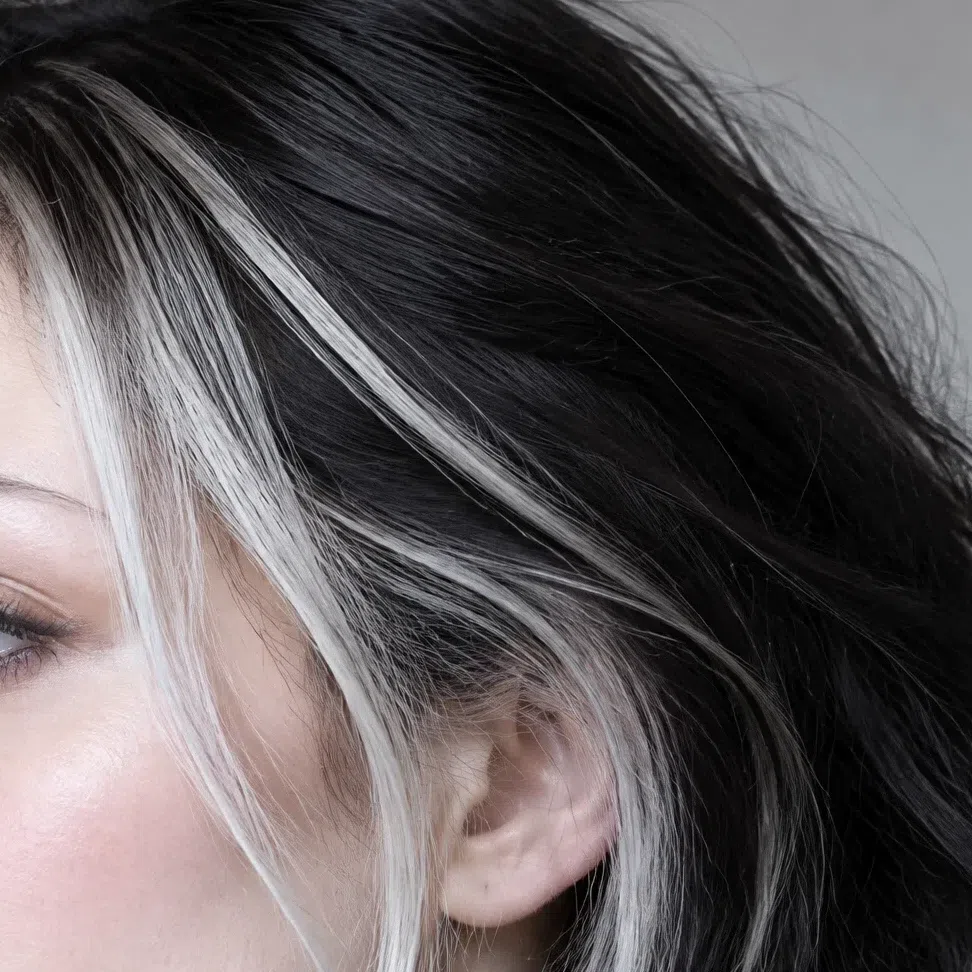
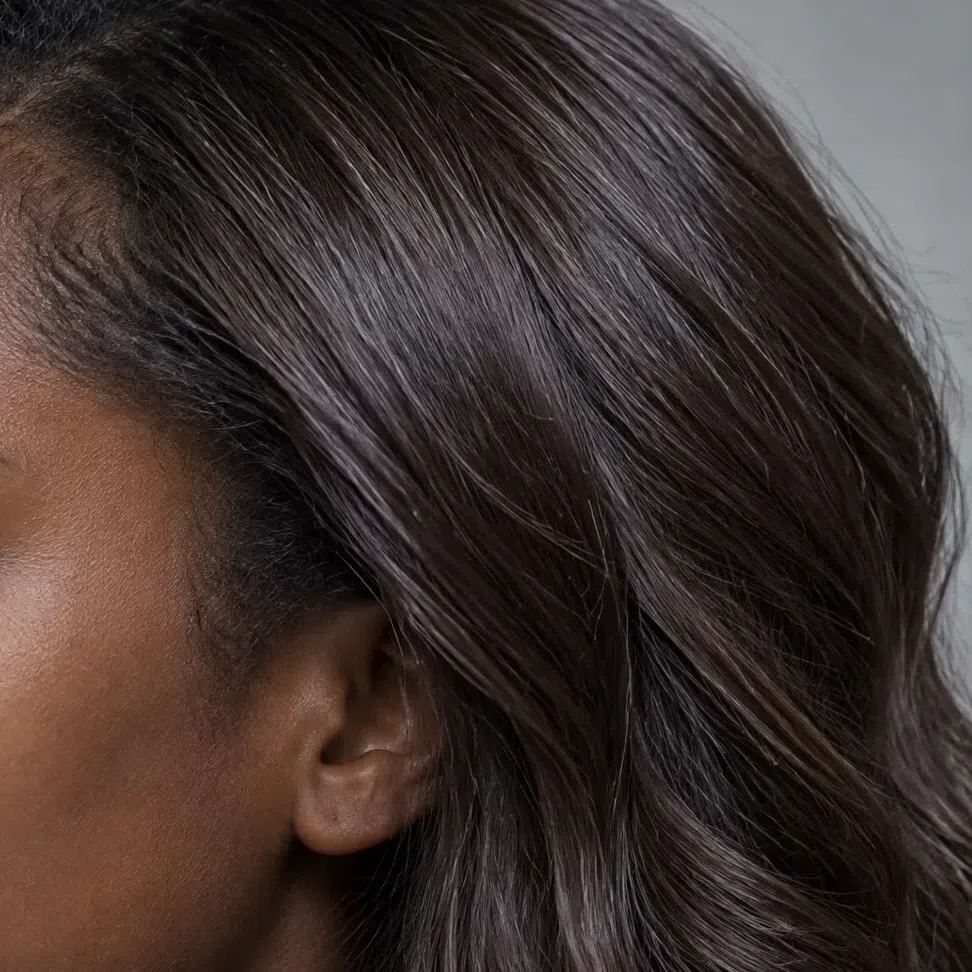
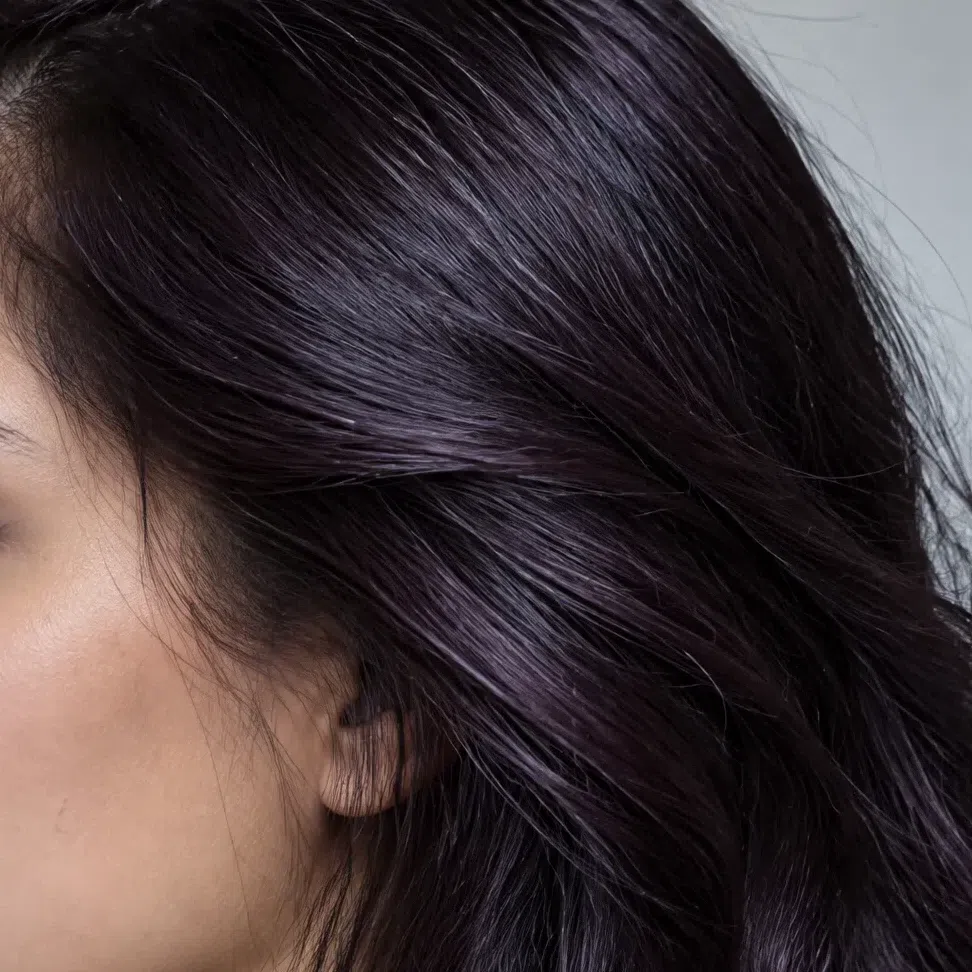
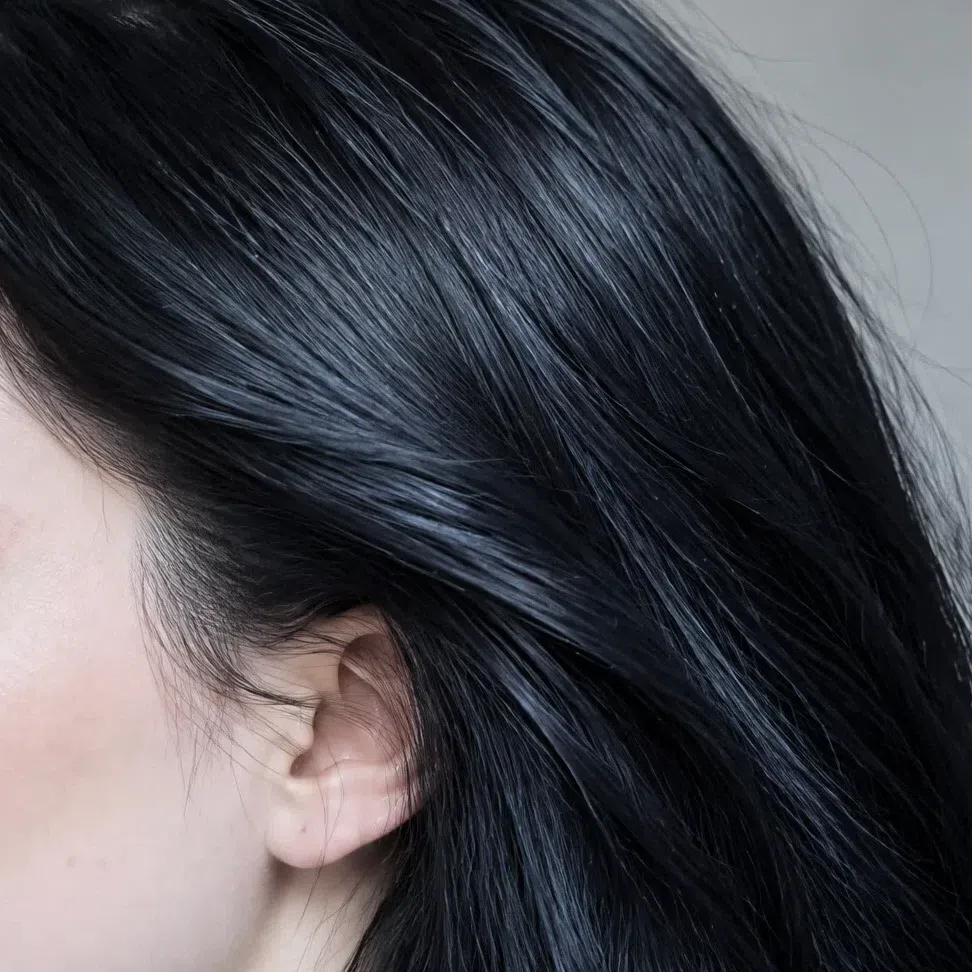
Start here
Three dark rungs, and where the brightness goes
Colorists write every shade as two numbers with a point between them. The level comes first: how light, from 1 for black up to 10 for the palest blonde. After the point comes the tone, the reflect the color throws when light hits it - ash, violet, gold, copper. Ask for something dark and cool and every colorist hears a different shade. Ask for a level 2 with a blue-ash reflect and there is only one.
Your palette puts every all-over shade on the three darkest rungs of that scale: blue-black at 1, black espresso and dark aubergine at 2, ash dark chocolate at 3. That is the shortest stretch any of the twelve subtypes uses. The rest of the palette - platinum, amethyst, sapphire, fuchsia - has no level at all, because it is never worn all over. It goes in as pieces, a few clean strands against the dark, and that is the whole idea: the depth stays, and the color is concentrated where it shows.
Keep the base dark and cold, within about two levels of your own hair and three at the very most. Put anything light or vivid into a few pieces, cleanly colored and kept up. What fails a Bright Winter is dullness and gold, whichever way they arrive.
The salon scale, and your part of it
- L10 lightest
- L9
- L8
- L7
- L6
- L5
- L4
- L3
- L2
- L1 deepest
Three rungs lit, all at the dark end. That is where the palette names shades to wear from root to end. If your own hair is a level 4 or 5, it still belongs here: the cold reflect carries over, and the numbers simply start one or two higher. The unlit top half is not closed to you either - platinum sits at 10 - but it opens only as streaks or ribbons. A whole head lifted into the middle of the scale loses the contrast that makes this coloring bright.
What is on this page
- What to ask for A sentence to say at the chair, the tone digits at level 2, and why a few pieces beat a full head of foils.
- Blonde? Platinum, as streaks. The same platinum all over, and the in-between blondes, cost you your contrast.
- Clear reds Black cherry and ruby hold. The same red with the color drained out of it does not.
- Going white Blue-black over white roots is the loudest regrowth there is. Four ways through it, on two women.
- Keeping it bright Jewel colors wash out rather than warm up. Ten weeks of amethyst, and what slows it down.
- Colors to avoid Twelve shades on one ordinary face outdoors, four of them cool and still wrong.
- The level list All eight shades with the level or placement to ask for, and the tone digits, in one block.
What to ask for at the chair
A Bright Winter appointment is usually two small jobs in one chair. The base is a gloss or a demi-permanent color at your own depth, made colder and shinier. The pieces - platinum, or one of the jewel shades - are a separate service with lightener, and there are only ever a few of them. Name both halves, or one of them gets done to the whole head.
Jumps to the board. Pick your natural level there and your part of the ash column lights up.
Zero is used in the numbering to indicate how intense a tone is.
Say thisI am about a level 2 naturally. I would like to stay at a level 2 with a clear blue-ash reflect - a 2.1, glossy, with no gold or copper in the formula - and two or three platinum streaks at the front, toned icy.
Put your own level in place of the 2. Want a jewel shade instead of platinum? Keep the first half and swap the second: ...and three amethyst ribbons through the front, lifted clean first so the violet reads true. Pieces are usually priced as their own service, so ask for both prices up front.
Three choices inside the sentence
-
Which dark
Your palette names whole-head shades at 3, 2 and 1 and nowhere else. So the level is your own, or one or two deeper. Most Bright Winters start somewhere in those three rungs and need no lightener on the base at all; a gloss or a demi-permanent color does the job.
“I am a 2. Keep me at a 2, or take me to blue-black.” -
Which reflect
After the point: .1 for blue-ash, which on near-black hair reads as a cold blue sheen; .2 for aubergine; a clean .0 for espresso. The zero moves the strength, as the quote above says: a 2.10 carries more ash than a 2.1, and a 2.01 only a trace. You want the reflect definite, not hinted.
“Blue-ash, a 2.1 - or a 2.10 if the brand makes one.” -
How many pieces
The light goes in as a handful of strands, never a head of foils: two or three platinum streaks at the front, or ribbons of amethyst, sapphire or fuchsia where they catch the eye when you move. The fewer there are, the brighter each one looks against the dark.
“Three streaks, front only. The rest stays dark.”
The tone digit, at level 2
The label on every tube reads level.tone. Below, one woman holds level 2 in all four frames, so only the reflect changes. At this depth the tone shows as a sheen along the highlights rather than as a color you notice indoors - and the sheen is where a Bright Winter’s hair does its work.
-
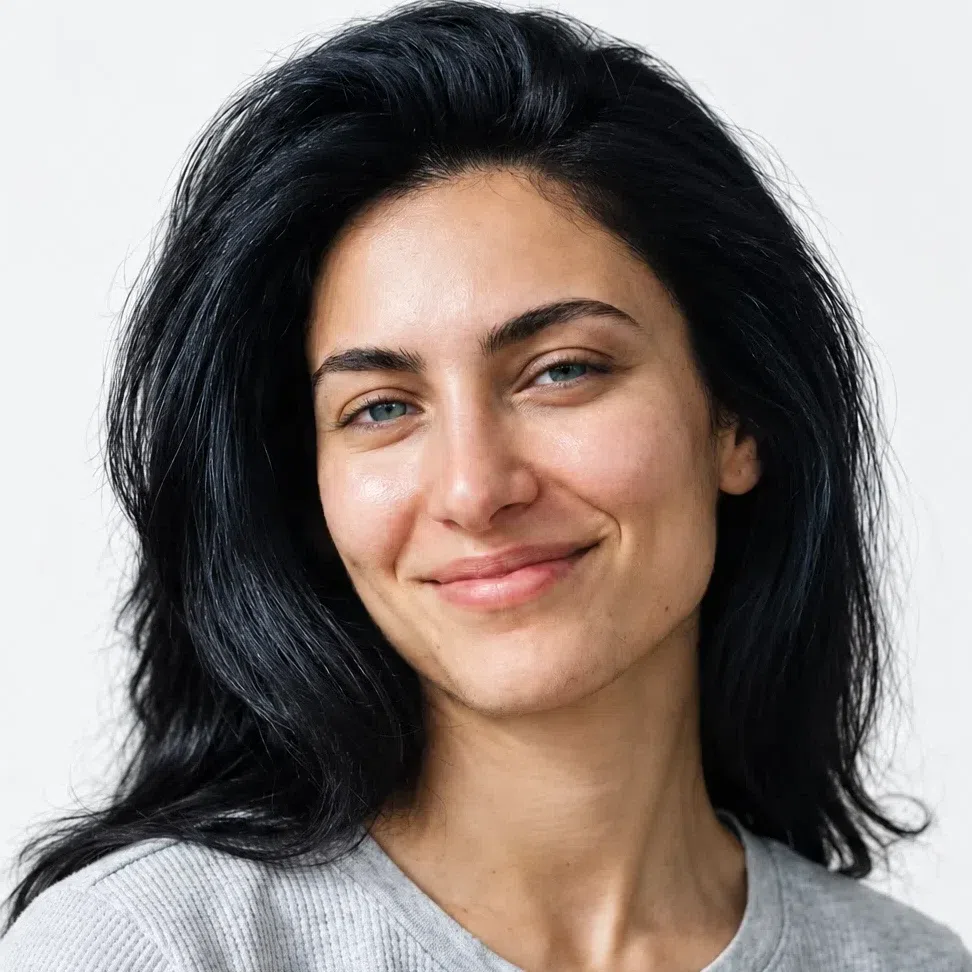 2.1 Ash
Your blue-black’s reflect, one level up. Cold steel along the highlights, and her eyes look lighter beside it.
-
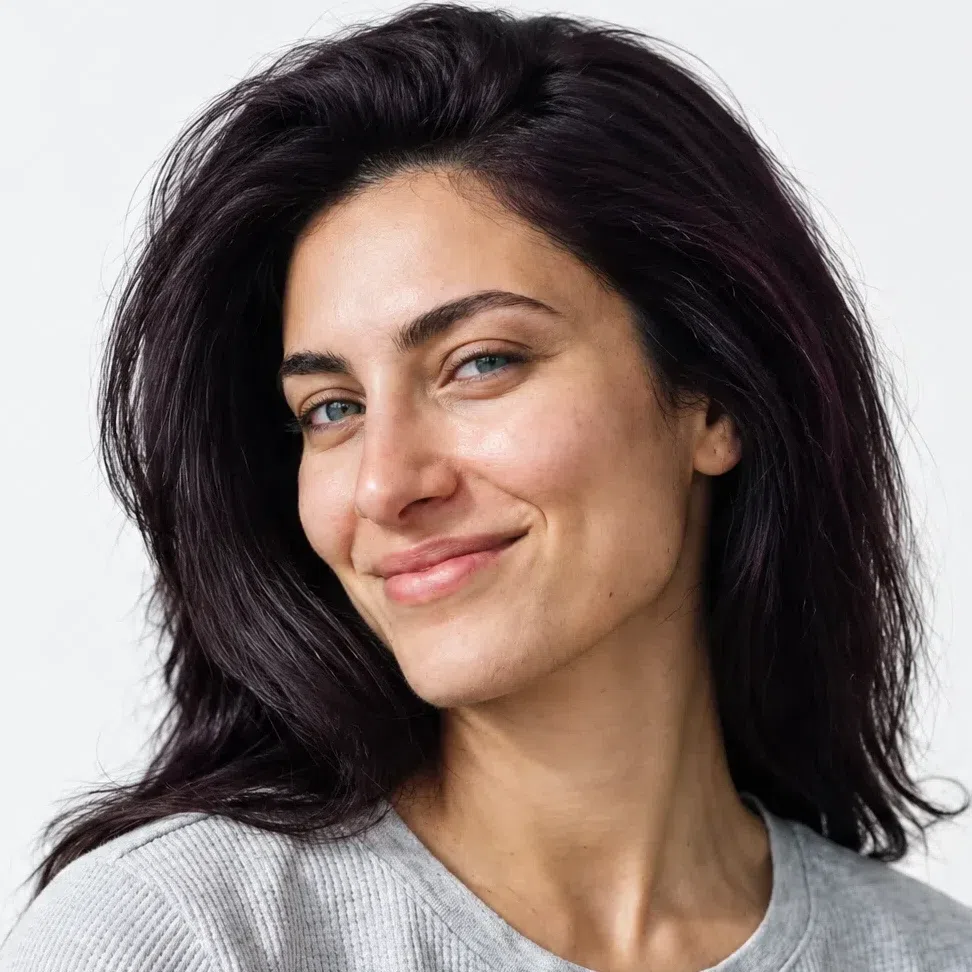 2.2 Violet
Dark aubergine, named on your palette at level 2. Near-black until she moves, then plum.
-
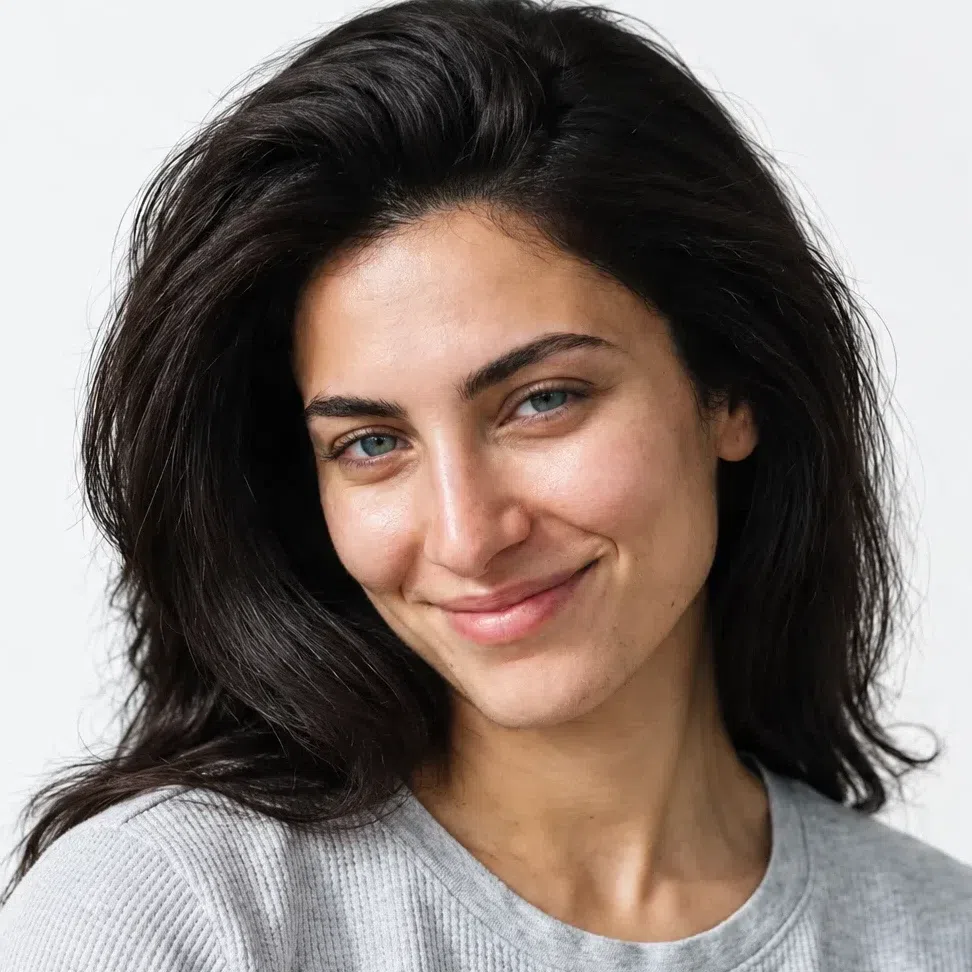 2.0 Natural
Black espresso, the other shade your palette names here. Deep and neutral, a clean base for pieces.
-
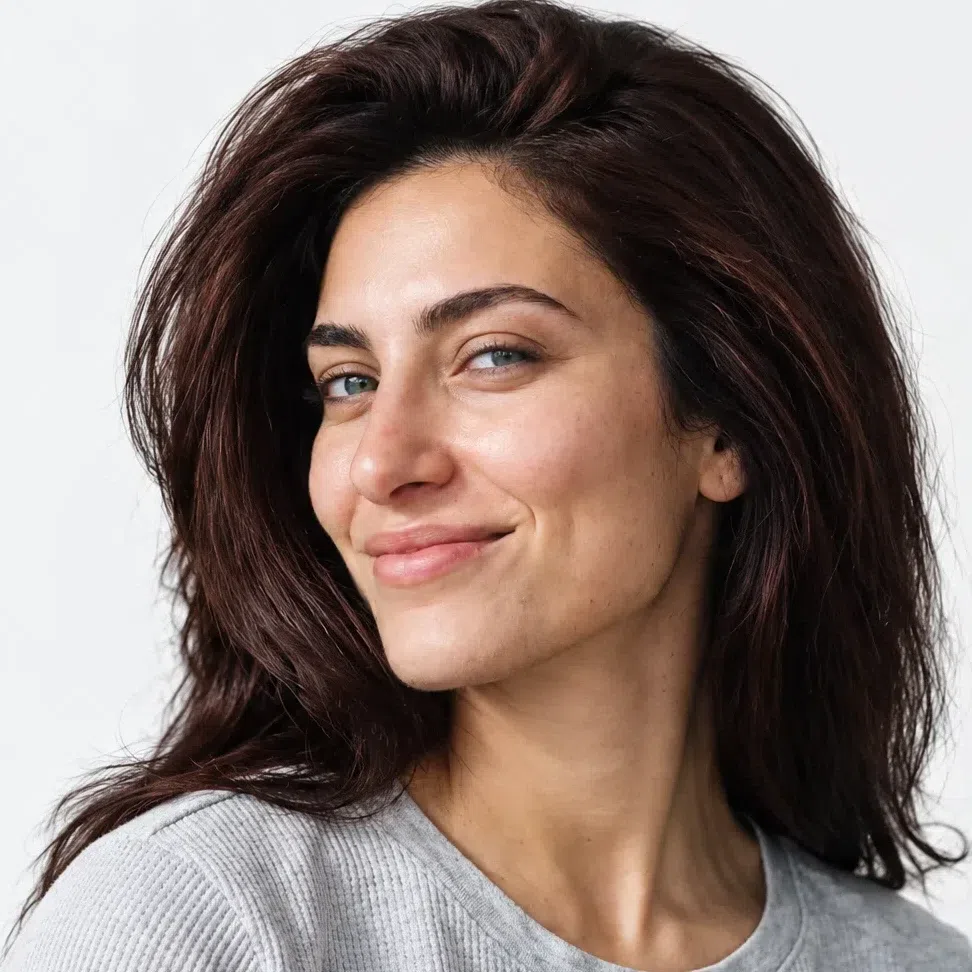 2.4 Copper
The same depth with a copper reflect. The glow lands on her skin and makes it ruddy rather than clear.
- 2.1 Ash The chip is your blue-black’s level 2 value. On hair this dark an ash reflect reads as a cold blue sheen rather than as gray, and it holds back the red-orange every dark head carries underneath.
- 2.2 Violet The chip is your dark aubergine, named at level 2. Most systems use .2 for violet and a few for a green-leaning matt, so say violet along with the number.
- 2.0 Natural No reflect added. The chip is your black espresso, which your palette describes as deep brown kept free of red and gold. Some brands blend gold into their natural line, so ask.
- 2.3 Gold Hard to see indoors at level 2; in daylight it turns yellow next to cold skin. The chip is the avoid list’s golden blonde, built down to level 2.
- 2.4 Copper The warm reflect at the head of your avoid list, where it appears as rust. The chip is that rust taken down to level 2.
Three chips are your palette’s own level 2 values: black espresso and dark aubergine where they are named, and the blue-black ramp at that rung. The gold and copper chips are built at the same depth from two shades on your avoid list. On screen they sit close together, because level 2 is nearly black; the photographs, where light runs along the strands, tell them apart far better.
The salon board, cut down to your squares
A colorist’s board crosses depth with tone. Keep only the Bright Winter squares and nearly all of them sit in the bottom rows: one cold column from level 4 down to 1, violet and natural beside it, and above level 5 nothing but your avoid list.
Outlined: ash, from level 4 down to level 1 - ash dark chocolate at 4 and 3, blue-black at 2 and 1. Violet (dark aubergine) and natural (black espresso) are yours from level 5 down. Everything lighter, and the whole warm side, holds avoid shades and salon codes only.
None of these squares is a manufacturer’s swatch. Each is a value from your own palette, so a given brand’s 2.1 will sit a little off it - say blue-ash with the number. Four of your shades are missing from the board altogether: platinum, amethyst, sapphire and fuchsia are worn as pieces, and a piece has no level.tone square. The light squares that are filled - ash blonde, mousy light brown, dusty lavender, golden blonde, toffee, rust - all come from your avoid list, which is the page’s argument drawn as a chart.
And how the light is placed
The first pair is the dose question: one woman in one blue-black, with three platinum streaks and then with fine highlights through the whole head. The next two, and the pair after them, come from a second woman with a natural level 4, photographed from above three weeks after each appointment.
-
 A few pieces
Three streaks at the front and blue-black everywhere else. Each one reads as light because the dark around it is unbroken.
-
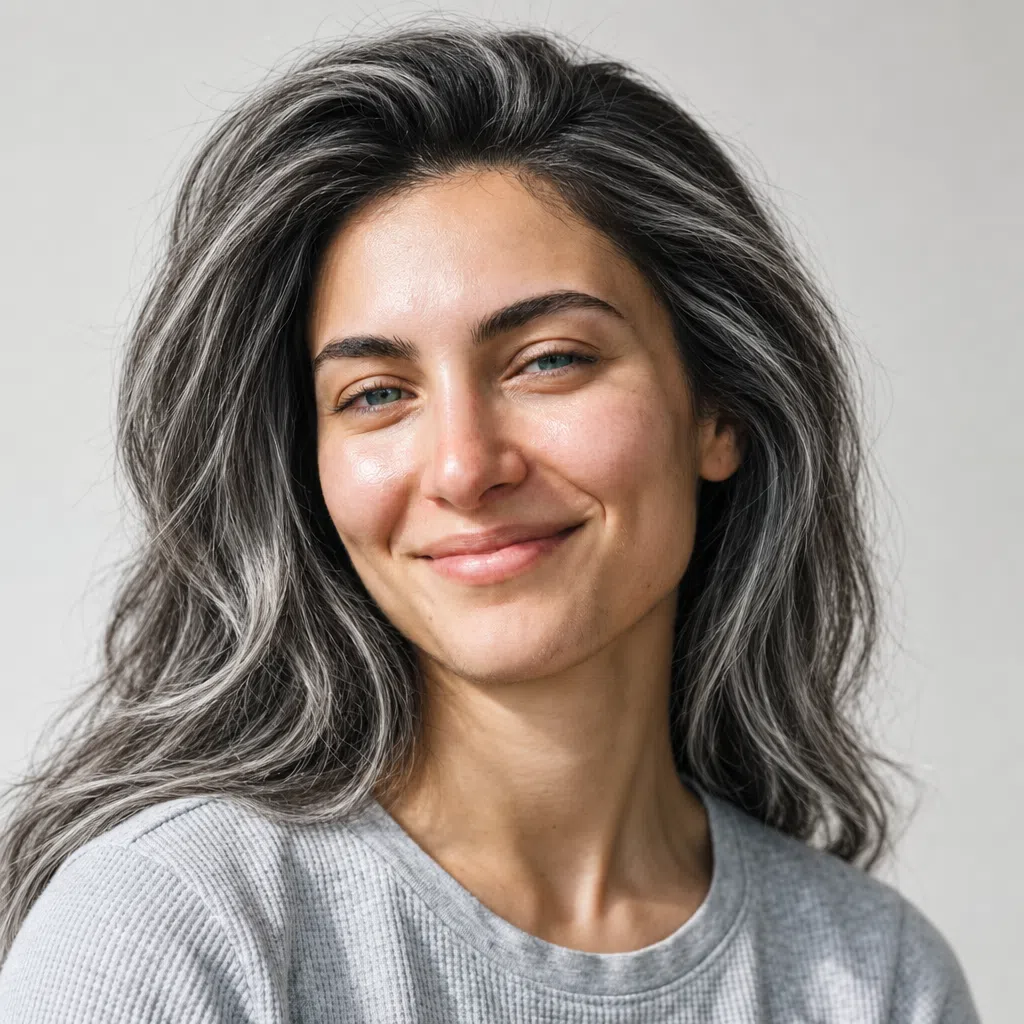 Highlights all through
The same platinum spread through the whole head. The dark is broken up everywhere, and from across a room she reads as streaky gray.
-
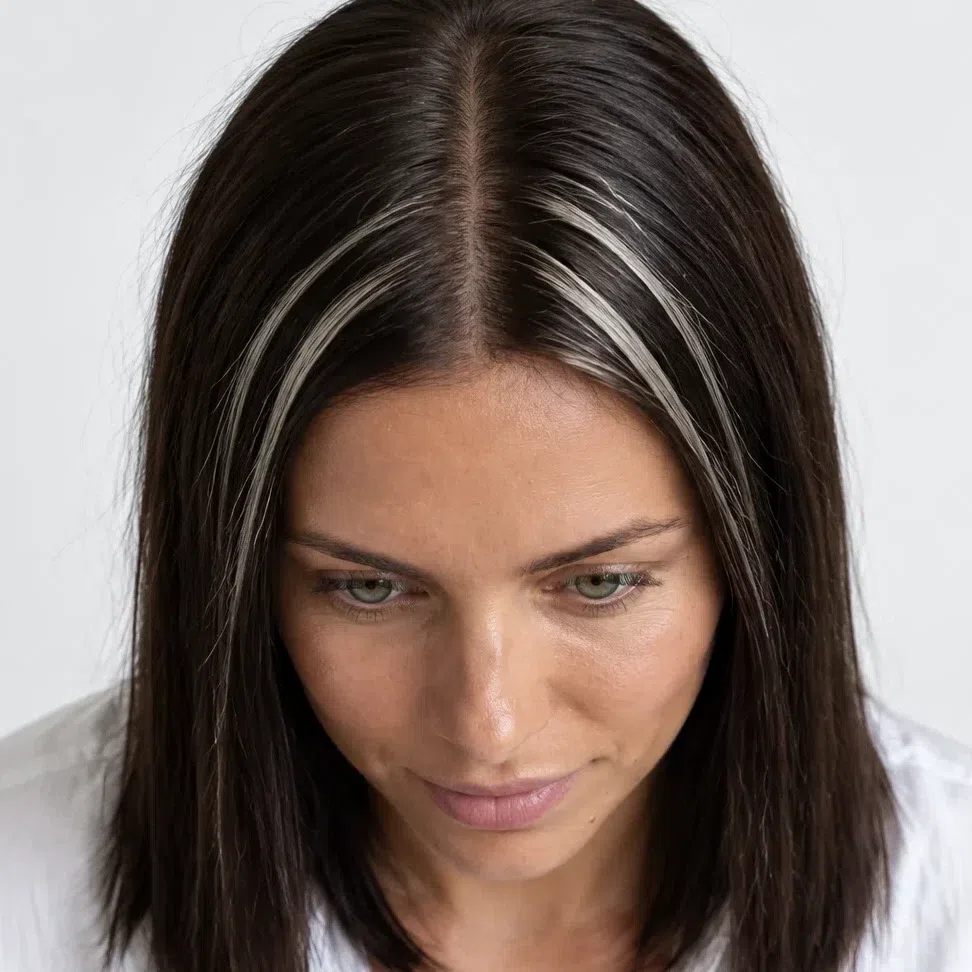 Platinum streaks
Streaks, three weeks on. A few millimeters of her own brown at each root, and the parting looks as it did on the day.
-
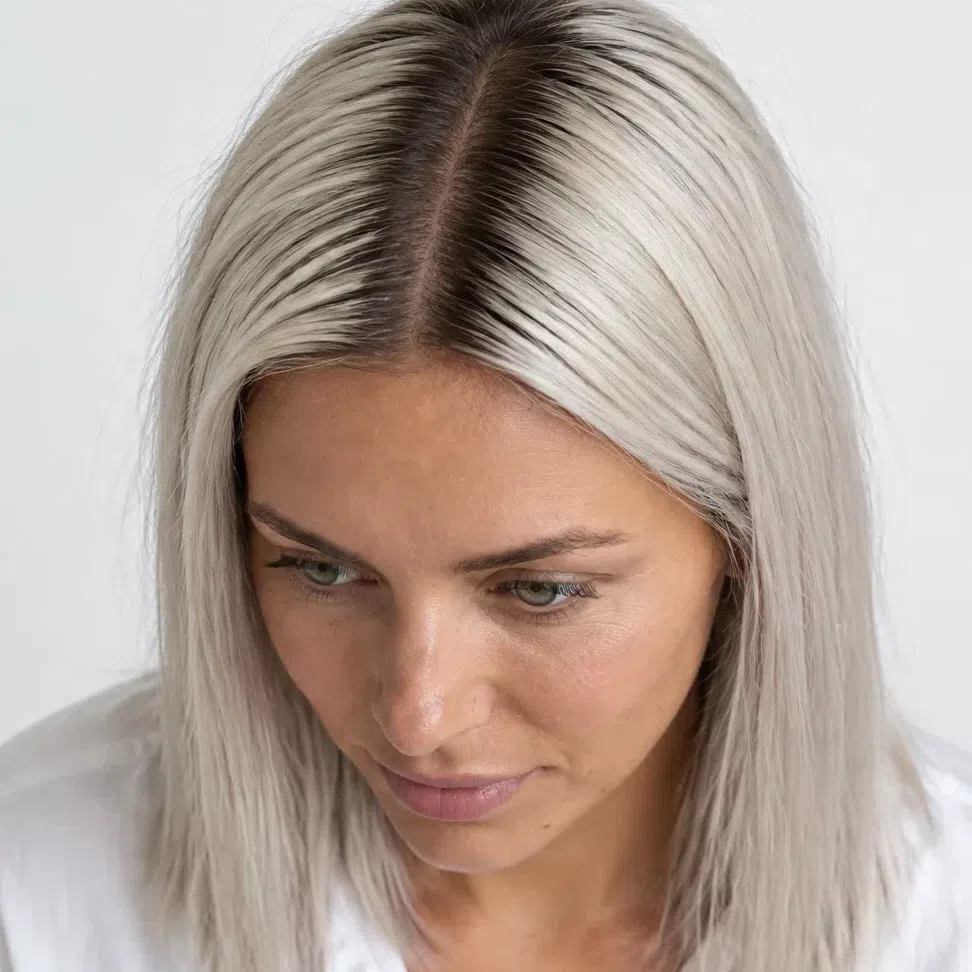 Platinum all over
Platinum over the whole head, six levels above her own. Three weeks on, a dark band runs the length of the parting.
And the cost of going darker
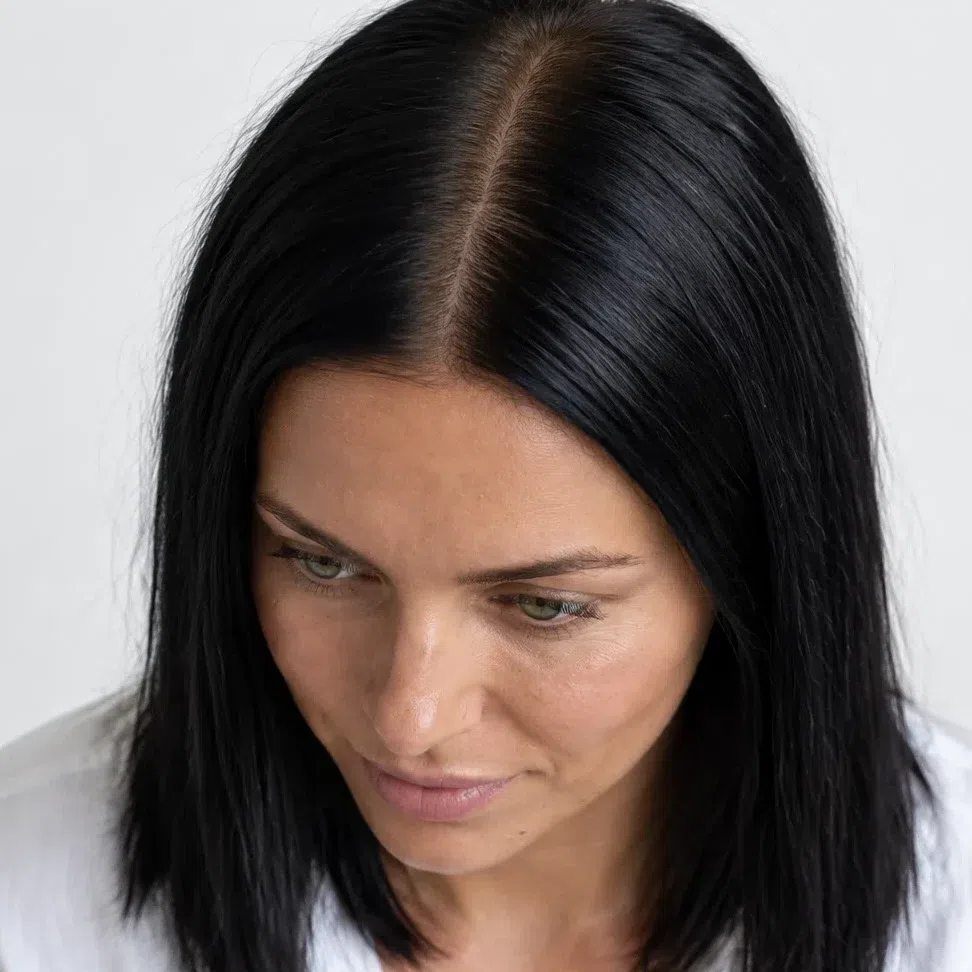
Deeper is the easy direction for this palette, but distance still shows at the root. The same natural level 4, three weeks on: one level down leaves nothing to find, and three levels down leaves a band of her own lighter brown against the blue-black.
-
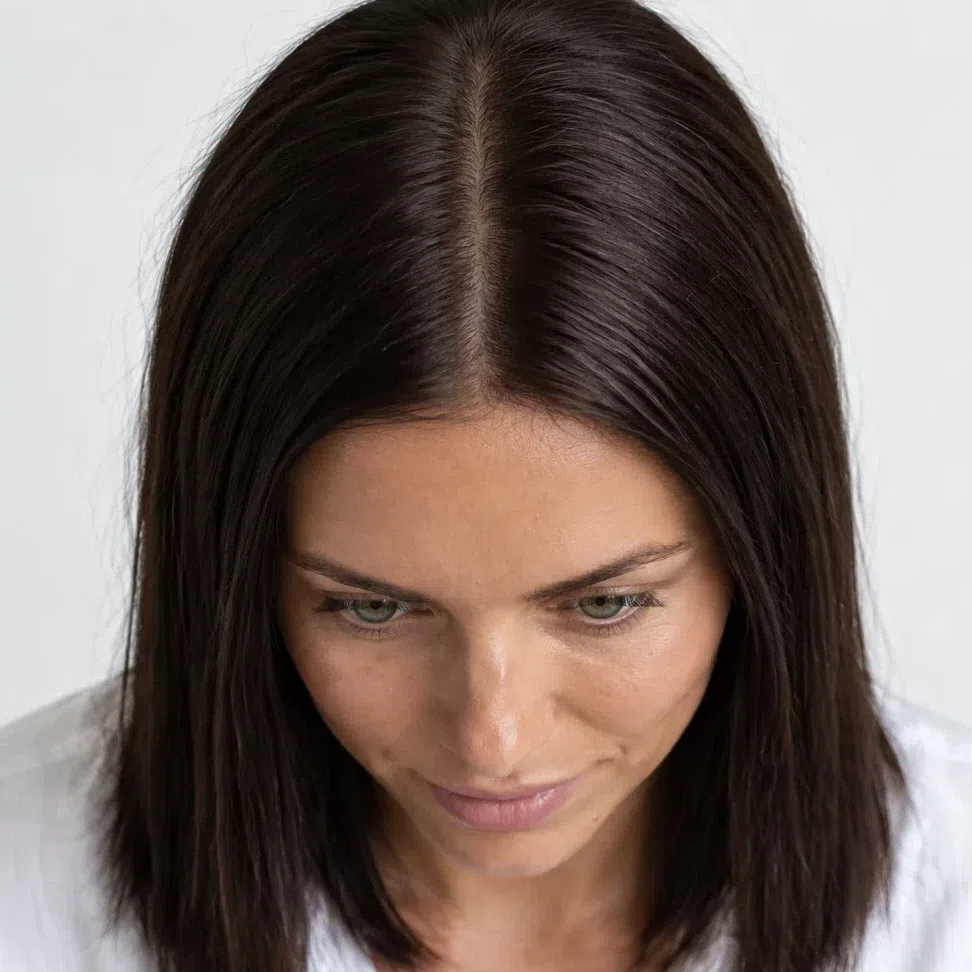 One level deeper
Ash dark chocolate over a natural 4. The regrowth melts into it and the parting reads as one brown.
-
 Three levels deeper
Blue-black over a natural 4. The new growth is a lighter band, and brown that close to blue-black looks warm.
The phrasebook
Say this
- “A gloss at my own level, blue-ash”
- More shine and a colder reflect, with no lightener anywhere near the base.
- “Two or three streaks, not highlights”
- A few bright pieces instead of a head of foils - the difference between contrast and gray.
- “Lift the pieces clean before the color”
- Jewel shades go onto lightened hair, and the paler the lift, the truer the violet or the blue.
- “A 2.10, with no gold in the mix”
- A definite cold reflect, from a formula that stays cold as it fades.
And what these get you
- “Something sun-kissed”
- Honey or caramel through the lengths. Both are warm, and both are on your avoid list.
- “Soften it, a few shades lighter”
- The whole head lifted toward the middle of the scale, where your contrast drains away and dark hair shows orange.
- “Lots of fine highlights, blended”
- Pale strands everywhere, and hair that reads gray-brown from a distance.
- “A rich, warm brown”
- Usually brown with red or gold in it. On you it looks ruddy, not rich.
So the brief has two parts: a cold, dark base, and a small dose of light on top of it. Which raises the question most Bright Winters bring with them - can you be blonde at all?
Can a Bright Winter be blonde?
Your palette answers with a single shade: platinum, and only as streaks. No blonde on it is meant for the whole head, and the ash, golden and strawberry blondes all sit on the avoid list. Two women below: one lifting her whole head a step at a time, one keeping her dark base and changing only what is painted into it.
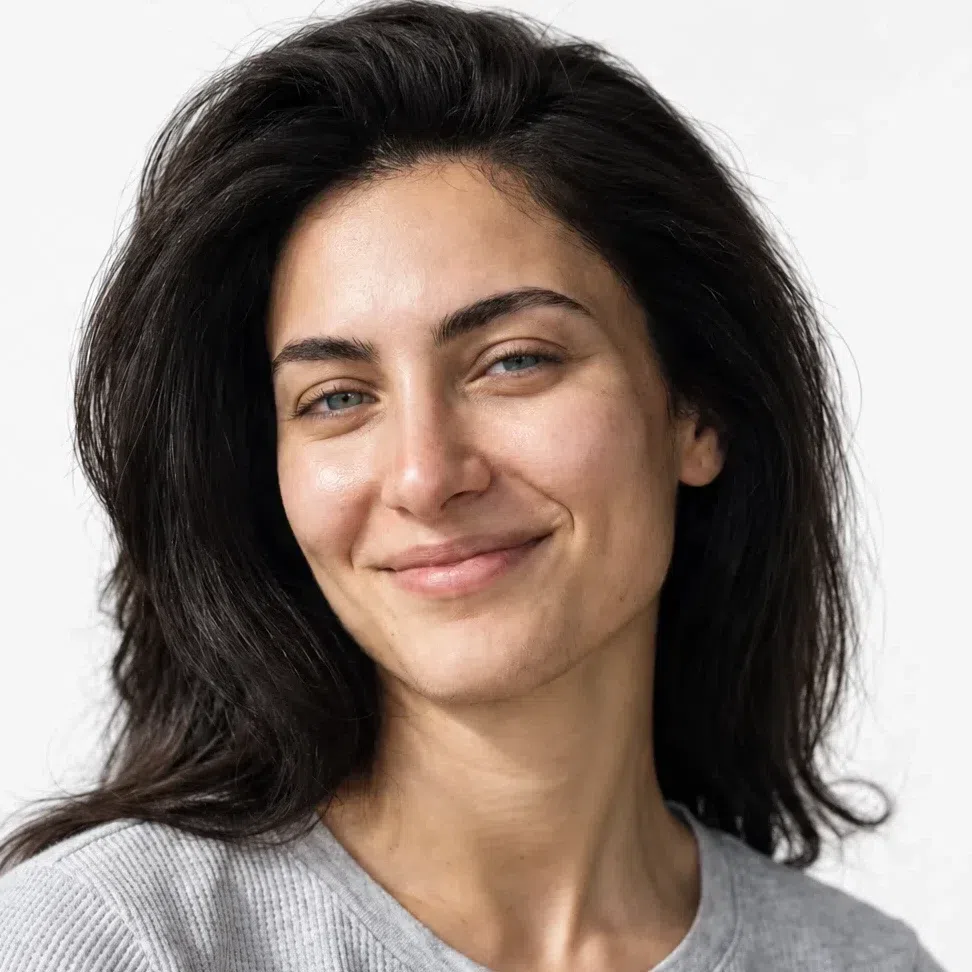
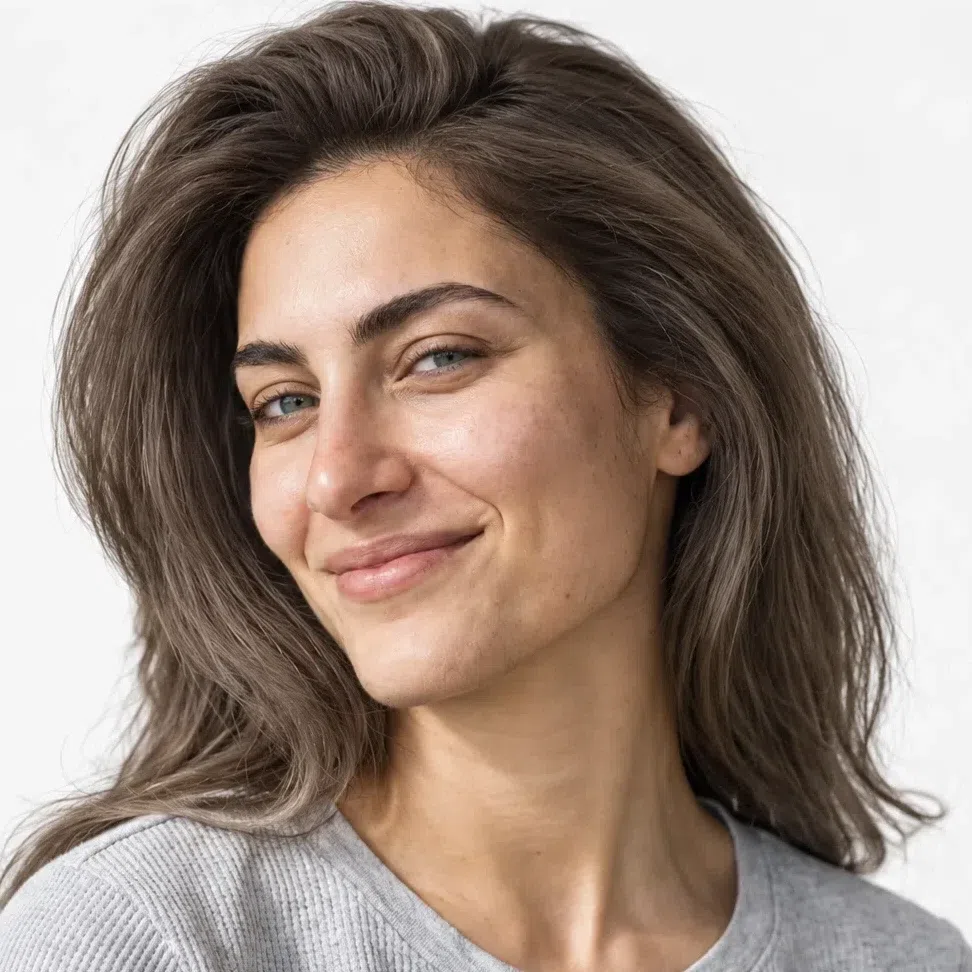
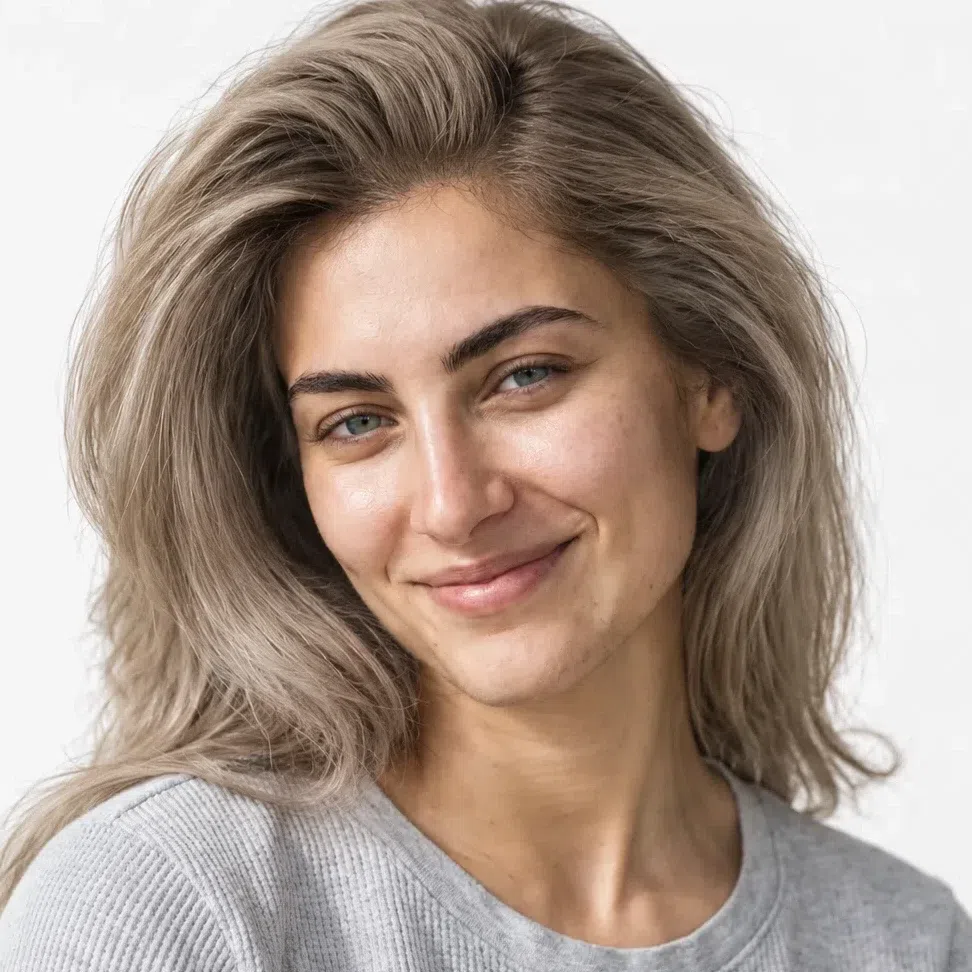
As streaks, yes - and those can go all the way to platinum. All over, no. Within three levels of your own color the base can move, but every one of those levels softens your contrast, and past them the whole head reads pale and the face loses its edge. Keep the blonde to a few icy pieces against the dark, and the jump from near-black to white becomes the brightest thing a Bright Winter can wear.
A natural level 2 on light olive skin, the whole head lifted in steps. Watch the gap between her hair and her face close up.
-
 Her natural, L2
Her own near-black. The contrast your palette is built on, with no work done.
-
 Lifted, L5
Three levels up, the most the base should take. Cool and tidy, and already quieter around her eyes.
-
 Ash blonde, L8
Ash blonde, from your avoid list. Dusty and flat, and her face goes gray along with it.
-
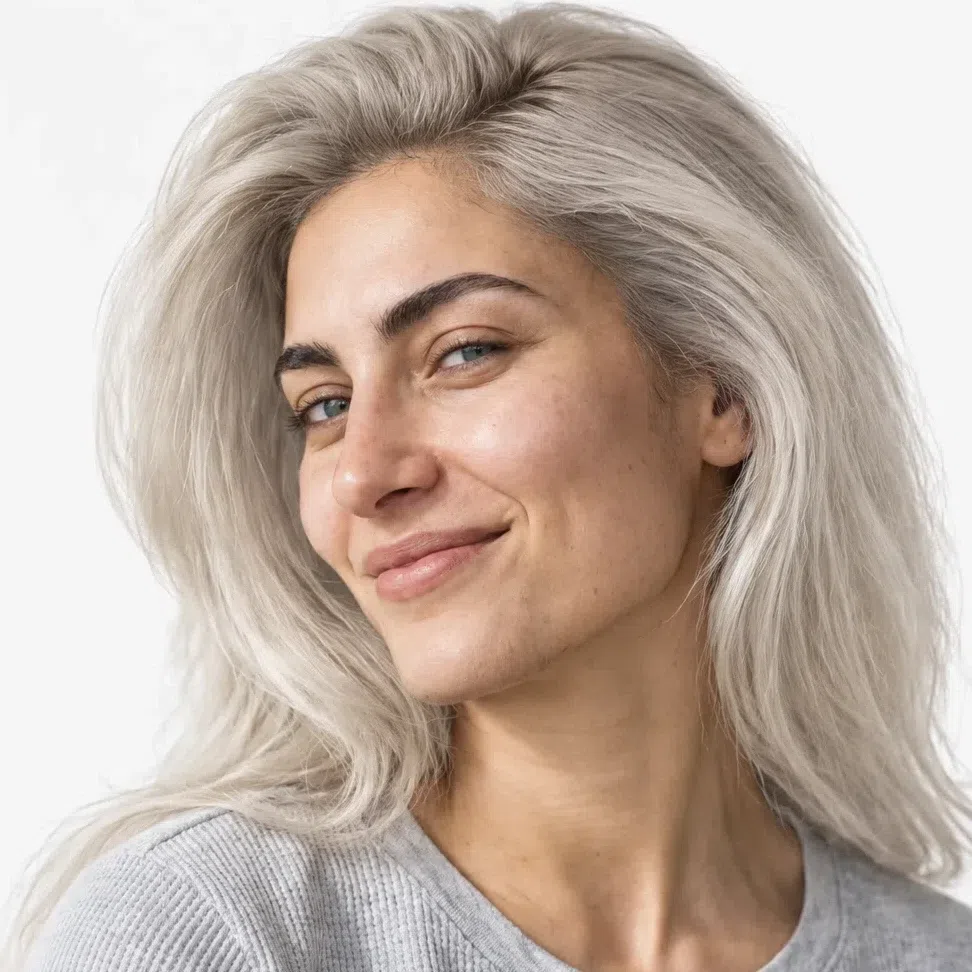 Platinum, L10
Platinum all over: clean and cold, the right shade in the wrong dose. Nothing dark is left to frame her face.
A natural level 3 on tan olive skin, the base kept as it is. Only the color of the pieces changes.
-
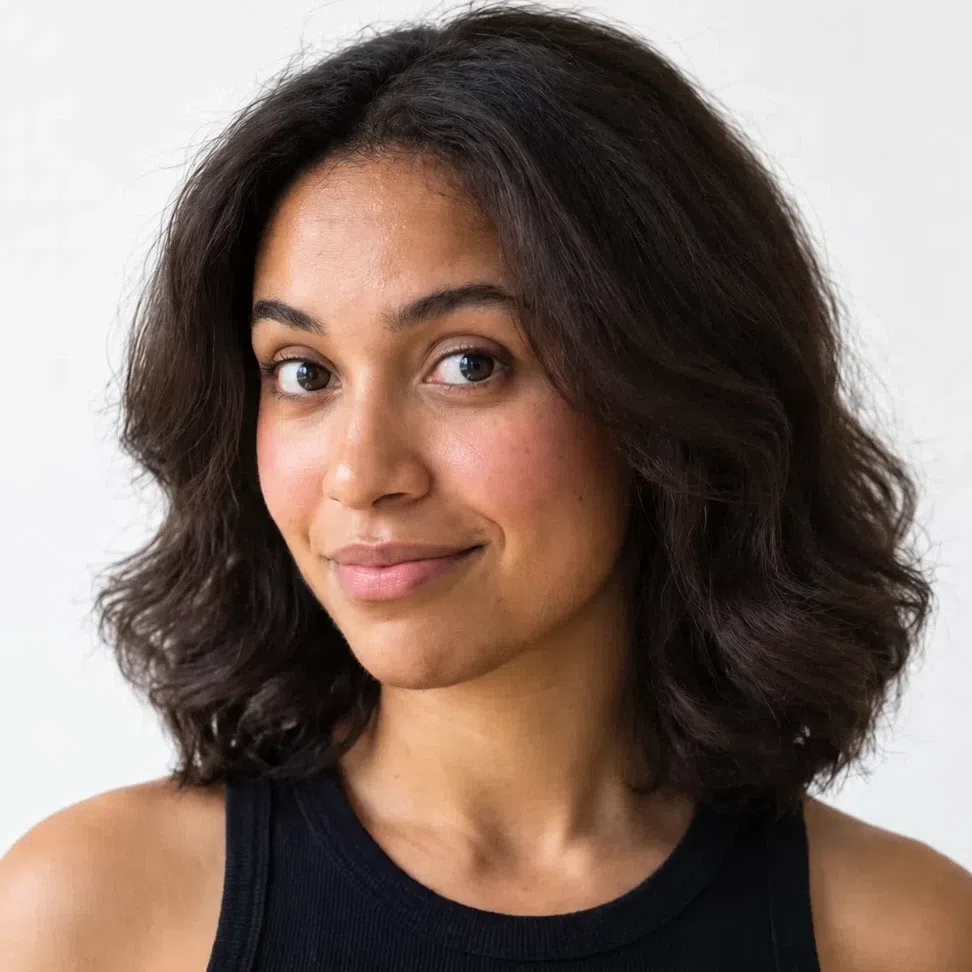 Her natural, L3
Her own cool dark brown - the ash dark chocolate your palette names at level 3.
-
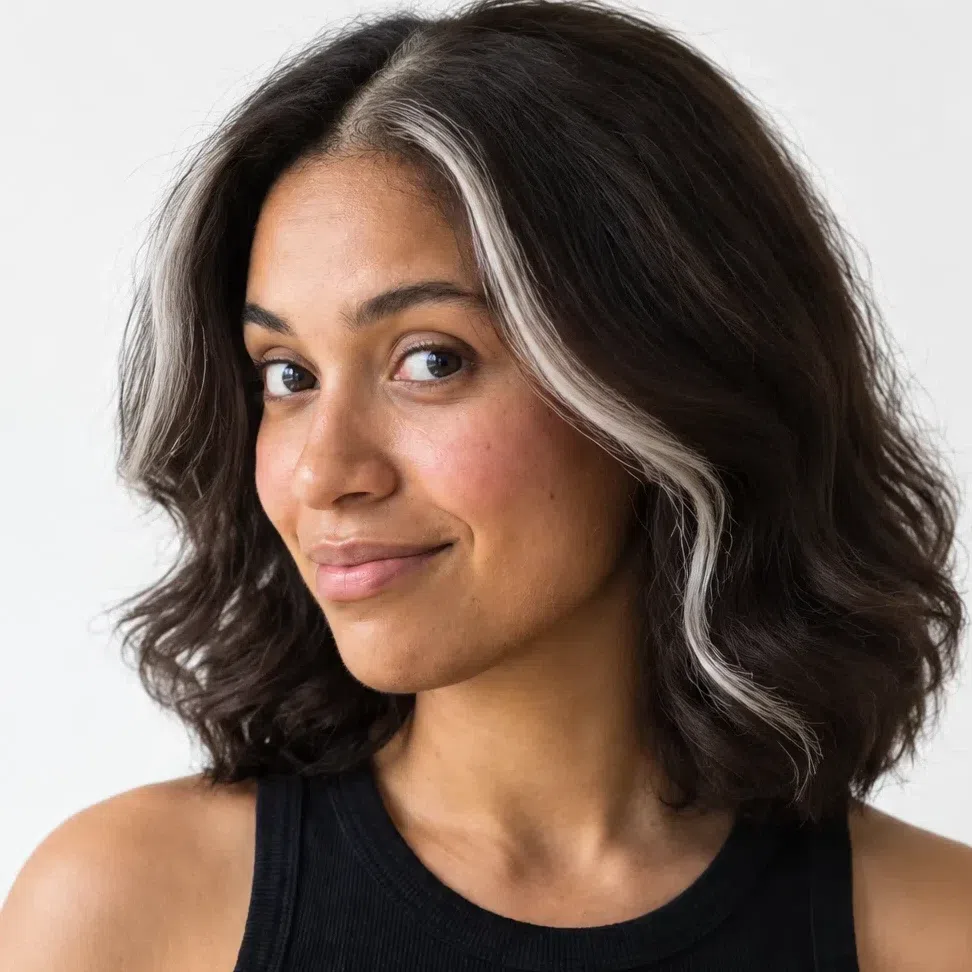 Platinum streaks
Three streaks of the same platinum. White against dark, and the whole face lifts.
-
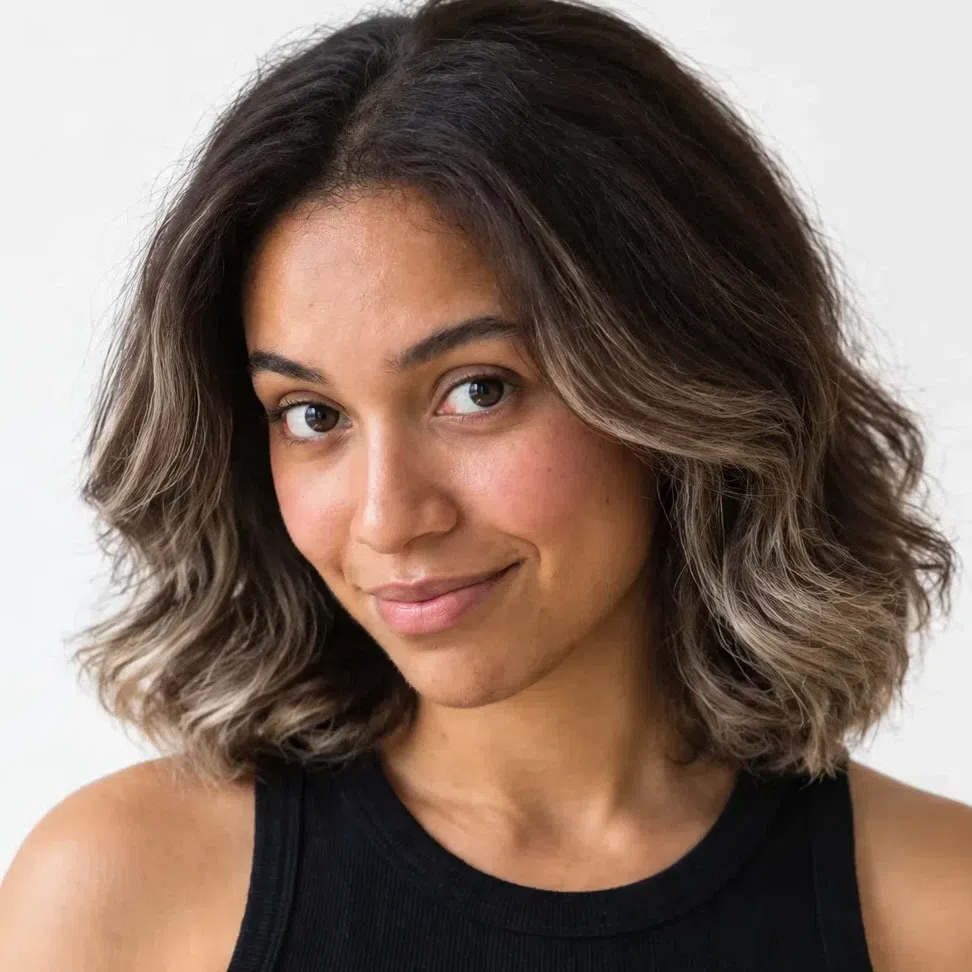 Ash blonde pieces
Ash blonde as pieces. Chalky against the brown, and it passes for early gray.
-
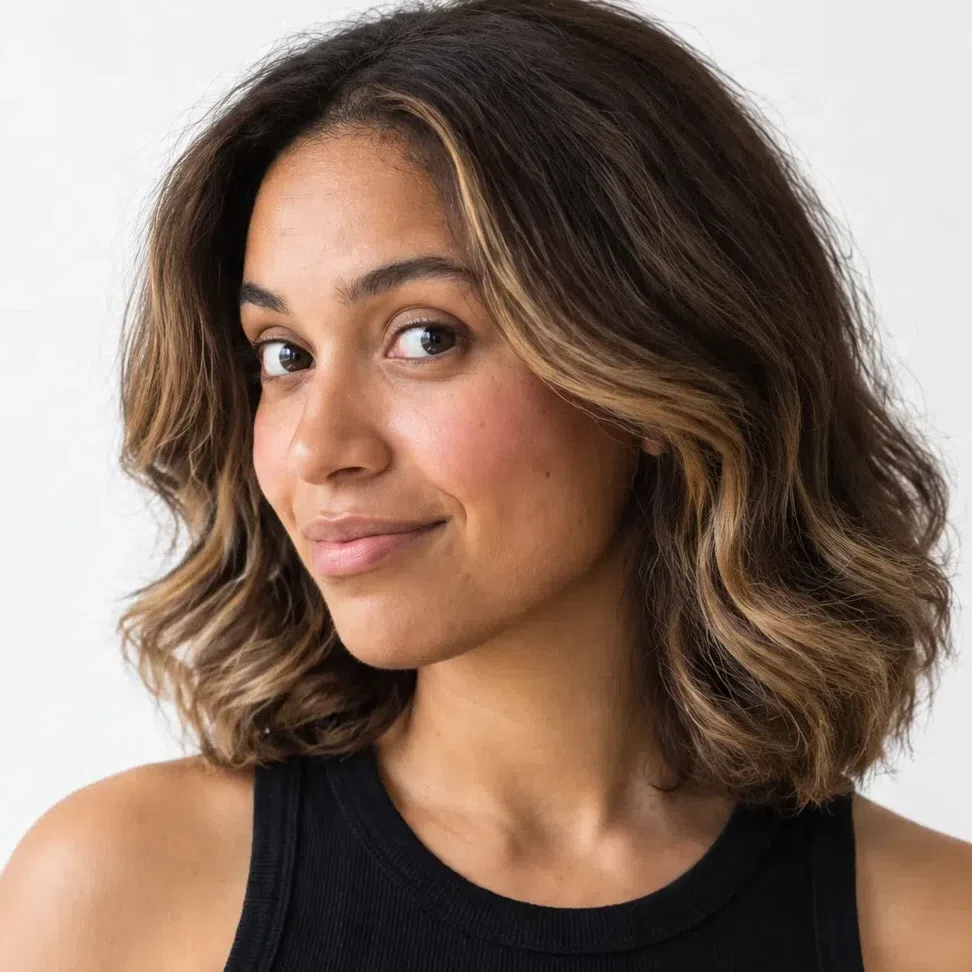 Golden pieces
Golden blonde in the same places. Sun-streaked and warm, and on her it looks accidental.
Find the platinum in both rows. It is one hex. All over the first woman, it takes her contrast away; as three streaks on the second, it adds to it. Then find the ash blonde: it fails in both rows, all over and as pieces, because it is dull. For a Bright Winter the dose and the clarity of a blonde decide it. How light it is matters least.
The trouble with lifting the whole head is chemistry. On its way to pale, lightener carries dark hair through red, then orange, then yellow, and only near the end is anything light enough to tone icy. Stop the whole head at 5 or 6 and it sits in its warm stage; toned cool, it still brings that warmth back up as the toner fades. A streak goes all the way to pale in one small section, where the lift is easy to control and cheap to repeat.
Streaks also grow out kindly. A few pieces at the front leave most of the head untouched, so the new growth is dark hair meeting dark hair, and the pieces can often go eight to ten weeks between visits. Platinum all over wants its root redone every four to six.
If you want platinum pieces
-
Keep it to a few
Two to five streaks, placed where your hair parts and where it frames your face. The dark between them does half the work.
Three streaks, front only. -
Lift clean, tone icy
Ask for the pieces lifted to a pale level 10 and toned with violet, so they read white and not yellow. A bond builder in the lightener protects the strands.
Level 10 on the pieces, toned icy, with a bond builder. -
Refresh the toner, not the lift
Platinum turns creamy as its toner washes out. A toner every five or six weeks brings it back; lightening it again is not needed and costs the hair.
Toner on the streaks only.
Blonde, then, comes down to dose and clarity. Red is mostly about clarity: the same red can shine or fall flat depending on how much color it carries.
Can a Bright Winter have red hair?
Yes - this is one of the few colorings that can wear a red that looks like a gemstone. The catch is clarity. The test red on your palette page is a clean, cold one, and the same red with its color drained out turns brown and tired. Below, two women at one depth and one hue, with only the amount of color changing.
Yes, if the red is clear. Black cherry and ruby work; muted wine is the edge; rosewood, the same red gone soft and brownish, is past it. It has to stay cold as well - the orange reds, rust and red chestnut, fail for that other reason, and they head your avoid list.
Tan olive skin with a cool undertone. Level 3 in every frame and one cold red, from soft to jewel-clear.
-
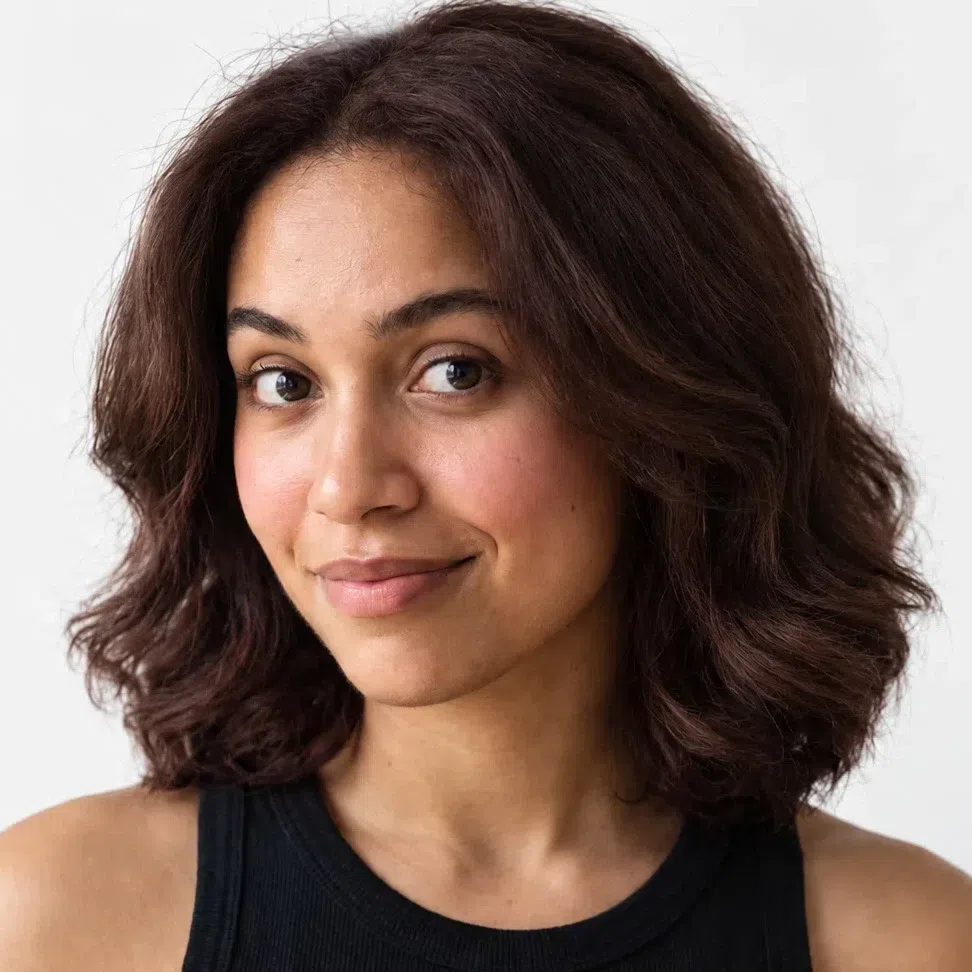 Rosewood, L3
The red with most of its color gone. It reads brown, and her skin looks tired beside it.
-
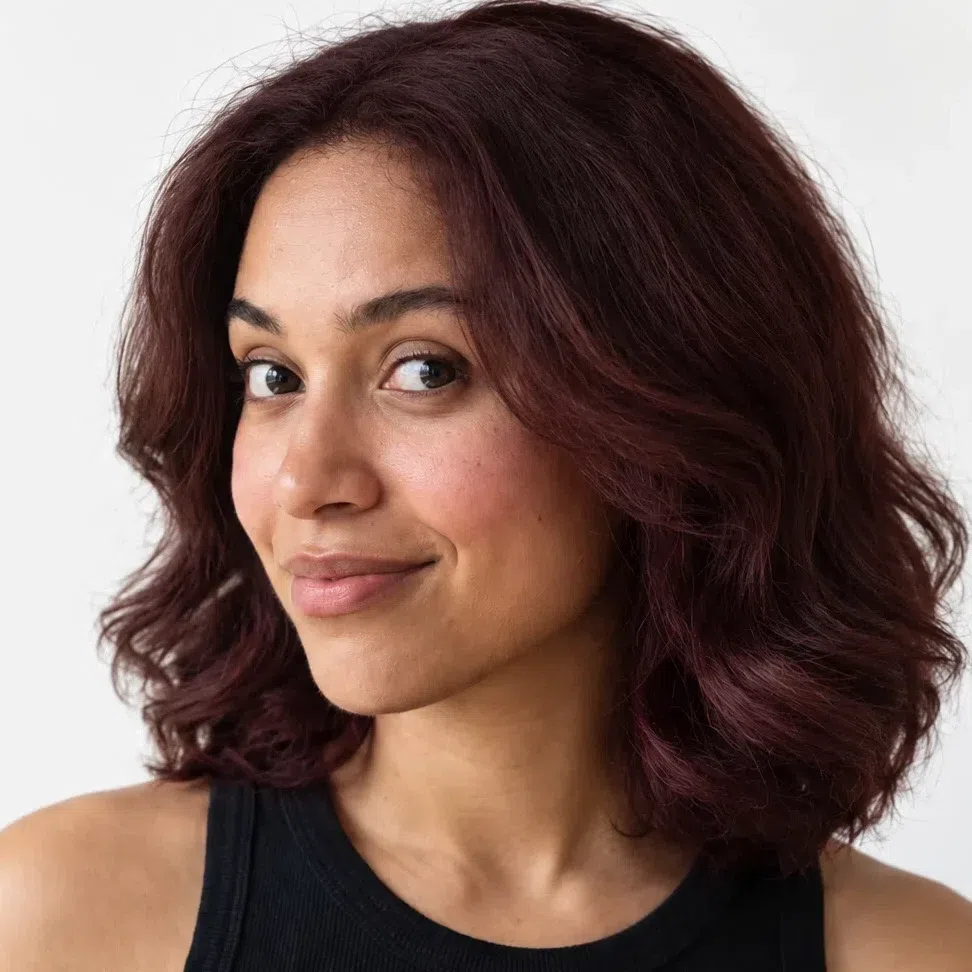 Muted wine, L3
A little more color, still smoky. Wearable, but it does nothing for her eyes.
-
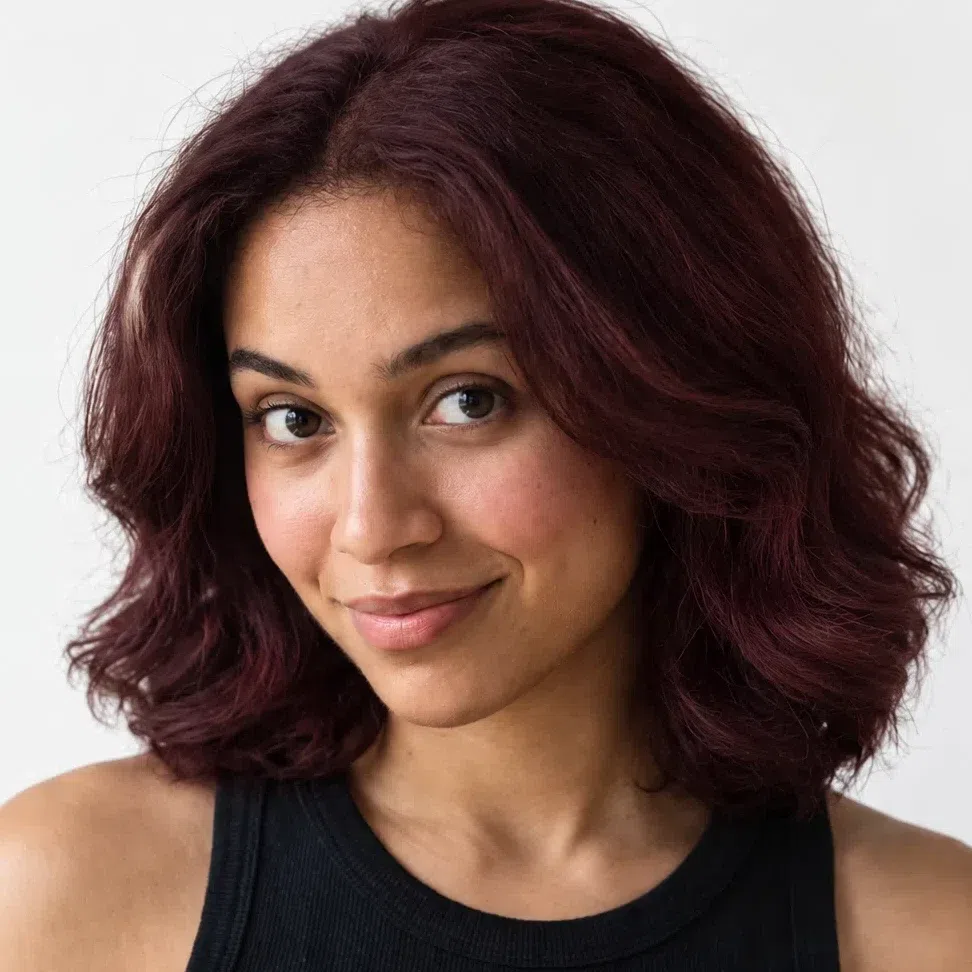 Black cherry, L3
Clear and cold. Her skin looks cleaner at once.
-
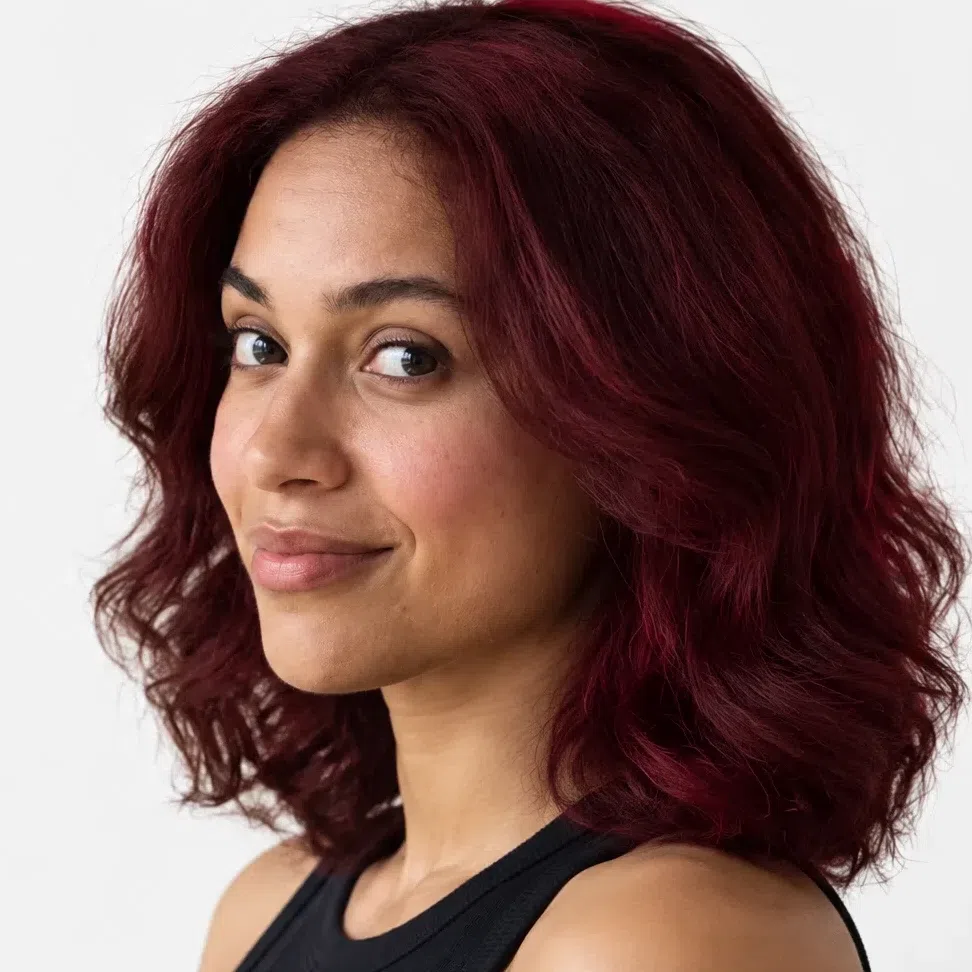 Ruby, L3
The same red at full strength. The most color in the row, and the frame that suits her best.
Deep skin, cool undertone: the same four reds, the same level 3.
-
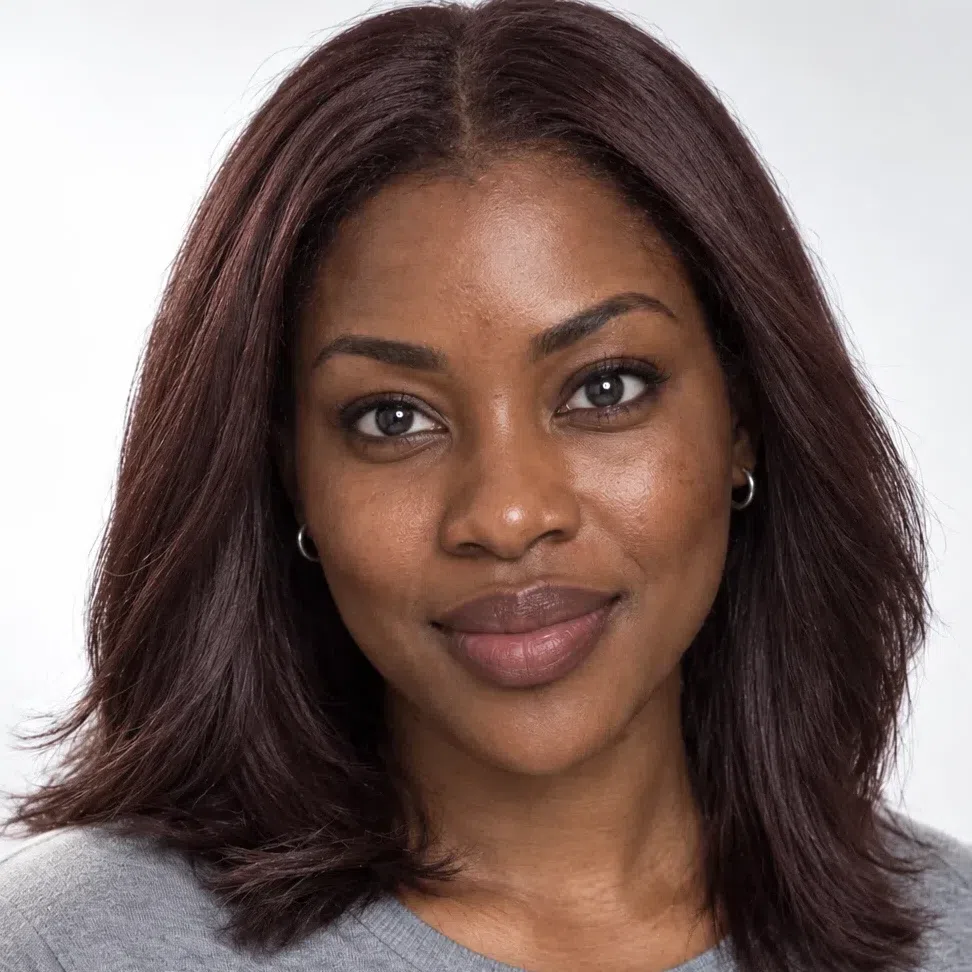 Rosewood, L3
The red with most of its color gone. It reads brown, and her skin looks tired beside it.
-
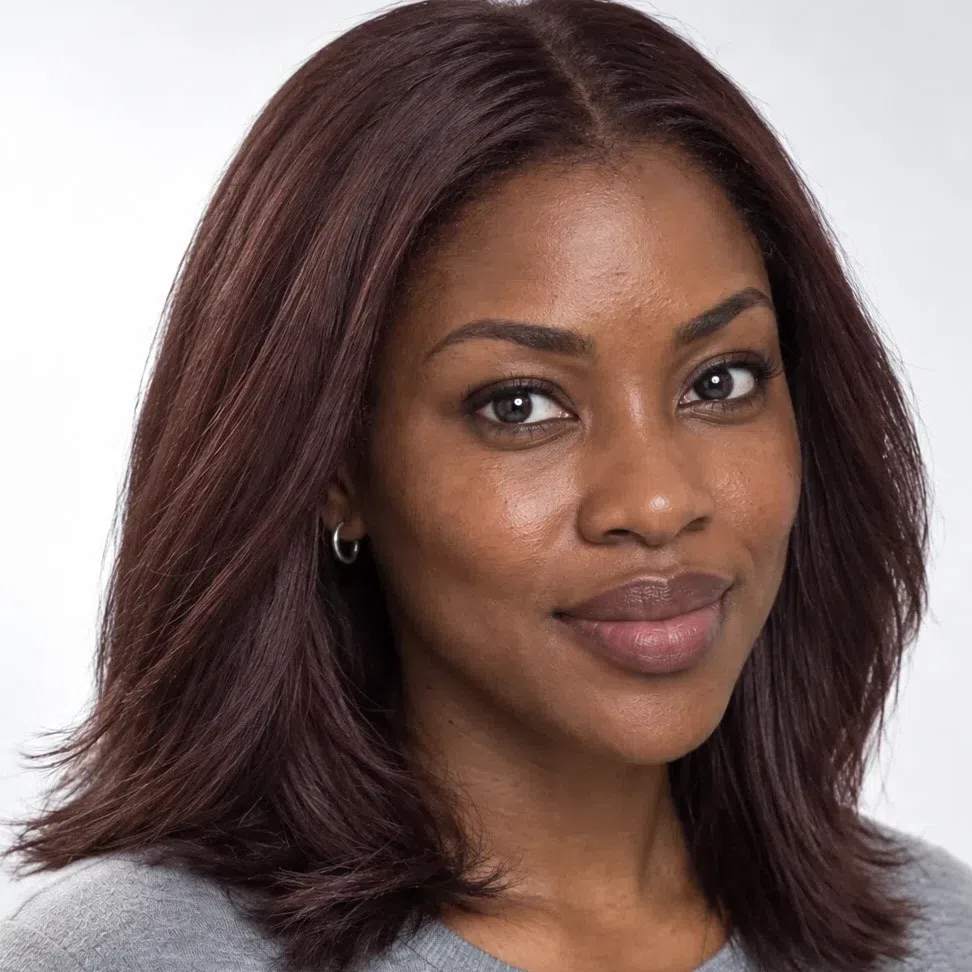 Muted wine, L3
A little more color, still smoky. Wearable, but it does nothing for her eyes.
-
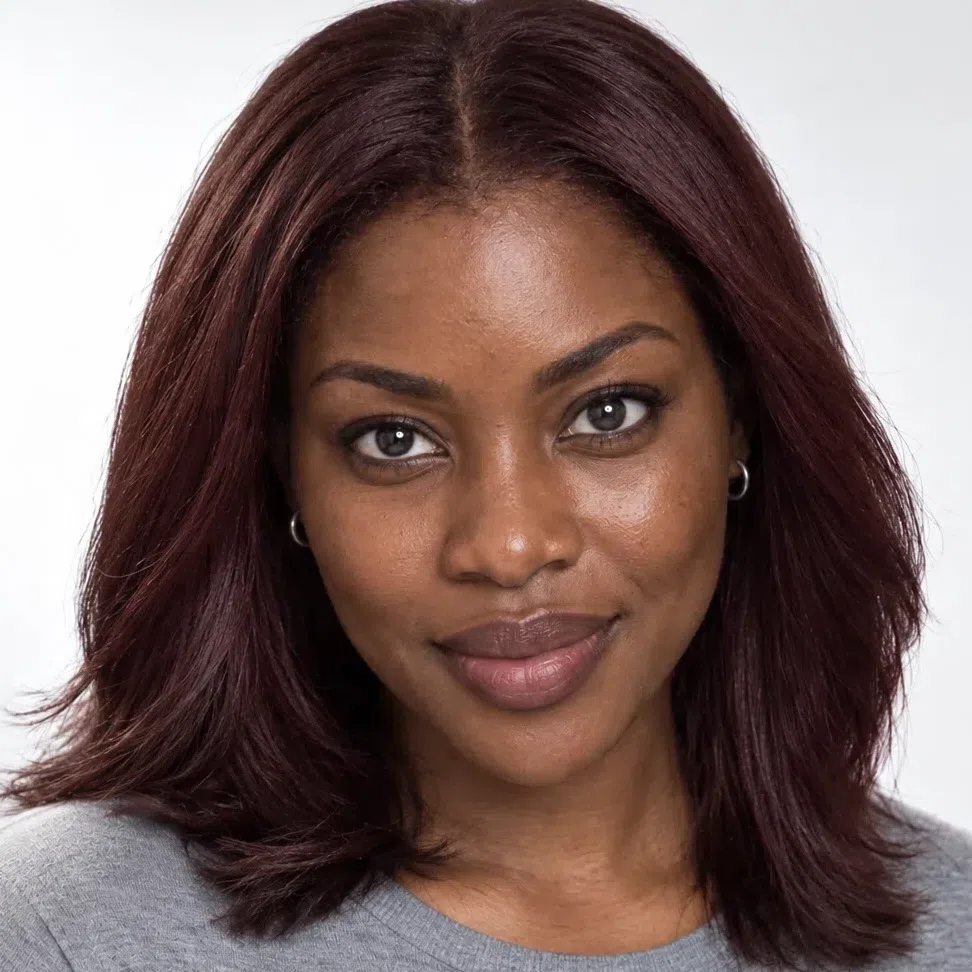 Black cherry, L3
Clear and cold. Her skin looks cleaner at once.
-
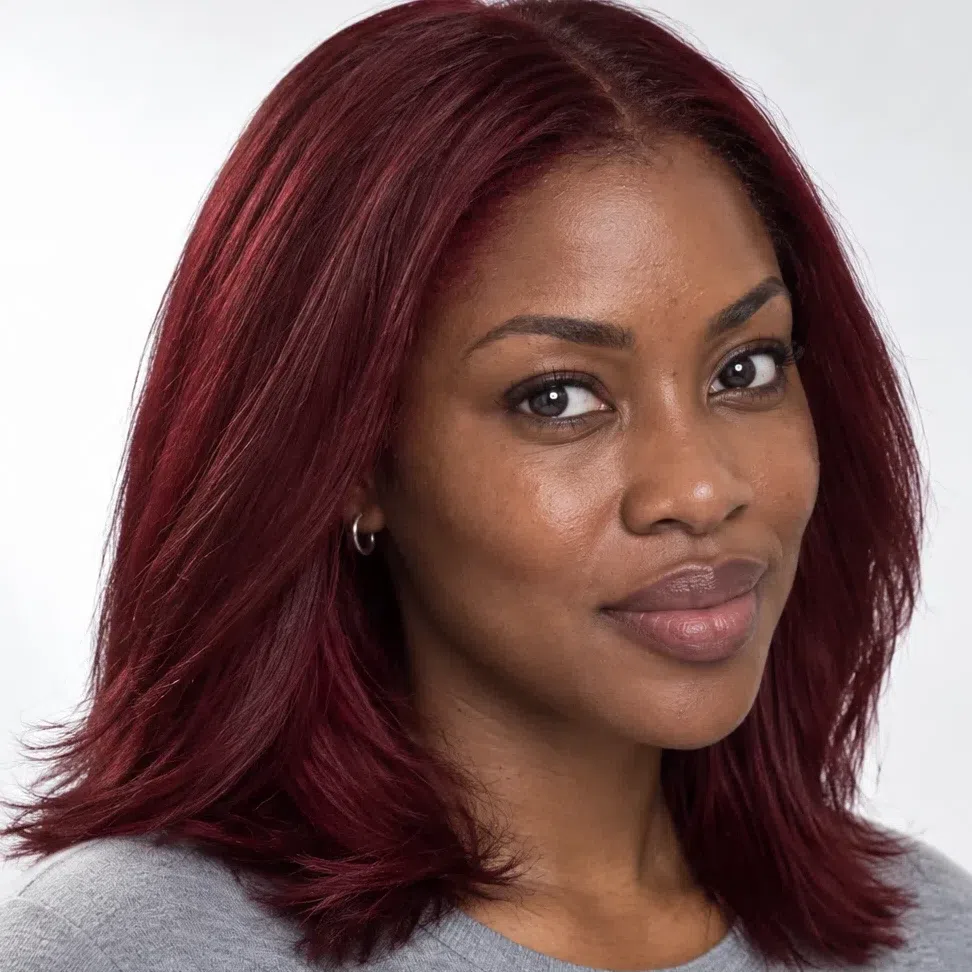 Ruby, L3
The same red at full strength. The most color in the row, and the frame that suits her best.
Left to right, the depth never moves. Every frame is level 3, in one hue - the cold red from your palette’s own quiz. What rises is chroma - the amount of color - about sevenfold from the first frame to the last. No frame carries a chip: your palette names no red at this depth, and a chip we had to invent would pass for a measurement. The two rows agree. On olive skin and on deep skin the line falls at the same frame, because clarity belongs to the dye, not to the complexion under it.
Muted seasons are told the opposite: their reds work because they are soft. Yours work because they are not, which is why a red that looks sophisticated in a photo of someone else can look dull on you.
In salon numbers a clear red is a .6, and a cold one pairs it with violet: a 3.62, or a 3.66 for more intensity. Say cherry or ruby along with the number. A .4 anywhere in the code turns it copper.
For red without the whole head, your palette has fuchsia tips: a cold pink on the ends or on a few inner strands. It goes onto lightened hair as a direct dye, so it washes out instead of growing out.
A clear red shares one weakness with every dark color on this page: a white root shows against it at once. Which is where gray comes in.
Going gray as a Bright Winter
Gray on dark hair arrives as white, and white against blue-black is the strongest contrast a head of hair can carry. That can be the problem or the answer. Covered, the line is back within weeks; brightened, it looks deliberate. Four ways to handle it, on two women.
Once it is bright white, yes. Clean white is cold and clear, your palette’s own terms. The hard part is the middle: blue-black dye over white roots makes the most visible regrowth of any coloring, and growing it out is the stage to rush. Full white suits deep skin outright; on fair skin it needs dark brows and a clear lip to keep the contrast up.
Fair porcelain skin, mid fifties, near-black hair already a third white.
-
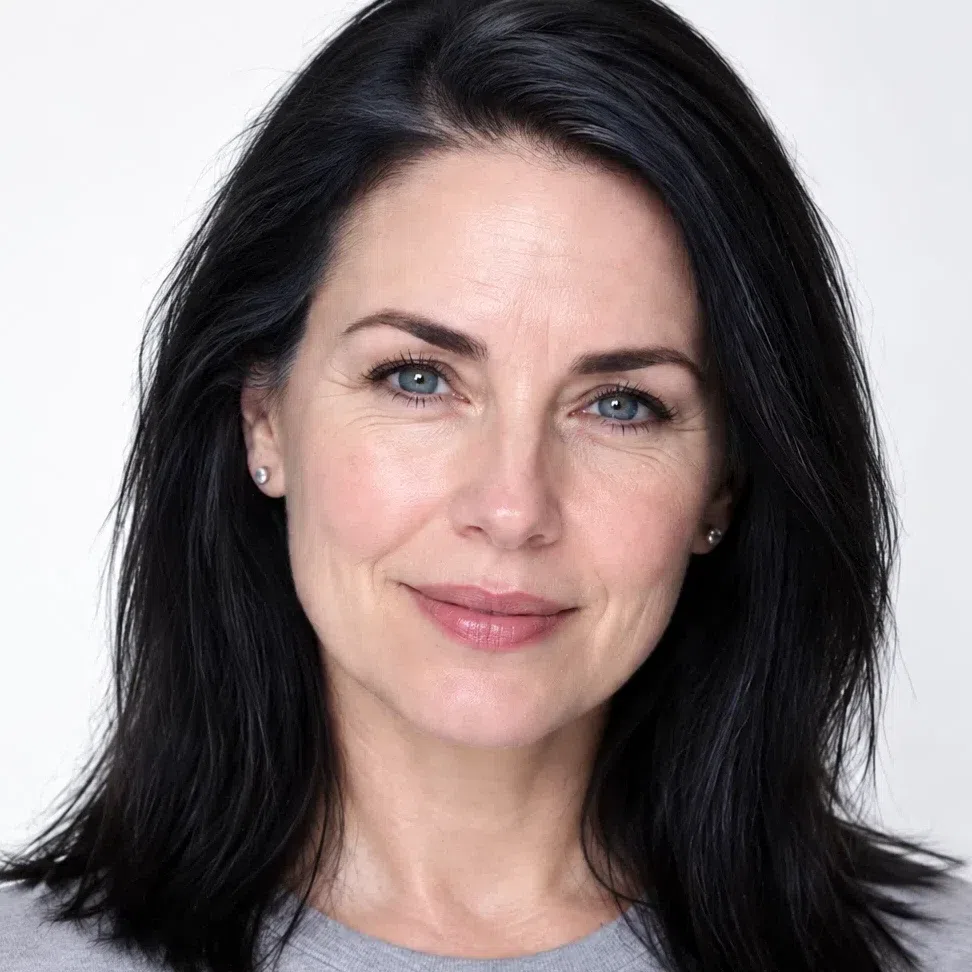 Covered
Blue-black over every white hair. Striking for two weeks, then a white line opens along the part.
-
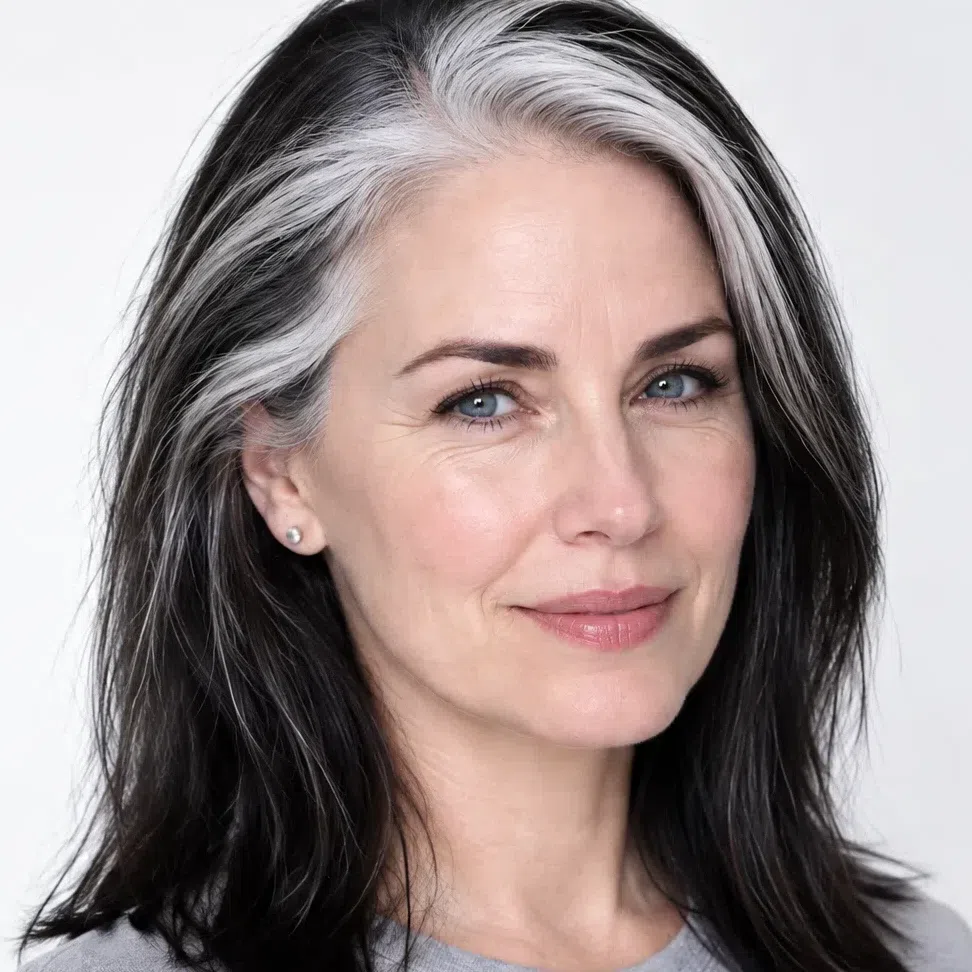 Brightened
A silver toner on the white, the blue-black kept below it. Salt-and-pepper at full contrast.
-
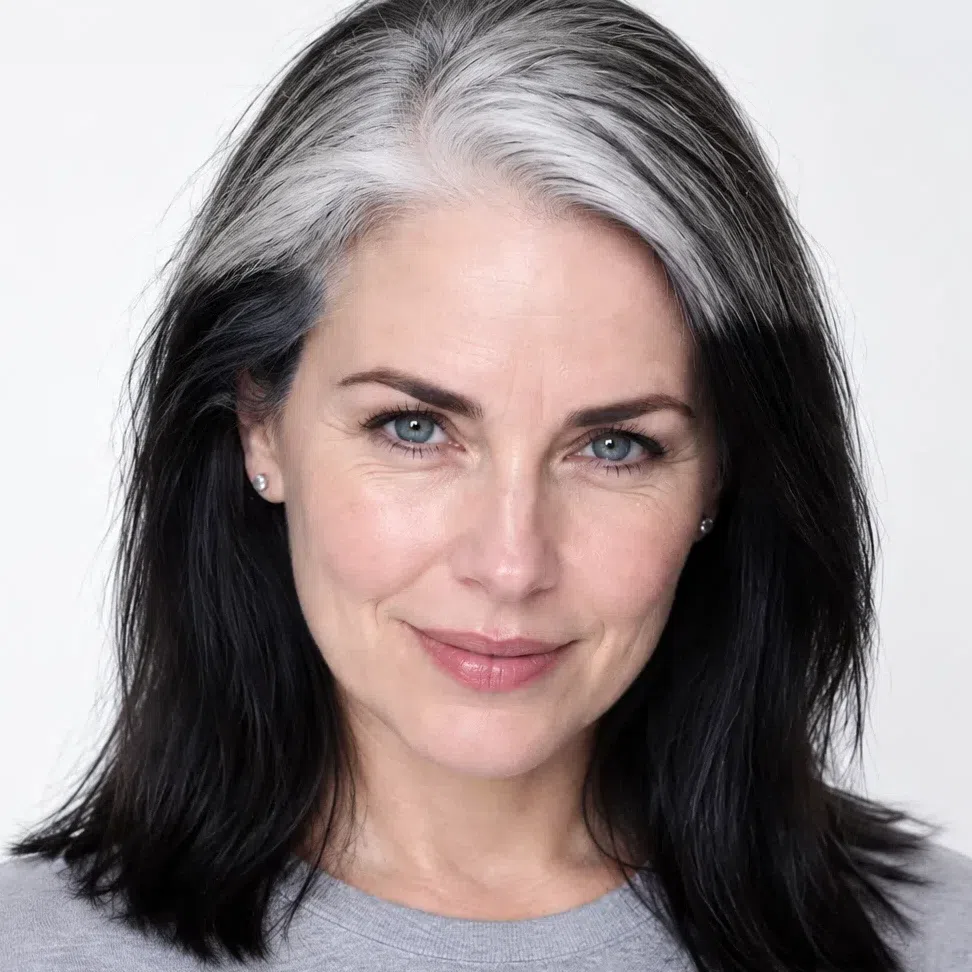 Growing it out
White roots meeting old blue-black: the hardest line in the section. Get through it as fast as you can.
-
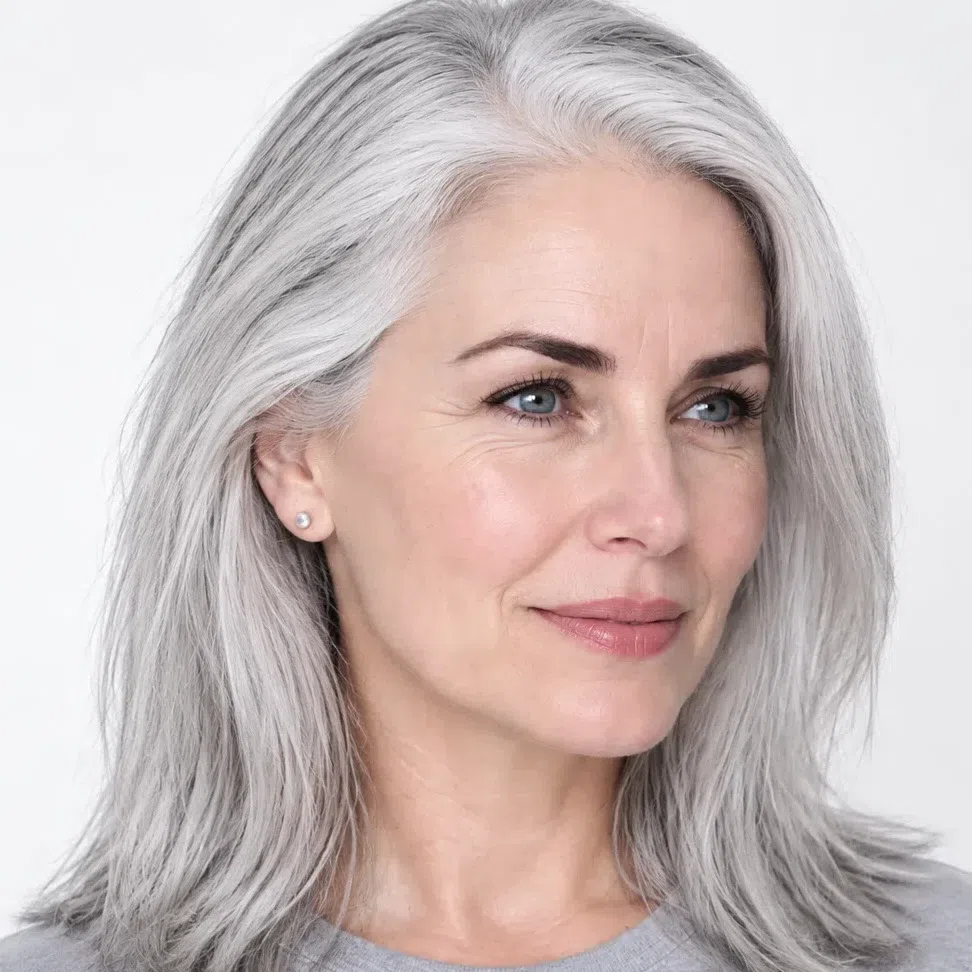 Full white
All white. Clean and cold, but on fair skin the frame goes soft, and her dark brows now do the work.
Deep skin with a cool undertone, mid fifties. The same four choices.
-
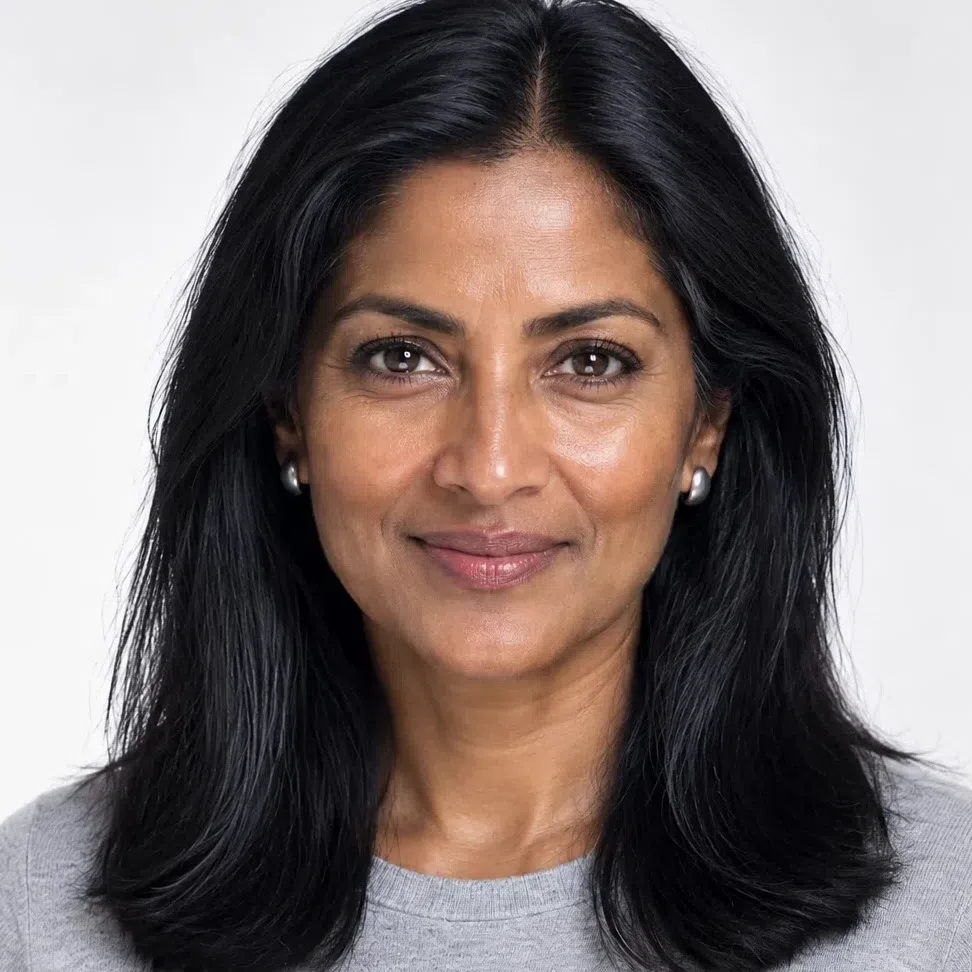 Covered
Blue-black over every white hair. Striking for two weeks, then a white line opens along the part.
-
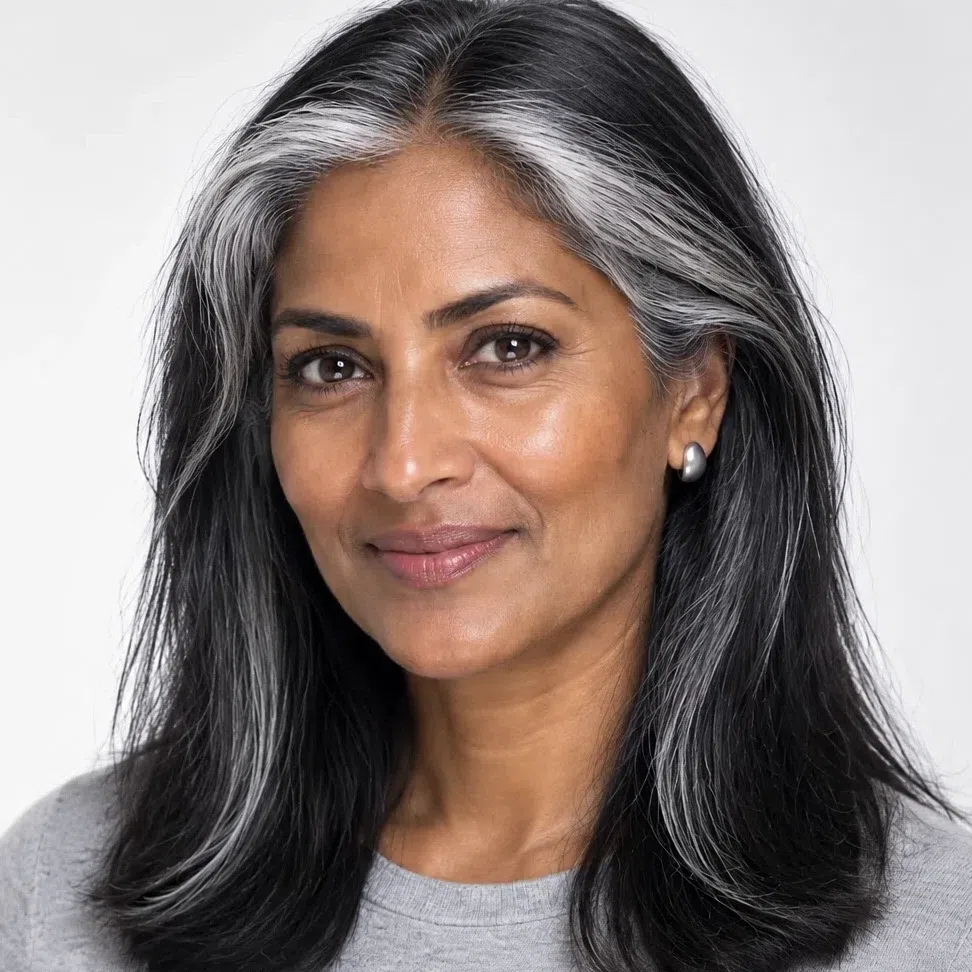 Brightened
A silver toner on the white, the blue-black kept below it. Salt-and-pepper at full contrast.
-
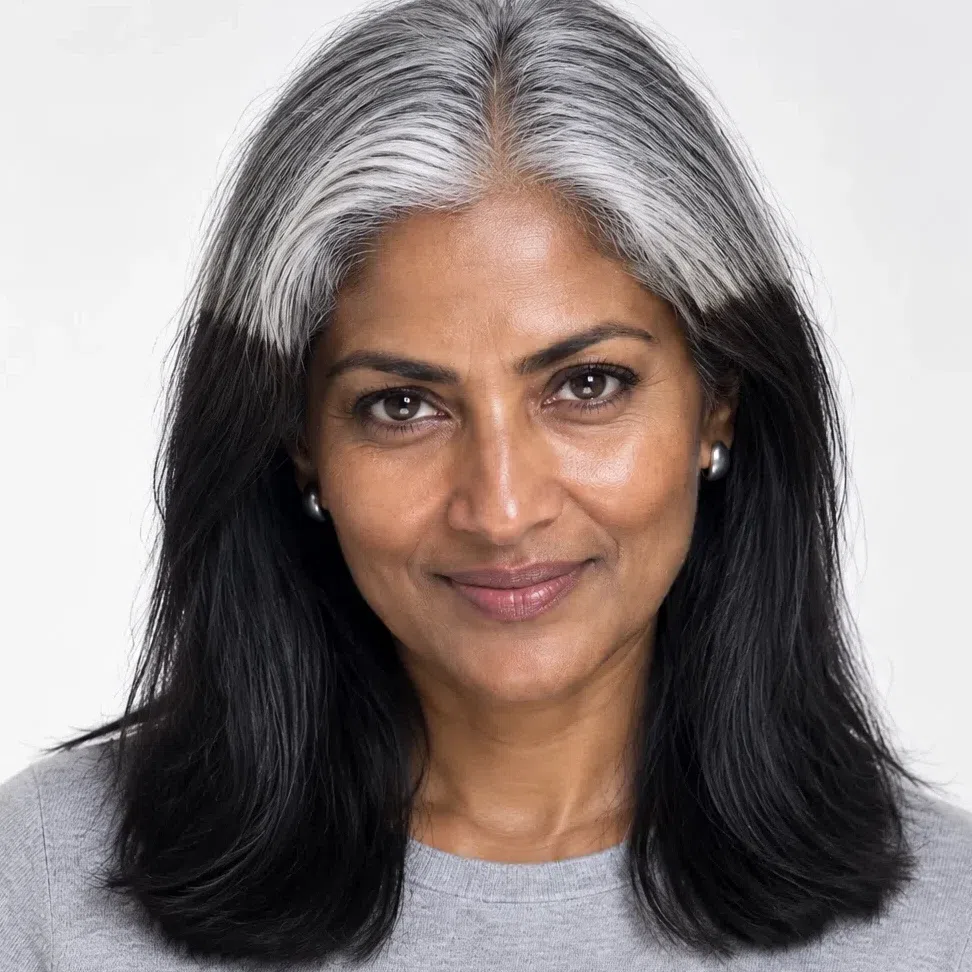 Growing it out
White roots meeting old blue-black: the hardest line in the section. Get through it as fast as you can.
-
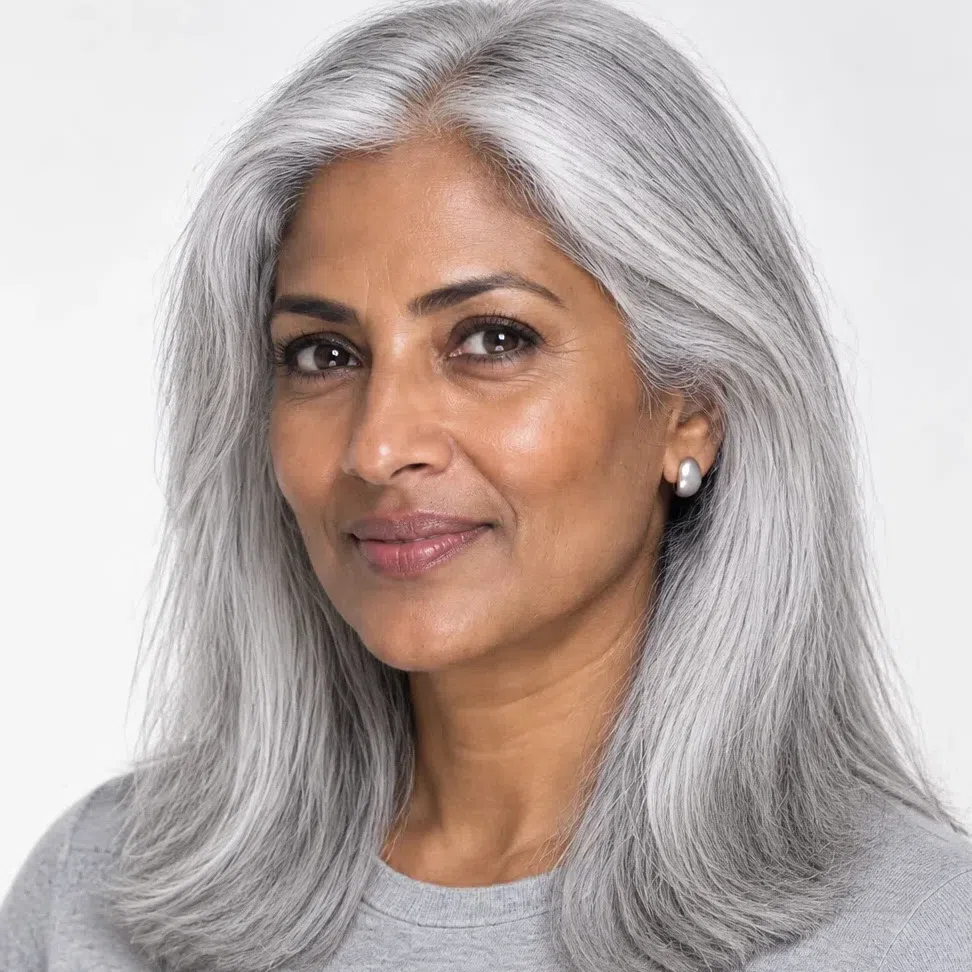 Full white
All white against deep skin: the strongest contrast in the section, and it reads as a choice.
Set the last frame of each row side by side. On deep skin, white hair becomes the brightest thing on the face, and that contrast is the look. On fair skin the same white sits close to the skin, and her brows and eyes have to hold the edge. One frame is tagged good and the other warn for that reason alone. In both rows, the third frame is the one to keep short.
The study behind the quote above set out to test gray on its own. It showed 120 people the same faces twice, once in their own hair color and once edited to plain gray, and the gray versions were rated older. That gray was flat and added on a screen - untoned, dull, chosen by nobody. It is the version a Bright Winter has the most reason to steer around.
What makes white look intended is brightness. White that has yellowed reads tired beside a clear complexion; a clean, faintly blue white reads crisp. A violet or silver toner every few weeks keeps it on the right side.
Gray hair color is one such trait that can potentially alter social perceptions related to aging, but has rarely been investigated independently from other correlated physical characteristics.
White and platinum drift creamy, and the jewel colors wash out. Keeping a bright color bright is the next section.
Keeping it bright, between appointments
Your color fails differently from most. The dark base holds; the pieces are what go. Amethyst, sapphire and fuchsia are direct dyes laid over lightened hair, and they wash out - paler with every shampoo, and duller as they go. The row below follows one set of amethyst ribbons for ten weeks.
The base is not the problem. The pieces are losing their color, and a jewel shade that loses color does not fade to a pretty pastel. It fades to dusty. By week ten the amethyst in this row has become the dusty lavender on your avoid list. The fix is to put color back into the pieces, not to lighten them again.
Ten weeks of amethyst ribbons in blue-black hair, at the same close crop every time. The blue-black never moves; the violet thins out around it.
-
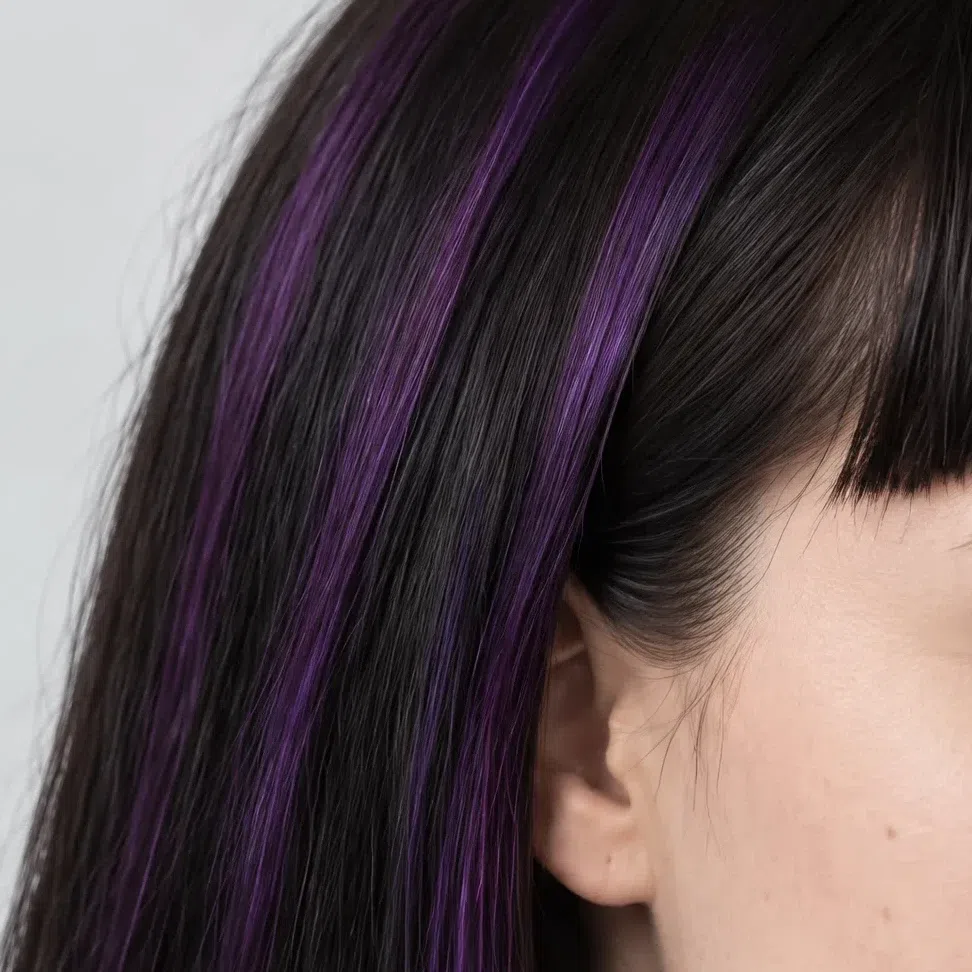 Day one
Amethyst ribbons, your palette’s shade, fresh from the salon.
-
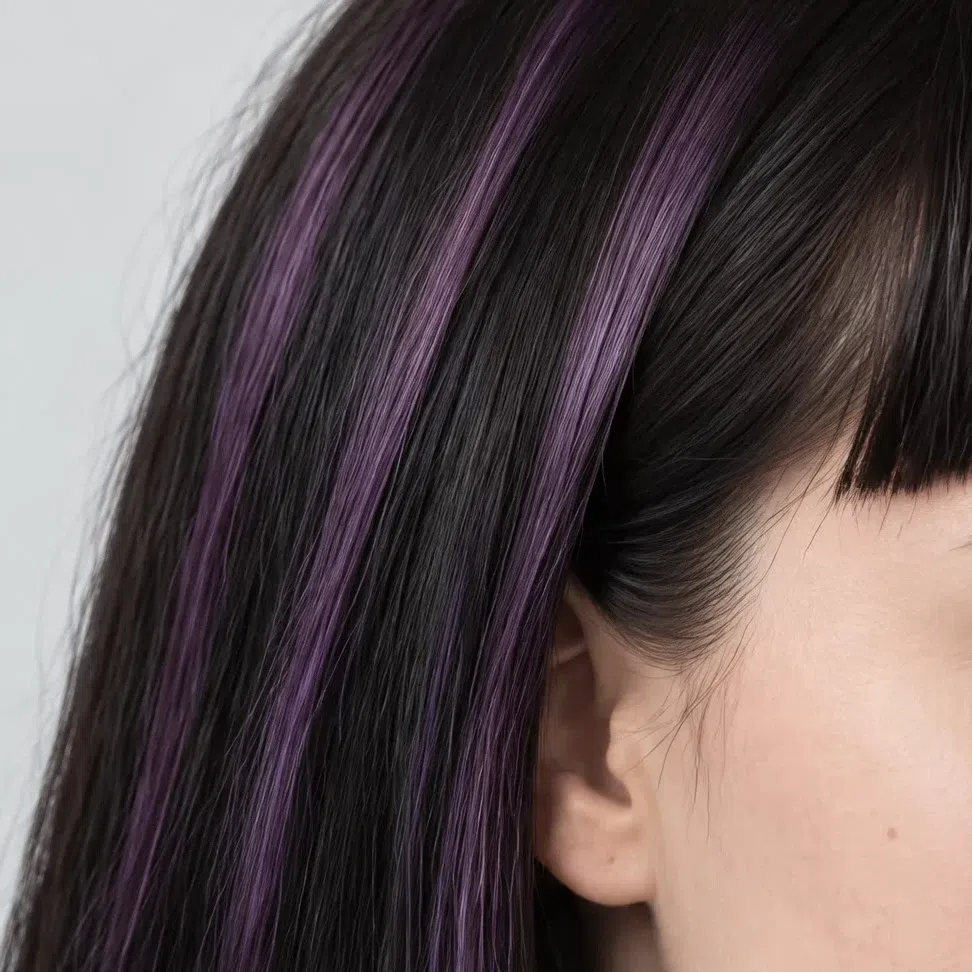 Three weeks
Softer, and still clearly violet.
-
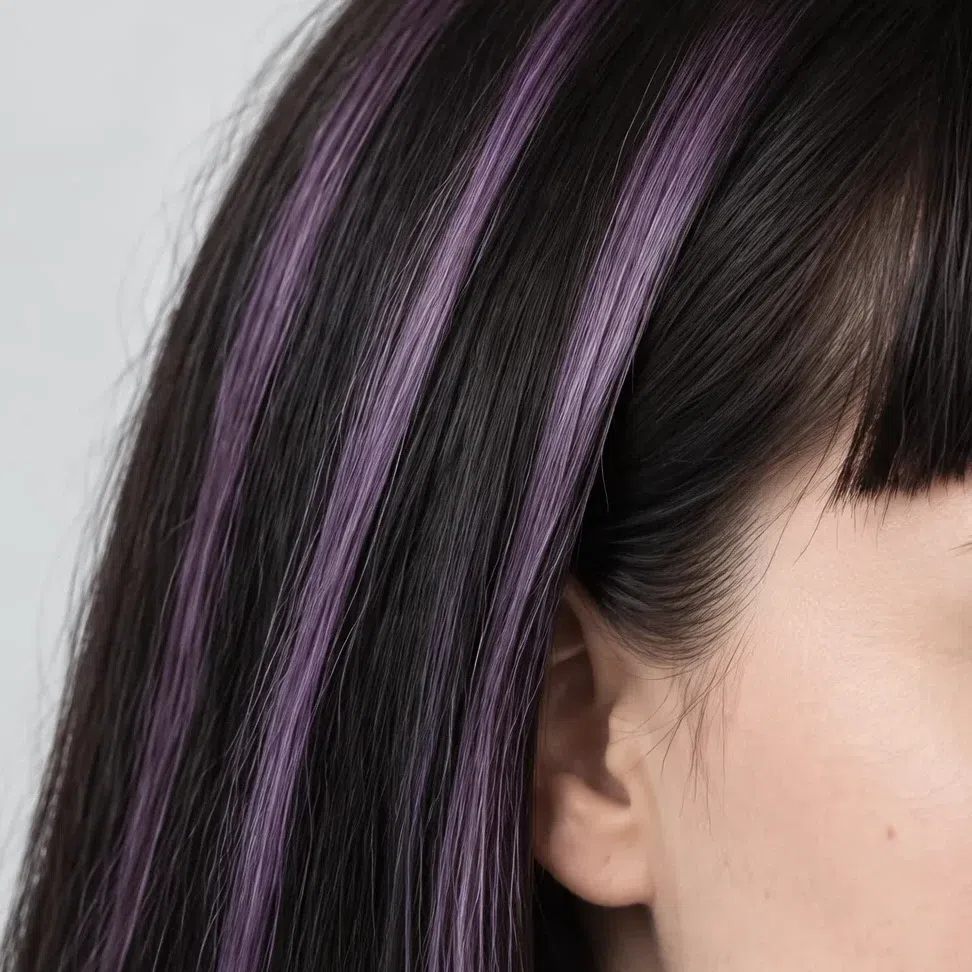 Six weeks
A pale, chalky lilac. The jewel has gone out of it.
-
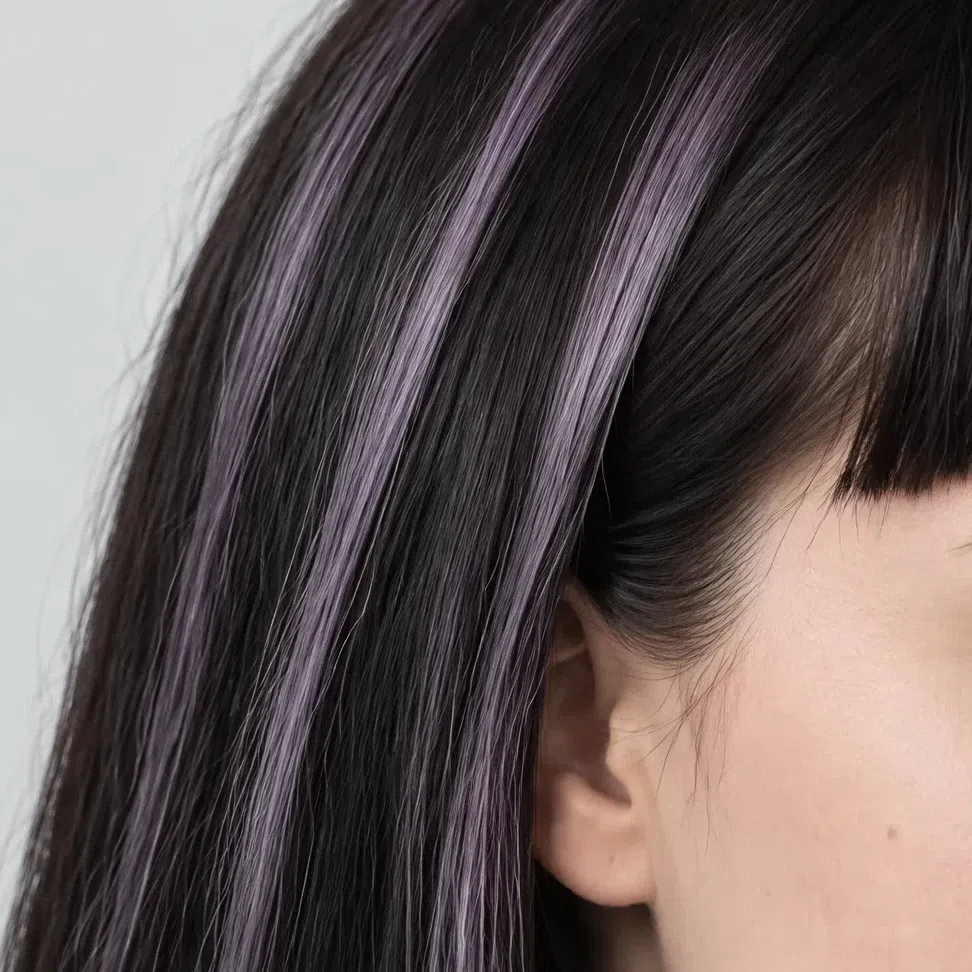 Ten weeks
Dusty lavender, a shade from your avoid list. The base has not changed at all.
The first chip is your palette’s amethyst and the last is the avoid list’s dusty lavender; the two between are built on the straight line that joins them. Along that line the pieces gain nearly forty points of lightness and lose almost two thirds of their chroma, while the hue barely moves. A direct dye does not turn into another color as it goes. There is simply less of it left.
Why so fast? Permanent color forms inside the hair and stays there. Semi-permanent and fashion colors are held by a much weaker bond, which is the point of the quote above, and water draws them back out. A 2020 wash-water study of a commercial semi-permanent formula found its blue dye one of the two, of five measured, least firmly fixed to hair - and on the first day of washing it came out into the water at about six times the concentration of the other. Sapphire tends to go first, and on a pale yellow lift it passes through teal on the way out.
The dark base is the easy half. Blue-black loses its blue reflect first and drifts toward a warmer brown-black, and blue - a blue mask, or a blue-ash gloss - puts the cold back, because blue cancels orange. Violet is the one for yellow: platinum streaks going creamy, and white hair.
However, the dye can be extracted easily from the hair by daily shampooing due to the weakness of the bond.
Four things that keep it bright
-
 Cold water, fewer washes
Every wash takes some of the dye with it. Wash less often, with a gentle color-safe shampoo, and finish with a cool rinse.
Every third day, rinsed cold. -
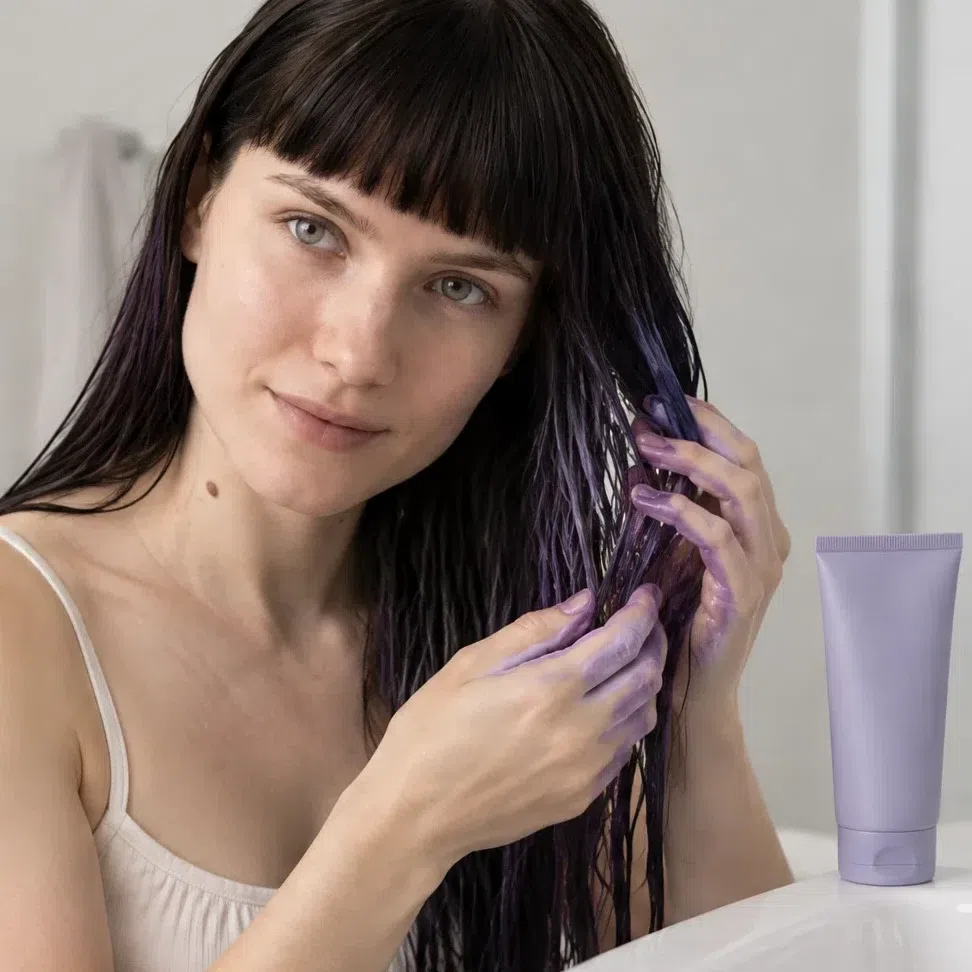 A tinted conditioner
A conditioner carrying the same violet, used once a week, puts a little color back into the pieces between visits.
Violet conditioner on the ribbons, Sundays. -
 Blue for the black
A blue mask once a week keeps the base cold by canceling the orange that dark hair shows as its reflect fades.
Blue mask on the lengths, five minutes. -
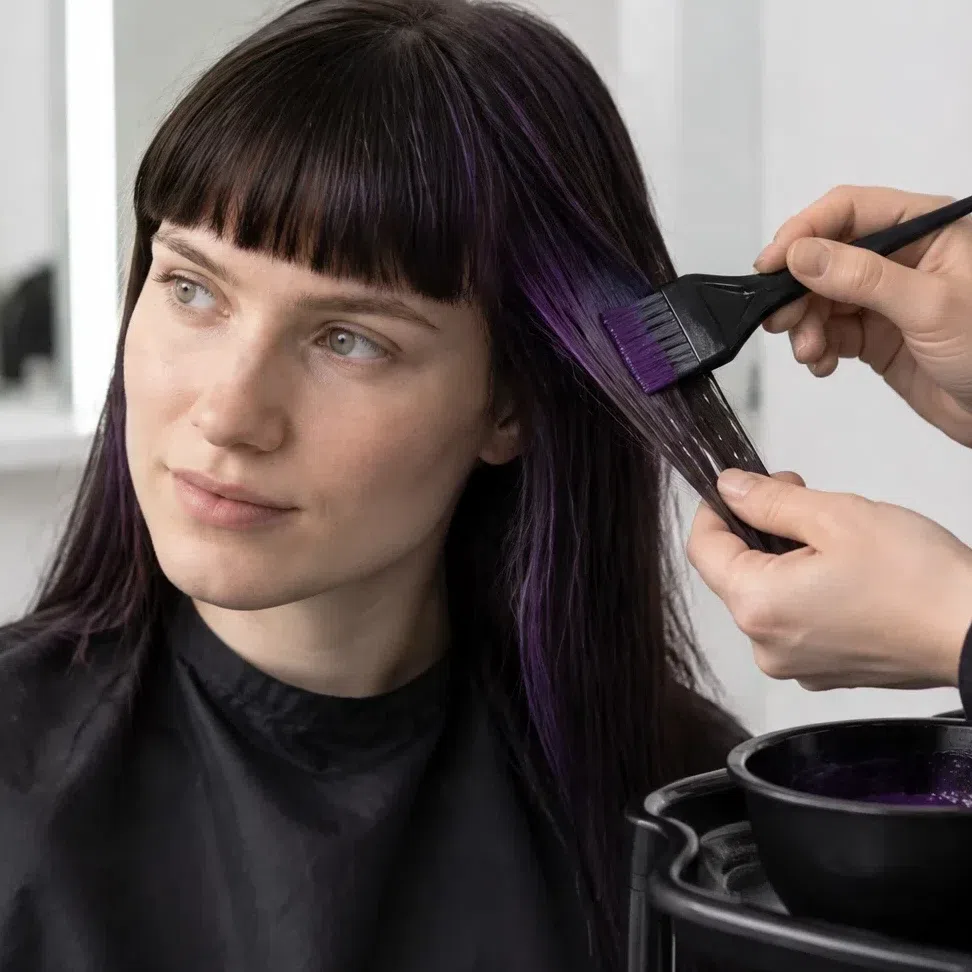 Refresh the pieces
A short salon visit every four to six weeks to recolor the pieces, with no lightener. The base only needs its gloss every couple of months.
Color on the pieces only, no lift.
Care keeps a right color right; it cannot rescue a wrong one. Next: the shades that were never going to work, on an ordinary face on a gray afternoon.
Hair colors to avoid, and why they fail
Two mistakes first, which look alike in the mirror and need opposite repairs. Then twelve shades on one ordinary woman, photographed outdoors on an overcast day - the light most people will see your hair in, and much harder on it than a studio.
The two mistakes
It went flat
- How you can tell
- Your hair looks like one dark mass. Your skin looks paler than it should, and bright colors near your face suddenly look loud rather than right.
- Why
- A near-black with no reflect, usually a box color chosen for coverage, or a cool dark that has faded dull. Without a sheen, dark hair soaks up light instead of sending it back, and the snap between your hair, skin and eyes is gone.
- Fix
- Add shine and a little light - at the surface, not through the whole head. A blue-ash or violet gloss brings the reflect back, and a few platinum or jewel pieces at the front add the brightness. Lightening all of it is the wrong instinct: it trades flat for dusty.
It went dusty
- How you can tell
- In daylight your hair looks soft and powdery - a grayish blonde, a faded pastel, a mousy brown - and your face looks tired beside it, even with makeup on.
- Why
- Color with too little clarity: ash or beige blondes, a lift that stopped halfway, or jewel pieces left to fade. Your coloring is bright, so hair without clarity makes the face look as if something is missing.
- Fix
- Go cleaner, and usually darker. Bring the base back to your own level with a cold demi-permanent color, then refresh the pieces or cut them out. Softening it further - one more ash toner, one more beige - is the instinct to resist.
The twelve shades, on a real face
The eight shades your palette page tells you to skip, with the same hexes and in the same two groups, then four from this page: cool shades that still miss. One woman on one gray street, and nothing changing from frame to frame but her hair.
Warm and golden
-
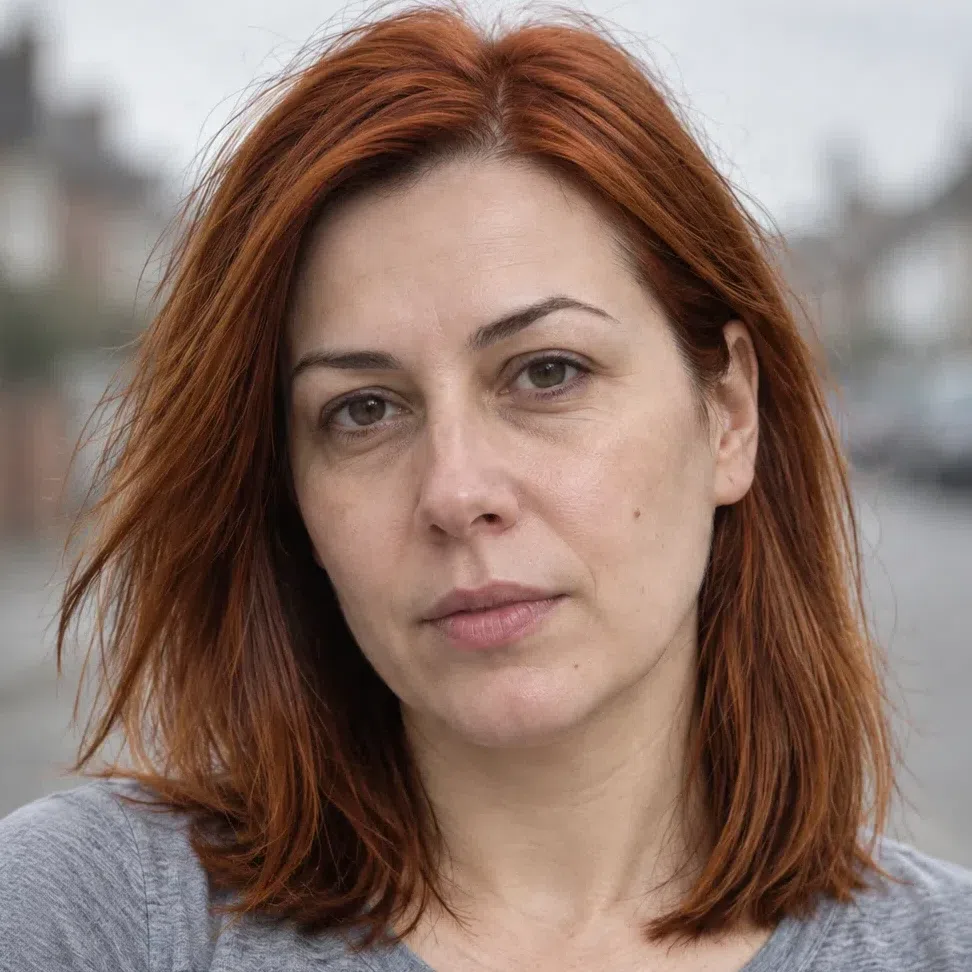 Rust
warm
-
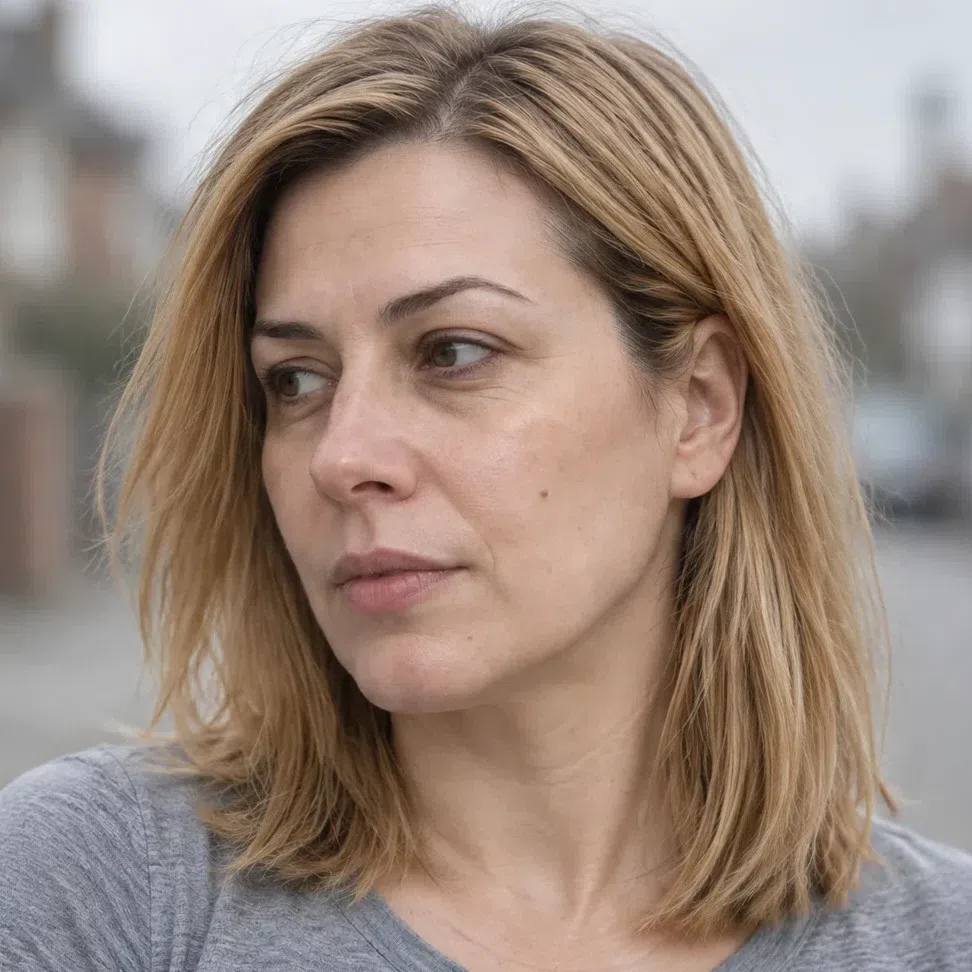 Golden blonde
warm
-
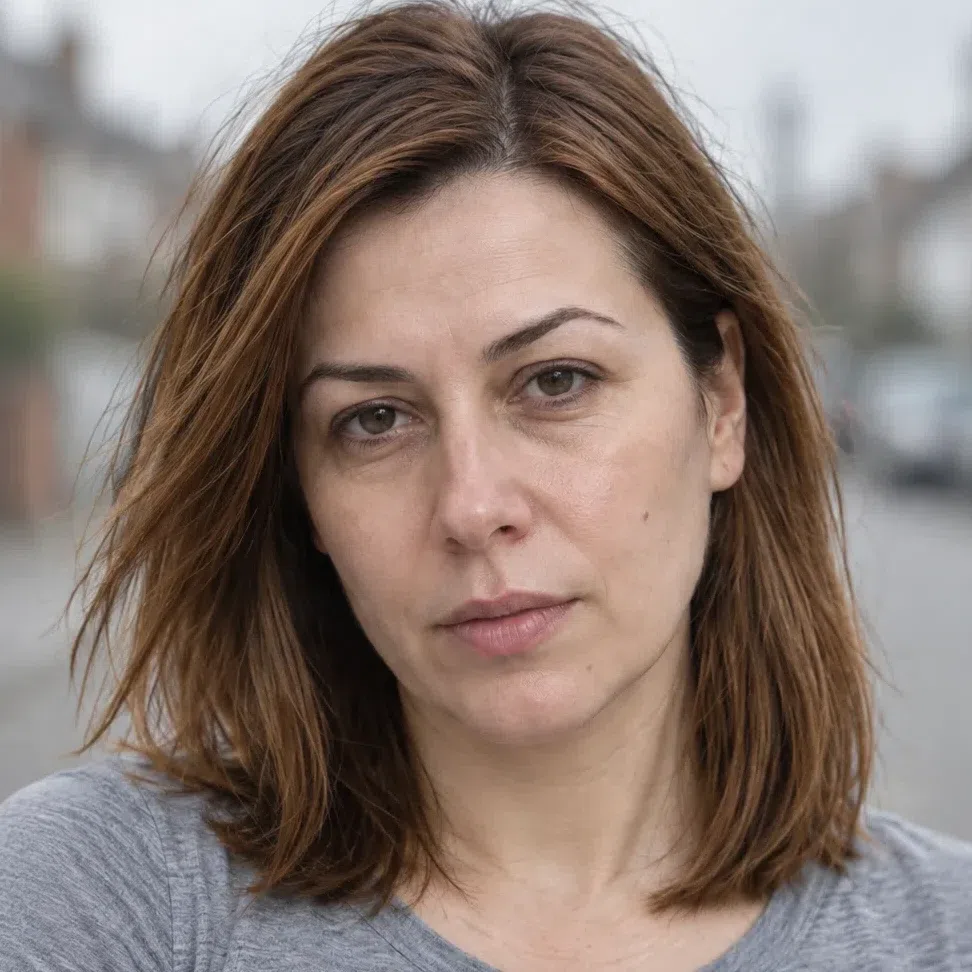 Toffee
warm
-
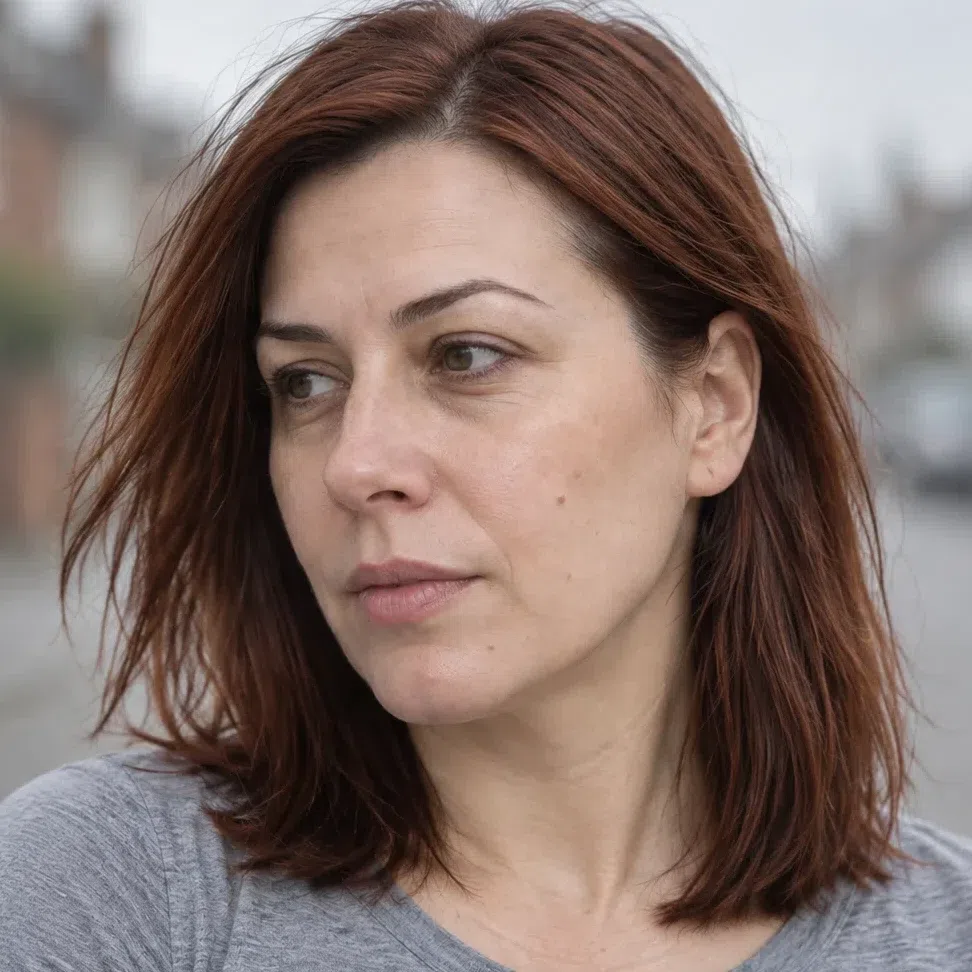 Warm red chestnut
warm
Rust, gold, toffee and red chestnut. Each one sets orange or yellow beside cold skin, and the skin answers by looking ruddy or sallow where it should look clear.
Soft and dusty
-
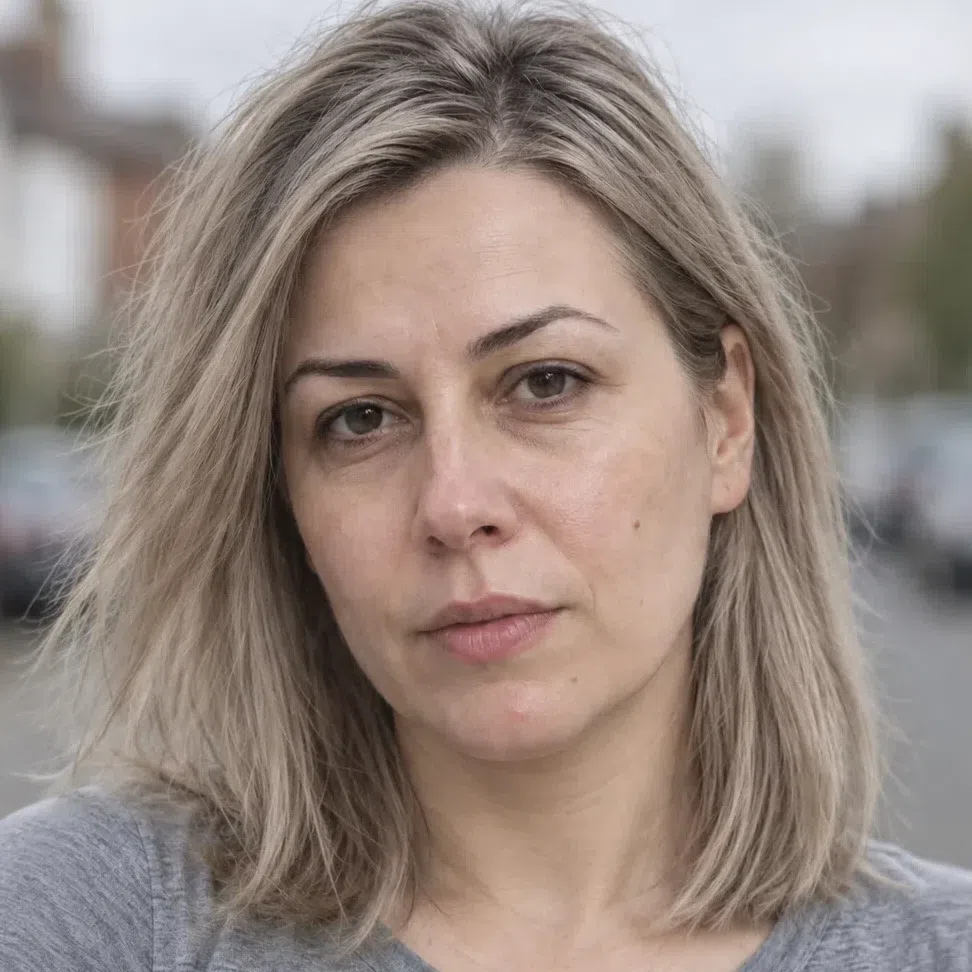 Ash blonde
clean
-
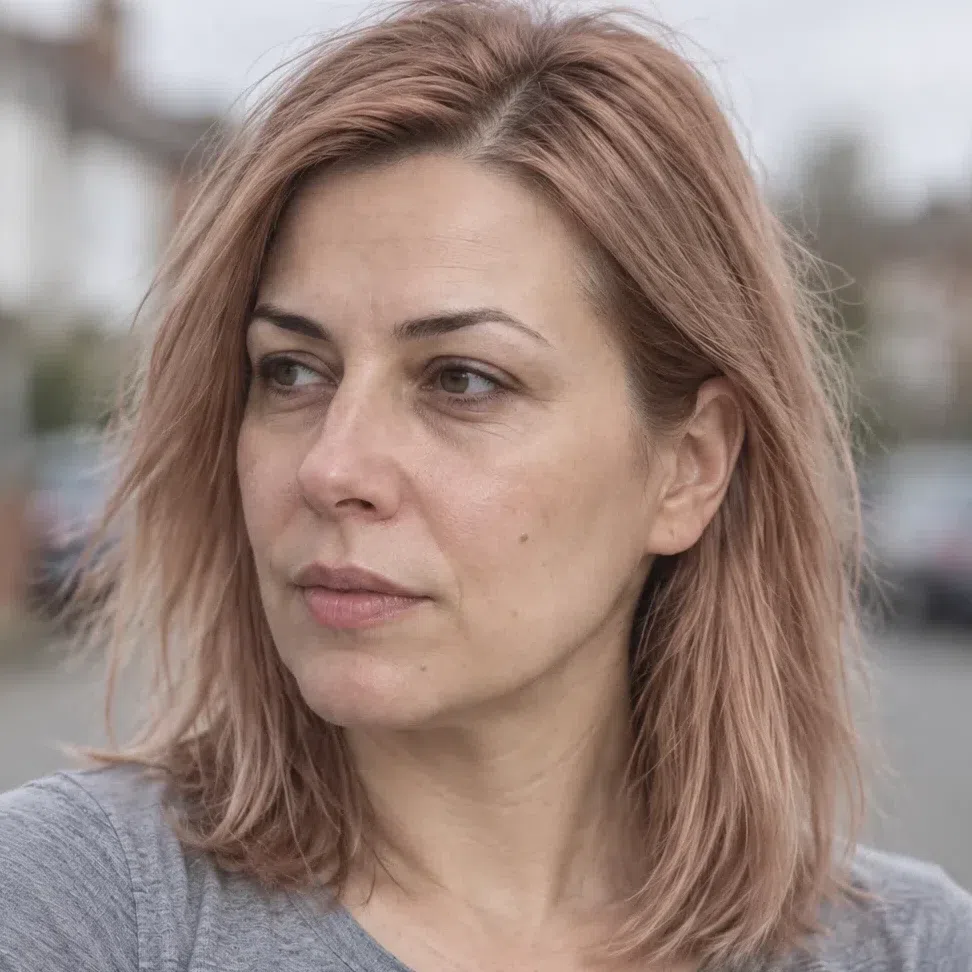 Strawberry blonde
warm
-
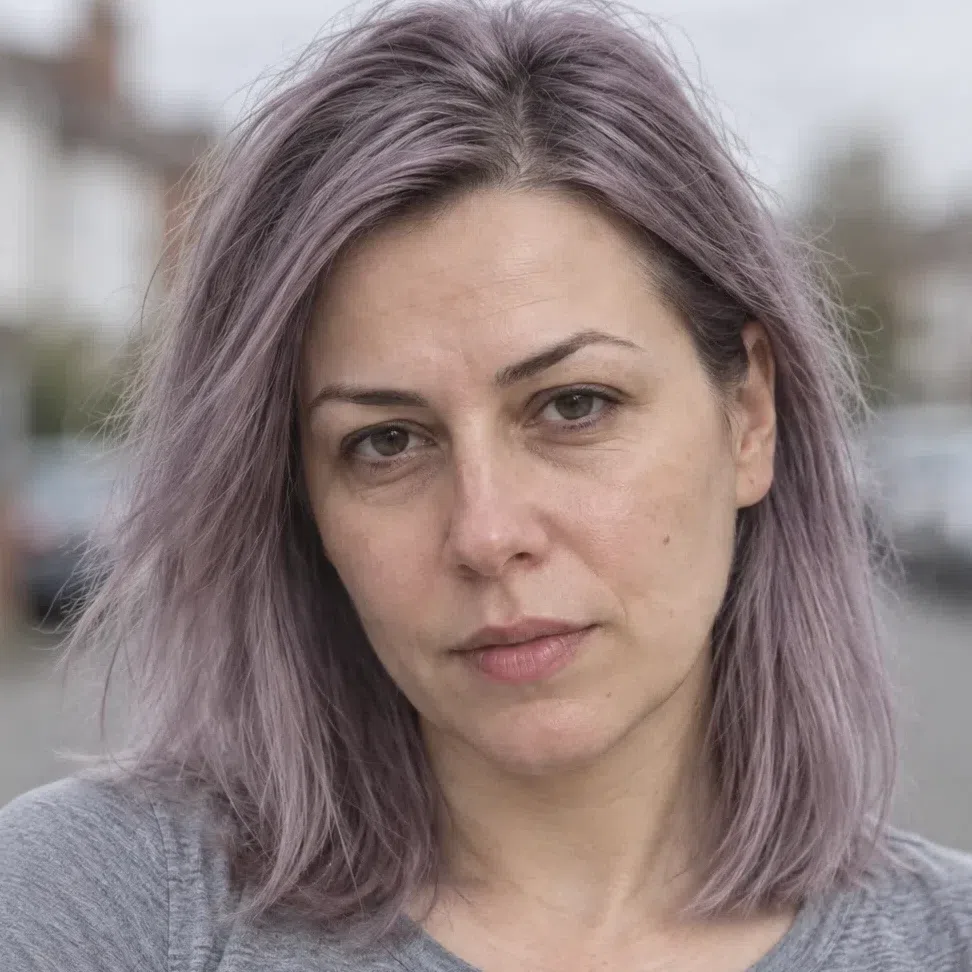 Dusty lavender
clean
-
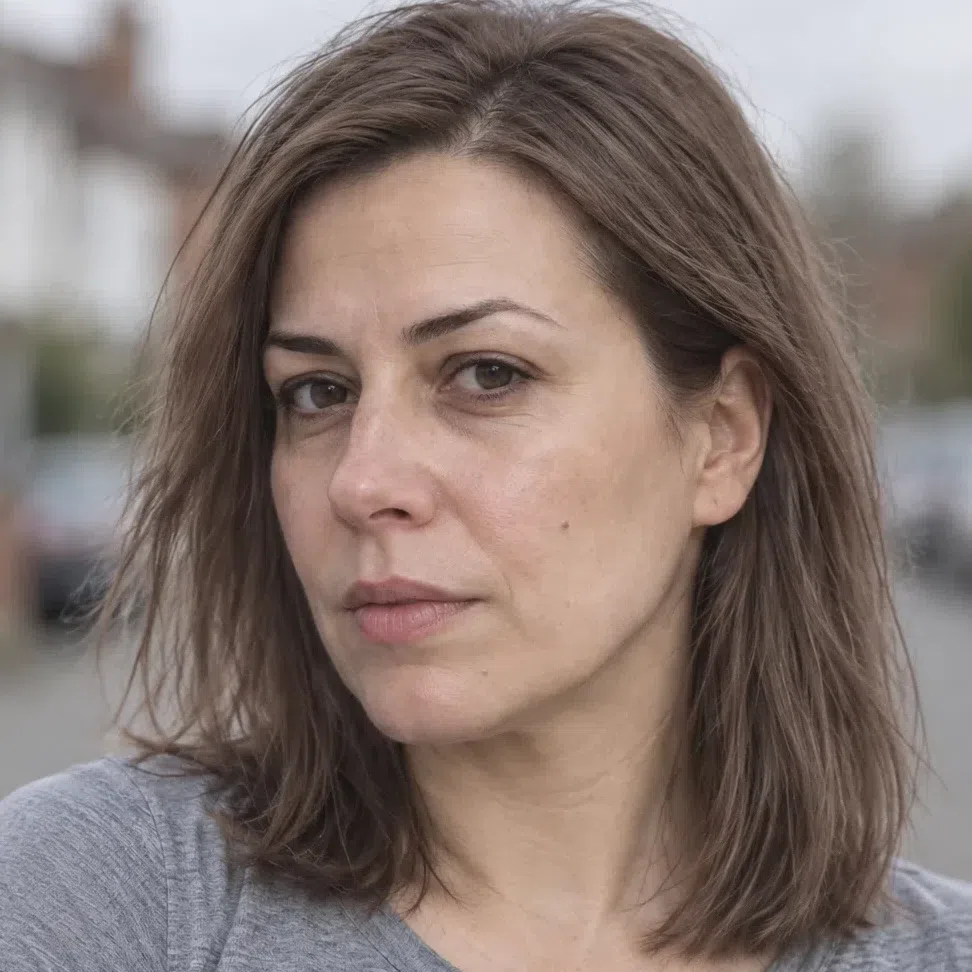 Mousy light brown
clean
The dusty side: ash blonde, strawberry blonde, dusty lavender, mousy light brown. None of them is loud, and that is the trouble - each one takes the clarity out of a face that runs on it.
Cool, and still wrong
-
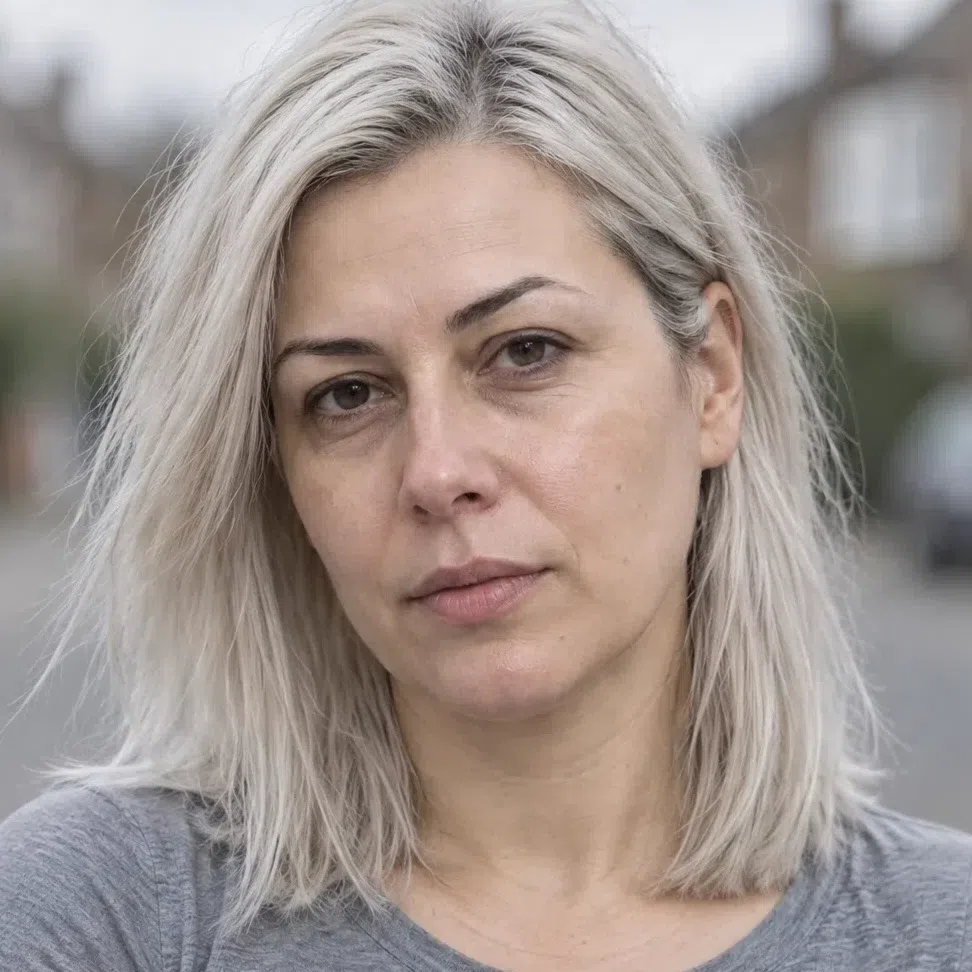 Platinum all over
hard
-
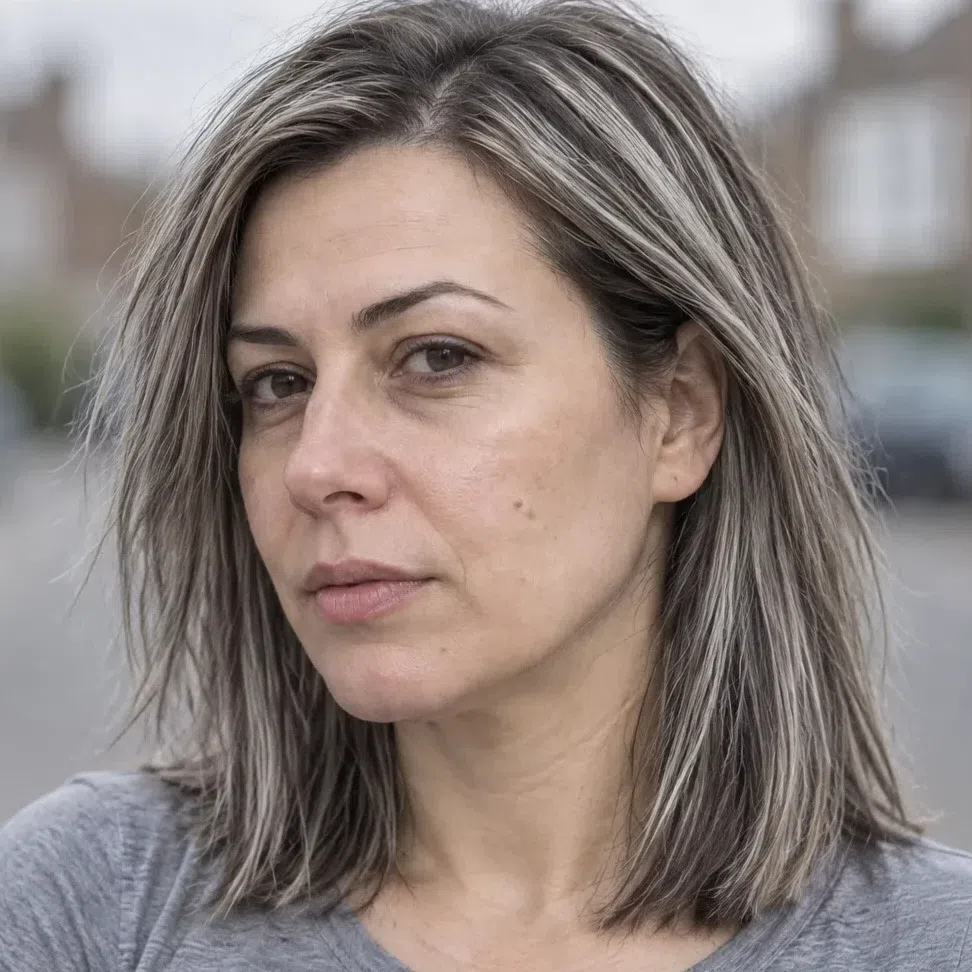 Highlights all through
clean
-
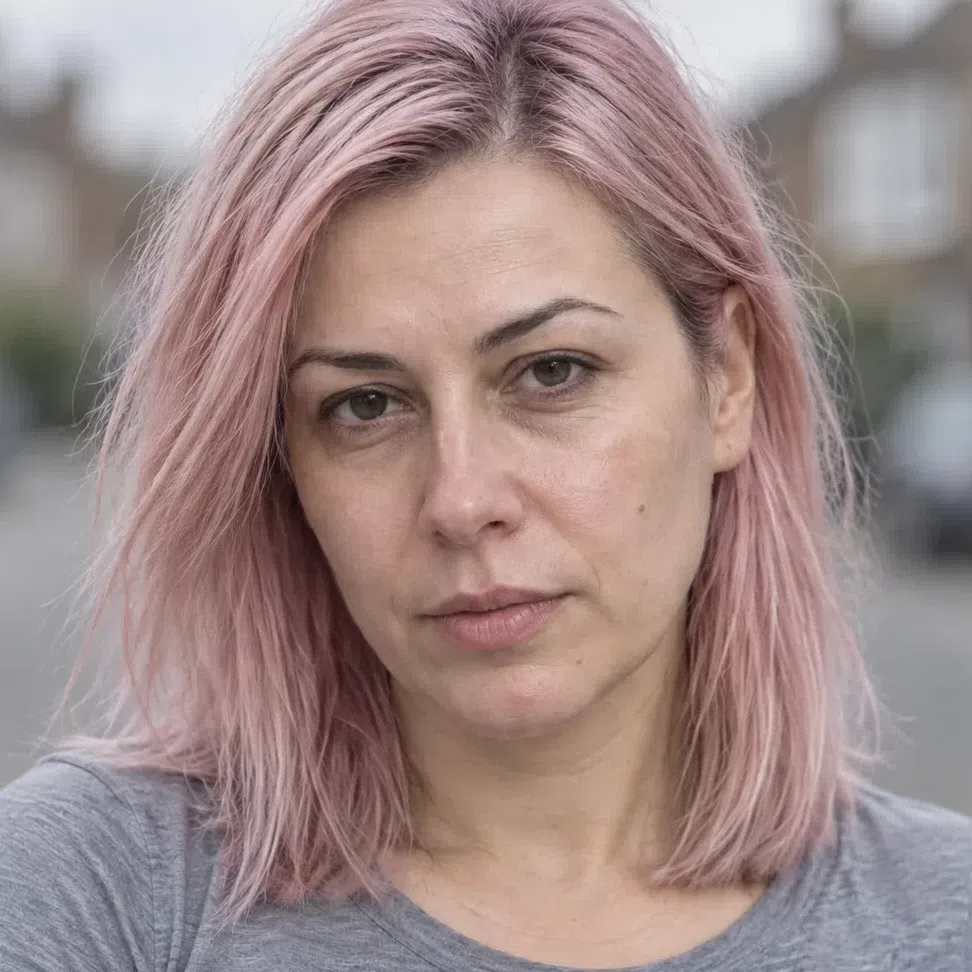 Pastel pink
clean
-
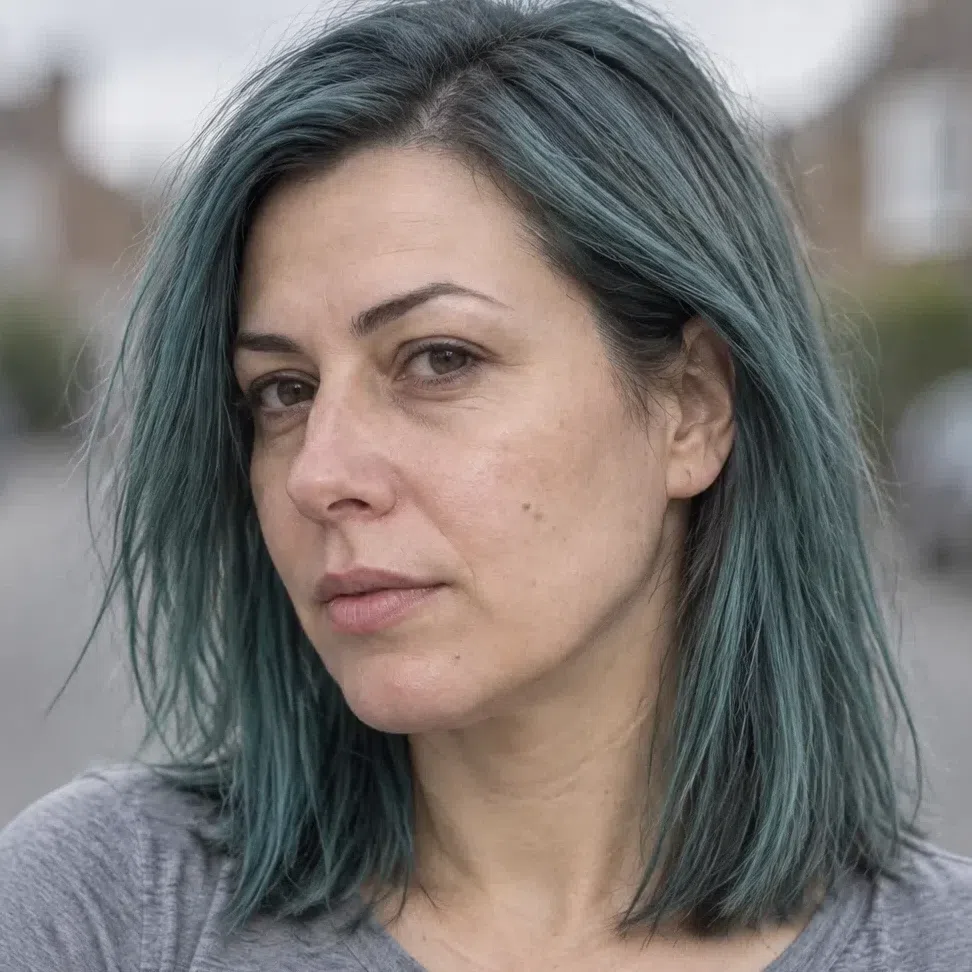 Sapphire, gone teal
clean
The group to study. Every one of these is cool, and every one still misses: too much light, too little color, or a jewel shade left to wash out.
What the tags mean
- warmWarm
- Rust, gold, toffee, copper, strawberry: warmth set against a cold undertone. The makeup page uses the word the same way.
- cleanToo soft
- Dusty, chalky or muddy: ash and mousy browns, pastels, jewel colors that have faded. Muted seasons use this tag for color that is too vivid. A Bright Winter runs on clarity, so here it flags color with too little.
- hardToo far
- Light that has left the face behind - platinum over the whole head. The problem is the distance between hair and features, not the shade itself.
Five warm, six too soft, one too far. The one shade that fails on lightness alone is your palette’s own platinum, worn all over instead of as streaks, and highlights all through is that same platinum in the wrong dose again, reading as gray. Pastel pink is fuchsia with the clarity gone; sapphire gone teal is a blue piece left to fade; and dusty lavender, from your palette’s own list, is where the amethyst in the upkeep row ends up. Everything that does work is gathered in the next block.
Your eight shades, with the level to ask for
Four dark shades with their level, four accents with their placement, then the five tone digits you are likely to hear. Screenshot it before the appointment.
The shades, with the level or placement
- Blue-black L1 #14161C
- Black espresso L2 #2E251F
- Dark aubergine L2 #2E1C38
- Ash dark chocolate L3 #3D342E
- Platinum streaks Pieces #E6E6E8
- Amethyst ribbons Pieces #6A2E86
- Sapphire lights Pieces #0F52BA
- Fuchsia tips Pieces #D93691
The numbers
- Ash 2.1 #303137
- Violet 2.2 #2E1C38
- Natural 2.0 #2E251F
- Gold 2.3 #332C20
- Copper 2.4 #452513
Yours: 2.1 (the blue-ash reflect of your blue-black), 2.2 (dark aubergine) and a gold-free 2.0 (black espresso). Not yours: 2.3 and 2.4. The first number is your own natural level, or one below it, and only that number moves: a 2.1 and a 3.1 are the same cold reflect at two depths. The four accents have no level.tone code at all: platinum is lightener and an icy toner on a few strands, and amethyst, sapphire and fuchsia are direct dyes placed on lightened pieces.
The sentence to say, word for word: “I am about a level 2 naturally. I would like to stay at a level 2 with a clear blue-ash reflect - a 2.1, glossy, with no gold or copper in the formula - and two or three platinum streaks at the front, toned icy.”
The full Bright Winter palette →
Questions people ask
What is the best hair color for a Bright Winter?
Is Clear Winter hair color the same as Bright Winter?
What hair colors should a Bright Winter avoid?
Can a Bright Winter be blonde?
Should a Bright Winter get highlights?
What is the best hair color for a Bright Winter with brown hair?
Can a Bright Winter have red hair?
Can a Bright Winter wear blue, purple or pink hair?
How should a Bright Winter handle gray hair?
What hair color makes an older Bright Winter look younger?
What should a Bright Winter ask for at the salon?
Why do my colored pieces fade so fast?
Can I dye my hair at home as a Bright Winter?
Where this came from
The sources behind the factual claims on this page: salon numbering, the pigments in hair, what lightener does, why one color cancels another, how dye leaves hair in water, and how gray hair is read.
-
International Colour Charts for Hairdressing (opens in a new tab)
Hair & Makeup Artist Handbook, 2023
The level-and-tone numbering behind the salon section, and the sentence quoted there: a zero changes how strong a tone is, so a 2.10 is more definite than a 2.1 and a 2.01 is only a trace. Brands do not all follow the convention, so say the word as well as the number.
-
Diversity of human hair pigmentation as studied by chemical analysis of eumelanin and pheomelanin (opens in a new tab)
Ito & Wakamatsu, Journal of the European Academy of Dermatology and Venereology, 2011
Background for the blonde section. Hair color is set by the balance of black-brown eumelanin and reddish-brown pheomelanin, and black and brown hair carry a trace but constant level of the reddish one. That this is the warmth a partly lightened dark head shows is colorists’ practice, not this study’s finding.
-
Mechanistic insights into the bleaching of melanin by alkaline hydrogen peroxide (opens in a new tab)
Smith, Garrett, Naqvi et al., Free Radical Biology and Medicine, 2017
Behind the blonde section. Alkaline hydrogen peroxide, the chemistry of lightener, bleaches hair by breaking its melanin down - which is why a whole head lifted from near-black is a long job and a few streaks are a short one.
-
The Art of Color: the subjective experience and objective rationale of color (opens in a new tab)
Itten, Reinhold (Internet Archive), 1961
Behind the rule that toning works on color-wheel opposites: violet sits opposite yellow and blue opposite orange. That is why violet belongs to platinum streaks and white hair, and blue to a blue-black losing its cold.
-
Protection of oxidative hair color fading from shampoo washing by hydrophobically modified cationic polymers (opens in a new tab)
Zhou, Foltis, Moore & Rigoletto, Journal of Cosmetic Science, 2009
Behind the washing advice in the keeping-it section: dye leaves hair mainly by dissolving in water, so every wash takes a little with it. The study measured oxidative color; semi-permanent color is held more weakly still.
-
A novel "permanent" acid-type hair color made possible with dye-metal ion complex technology (opens in a new tab)
Ochiai, Kawasoe, Yasuda et al., Journal of Cosmetic Science, 2005
Quoted in the keeping-it section. The authors set out to make acid-type semi-permanent color last longer, and start from its weakness: the dye bonds loosely to hair protein and daily shampooing extracts it. The jewel shades on this page are direct dyes of related kinds; that they fade the same way is our reading, and matches what colorists report.
-
Assessment of semi-permanent hair dyes in wash water from beauty salons by liquid chromatography-tandem mass spectrometry-selected reaction monitoring (LC-MS/MS-SRM) (opens in a new tab)
Franco, da Silva & Zanoni, Analytical Methods, 2020
Behind the note that blue goes first. Measuring five dyes from a commercial semi-permanent formula in salon wash water, the authors found the blue one (Basic Blue 99) among the two with the weakest hold on hair, released at about six times the concentration of the other on the first day of washing.
-
Gray hair influences perceived age and social perceptions (opens in a new tab)
Nutt, Thorstenson & Yorzinski, Frontiers in Psychology, 2025
Quoted in the gray section. 120 participants rated the same faces in their own color and edited to gray: the gray versions read older and less attractive. One study, digitally grayed photographs, and no toned or brightened white - which is the distinction this page draws.
-
Color Me Beautiful (opens in a new tab)
Jackson, Ballantine (Internet Archive), 1980
Background on the seasons. Color Me Beautiful (1980) brought four-season color analysis to a wide readership. The twelve-season split that names a Bright (Clear) Winter came later, but Winter as cold, clear and high in contrast starts here.
The numbering, the chemistry, the color theory, the washing studies and the gray-hair study are sourced. Which shades suit a Bright Winter, why a whole-head lift costs contrast, how clear a red has to be, and how white sits on fair and deep skin are our own analysis, drawn from the parent palette. Lightness, hue and chroma come from this site’s own swatches. Four statements are colorists’ practice rather than measured findings: that lightener lifts dark hair through red, orange and yellow on its way to pale; that jewel shades read truer on paler lifts; that a few streaks can go longer between visits than a whole head; and that faded blue on a yellow lift reads teal. We have not found studies that measure them, and say so rather than dress an opinion up as a citation.