Light Summer hair color: your levels, and what to ask for
Hair color is the one thing on your head that has a number, and saying that number is most of the job. Your range runs from about level 10 to level 6, all of it cool and all of it light - here is the whole range, what to ask a colorist for, and how far you can push blonde, red and gray.
- Levels 10 to 6
- Blonde, red and gray
- What to say at the chair
Your range, in salon levels
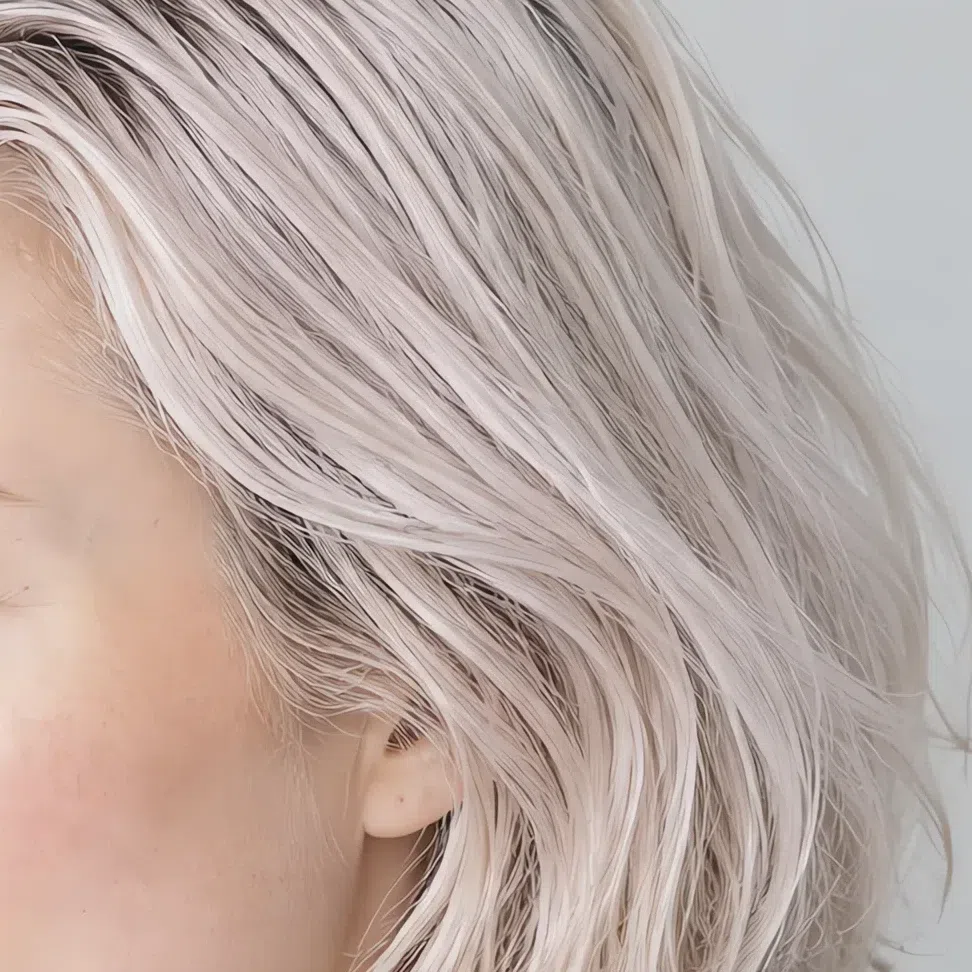
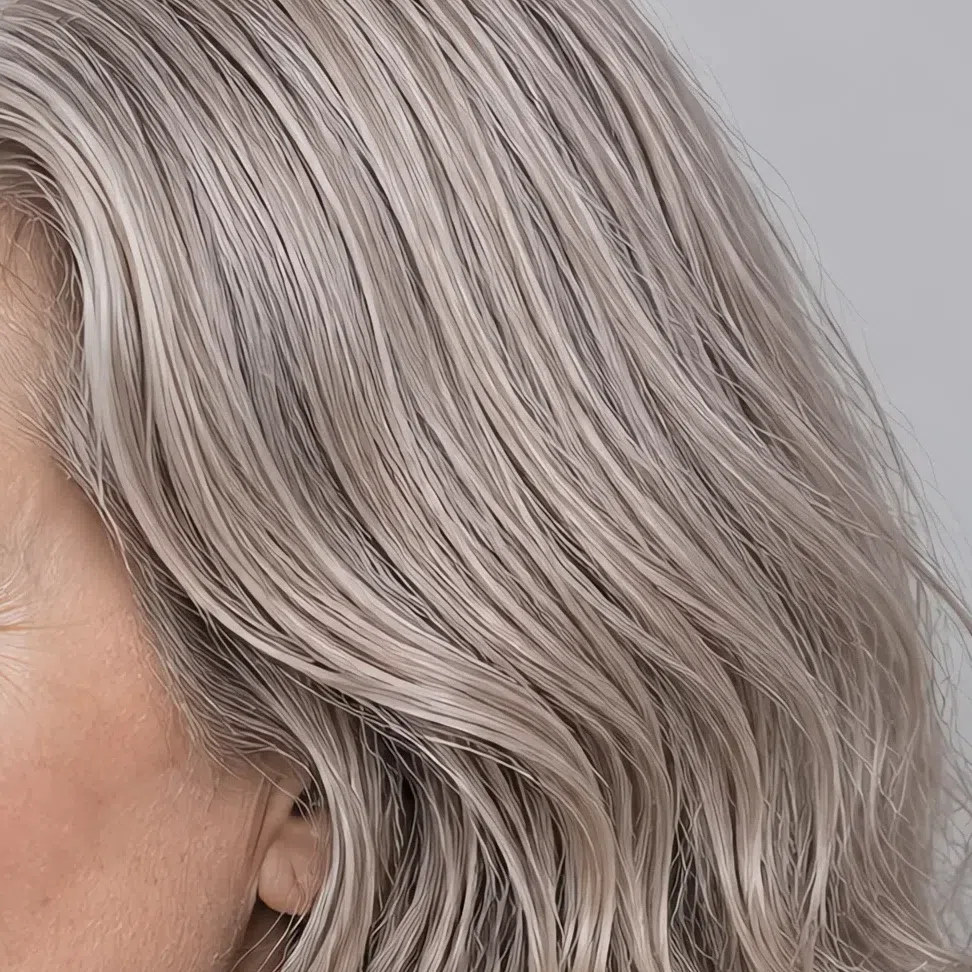
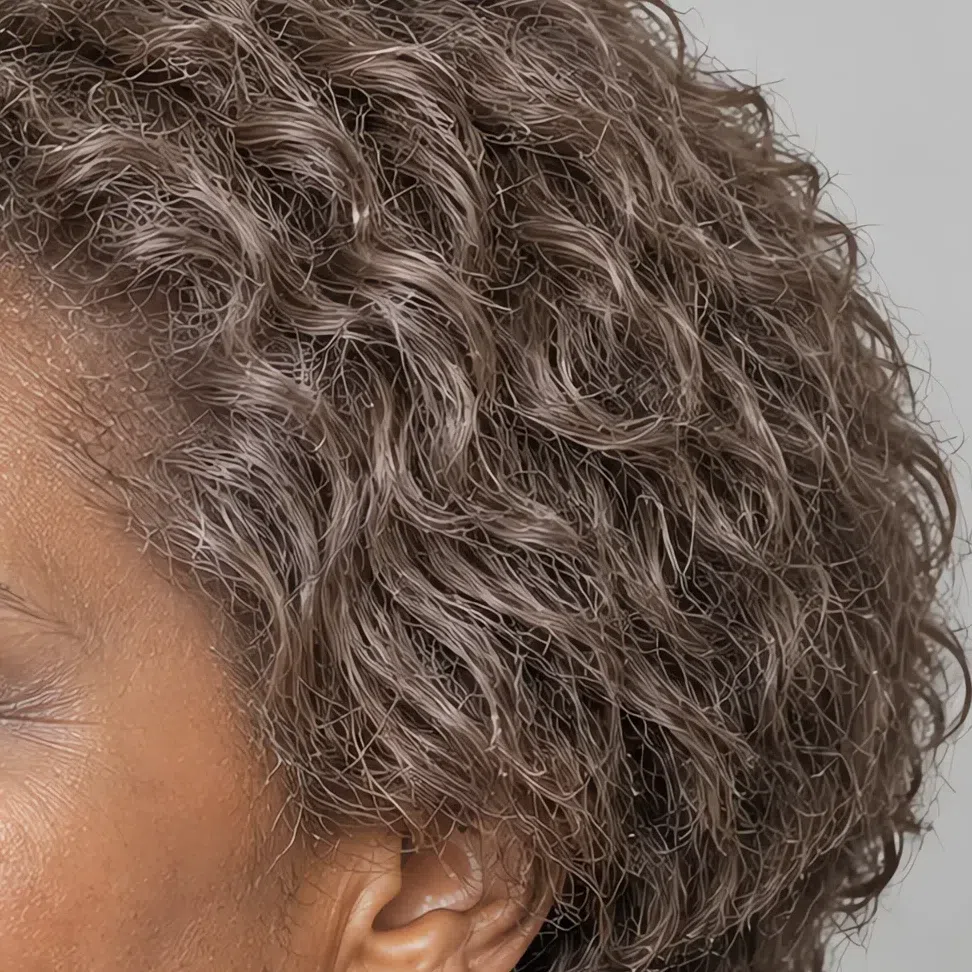
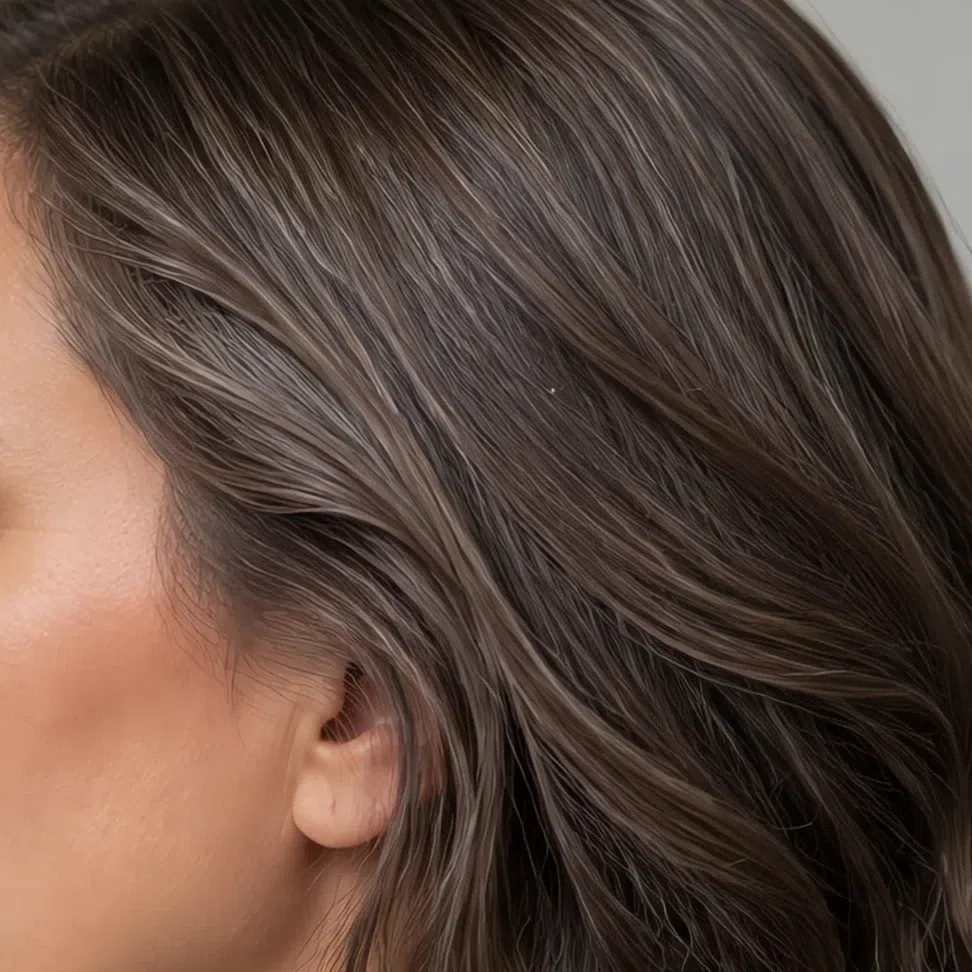
Start here
You are a Light Summer. Here is what to dye it.
Every hair color has a number, and on this page the number does most of the work. Colorists count in levels - 1 for black, up to 10 for the palest blonde - and a level is the one word in the whole conversation that means exactly the same thing to you and to the person mixing the bowl. Ash is a direction; level 8 is a place.
Your shades sit between level 6 and level 10, the top half of the scale, and every one of them is cool and quietly greyed. The unusual thing about this season is that the light end is home. Most people are warned about going lighter; you are the one coloring that has to be careful going deeper.
Stay within about two levels of your natural depth - three at the very most - take the ash or pearl version of whatever you pick, and keep it multi-tonal. Lighter is nearly free; depth is what costs you, and warmth costs you more.
The salon scale, and your part of it
- L10 lightest
- L9
- L8
- L7
- L6 deepest
- L5
- L4
- L3
- L2
- L1
Lit cells are the levels this palette names a shade at. The ramps under each shade reach a step further in both directions, and the flat cells at the deep end are still Light Summer hair - the natural range on the palette page runs to level 4, and if that is you the tone stays exactly the same and only the number changes. What the band really marks is where going deeper on purpose stops working: dye that sits below it becomes the darkest thing on your face, and a face with no dark note of its own goes quiet behind it.
What is on this page
- What to ask for The words that get an ash or pearl result at the chair, and the ones that quietly get you gold.
- Can you be blonde? Yes - this is the season blonde was made for. Where the ceiling sits, and the one way it still goes wrong at the top.
- Red A cool rose cast at your own level, and that is about all. Auburn and copper belong to a different season.
- Going gray Silver is light, cool and soft - the three words of this palette. What to do with it.
- Keeping it Why ash and pearl turn yellow in three weeks, and the four things that stop it.
- The level list Every shade and its number in one block. Screenshot it and show them.
What to ask for at the chair
That rule is easy to hold in your head and hard to say out loud, because the words a colorist works in are not the words the internet uses. Here is the whole conversation, starting with the sentence itself.
Jumps to the color chart further down. Pick your natural depth and it marks the levels and the tone that are yours.
Depth is given a whole number from 1 to 10, where 1 is the darkest hair colour (black), and 10 is the lightest (lightest blonde).
Say thisI am about a level 6 naturally. I would like to go to a level 8 ash - so an 8.1 - and keep it multi-tonal with a soft root rather than one flat block.
Swap in your own two numbers. Everything below is just that sentence taken apart.
The three things you are actually saying
-
How light
The level. 1 is black, 10 is the lightest blonde, and this palette lives at the top of that scale. Give both numbers - where you are and where you want to be - because the distance between them is what decides whether this is one appointment or three.
“I am about a 6 now, I would like to be an 8.” -
Which direction
The tone, written after the point. Ash is .1 and it means blue-based. On this coloring there is a second digit worth asking about: .2 is violet in some brands, which is where pearl blonde comes from and is yours - and matt-green in others, which is not. It is one question and it is worth asking.
“Ash - an 8.1. Is your .2 a pearl or a matt?” -
How it is placed
The technique. Pale hair goes flat faster than deep hair does, because there is less depth left in it to make shadows with. Ask for fine variation and a soft regrowth line rather than one solid block. This is free, and almost nobody asks for it.
“Multi-tonal, with fine babylights and a root smudge rather than a line.”
Reading the number on the tube
Salon colors are written level.tone - the digit before the point is how light, the digit after is which direction it leans. All four below are the same woman at the same level 8. Only the digit after the point moves.
-
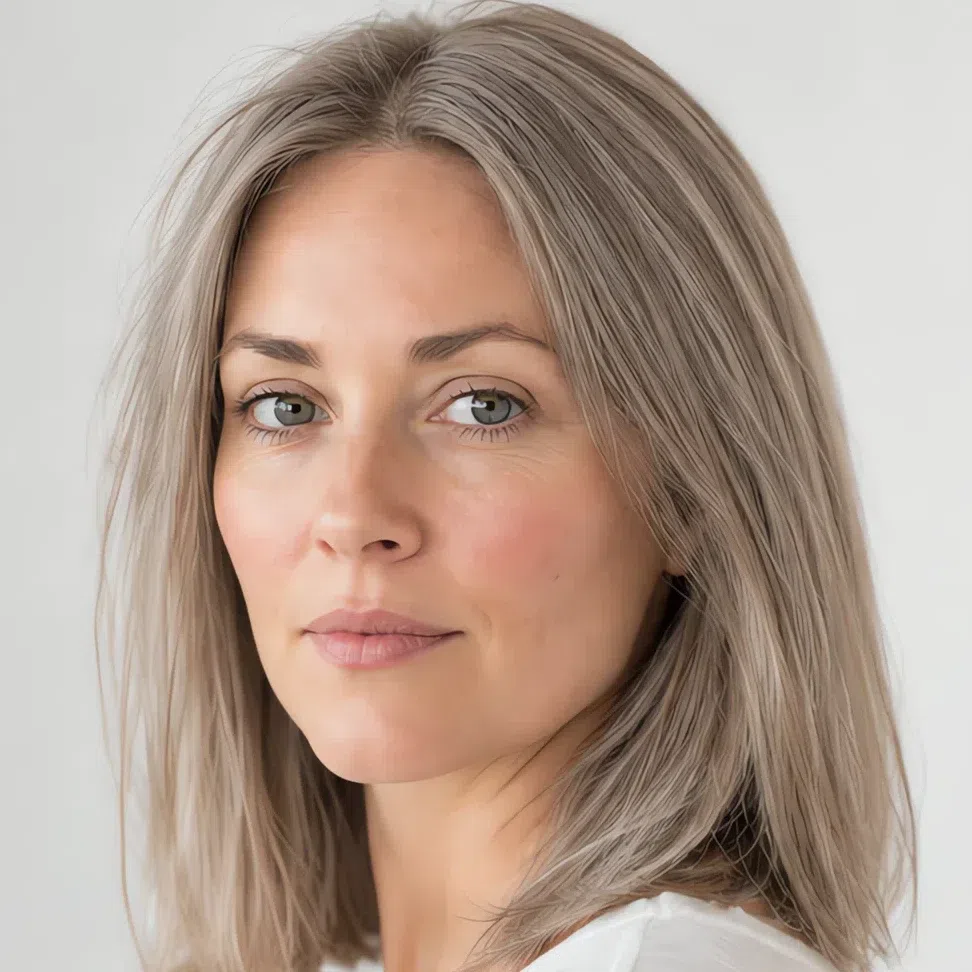 8.1 Ash
Yours, and the safe default.
8.1 Ash
Yours, and the safe default.
-
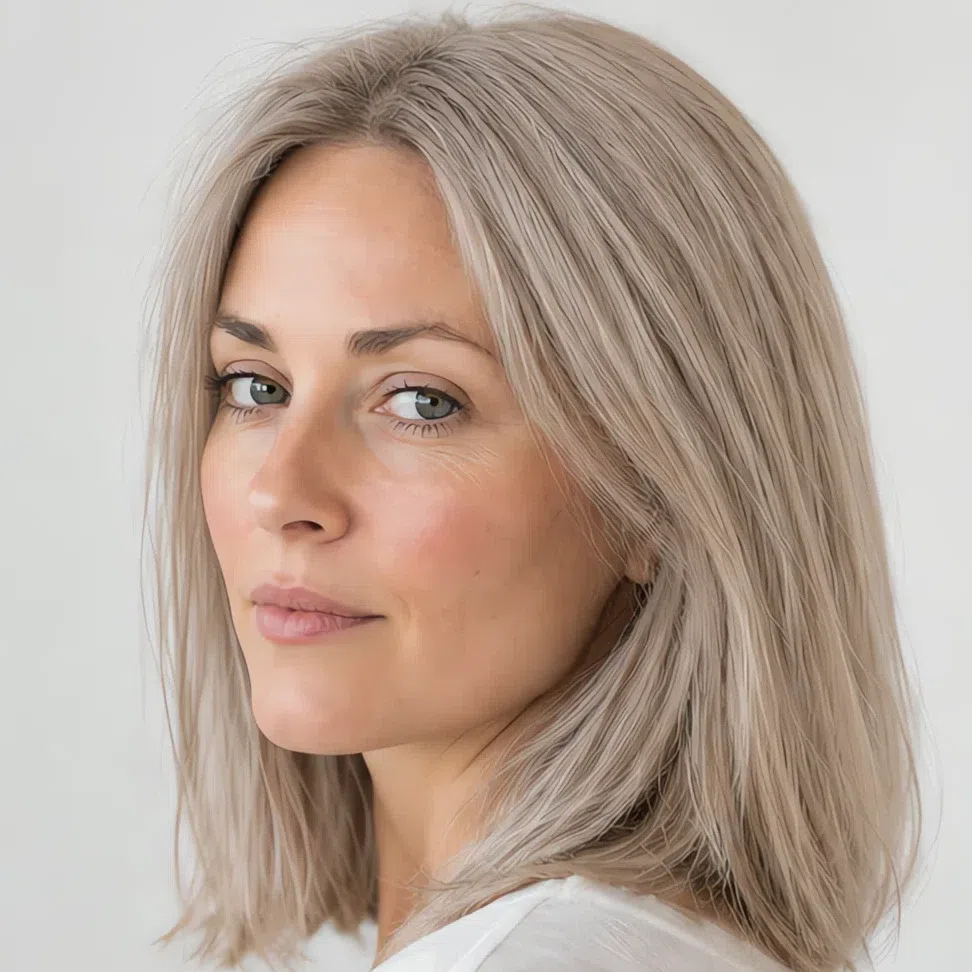 8.2 Pearl
Also yours - where the brand means violet.
8.2 Pearl
Also yours - where the brand means violet.
-
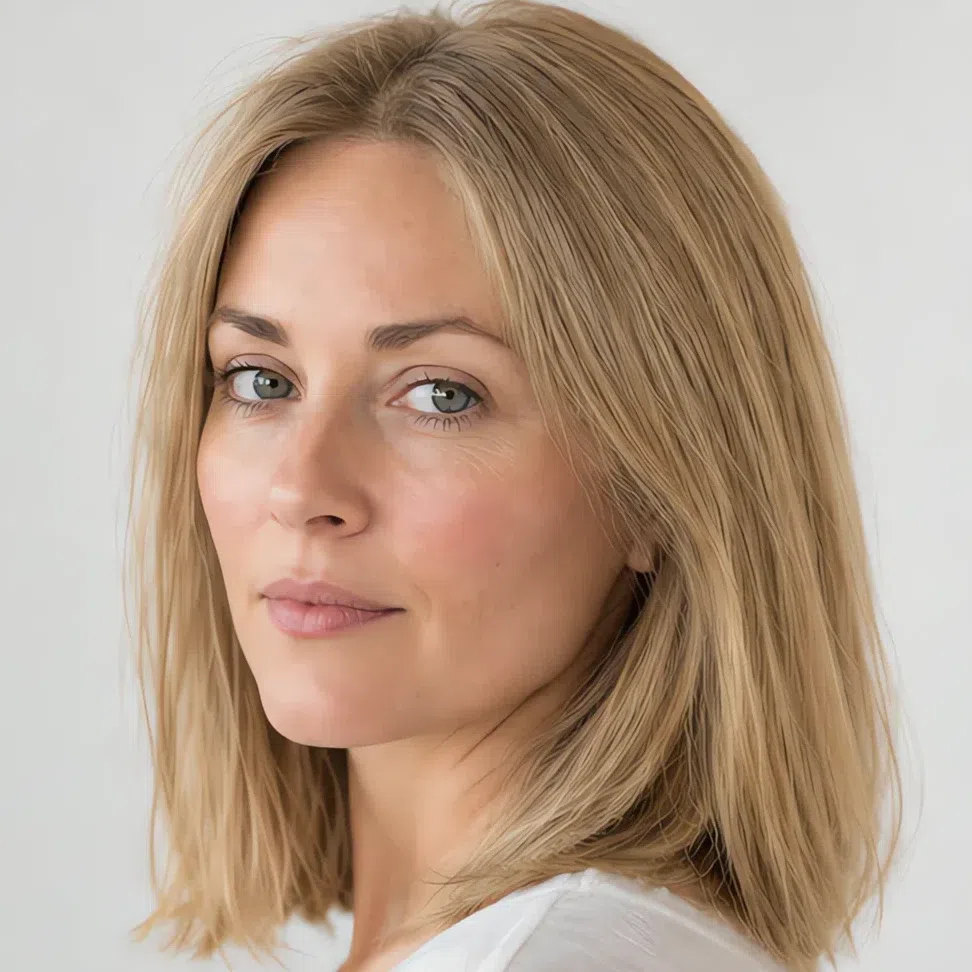 8.0 Natural
The base warmth left in.
8.0 Natural
The base warmth left in.
-
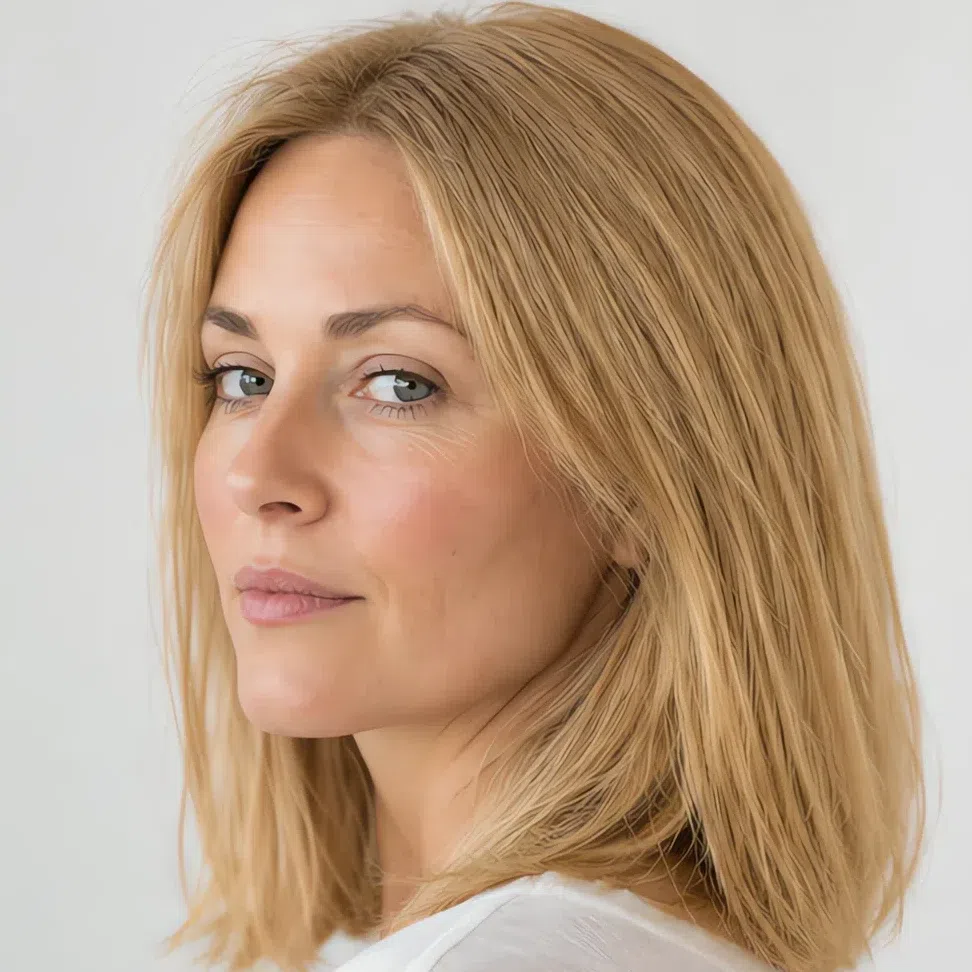 8.3 Gold
One digit away, and a season away.
8.3 Gold
One digit away, and a season away.
- 8.1 Ash The digit you want, and the one piece of salon numbering that is the same in every major system. Blue-based, so it cancels the yellow that pale hair keeps producing on its own.
- 8.2 Pearl, or matt The one code on this page worth a question rather than a rule. Violet in some brands - that is where a pearl blonde comes from, and it is arguably the best shade this coloring can have. Matt-green in others, which flattens you. Ask which one they mean.
- 8.0 Natural No tone correction at all. It looks safe on the chart and comes out warmer than it looks, because a light base has a great deal of yellow sitting under it and nothing in a .0 removes any of it.
- 8.3 Gold The direction your coloring has least room for. Gold at level 8 is not subtle - it is the brightest thing available at the top of the scale, and it arrives in the room before you do.
- 8.4 Copper Further along the same road. Worth knowing by sight, because it is what sun-kissed, caramel and honey usually resolve to at the bowl.
Swatches are this season’s own level 8 in each tone family - .1 and .2 are the palette’s ash and pearl ramps, .3 and .4 are its own avoid values - and the photographs above are those values on hair, so the chip and the render cannot disagree. Numbering past .1 varies between brands: say the word as well as the number and you are covered either way.
The whole chart, and the part of it that is yours
A salon color chart is one big grid: how light the color is down the side, which direction it leans across the top. Below is that grid with only Light Summer plotted on it.
The outlined column is the answer, top to bottom: one tone digit, any depth you naturally are. A Light Summer at a level 10 and a Light Summer at a level 4 ask for the same thing and get a different number - which is why the request is always your level plus .1, never a shade name off a poster.
Three honest notes. The swatches are our values, not a brand’s - a code is a slightly different color in every manufacturer’s range, which is the whole reason this page keeps telling you to say the word as well as the digit, so no chart can print one true hex per code. The second column is the interesting one on this coloring: those four squares are the pearl ramp this palette publishes, and you get them in the brands where .2 means violet. In the brands where it means matt-green you get something else entirely, which is why .2 is drawn as a question rather than an answer. And the grid stops at level 4 because that is where our measured swatches stop, not where the color stops: a Light Summer with a level 3 or level 2 natural asks for the same ash column at her own number.
And how it is placed
Same shade again, same woman - the level 8 ash from above, with only the placement changing. The first pair is what happens across the length; the second is what happens where it meets your own hair.
-
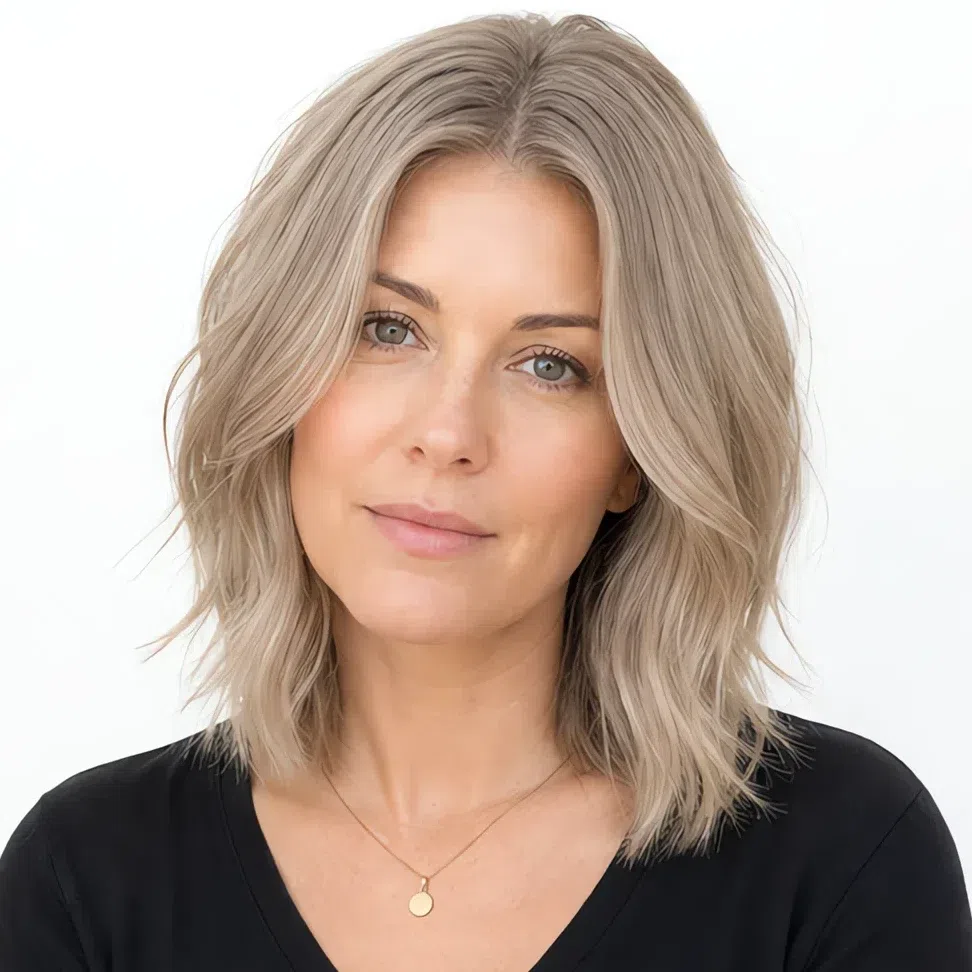 One flat block
The default. Identical root to tip, and the moment pale hair starts reading as a wig.
One flat block
The default. Identical root to tip, and the moment pale hair starts reading as a wig.
-
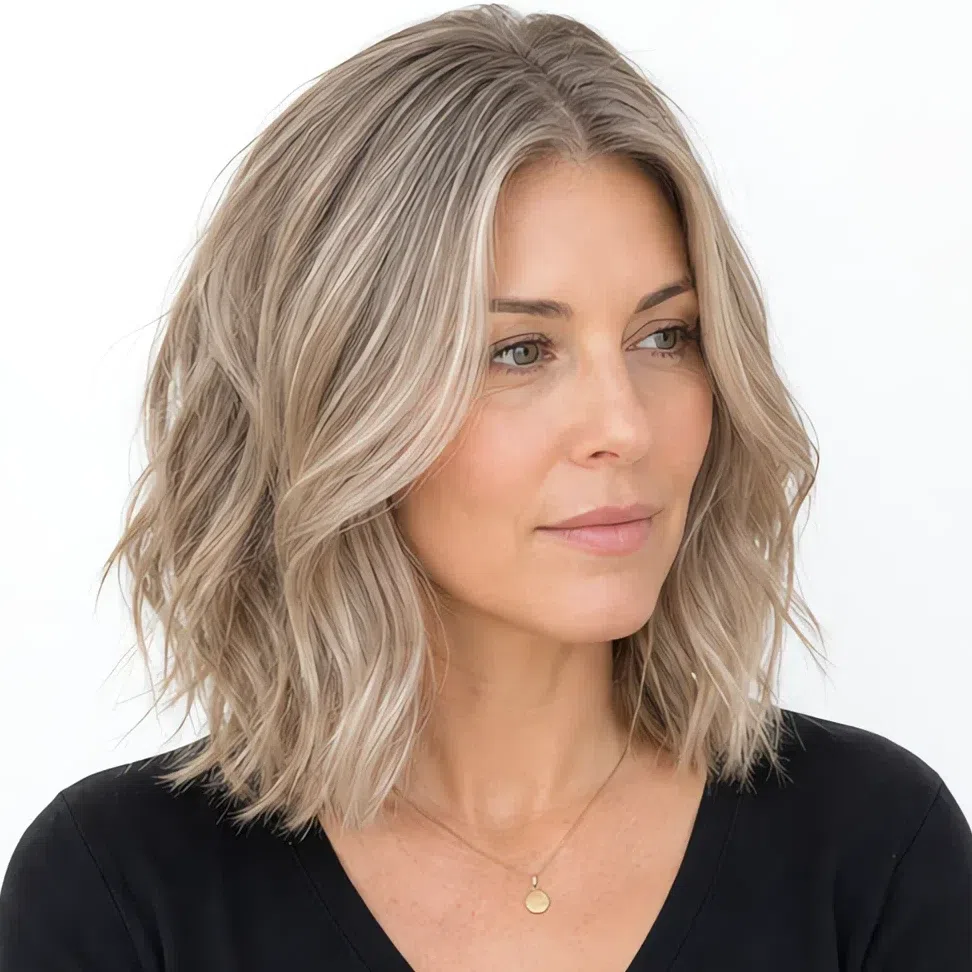 Multi-tonal
Ask for this. Many close shades at once, the way light actually falls through hair.
Multi-tonal
Ask for this. Many close shades at once, the way light actually falls through hair.
-
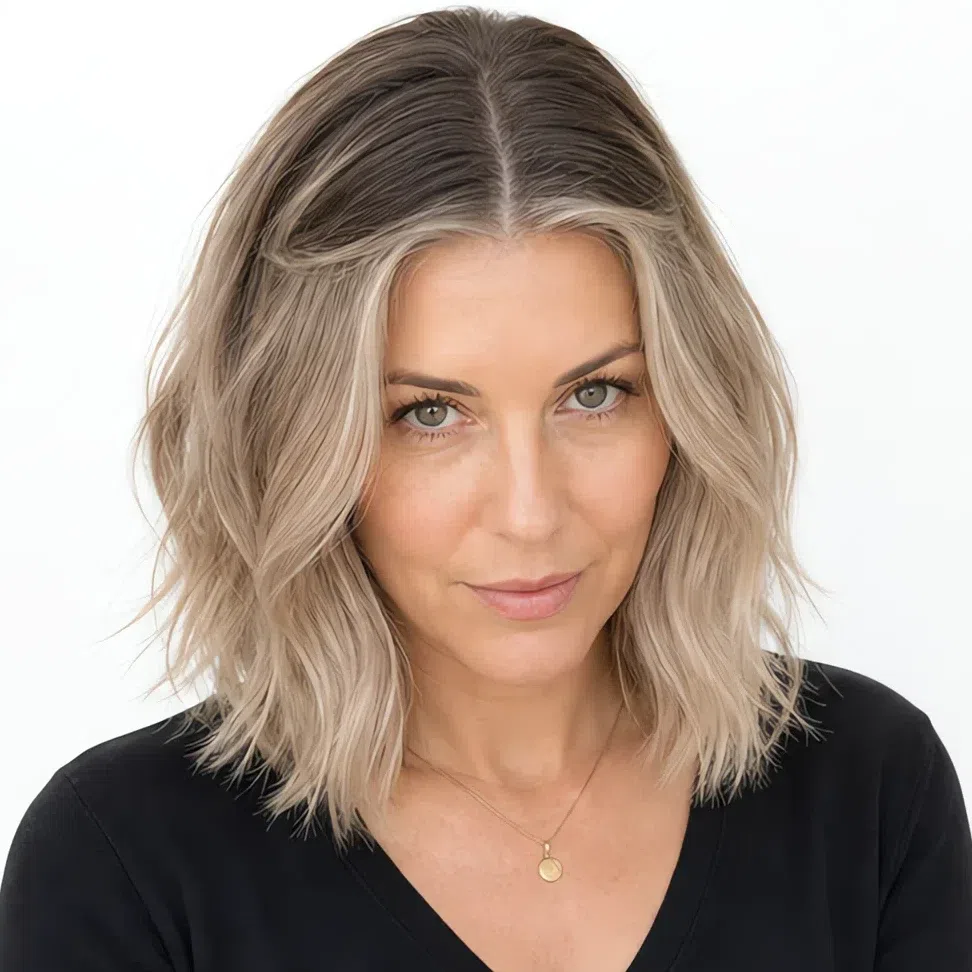 A hard regrowth line
What a flat application looks like at three weeks. A drawn line across the top of the head.
A hard regrowth line
What a flat application looks like at three weeks. A drawn line across the top of the head.
-
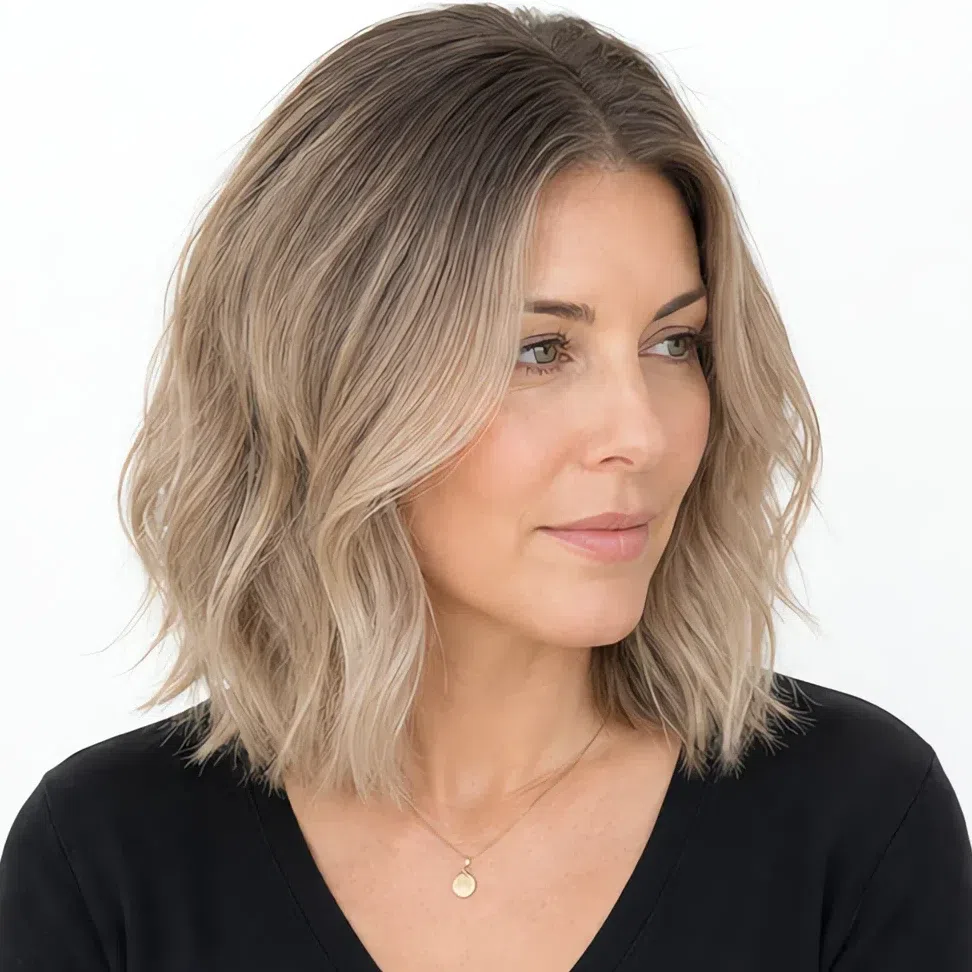 A root smudge
The same regrowth, softened at the appointment. Costs nothing extra and buys about a month.
A root smudge
The same regrowth, softened at the appointment. Costs nothing extra and buys about a month.
And what the distance costs you
The quiet argument for the rule at the top of this page. Regrowth is not a technique problem, it is a distance problem - how far the color sits from what grows out of your head. One woman, a level 6 natural, three weeks after two different appointments, photographed at the parting.
-
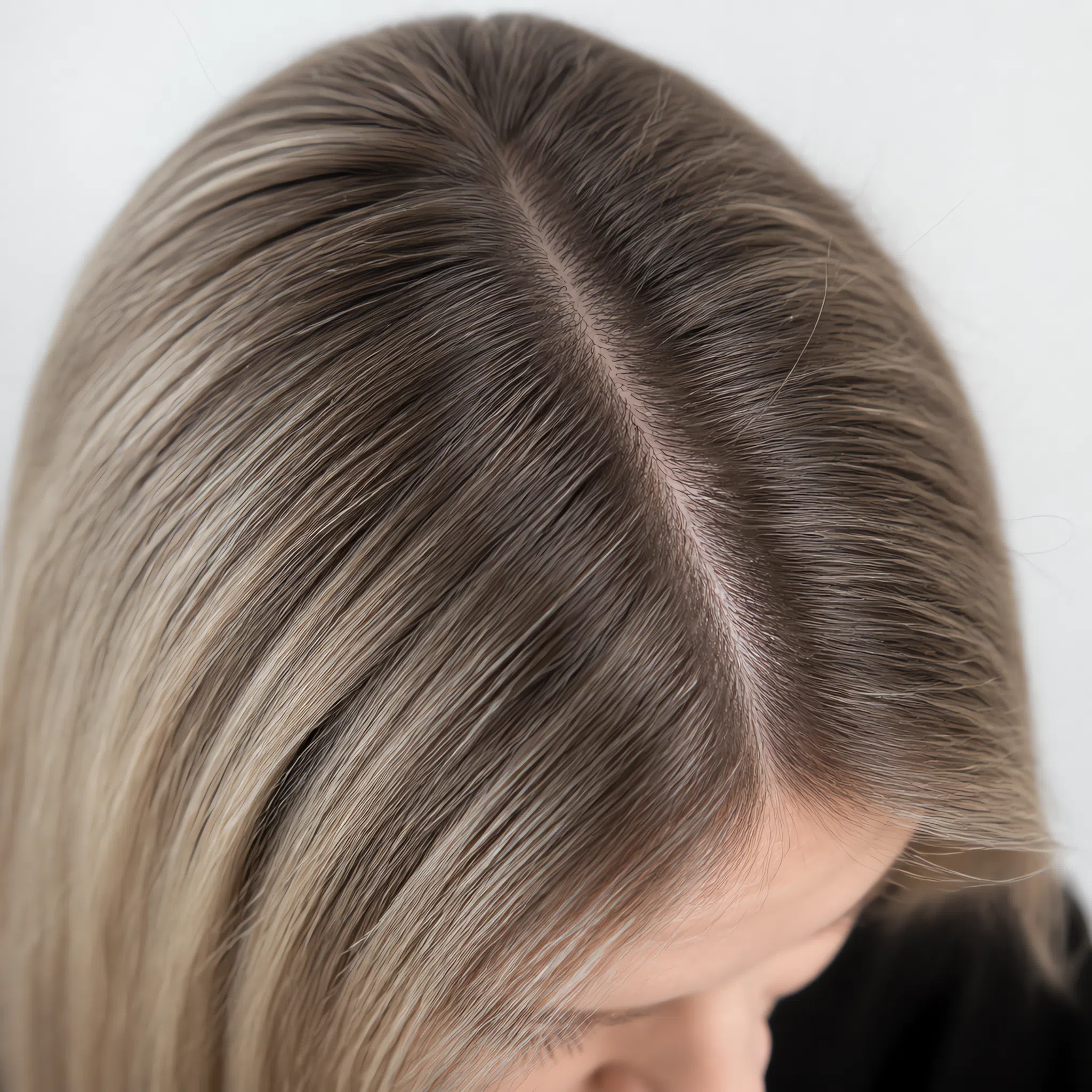 Two levels from natural
Three weeks in. There is barely a line to find, because there is barely a difference to see.
Two levels from natural
Three weeks in. There is barely a line to find, because there is barely a difference to see.
-
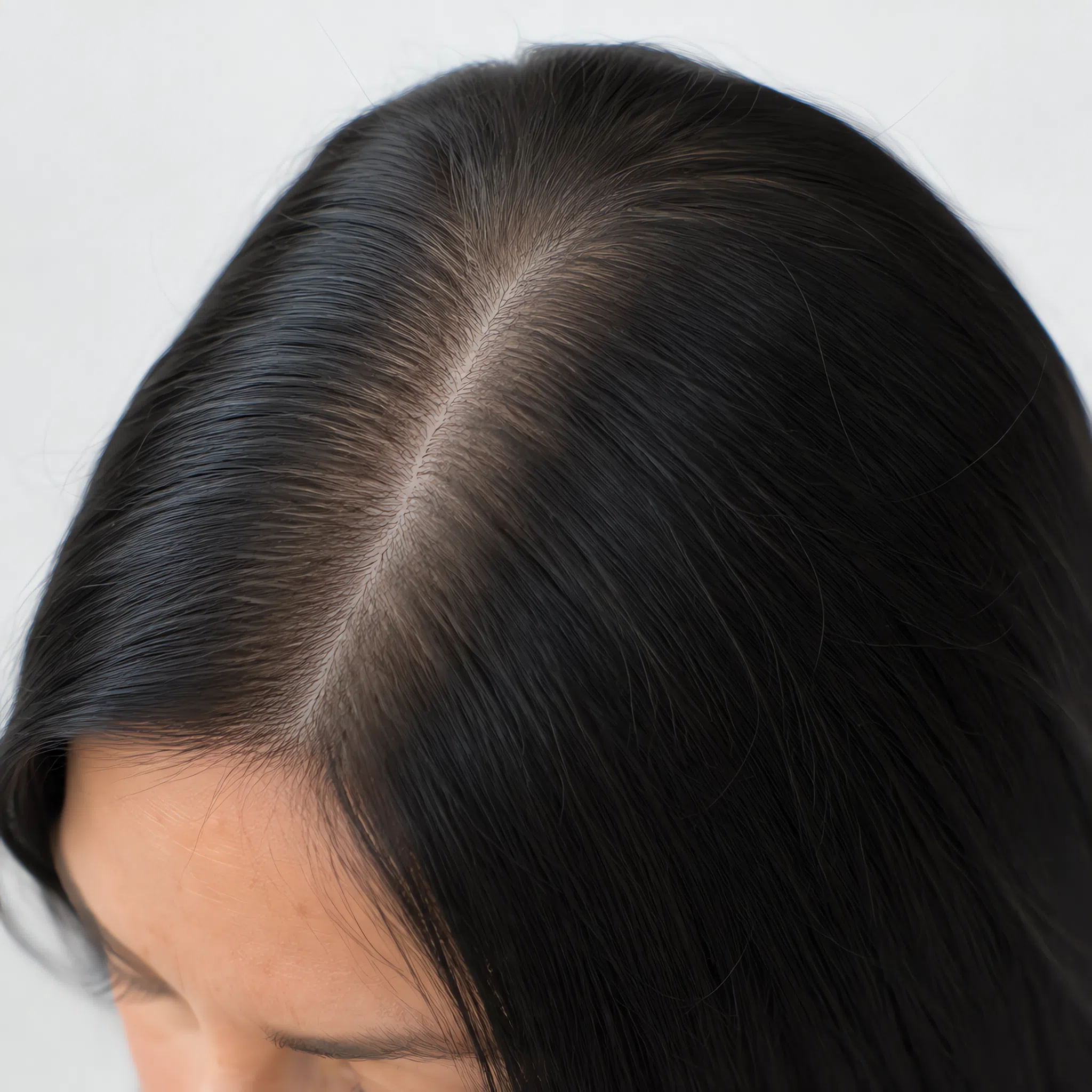 Five levels from natural
The same three weeks, in the direction this coloring is tempted by. Your regrowth line is the pale one - and it is just as loud.
Five levels from natural
The same three weeks, in the direction this coloring is tempted by. Your regrowth line is the pale one - and it is just as loud.
The phrasebook
Say this
- “Level 8, ash”
- A number and a direction, with nothing left to interpret.
- “Is your .2 a pearl or a matt?”
- The one question that finds the best shade in the room, in the brands that have it.
- “Fine babylights, nothing chunky”
- Dimension without contrast - the only kind this coloring can absorb, and it is already in your palette.
- “A root smudge, not a line”
- Regrowth that goes soft over eight weeks instead of announcing itself at three.
And what these get you
- “Sun-kissed”
- Gold and copper, chosen at the salon’s discretion. It is a mood, not an instruction.
- “Caramel, honey, bronde”
- Three shades named for their warmth. All three belong to a different season.
- “Something with more depth, a darker base”
- The one instruction that reliably undoes this coloring. Depth here does not add richness, it adds a dark edge to a face built without one - and it is the single commonest way a Light Summer leaves a salon looking older.
- “Warm it up, I look washed out”
- Warmth you cannot wear. The washed-out feeling is almost always too little variation, not too little warmth - so this buys the wrong fix and keeps the flatness.
Two numbers and one word will get you further than any photograph, and staying near your own level is what buys the eight weeks between appointments. Which leaves the question this coloring actually arrives with - and it is the one question where the answer here is more generous than almost anywhere else.
Can a Light Summer be blonde?
This is the question almost everyone arrives with, and here it is nearly the wrong question. Most seasons have to be talked down from blonde. This one has to be talked out of the last two levels of it.
Yes - and more freely than almost any other coloring. Your ceiling is still about three levels above your own natural, but unusually, the top of the scale is inside your palette rather than past it. What goes wrong up there is not how light it is. It is how clean it is.
Starting from a level 6 natural - the mousy mid brown a great many Light Summers grow. The tone stays cool and ashy throughout; the only thing changing is how light it goes.
-
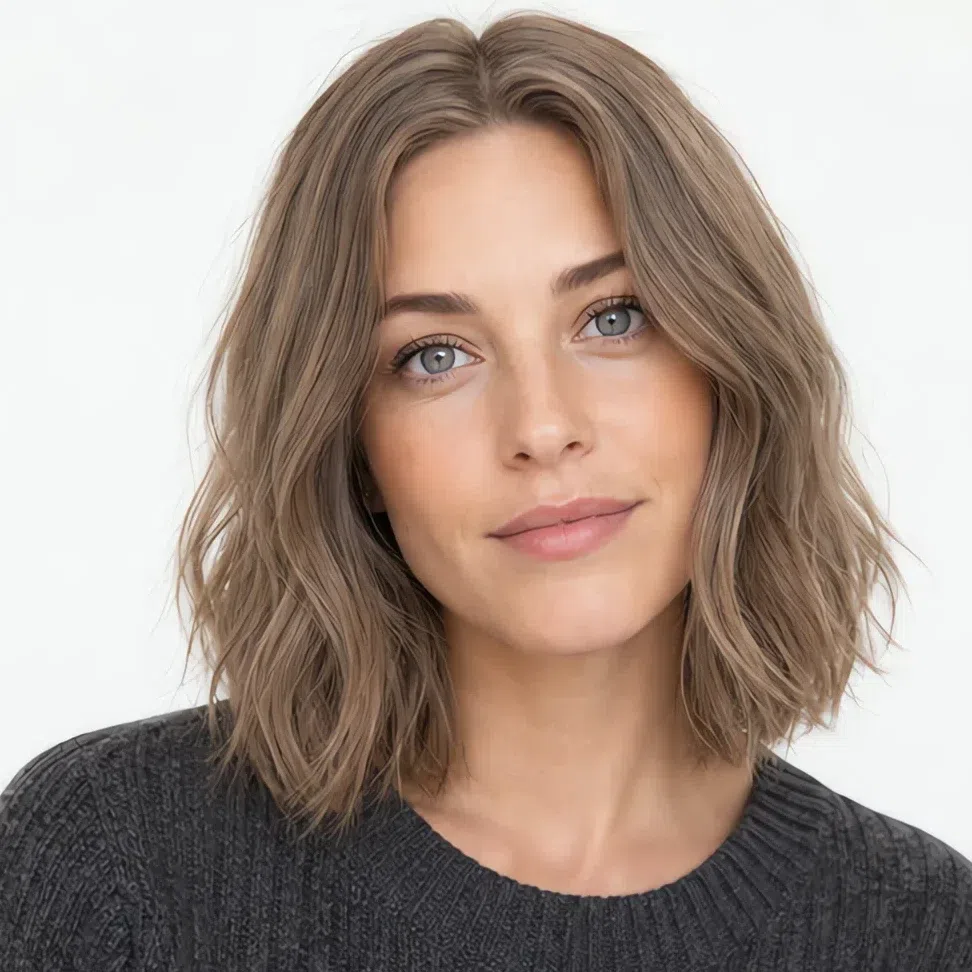 Her natural, L6
Where she starts. Flat-looking in a mirror, and the exact tone the palette is built against.
Her natural, L6
Where she starts. Flat-looking in a mirror, and the exact tone the palette is built against.
-
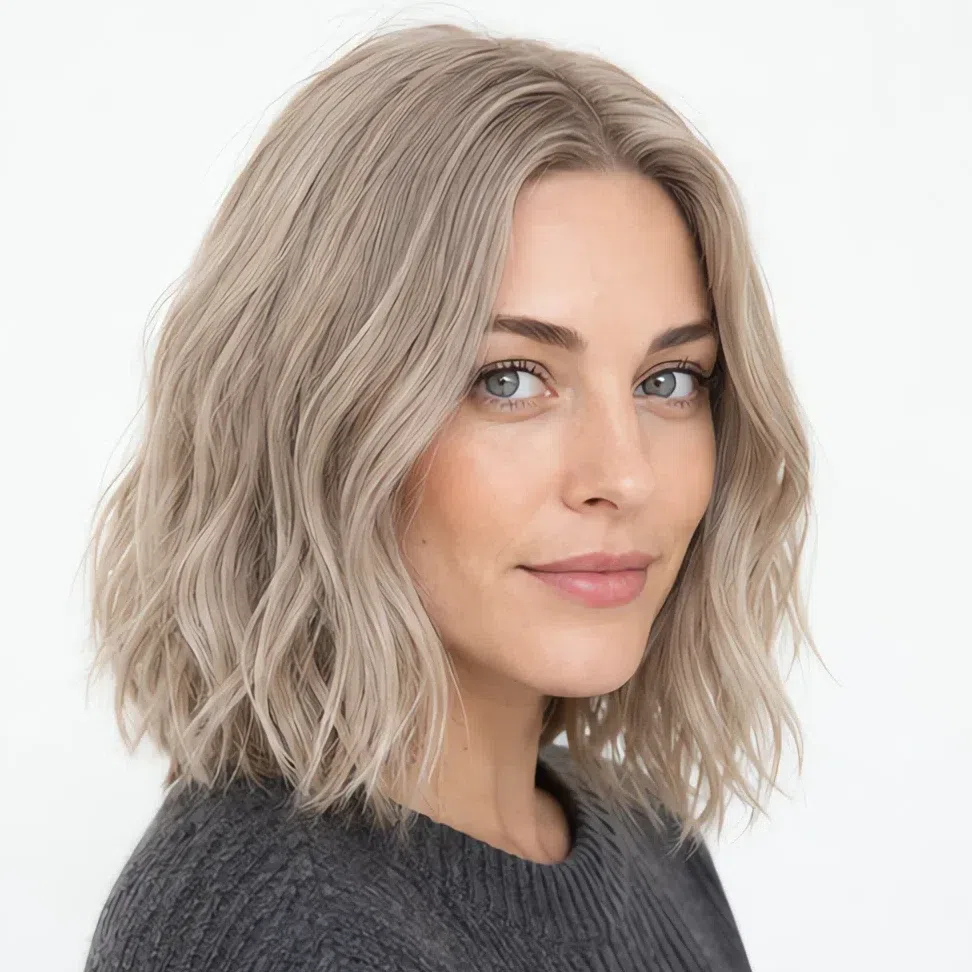 Two levels up, L8
Comfortably blonde, and still recognisably her.
Two levels up, L8
Comfortably blonde, and still recognisably her.
-
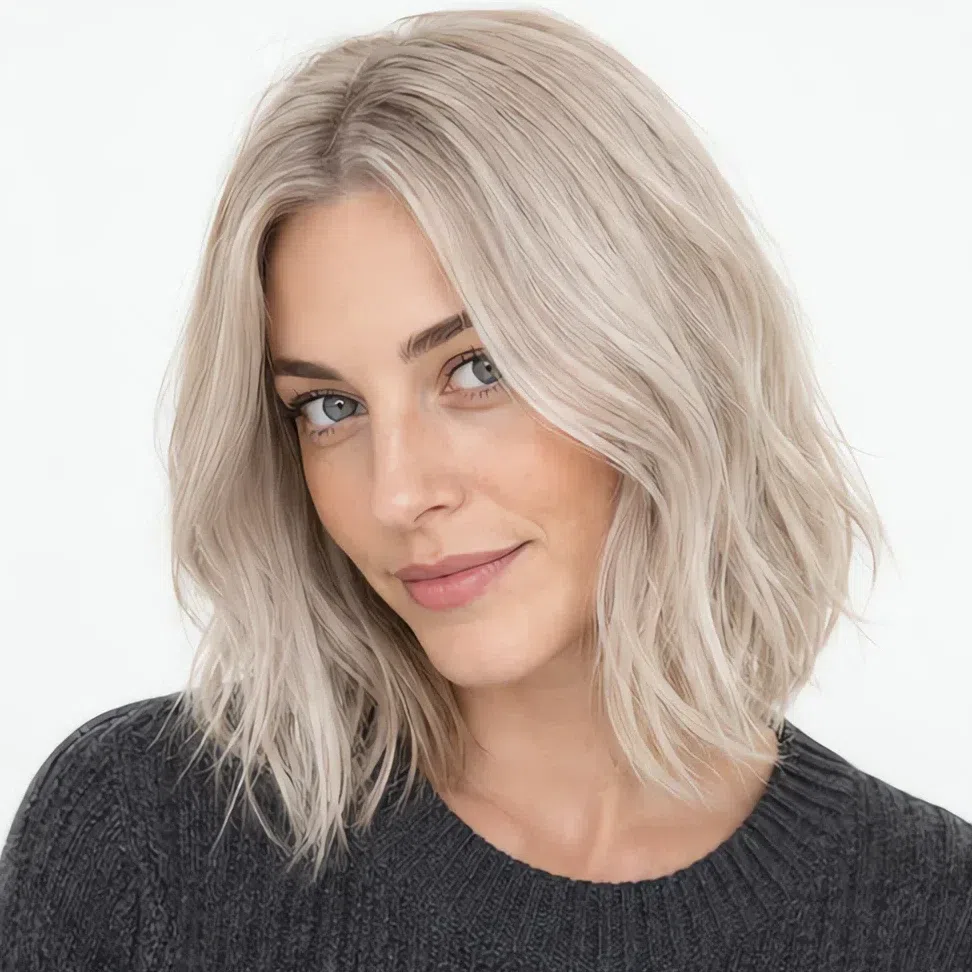 Her lightest, L9
Her ceiling. Light, and still holding a soft ashy cast.
Her lightest, L9
Her ceiling. Light, and still holding a soft ashy cast.
-
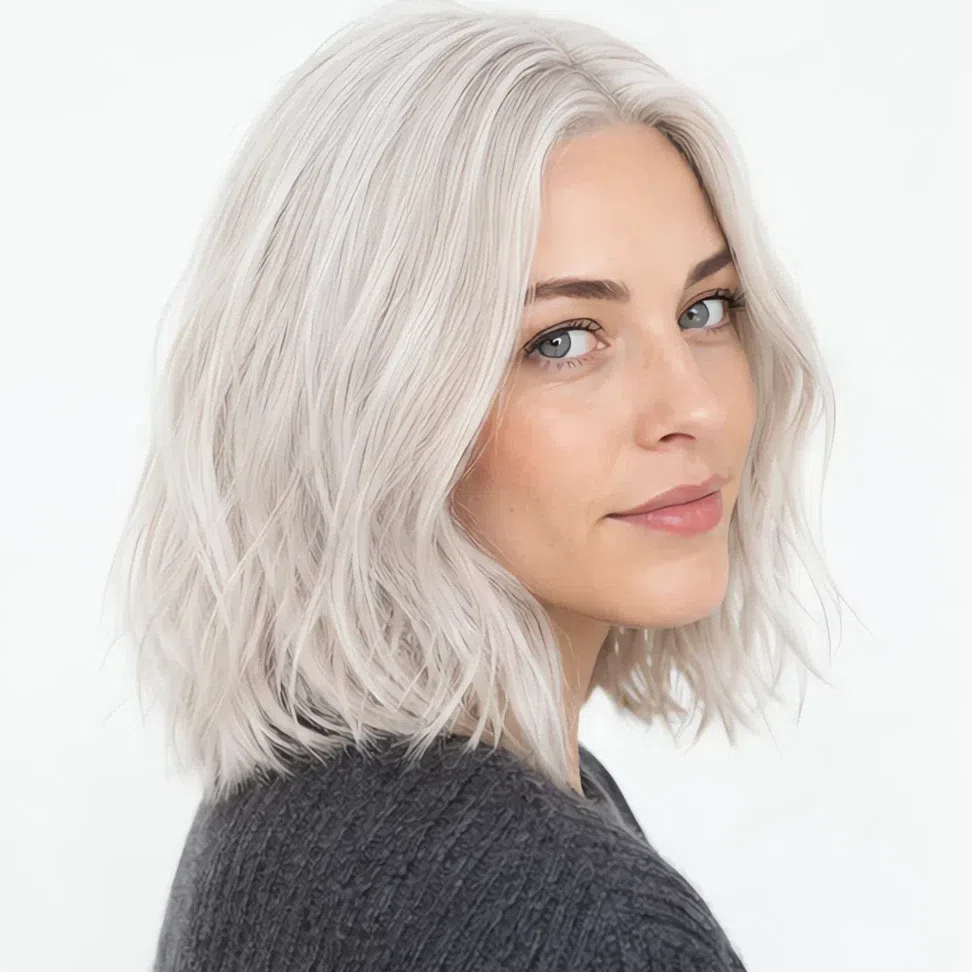 Past it, L10
Four levels up. The hair is now the brightest thing in the frame, and her brows have gone missing.
Past it, L10
Four levels up. The hair is now the brightest thing in the frame, and her brows have gone missing.
And the same climb from a level 8 natural, which on this coloring is common rather than exotic. Same rule, same tone, different numbers - and a much shorter road.
-
 Her natural, L8
Where she starts, with no color on it at all.
Her natural, L8
Where she starts, with no color on it at all.
-
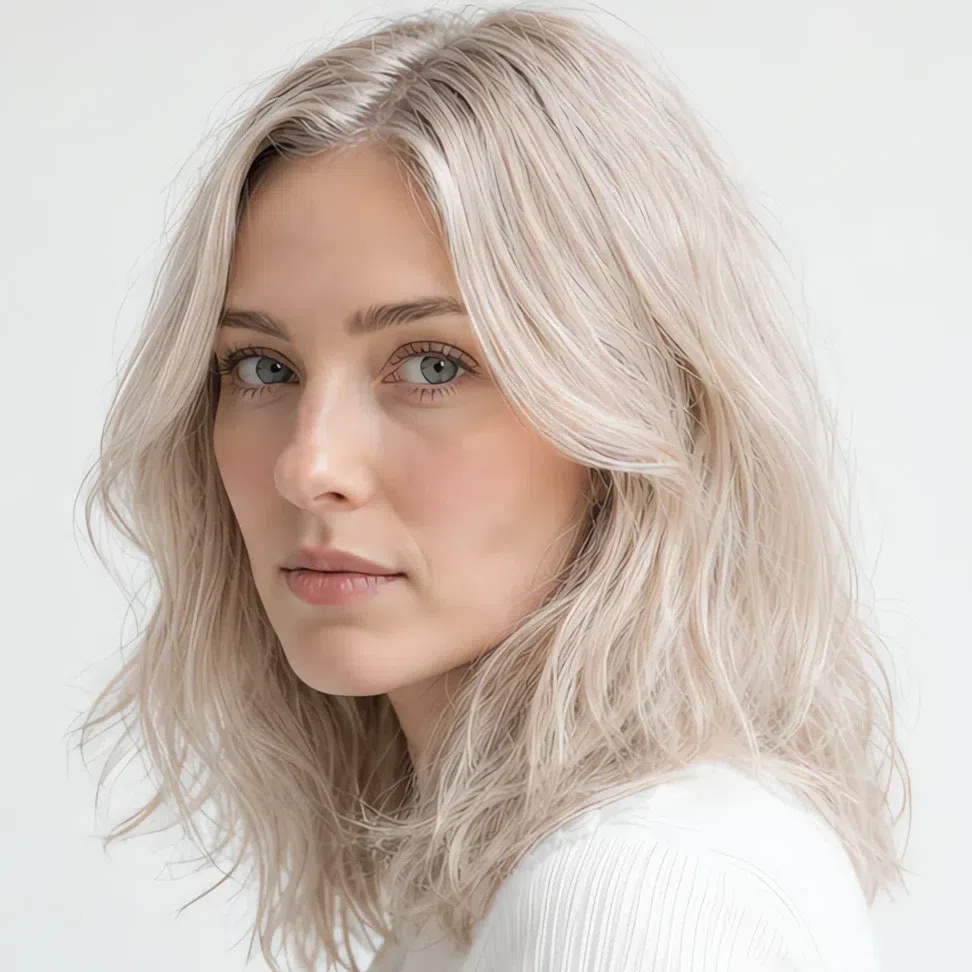 One level up, L9
A single level, and mostly a tone job. This is the appointment most Light Summers actually need.
One level up, L9
A single level, and mostly a tone job. This is the appointment most Light Summers actually need.
-
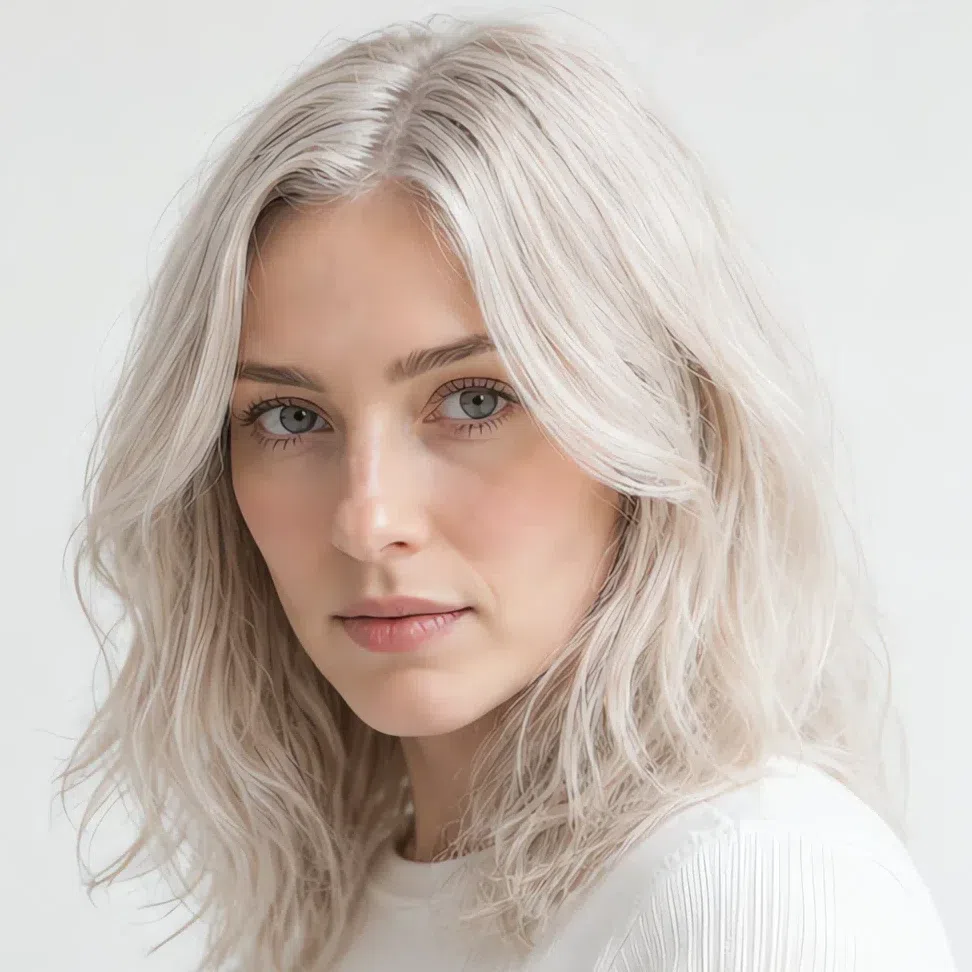 Her lightest, L10
Her ceiling, and the top of the scale. Two levels up, and the lilac cast keeps it soft.
Her lightest, L10
Her ceiling, and the top of the scale. Two levels up, and the lilac cast keeps it soft.
-
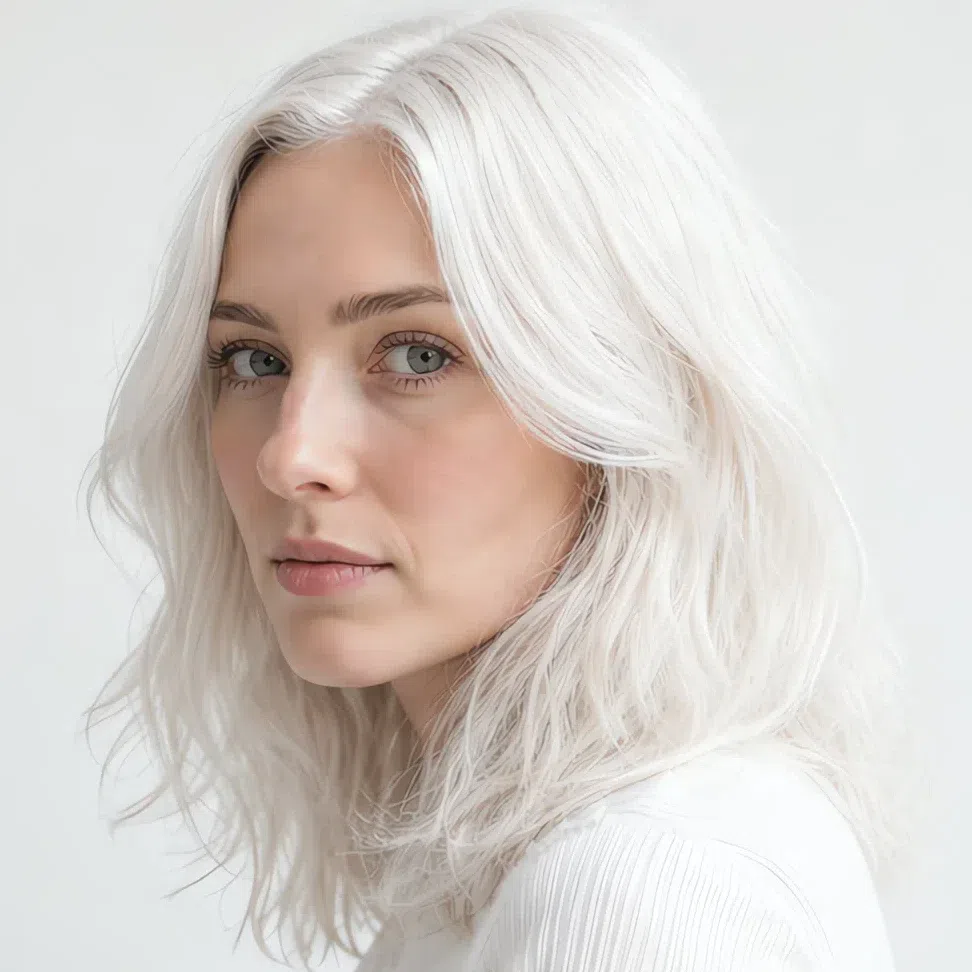 Past it, bleached white
The same lightness with the pigment taken out. Not lighter than the frame before it - cleaner, and that is the overshoot.
Past it, bleached white
The same lightness with the pigment taken out. Not lighter than the frame before it - cleaner, and that is the overshoot.
Look at the fourth frame of the first row and the third of the second. Level 10 is the same color in both - the same icy platinum, the same tube. On a level 8 natural it is two levels up and it is hers. On a level 6 natural it is four levels up, and it has become the brightest thing on her face. One woman’s ceiling is the other woman’s mistake, which is the clearest possible argument that the number that matters is the distance, not the level.
Notice what does not change as either row climbs. Every frame is cool and ashy; nobody moves toward gold. What changes is the gap - and a gap is the one thing this coloring has no way to absorb. Your eyes, your skin and your brows all sit within a few steps of each other, so the moment the hair steps out of that band it stops being your hair and becomes the subject.
Then look at how little separates the last two frames of the second row. From a level 8 natural there are only two levels of scale left, so at the top the question stops being how light and becomes how clean. A platinum with a faint lilac cast is still your color. A bleached optic white with every trace of pigment lifted out is not - it is a brighter, harder version of the same lightness, and it is the one way a Light Summer overshoots without ever leaving level 10.
Which is why the blondes that work here are the ones with something still left in them - ash, beige, pearl, mushroom. Not blonde with the volume down, which is the advice a deeper season gets. Blonde with the gray left in.
Blonde had a high ceiling and a narrow definition at the top of it. The next question has a narrow door from the very start, and the reason is a different one.
Red, and how far you can take it
Blonde was generous because it runs along the one axis this coloring has room on - lightness. Red runs along the two it does not.
Barely, and not as a red. What works is a cool rose cast laid over a light base at your own level - a pink you have to look for. Everything past that fails twice over at once, because a real red is both warmer than you and deeper than you, and this is the coloring with least room for either.
Four reds on a woman with a medium complexion, all at level 8. Nothing gets lighter or darker across the row - the only thing climbing is how clear and how warm the red is.
-
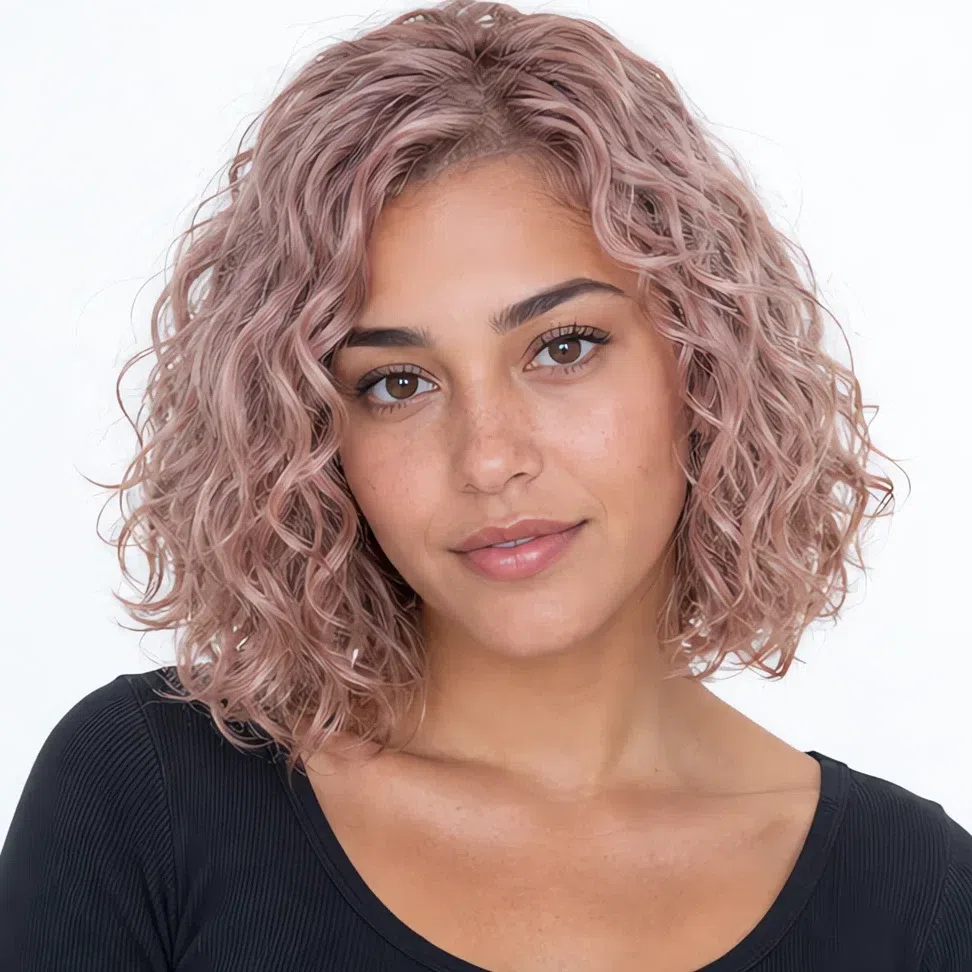 Rose blonde
A pink you have to look for. This is your version, and it is a tint rather than a dye.
Rose blonde
A pink you have to look for. This is your version, and it is a tint rather than a dye.
-
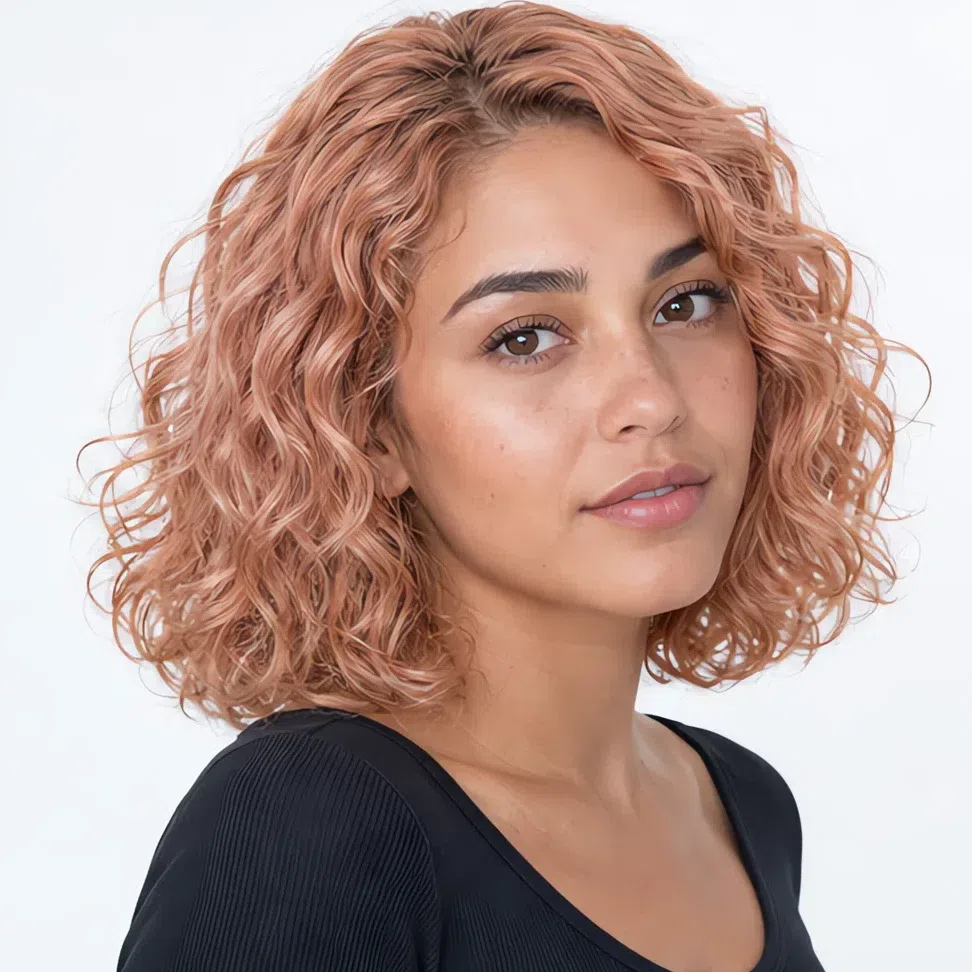 Rose gold
The far edge of it. Workable, and already asking something of you.
Rose gold
The far edge of it. Workable, and already asking something of you.
-
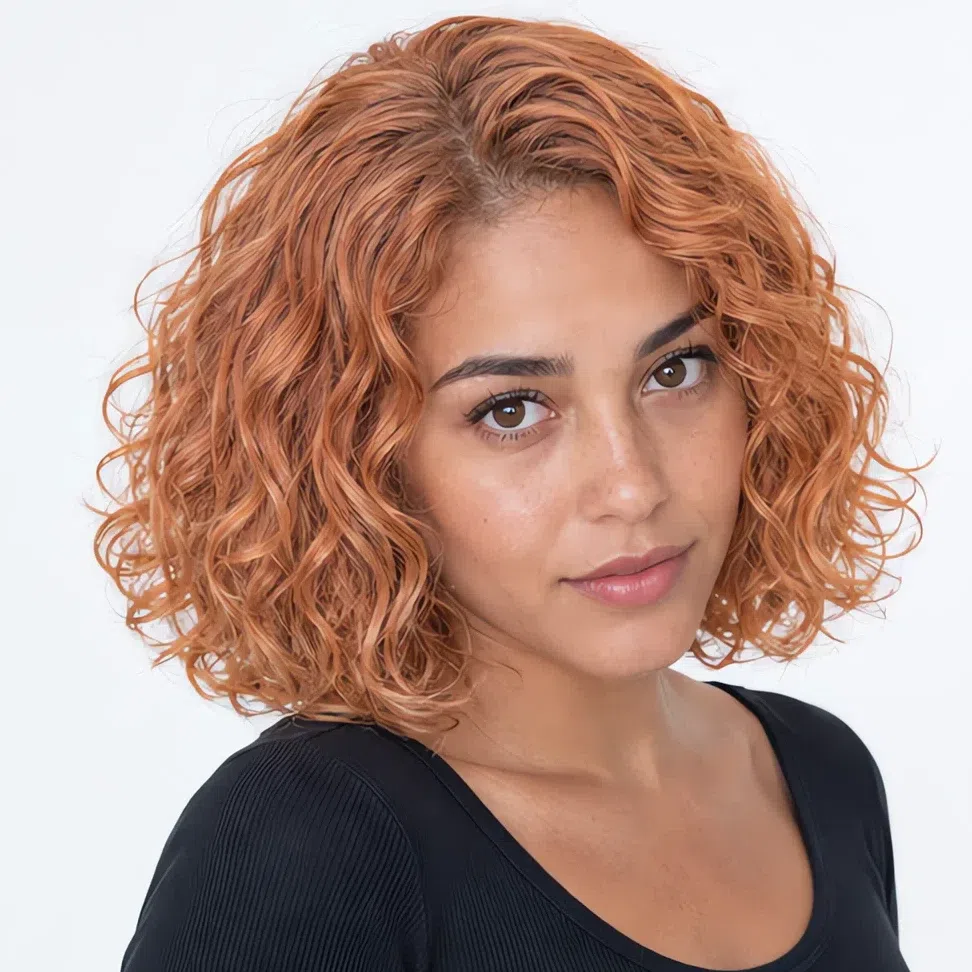 Copper blonde
The warmth arrives before she does, and her eyes have gone quiet behind it.
Copper blonde
The warmth arrives before she does, and her eyes have gone quiet behind it.
-
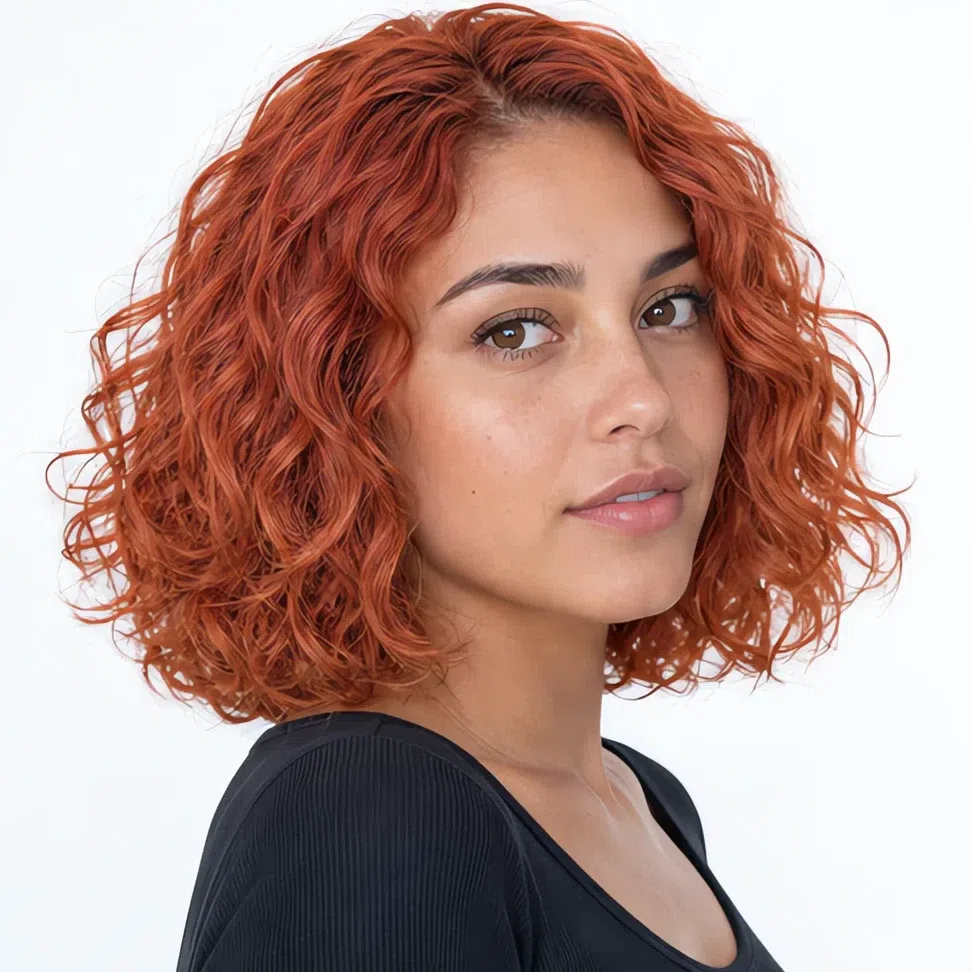 Clear red
Now the hair is the subject and the face is the background.
Clear red
Now the hair is the subject and the face is the background.
And the identical four shades at the identical level on deep brown skin - the same tubes, the same level 8, a different complexion.
-
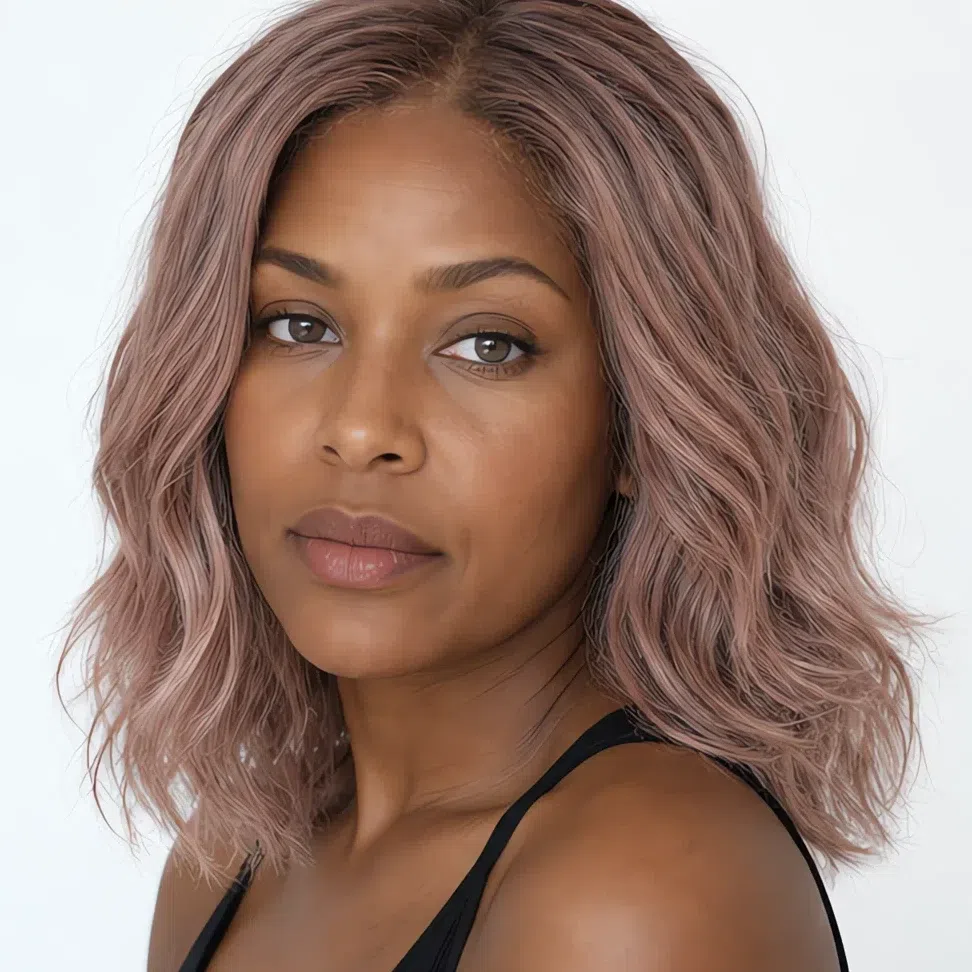 Rose blonde
The same tint at the same level. Quiet enough that her features stay in front of it.
Rose blonde
The same tint at the same level. Quiet enough that her features stay in front of it.
-
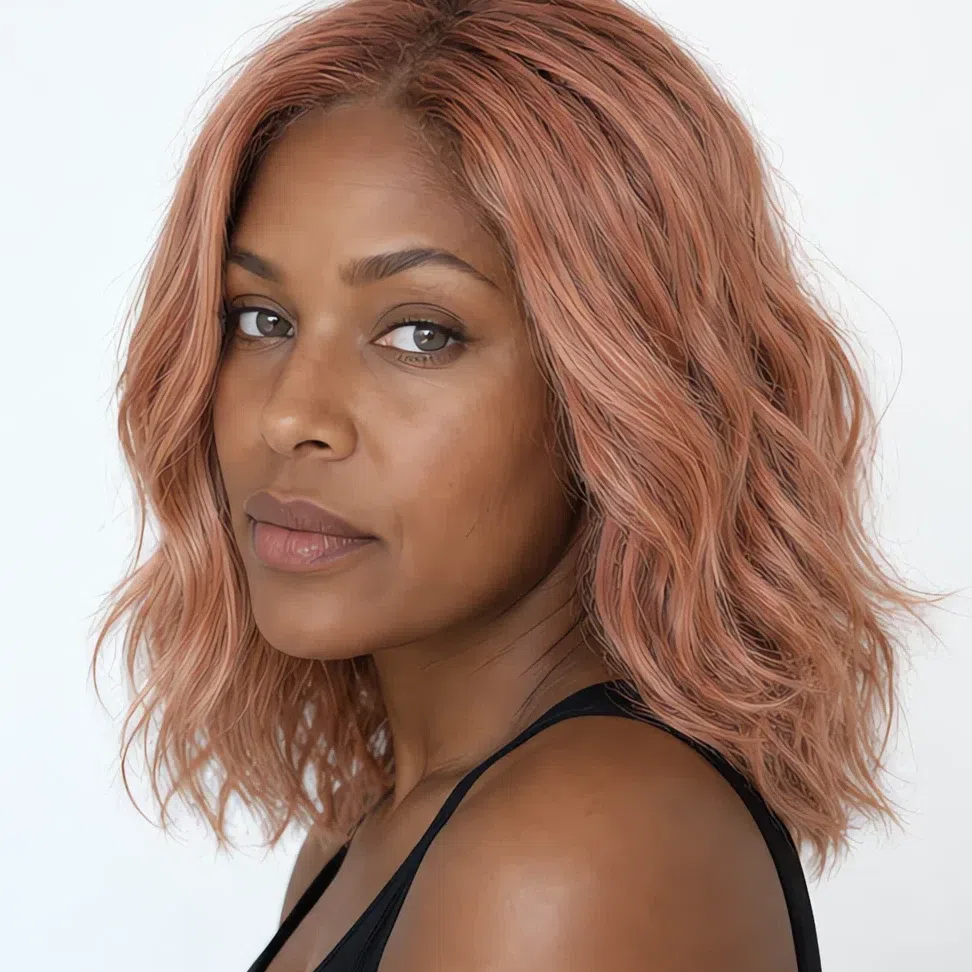 Rose gold
The same far edge, and the same amount of gray holding it back.
Rose gold
The same far edge, and the same amount of gray holding it back.
-
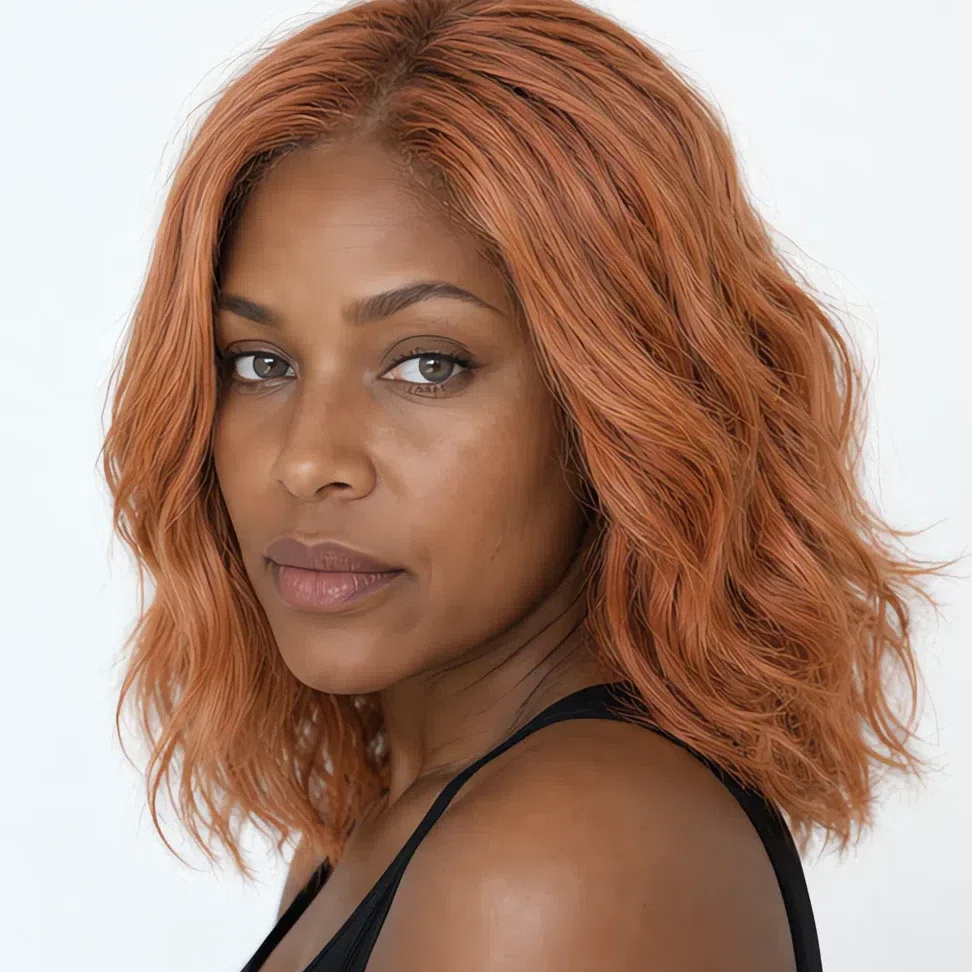 Copper blonde
Clarity fails here for exactly the reason it failed above.
Copper blonde
Clarity fails here for exactly the reason it failed above.
-
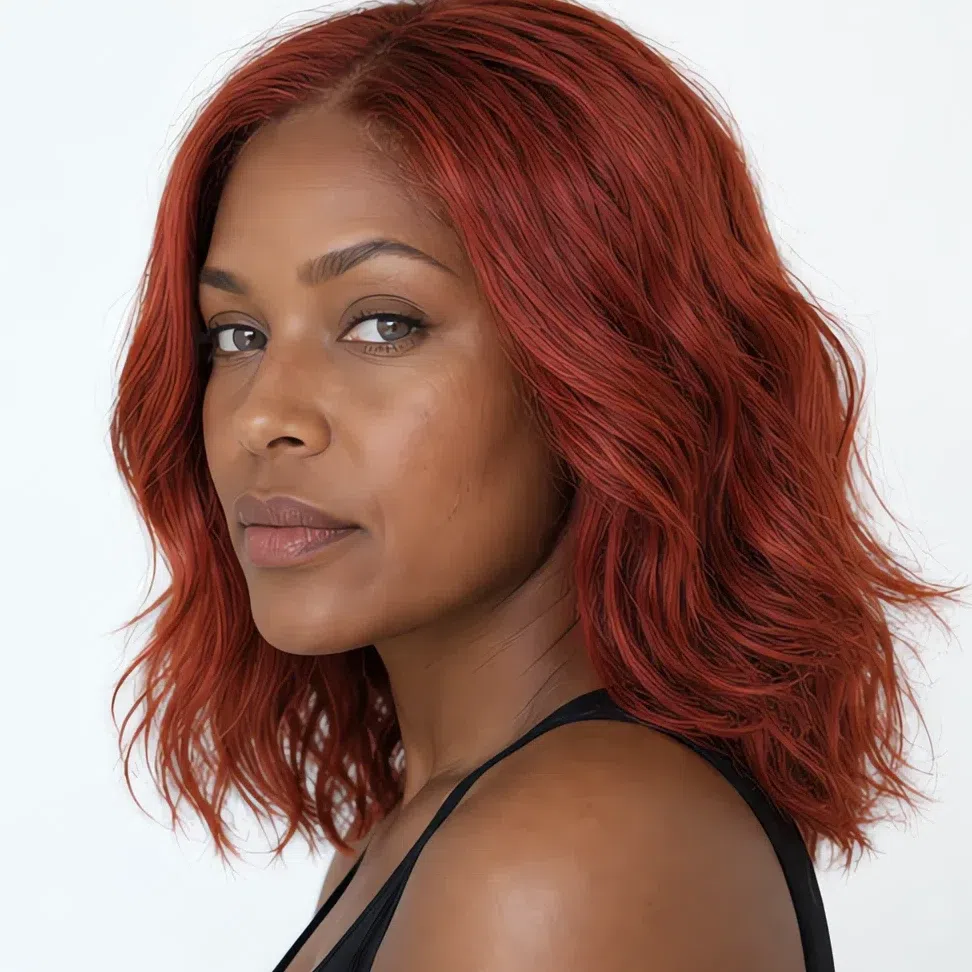 Clear red
And it fails at the same point on the scale, not a step later.
Clear red
And it fails at the same point on the scale, not a step later.
Two complexions, the same four shades, the same level - and the door shuts at the same point in both rows. That is the difference between this question and the blonde one. Blonde had a ceiling that moved with the reader; red does not, because saturation is a property of the dye rather than of the skin behind it.
Every other section on this page is about one axis going wrong - too light, too deep, too warm. Red is the one place where a single decision moves two at once. A red that reads as red carries saturation, and saturation is what your coloring has least of; and the reds people actually ask for by name - auburn, chestnut, ginger - are also several levels deeper than you grow. Turning one dial turns the other with it.
So the useful question is not is this red warm or cool. It is how much of it is a tint rather than a color. A rose cast sitting over a light ash base is a toner doing quiet work, and it stays behind your face. A copper is a dye, and it arrives first.
Which also means the version that works here is the cheapest one on the page. It is a gloss, it fades softly rather than growing out as a line, and if you dislike it you are a few washes from it being gone.
Both of those questions were about adding color. The next one is about what happens when color starts leaving on its own - and it is the section this coloring wins outright.
Going gray on purpose
The two questions above were about adding color. This one is about what happens when it starts leaving on its own - and of the twelve seasons, this is the one that gains most from it.
Better than yes. Silver arrives light, cool and soft-edged, and those are not merely three things this palette tolerates - they are the three words the palette is built out of. Everything the rest of this page tells you to ask a colorist for, gray does by itself.
Four things you can do about it, on light skin - a level 7 natural with a good deal of silver already through the temples and the parting.
-
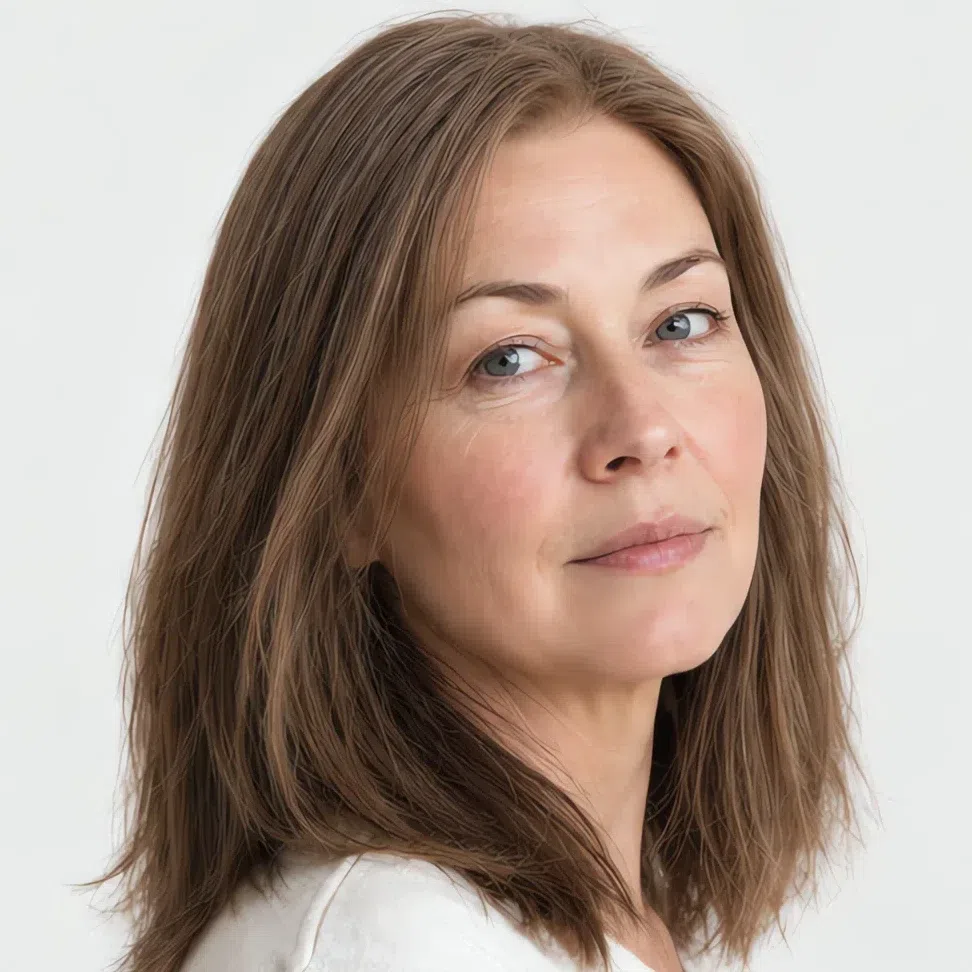 Covered
Legitimate, and the most expensive. Every root line for as long as you keep it up.
Covered
Legitimate, and the most expensive. Every root line for as long as you keep it up.
-
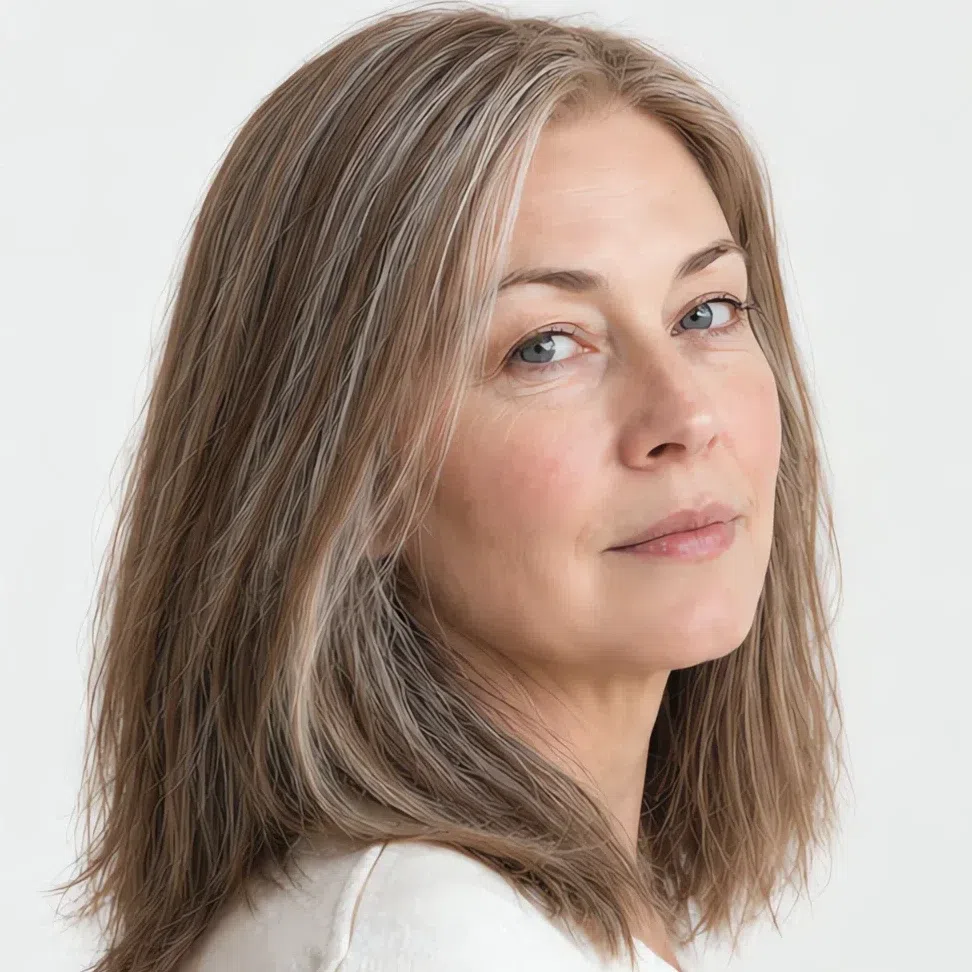 Blended
The silver stops being gray and starts being dimension - the multi-tonal brief, arriving free.
Blended
The silver stops being gray and starts being dimension - the multi-tonal brief, arriving free.
-
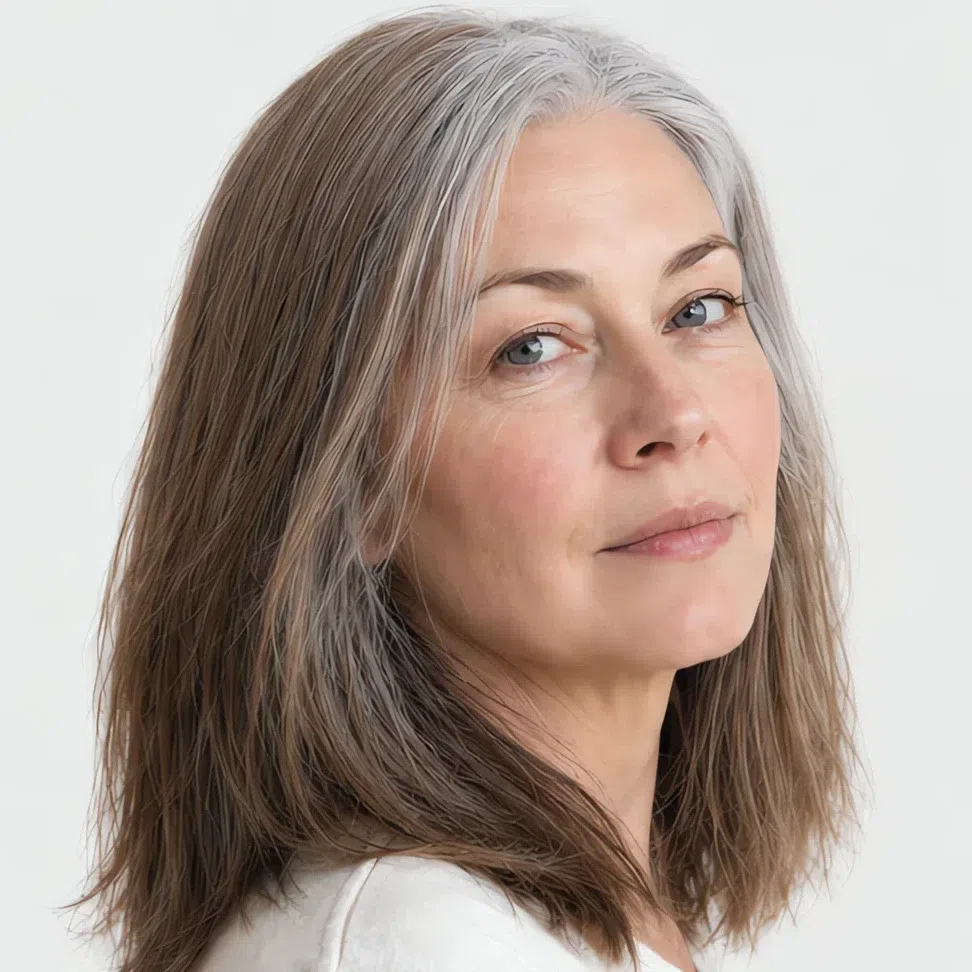 Growing it out
The awkward stage, handled: a long smudge instead of a line. Shorter here than on most seasons, because the two ends are close together to begin with.
Growing it out
The awkward stage, handled: a long smudge instead of a line. Shorter here than on most seasons, because the two ends are close together to begin with.
-
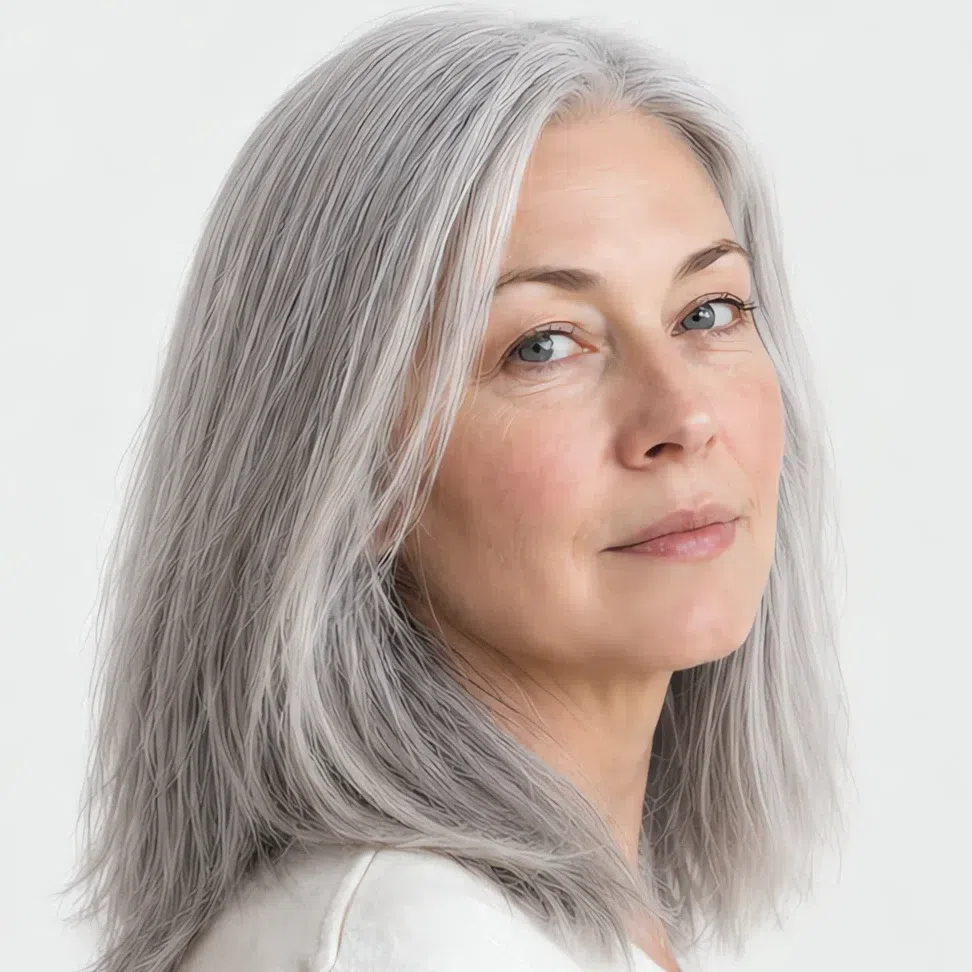 Full silver
Light, cool, soft. It lands inside her own range rather than above it.
Full silver
Light, cool, soft. It lands inside her own range rather than above it.
And the same four decisions on deep brown skin, from a level 5 natural. This is where the answer moves.
-
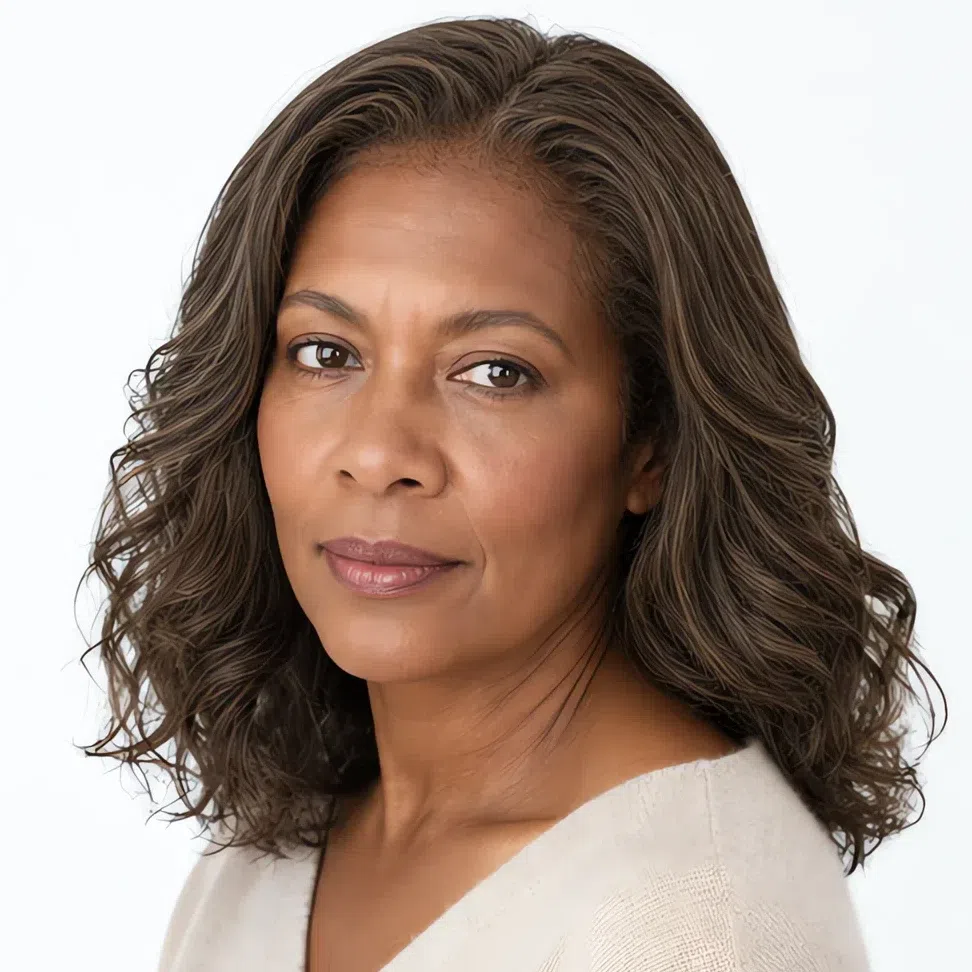 Covered
The same trade, and the root line is starker at this depth.
Covered
The same trade, and the root line is starker at this depth.
-
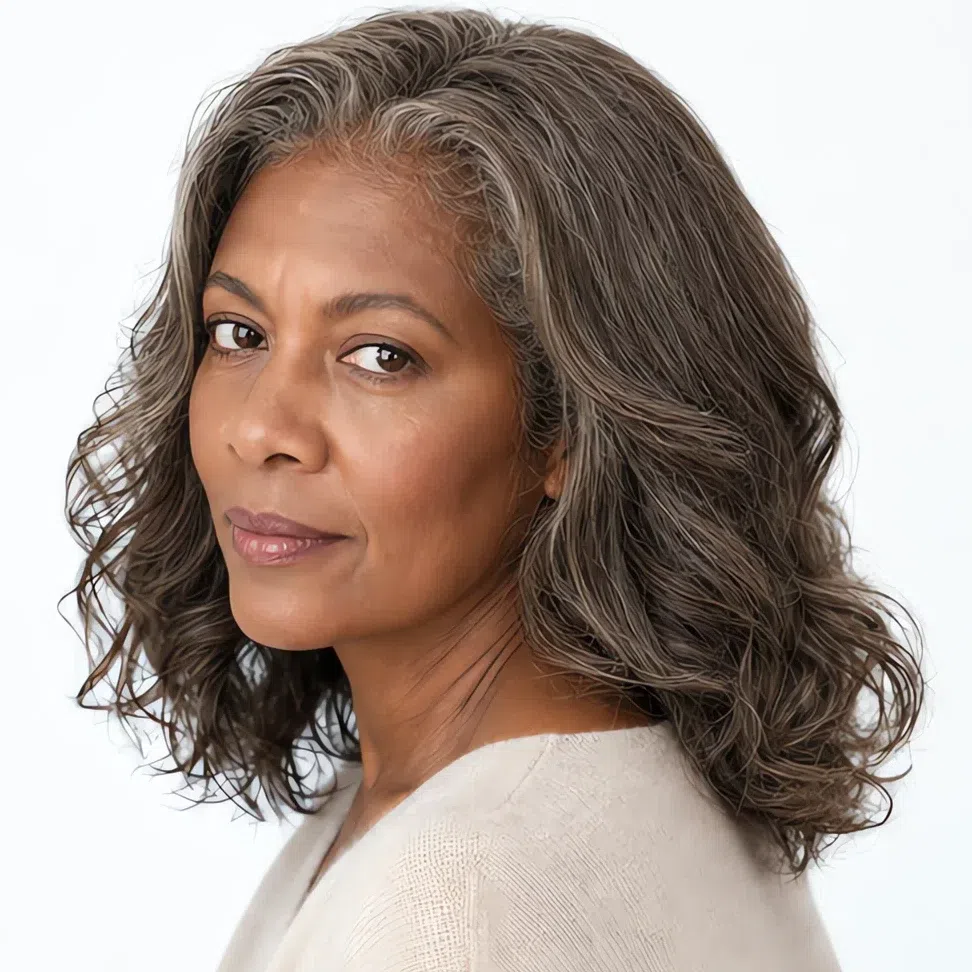 Blended
Arguably the best result on this page. The silver becomes light in the hair rather than an edge around it.
Blended
Arguably the best result on this page. The silver becomes light in the hair rather than an edge around it.
-
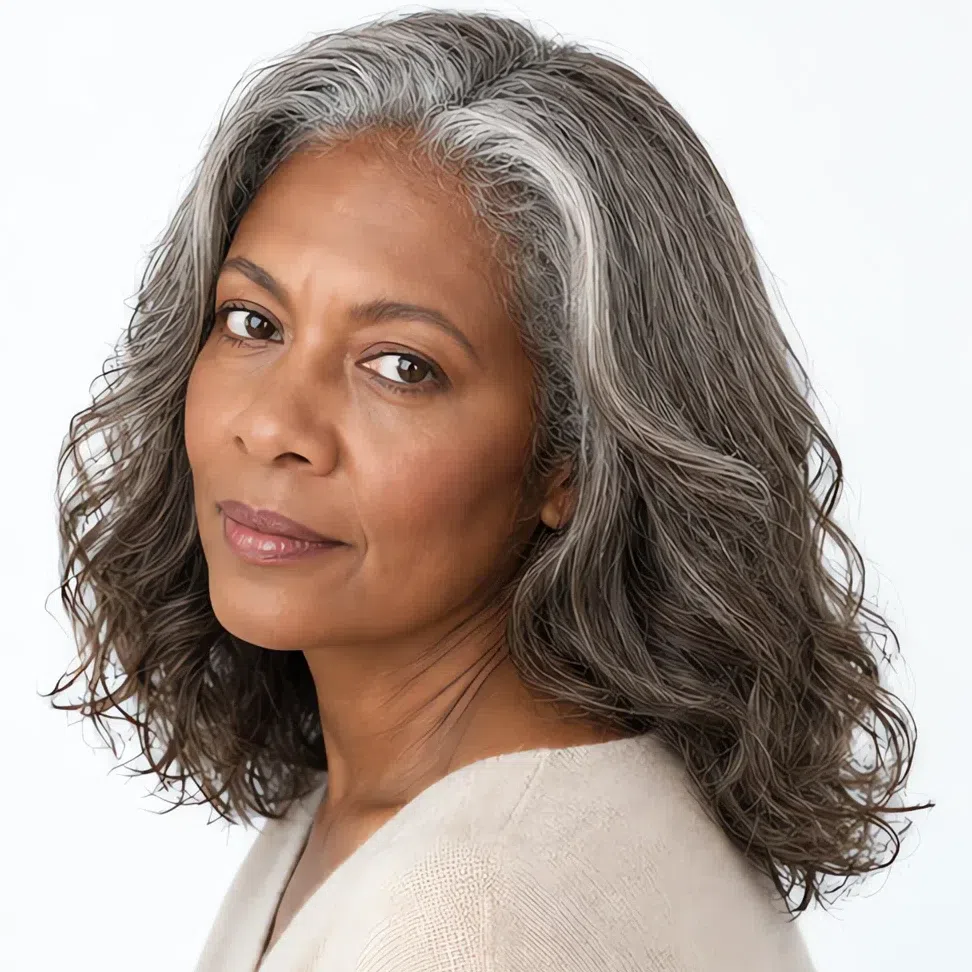 Growing it out
A longer road from a level 5, and the same smudge does the work.
Growing it out
A longer road from a level 5, and the same smudge does the work.
-
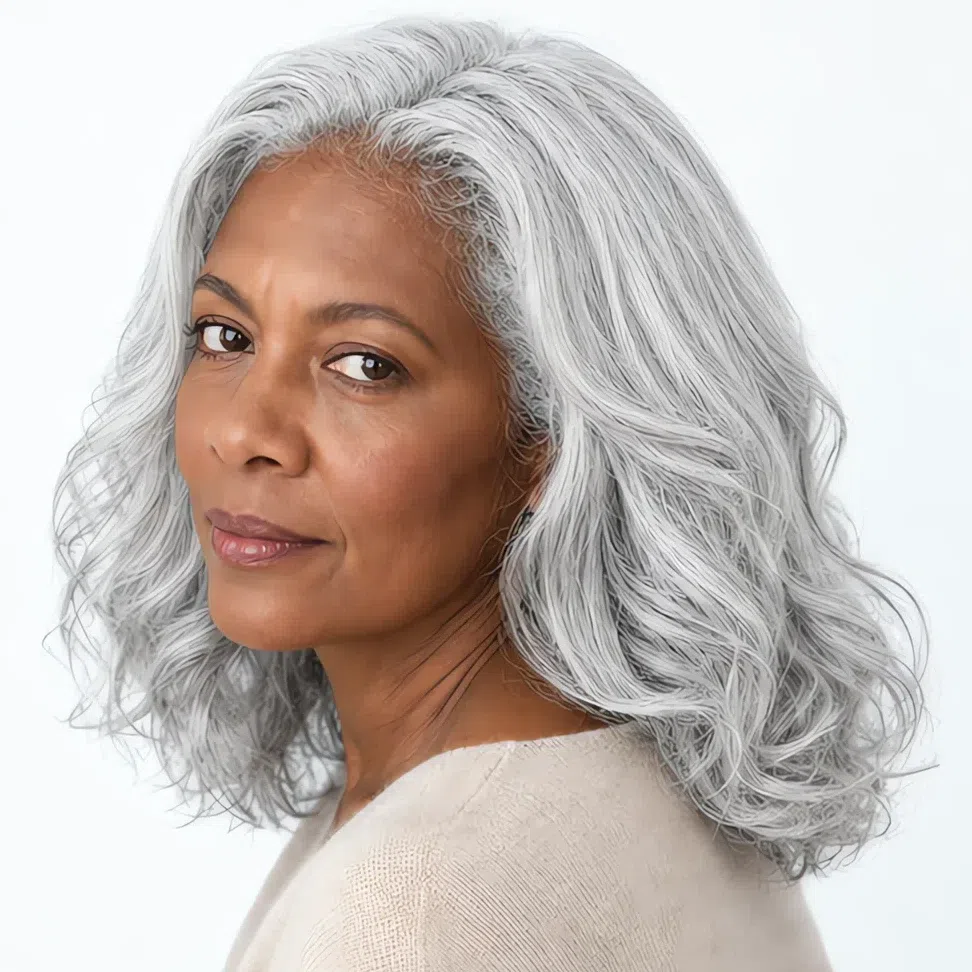 Full silver
Striking, and genuinely high contrast. A statement rather than a default.
Full silver
Striking, and genuinely high contrast. A statement rather than a default.
Compare the last cell of each row. On light skin full silver is quiet - it sits inside the value range and asks nothing of the face in front of it. On deep skin the same silver is loud, because the gap between hair and face is now the widest thing on the face. Neither is wrong, but only one of them is low-contrast, so on deeper skin the blended and grown-out options are the ones doing what this palette actually asks for.
The other three cells hold in both rows: covering is the expensive choice at every depth, and blending is the quiet win at every depth.
The reason gray suits you is arithmetic rather than taste. Your coloring is built at the top of the value scale with gray mixed through everything already - that is what ash has meant on every previous section of this page - and silver hair is the same fact in a purer form. For most seasons going gray means arriving somewhere new. For this one it means arriving where the palette already was.
There is one enemy, and it is the one from every other section: yellow. Silver has no pigment left to defend itself, so it takes up warmth from water, sun and styling heat faster than colored hair does - and it does it fastest of all at the top of the scale, which is where you live. A yellowed silver is the one version of this that stops being your color.
The melanocyte stem cell (McSC) system fails earlier than other adult stem cell populations, which leads to hair greying in most humans and mice.
Which is the last thing left to cover, and it is the part everybody underestimates: what happens between appointments.
Keeping it, between appointments
Every section above ends at the salon door. This is the eight weeks after it, and it is the part that decides whether any of the rest of this page held.
Your color is not fading. It is losing its cool - the ash was a toner laid over warmth that was always underneath, and as the toner washes out the warmth comes back up. The hair stays exactly as light as it was; only the temperature moves. At your end of the scale what comes back is yellow rather than orange, and it shows sooner, because a pale base has less pigment of its own to hide it behind.
The level 8 ash from the salon section, and four points in the weeks after that appointment. The level never changes. Look at how light she is in the first frame and then in the last - they are the same.
-
 Day one
Freshly toned, at its coolest. This is the version you paid for.
Day one
Freshly toned, at its coolest. This is the version you paid for.
-
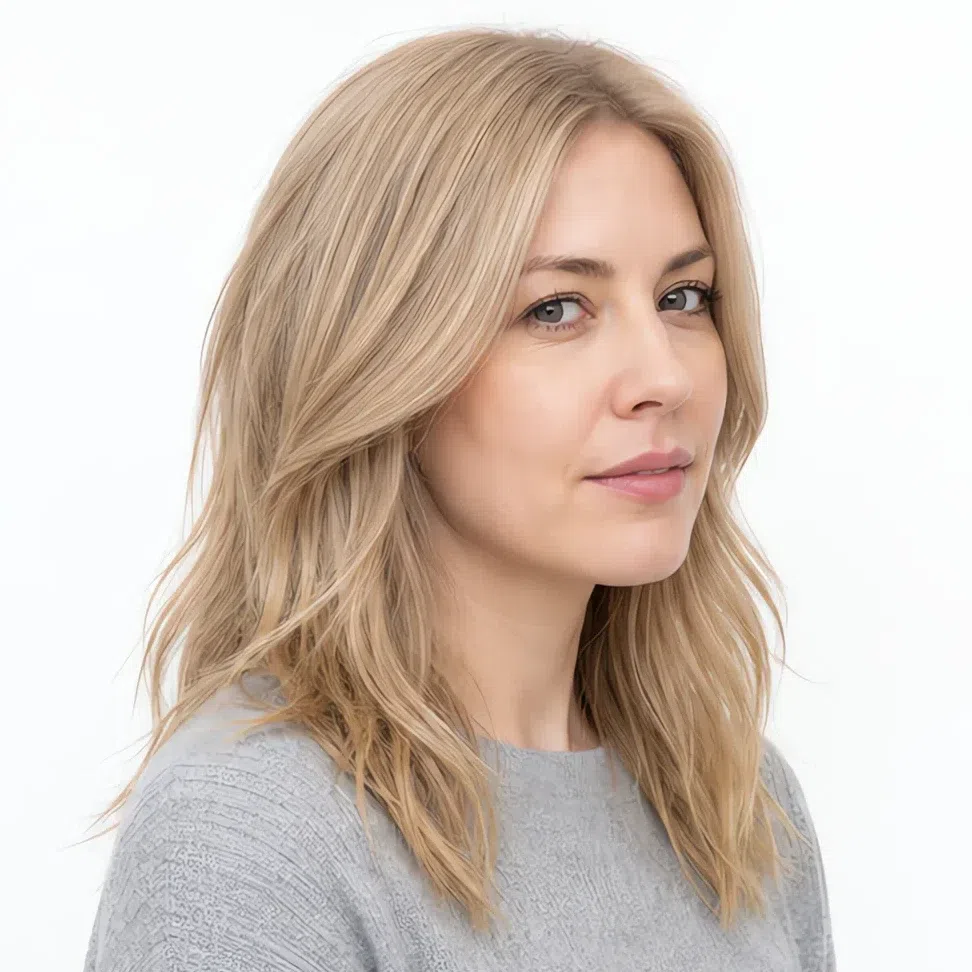 Three weeks
The cool cast has thinned. Most people first notice it in a photograph rather than a mirror.
Three weeks
The cool cast has thinned. Most people first notice it in a photograph rather than a mirror.
-
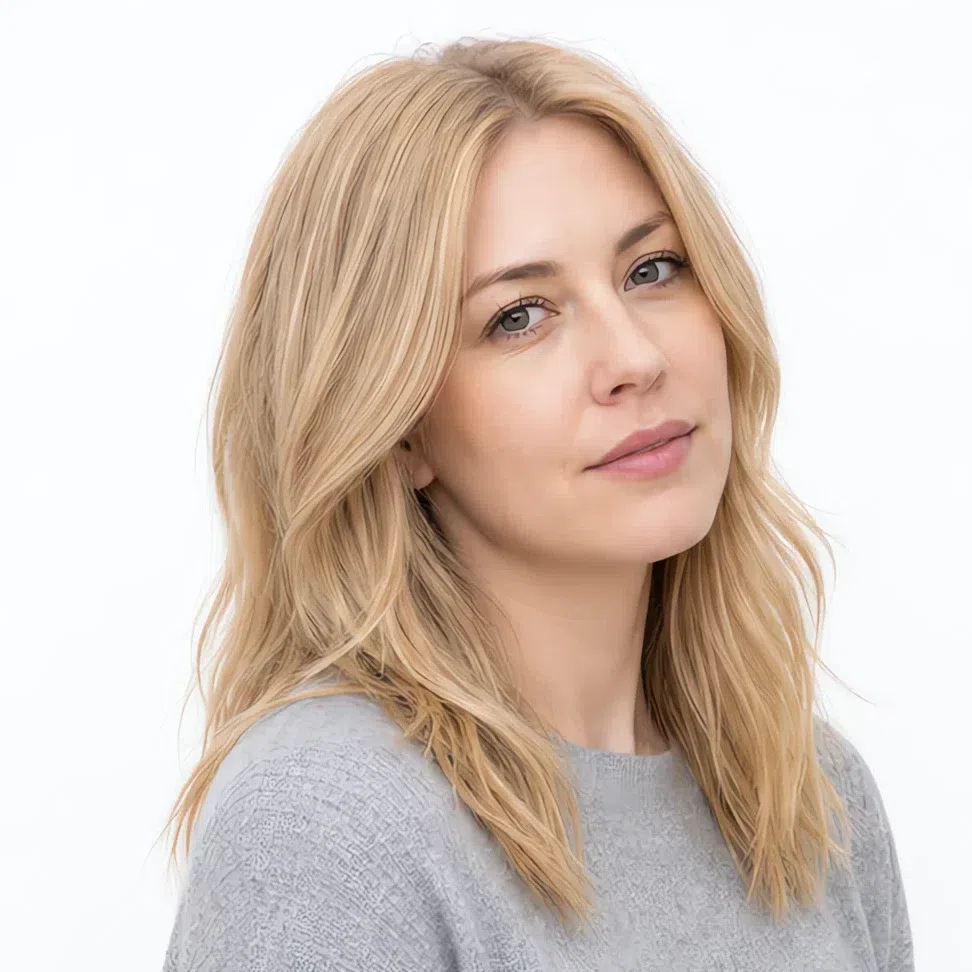 Six weeks
Clearly yellow now - and not one shade lighter than day one.
Six weeks
Clearly yellow now - and not one shade lighter than day one.
-
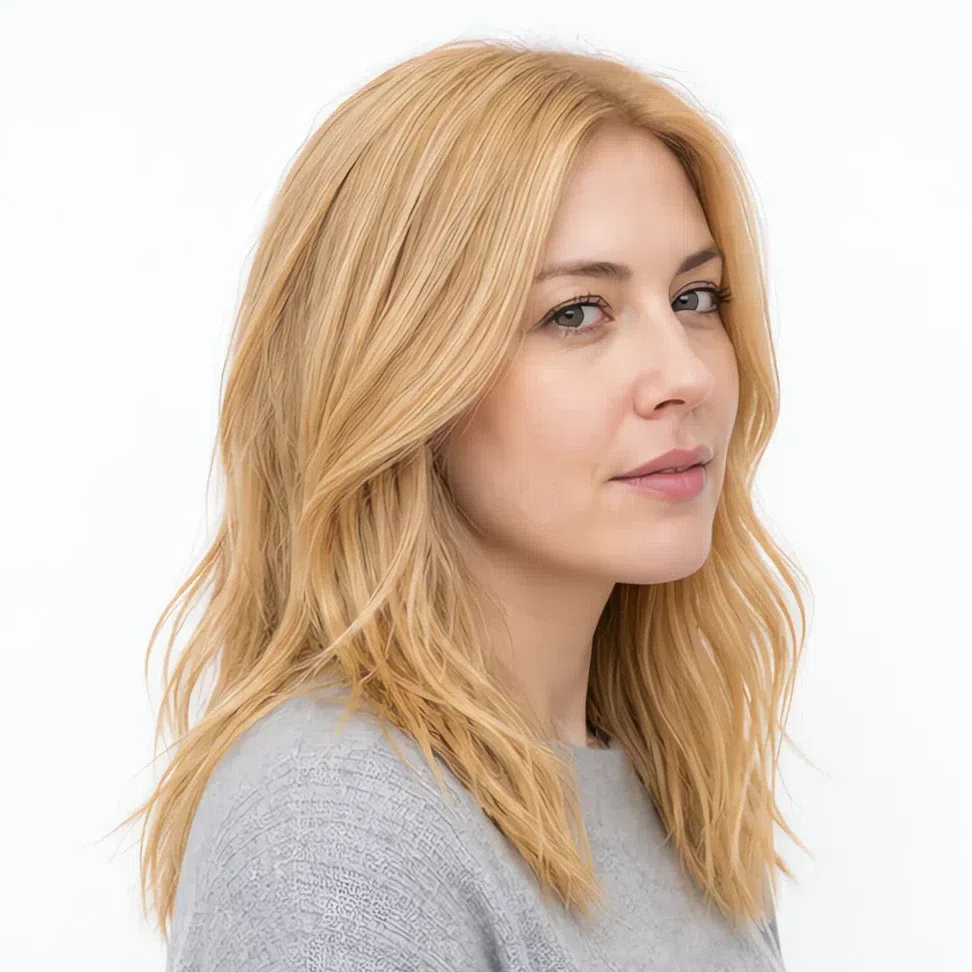 Ten weeks
This is what people call “it went brassy”. It went warm.
Ten weeks
This is what people call “it went brassy”. It went warm.
That distinction is the whole section. Brassy is not lighter, it is warmer - which is why going back and asking for a lighter color makes it worse rather than better, and why the fix costs about nine pounds instead of a hundred.
Muted cool shades take more upkeep than warm ones for a plain chemical reason: they are built by subtracting warmth rather than by adding pigment, and what you subtract does not stay subtracted. Hard water, sun and a hot dryer all speed it up.
And this coloring is the worst-placed of the twelve for it, because the effect scales with how light the hair is. Every level of lift removes pigment, so at a level 9 or 10 there is very little left to sit in front of the warmth underneath. The paler your color, the faster it tells on you - which is the honest cost of the palette being at the top of the scale, and the reason the four things below are not optional here.
This diversity arises mostly from the quantity and ratio of the black-dark brown eumelanin and the reddish-brown pheomelanin.
The four things that hold it
-
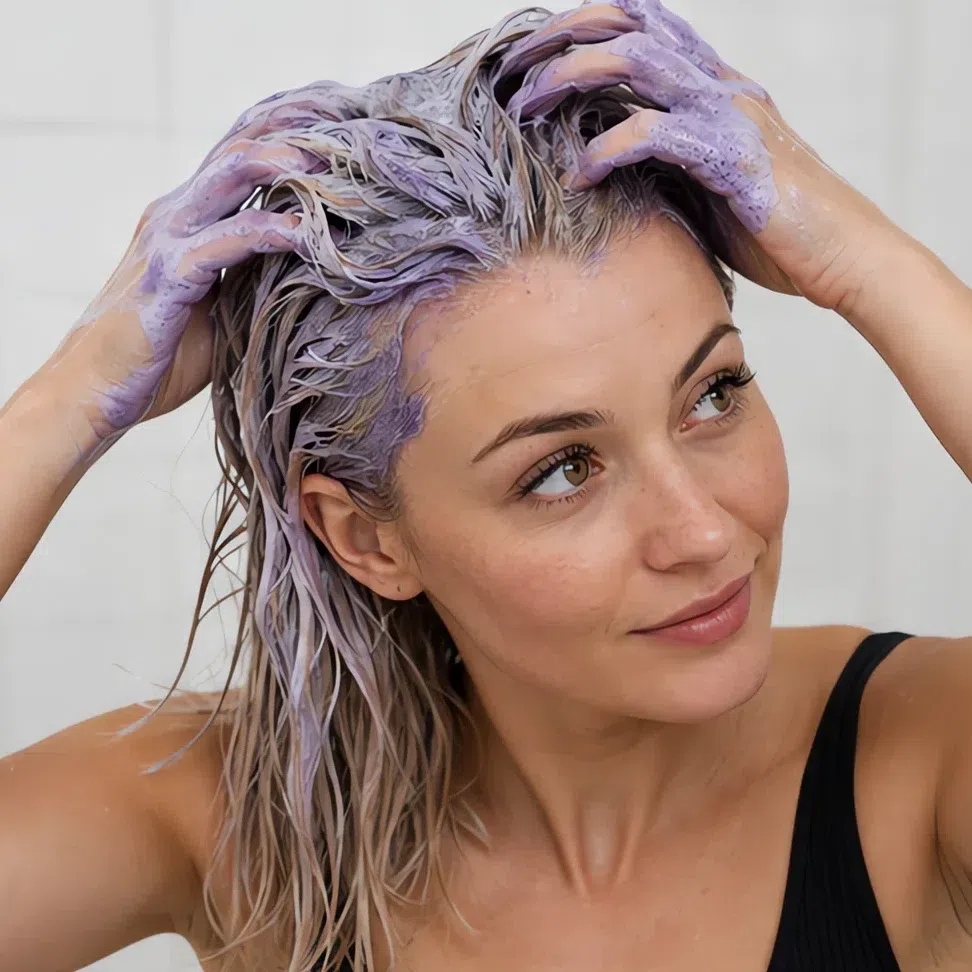 Tone at home
A toning shampoo once a week, matched to what is coming back. On this coloring that is nearly always purple, because purple cancels yellow and yellow is what a light base produces. Blue is for orange, which is what deeper hair goes - so it is the right bottle for a level 6 and below, and the wrong one for most of this page.
Level 7 and up → purple. Level 6 and below → blue. -
 Cooler water
Heat opens the cuticle and toner leaves through it. The last rinse cool does more than any bottle on the shelf, and it is free.
-
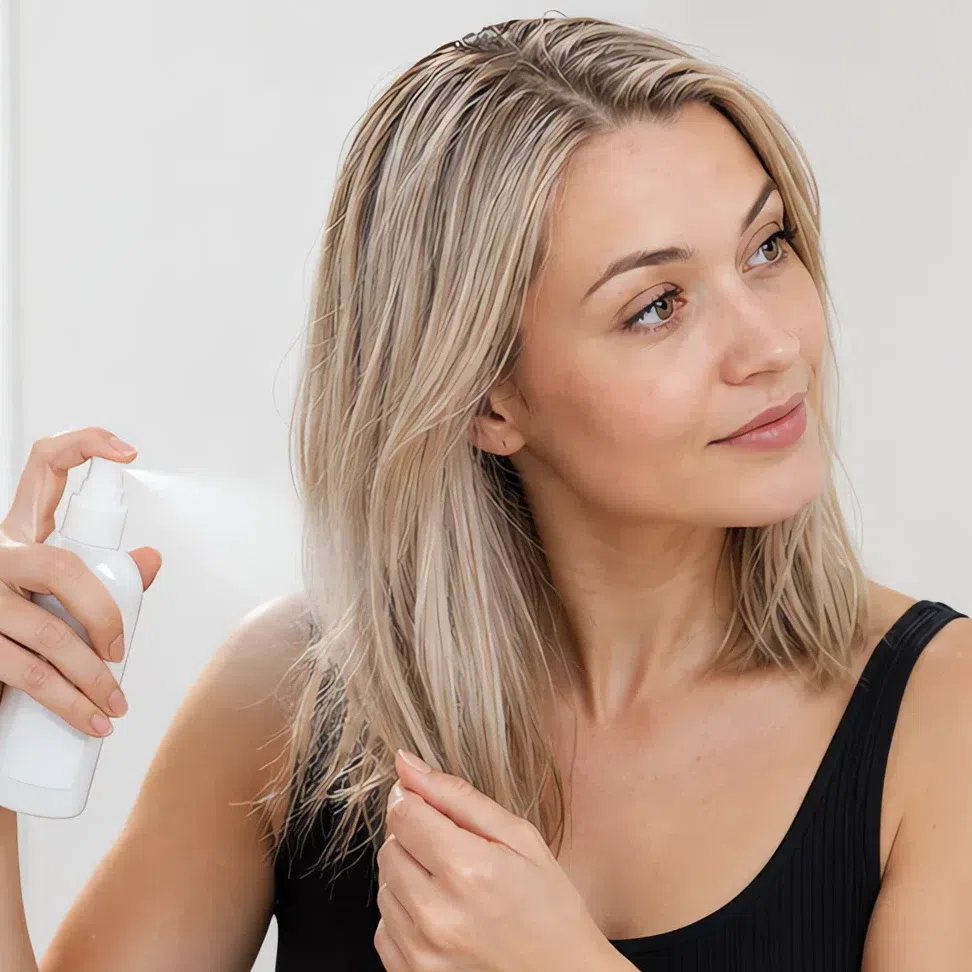 Less heat on the ends
Straighteners and dryers oxidise what pigment is left, and the warmth that surfaces is the warmth underneath. Heat protectant, lower setting - and it matters most at the ends, which have been lifted longest.
-
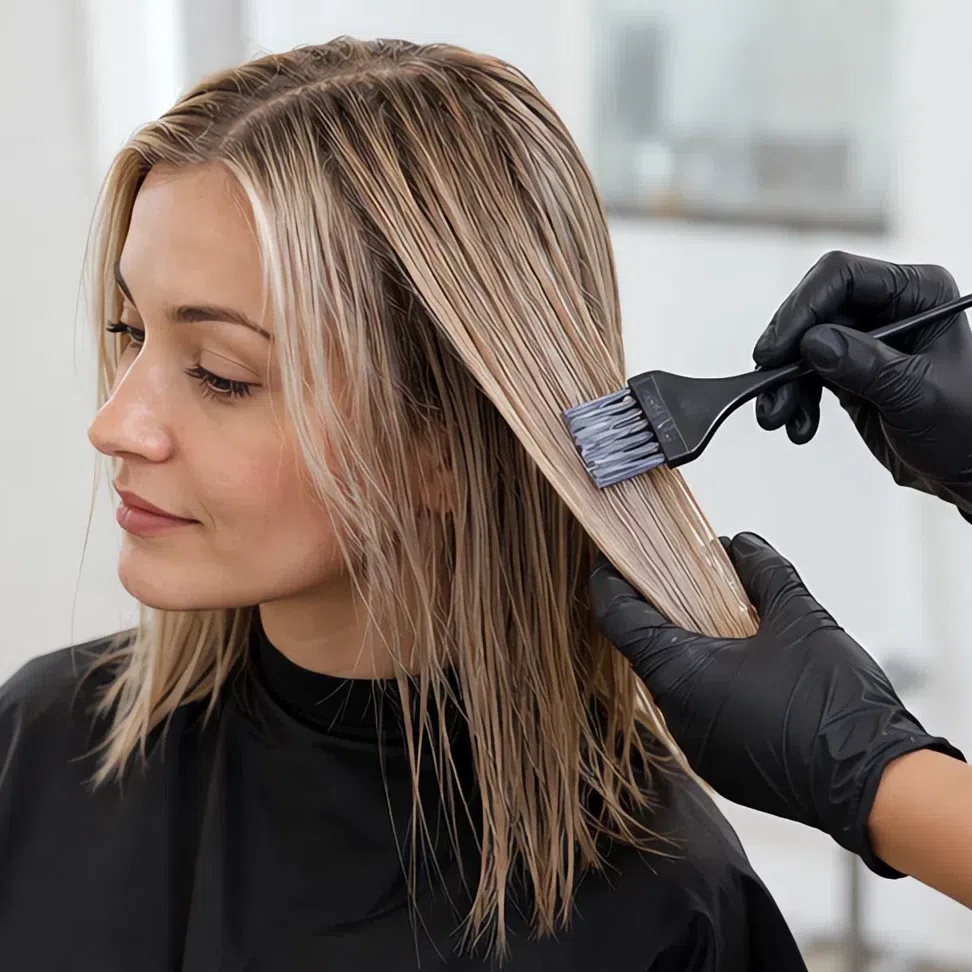 A gloss at week five
The one salon step worth booking between colors. A clear or ash gloss re-tones without lifting, so it costs a fraction of a color and buys most of the appointment back. On a pale base it is the difference between eight good weeks and four.
Ask for a toning gloss, not a color refresh.
Which is everything about doing it well. What is left is the part you come back to later, on the day something has gone wrong.
When the color does not work
Everything above this was about getting it right. This is the one you come back to later, when something is off and you cannot name what: two ways a Light Summer color goes wrong even when the shade was right, and then the shades that go wrong whatever your colorist does with them.
Two ways it goes wrong
The hair wears you
- What it looks like
- People compliment the color before they say anything about you. In a photograph your eye lands on the hairline first, and the face underneath reads harder, and a little older, than it does in your own mirror.
- Why
- The gap between your hair and your face is now wider than any gap your face makes on its own. Every feature you have sits within a few steps of its neighbours near the top of the value scale, so a color that steps outside that band stops reading as your hair and starts reading as something you put on. On this coloring it usually happens downward - a shade chosen for definition that lands several levels below anything you grow.
- Fix
- Keep the family and close the distance. One or two levels nearer your own, or the same shade knocked back with a toner, deals with almost all of it. The shade is rarely the problem - the distance is.
It went flat, and you look tired
- What it looks like
- You leave the salon looking about the same, or slightly duller. The hair reads as one solid pale block, the ends look dense and nothing moves when you do.
- Why
- Muted got mistaken for uniform. A single-process color at one level gives a low-contrast face no edge at all to work against - and pale hair shows this faster than deep hair does, because there is less depth left in it to make its own shadows.
- Fix
- Hold the level and add dimension rather than depth. Fine babylights, or lowlights a single level deeper, put the movement back without dropping the whole head. Reaching for a darker base is the instinct here, and it is the one that produces the first failure above.
And the shades that never work
Every shade below fails for one of three reasons, and they are the same three that run the makeup page. All twelve are on the same woman, in the same flat afternoon light, at the same crop - so what you are comparing is what each shade does to a face rather than what it looks like on a swatch.
Warm and golden
-
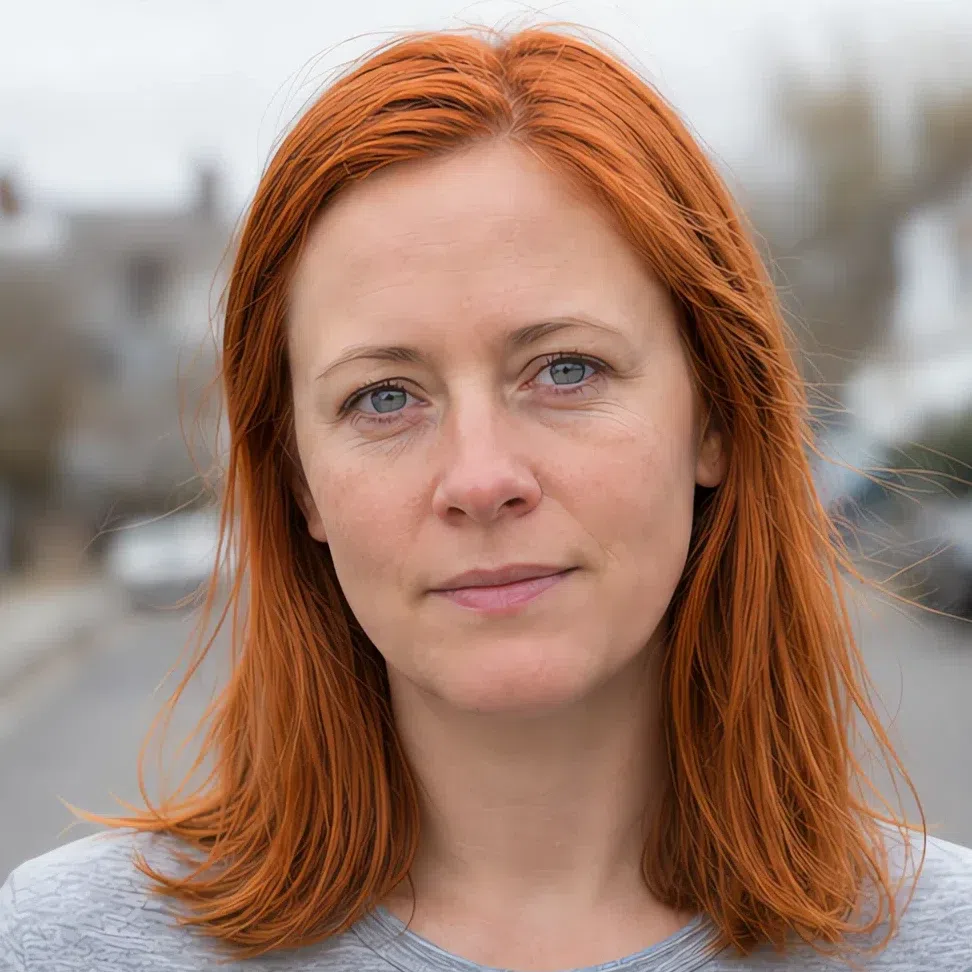 Copper
warm
Copper
warm
-
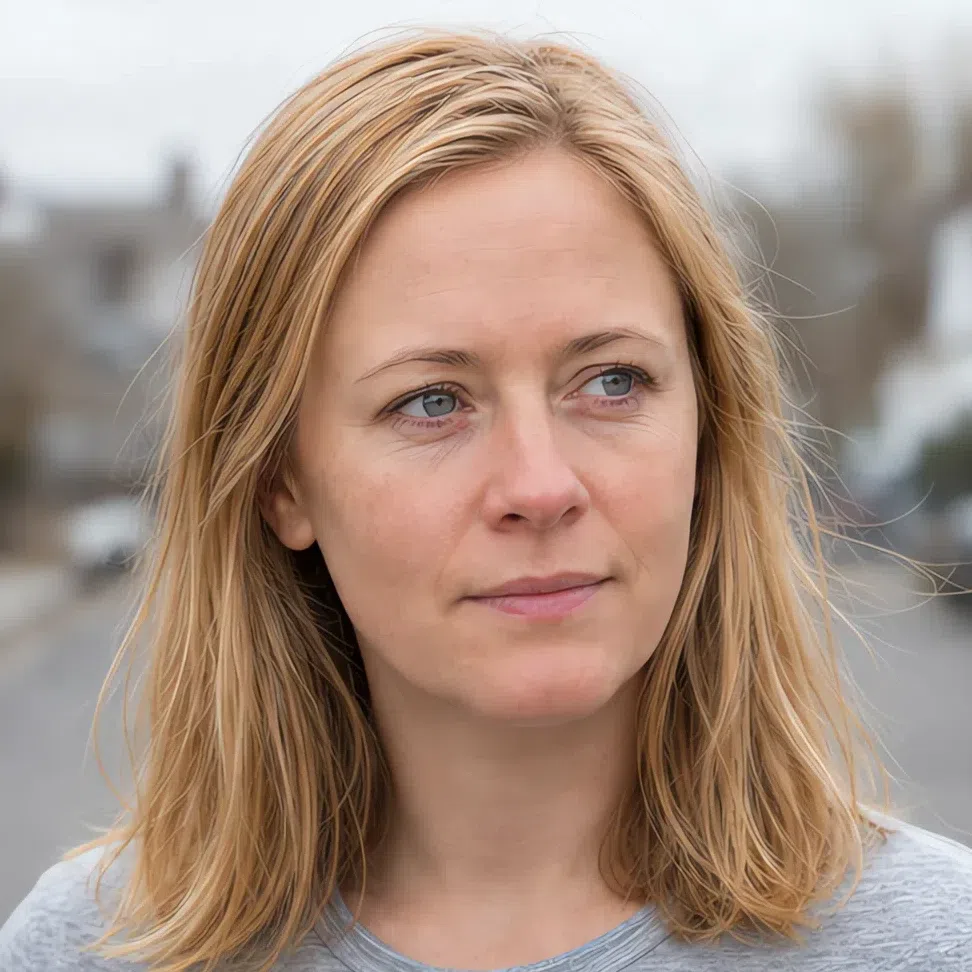 Golden blonde
warm
Golden blonde
warm
-
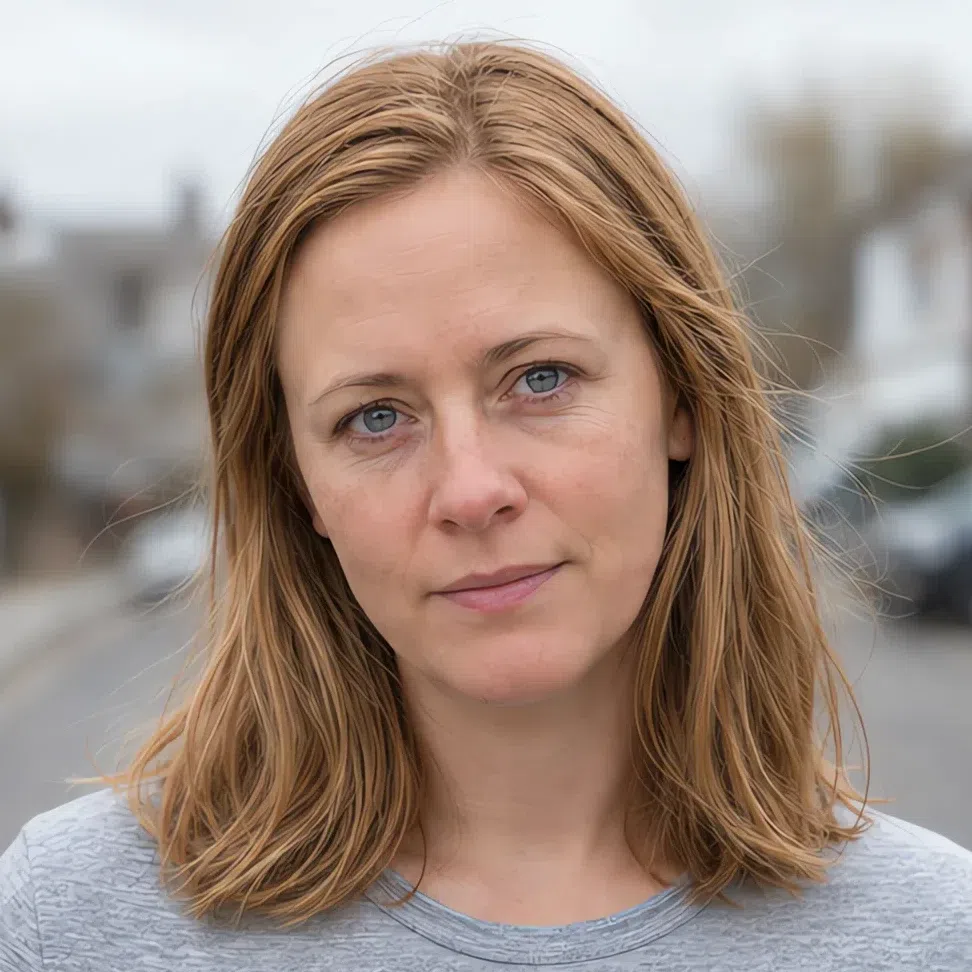 Caramel blonde
warm
Caramel blonde
warm
-
 Warm chocolate
warm
Warm chocolate
warm
The commonest mistake by a wide margin, because warmth is what most people mean when they say they want to brighten it up. Against skin this cool it does the opposite: it pulls the redness in your face to the surface and leaves everything else sallow. Watch what happens to her eyes across all four.
Too dark and too contrasted
-
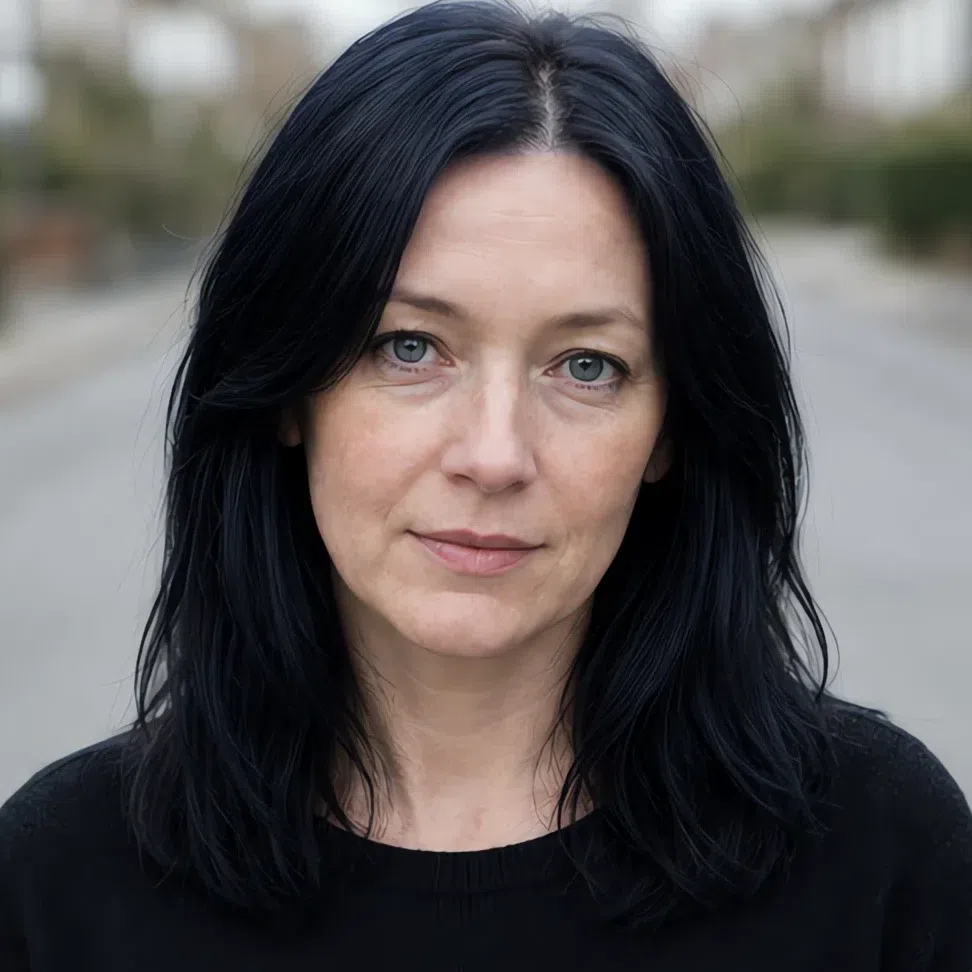 Blue-black
hard
Blue-black
hard
-
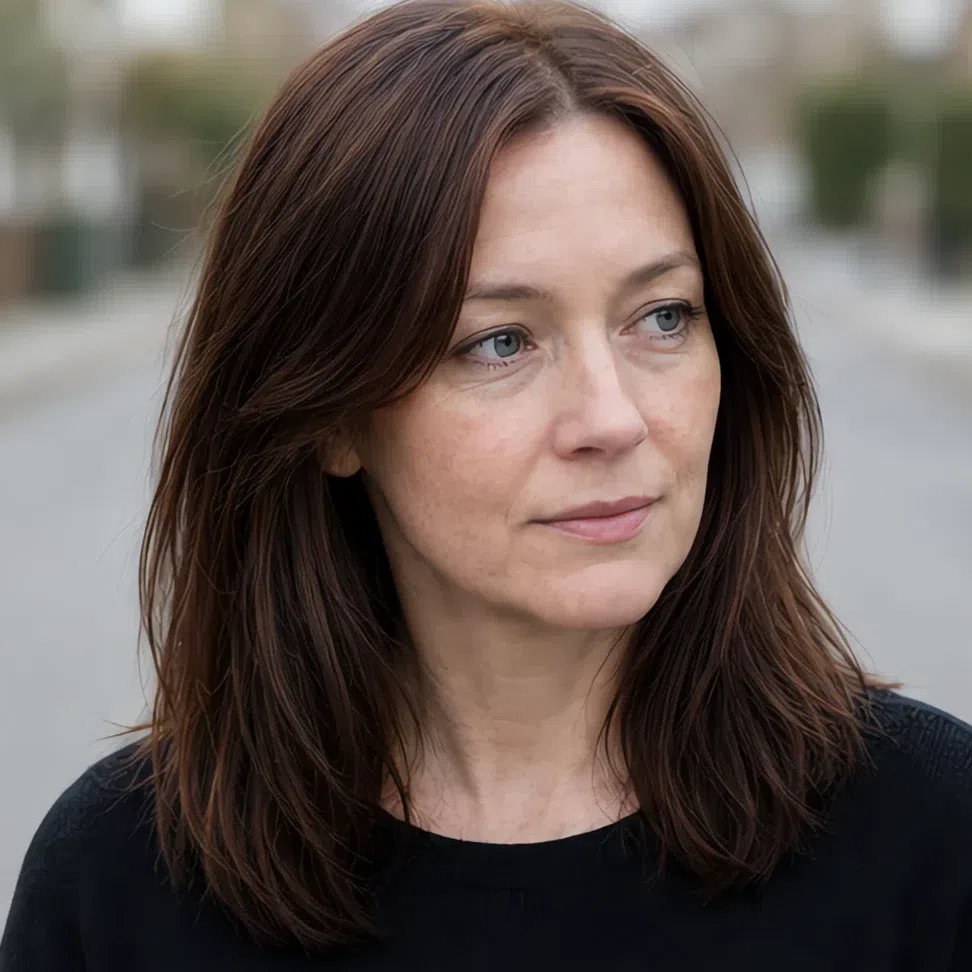 Dark chestnut
hard
Dark chestnut
hard
-
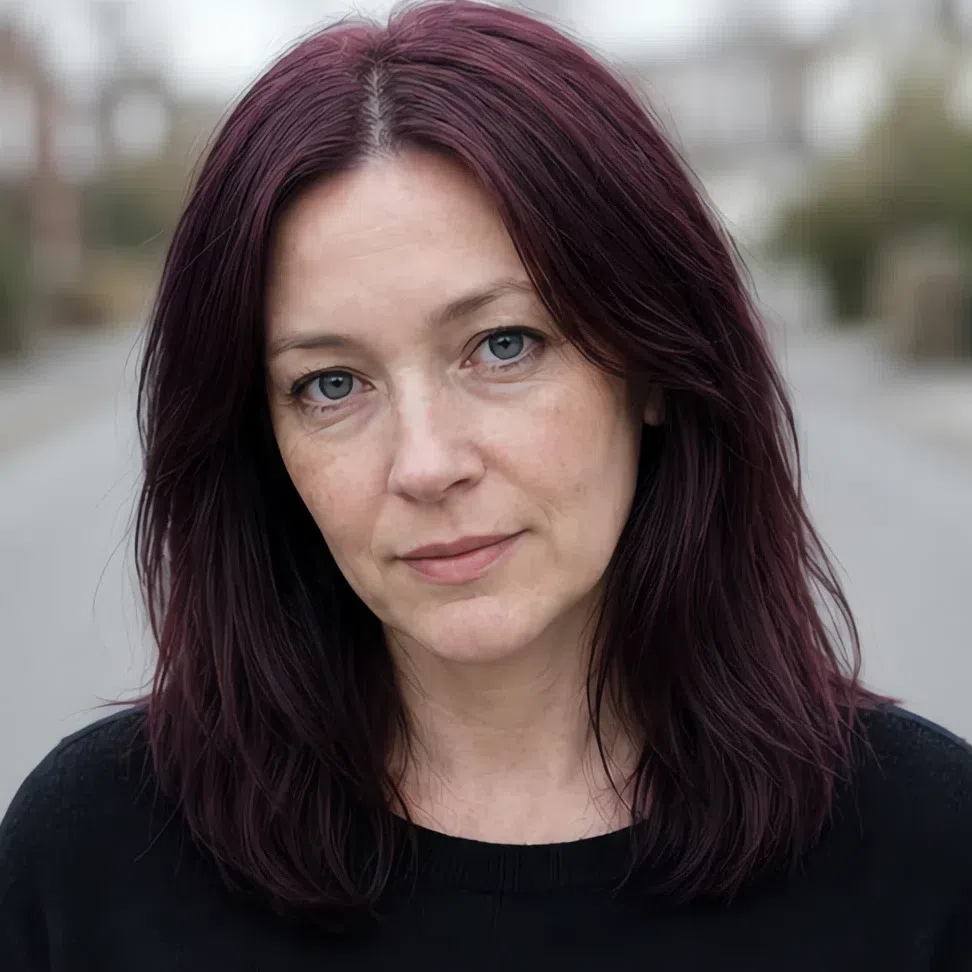 Aubergine
clean
Aubergine
clean
-
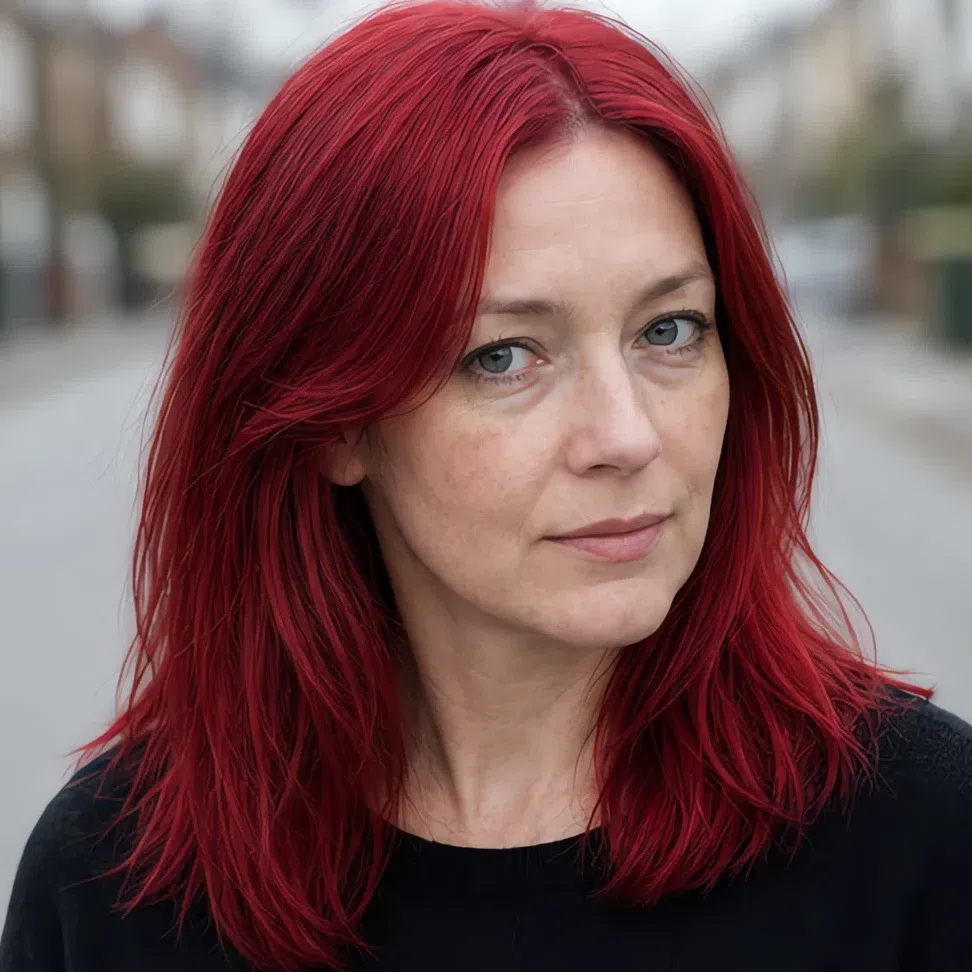 Vivid cherry red
clean
Vivid cherry red
clean
These fail at the hairline, and on this coloring they fail hardest of all twelve seasons. Your face is built at the top of the value scale with no dark note anywhere in it, so each of these lays the only hard edge you own straight across the top of your head - which ages a face far more reliably than going gray does.
Cool, and still wrong
-
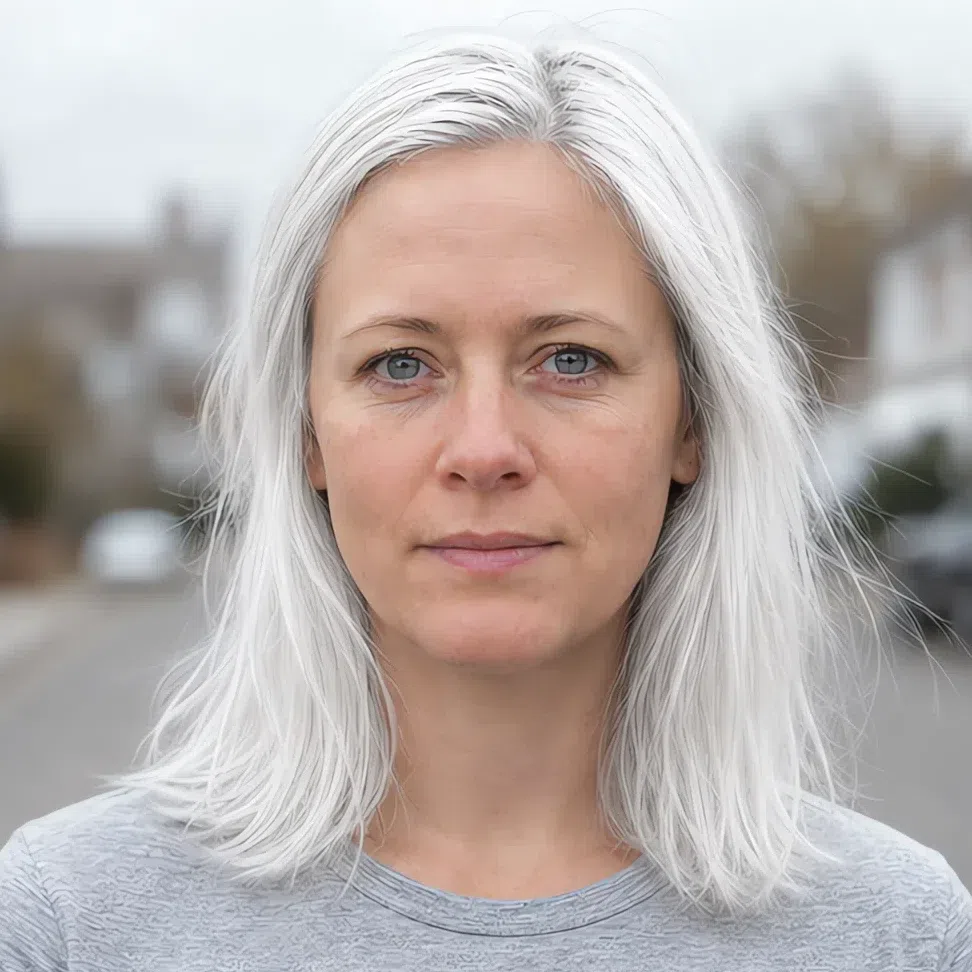 Bleached optic white
hard
Bleached optic white
hard
-
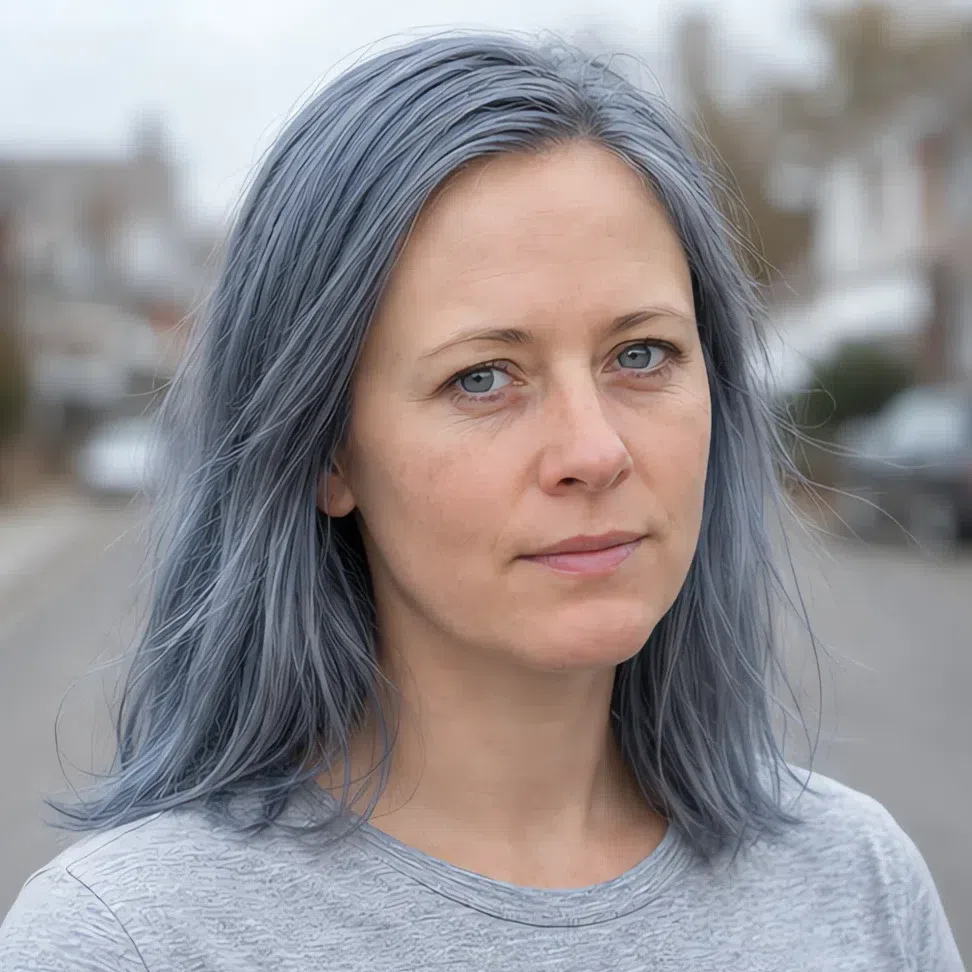 Steel blue-gray
clean
Steel blue-gray
clean
-
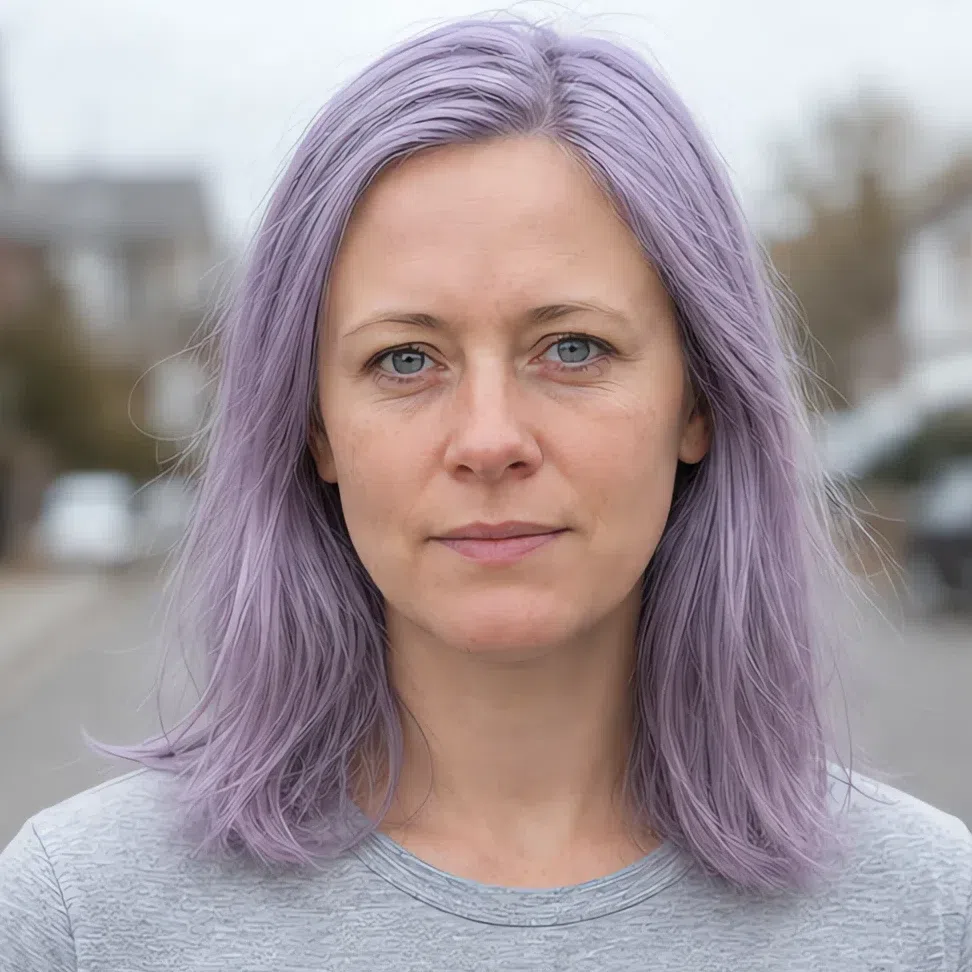 Pastel lavender
clean
Pastel lavender
clean
-
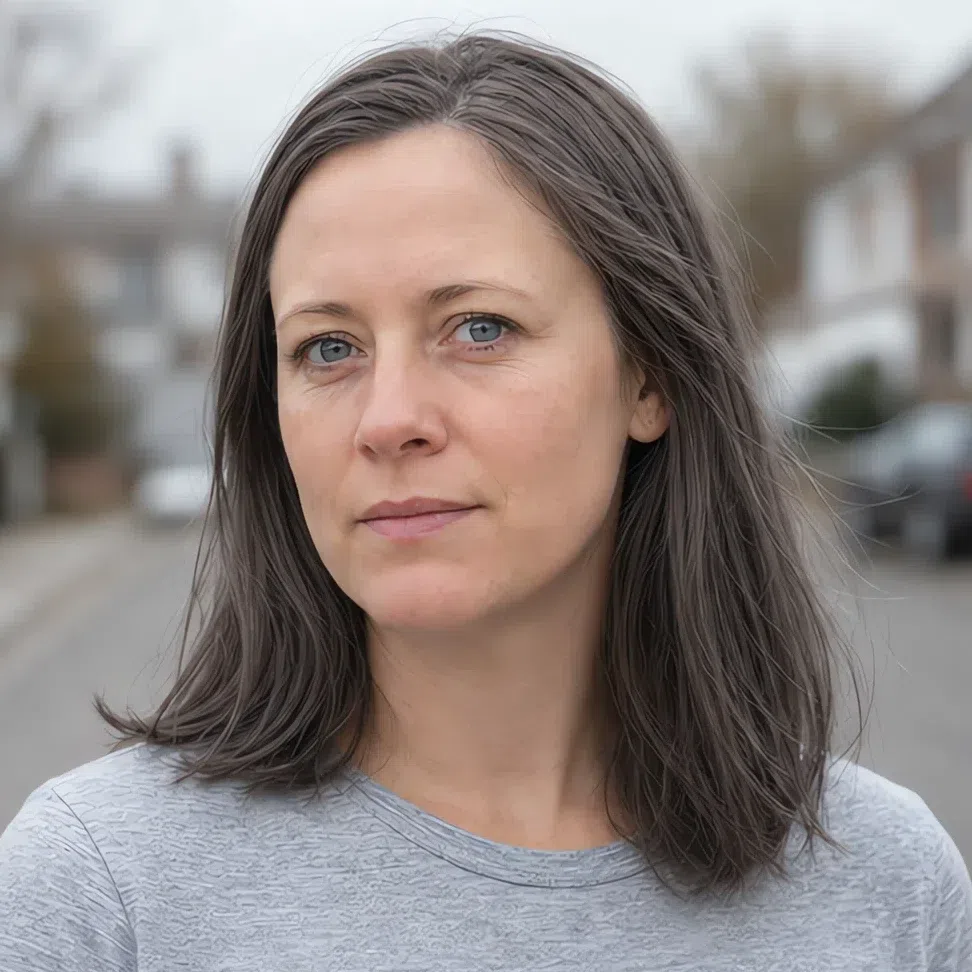 Ash brown, taken too deep
hard
Ash brown, taken too deep
hard
The useful group, because these are the four you will be told are safe. Cool is necessary and it is not sufficient. The bleached white is the blonde section’s ceiling ignored - not lighter than a platinum, just emptier; the blue-gray has no gray in it in the sense that matters here, because your silver is greige rather than blue; the lavender is cool and completely clean. And the last one is the page’s whole thesis in one frame: ash is exactly the right family, and four levels below your own it still fails.
Why each one fails
- cleanToo clean
- Full saturation, no gray in it. Your own coloring has gray mixed through everything, so a clean dye never looks like it grew out of your head.
- warmToo warm
- Gold, copper, caramel. Your undertone is cool and pink, and warmth sitting on top of it brings out redness first and dullness second.
- hardToo hard
- Either far end of the level scale - true black at one end, bleached white at the other. Both become the highest-contrast edge on your face, and the face recedes behind them.
Two of the three tags are about the dye and one is about the distance, and the distance is the part worth keeping: most bad hair color on a Light Summer is not the wrong color, it is the right color at the wrong distance - and on this season the wrong distance is nearly always downward. The hexes here are representative examples of each mistake rather than measured values from a tube; the four this palette does not publish are derived from the ones it does. What is left is the part to keep on your phone.
Your shades, and the numbers to say
Everything on this page in one block, so you can stop reading and go and book it. Screenshot it and take it to the appointment - the number beside each shade is the part to say out loud.
The shades, with the level to ask for
- Icy platinum L10 #F1ECE3
- Pearl blonde L9 #E6DED4
- Cool ash blonde L9 #D0C6B9
- Mushroom blonde L7 #BDB0A5
- Cool light brown L7 #B4A597
- Ash brown L6 #9A8C7F
- Cool balayage L8 #C7B8A9
- Babylights L8 #A99C91
The numbers
- Ash 8.1 #B8AEA1
- Pearl, or matt 8.2 #CEC6BB
- Natural 8.0 #C4B293
- Gold 8.3 #D9B978
- Copper 8.4 #C69456
Only 8.1 is a request, and 8.2 is a question worth asking - in the brands where it means violet it is where a pearl blonde comes from, and in the brands where it means matt it is not. The other three are here so you recognize what you are being offered. The level in front of the dot moves with your own hair: an 8.1 and a 6.1 are the same tone at different depths.
The sentence, if you want one ready: “I am about a level 6 naturally. I would like to go to a level 8 ash - so an 8.1 - and keep it multi-tonal with a soft root rather than one flat block.”
The full Light Summer palette →
Questions people ask
What is the best hair color for a Light Summer?
What hair colors should a Light Summer avoid?
Can a Light Summer have black hair?
Can a Light Summer be blonde?
Can a Light Summer go red?
Should a Light Summer cover gray hair?
What should I ask for at the hair salon?
Why does my hair color keep going brassy?
Which box dye is best for a Light Summer?
Where this came from
The sources behind the factual claims on this page - salon numbering, what the two pigments in hair are and what bleach does to them, why complementary colors cancel, and what is actually happening when hair goes gray.
-
International Colour Charts for Hairdressing (opens in a new tab)
Hair & Makeup Artist Handbook, 2023
The level and tone numbering used throughout the salon section - a trade convention, so a trade source. It is also the source for the warning about .2: “Not all hair brands follow the ICC numbering system for tones. Therefore, it is important to know how that particular brand labels its tones.”
-
Diversity of human hair pigmentation as studied by chemical analysis of eumelanin and pheomelanin (opens in a new tab)
Ito & Wakamatsu, Journal of the European Academy of Dermatology and Venereology, 2011
Behind the claim in keeping it that lightening exposes warmth already in the hair. Hair color comes from the quantity and ratio of two pigments - black-brown eumelanin and reddish-brown pheomelanin - measured chemically across black, brown, blond and red hair, with a trace but constant level of pheomelanin in all of it. Every head carries both; the brassy stage is that ratio showing, not a new color arriving.
-
Mechanistic insights into the bleaching of melanin by alkaline hydrogen peroxide (opens in a new tab)
Smith, Garrett, Naqvi et al., Free Radical Biology and Medicine, 2017
The other half of the same claim: what lightener does. Alkaline hydrogen peroxide degrades melanin through reactive oxygen species, and the study maps which ones do the work. Lightening is destruction of pigment, which is why a pale base has so little left to sit in front of the warmth underneath - and why the palest shades on this page need the most upkeep.
-
The Art of Color: the subjective experience and objective rationale of color (opens in a new tab)
Itten, Reinhold (Internet Archive), 1961
Behind the rule that neutralising works on color-wheel opposites - violet against yellow, blue against orange. That is why the toning shampoo on this page is purple rather than blue: at these levels the warmth that returns is yellow, and violet is what cancels it.
-
Dedifferentiation maintains melanocyte stem cells in a dynamic niche (opens in a new tab)
Sun, Lee, Hu et al., Nature, 2023
Behind the gray section. Hair loses color because melanocyte stem cells stop moving between compartments of the follicle - the study shows them toggling between states in a mobile niche, and accumulating as stranded cells that no longer produce pigment. Gray arrives with no pigment left to defend itself against warmth, which is why it yellows faster than colored hair.
-
Color Me Beautiful (opens in a new tab)
Jackson, Ballantine (Internet Archive), 1980
Background on the four-season system this whole site rests on. Color Me Beautiful (1980) built on earlier work by Johannes Itten, Belle Northrup and Harriet Tilden McJimsey, and put seasonal analysis into general use.
One honest distinction. The numbering, the pigment chemistry, the color theory and the biology above are sourced; which shades suit a Light Summer, where the blonde ceiling sits, how far red can be taken and how deep is too deep are our own analysis, built from the palette on the parent page rather than from any of these references. Nobody has published a study on that, and we would rather say so than dress an opinion up as a citation.