Warm Autumn hair color: copper, bronze, and what to ask for
Golden copper at the top, golden chocolate at the bottom - levels 7 to 4, with ginger, auburn and bronze in between. Warm Autumn (True Autumn in the older naming) shares its salon level with Warm Spring and not much else: the same number, a deeper and spicier tone, and a range that goes one level lower than any Spring. Below: the codes that get it, how far lighter you can go, which reds are yours, and why gray is the hardest question on this page.
- Levels 7 to 4
- Copper, never ash
- What to say at the chair
Your range, in salon levels
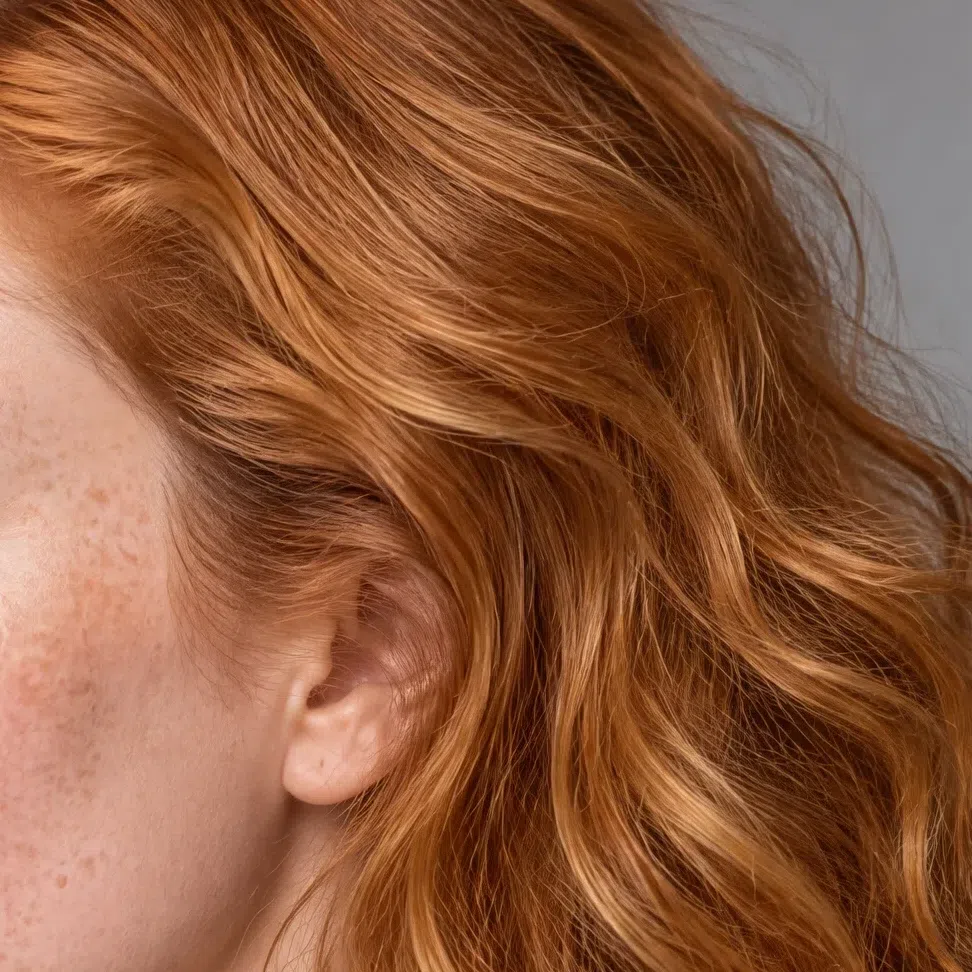
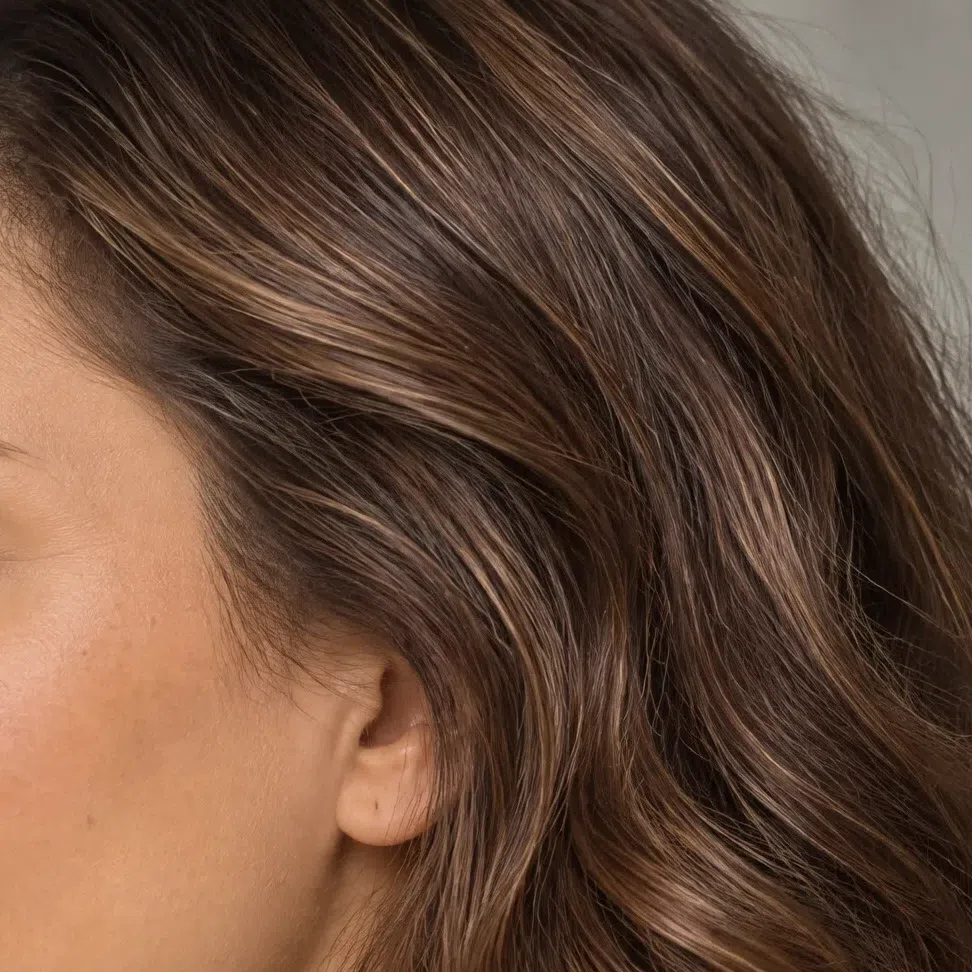
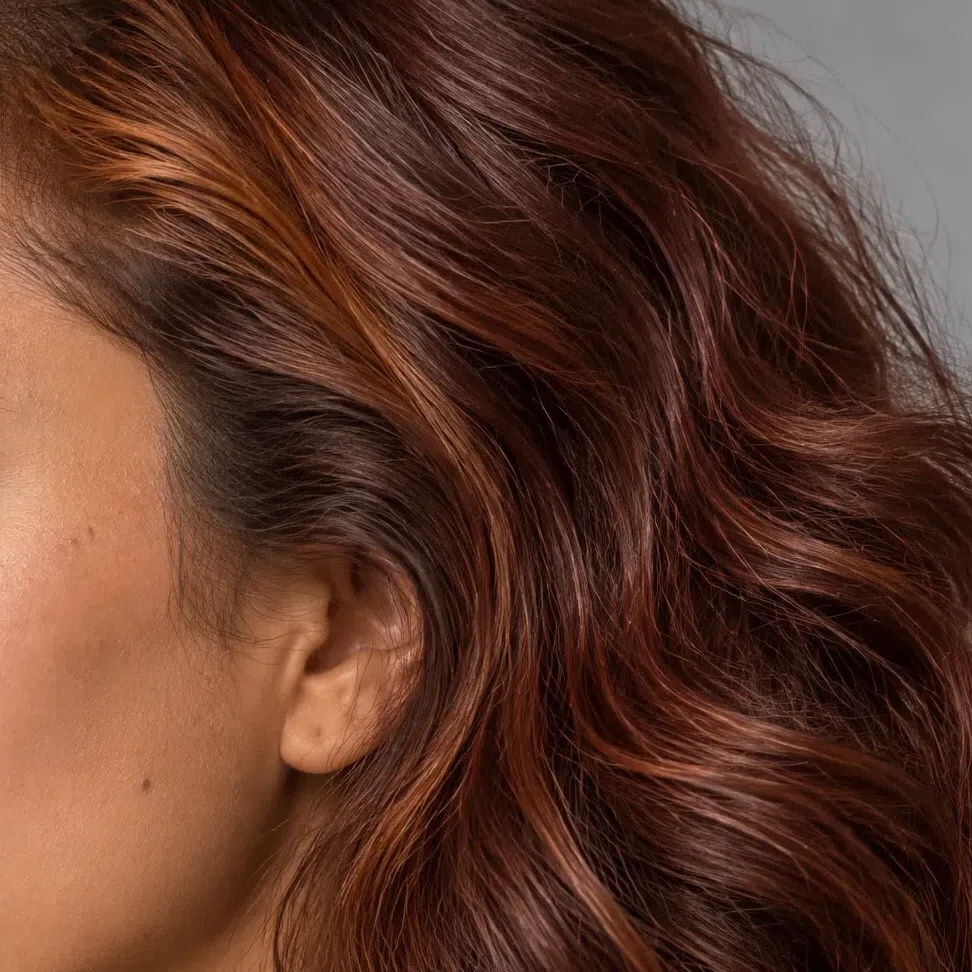
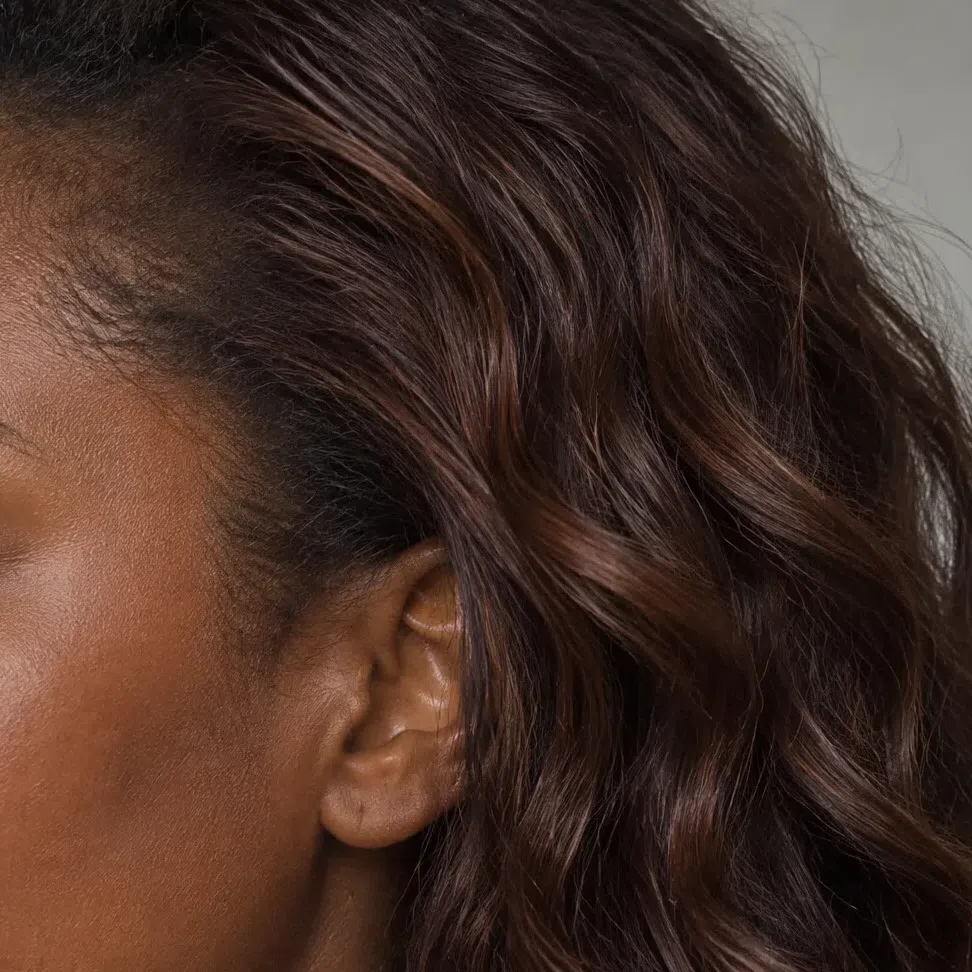
Start here
You are a Warm Autumn. Here is what to dye it.
Colorists talk in numbers, and two of them do most of the work. The level says how light: a scale from black at 1 to the palest blonde at 10. The tone, the digit after the dot, says which way the color leans - gold, copper, ash, violet. Warm, rich or a bit of glow will be mixed three different ways by three different colorists. Level 6, gold-copper will be mixed one way.
The shades on your palette span level 7 to level 4: golden copper and caramel at the top, golden chocolate at the bottom, with ginger, bronze and spiced auburn in the middle. The middle of that range is level 6, which is exactly where Warm Spring sits too. The difference between the two seasons is not the number. It is the tone: a Warm Spring’s gold is clear and light, yours is deeper and spicier, and bronze and copper do more of the work. Measured off the swatches, your hair palette is the third most saturated of the twelve seasons, and a good deal darker than any Spring’s.
Move two levels from your natural color at most - three at the very most, never above level 8 - and keep the digit after the point warm: gold, copper, or gold-copper, dark at the root and lighter through the lengths. For a Warm Autumn the tone decides more than the level does.
The salon scale, and your part of it
- L10
- L9
- L8
- L7 lightest
- L6
- L5
- L4 deepest
- L3
- L2
- L1
The lit cells, 7 to 4, are where your palette puts a named shade. Level 8 is dark only on a technicality: caramel and golden copper both run up to it, so treat it as the lid of the range. The cells below 4 are not a verdict on your birth color either. Plenty of Warm Autumns start at a 3 - the deep-skinned woman in the red and gray rows is one - with the same warmth at a lower number. What the band tells you is where dyeing pays off: lighter than 8 and the gold thins until the hair outshines the face; deeper than 4 and there is no warmth left to see.
What is on this page
- What to ask for The sentence to say at the chair, the tone digit that separates you from Warm Spring, and why caramel ribbons beat one flat color.
- How light? A golden caramel blonde, yes. Level 8 is the top, and whether you can reach it depends on where you start.
- Which red Red is yours. The line is not how much red, it is which side of red: ginger and auburn, never ruby.
- Going gray Silver is cool and your coloring is warm, so this is the one hard question on the page. Four ways to handle it.
- Keeping it Copper does not get lighter as it fades. It drifts toward the ash you avoided. Four ways to slow that down.
- What goes wrong Twelve shades on an ordinary face - including four warm ones that still fail.
- The level list Every shade with its level, in one block. Screenshot it for the salon.
What to ask for at the chair
A Warm Autumn and a Warm Spring can walk into the same salon asking for the same level 6 and both be right. What separates them is the digit after the point. Spring wants a clear gold; you want gold and copper, in that order, with depth left in. One sentence covers it; after it, the three pieces the sentence is made of.
Scrolls to the board. Choose the level you were born with and it lights up your range.
The primary tone is more dominant and has more influence over the final colour than a secondary tone.
Say thisI am about a level 5 naturally. I would like a level 6 gold-copper - a 6.34 - with caramel ribbons through the lengths and my own depth left at the root. If it needs toning at the end, a golden gloss, not an ash toner.
Swap the first number for your own. Everything after it stays, whoever you are: two warm digits in that order, ribbons over a kept root, a warm finish. Those are what turn a level 6 into a Warm Autumn level 6.
Three decisions in one sentence
-
How light
Depth on a one-to-ten scale, black at the bottom. Four rungs carry named shades on your palette - 7, 6, 5 and 4 - and most Warm Autumns are born on one of them or a rung below, so this is usually the smallest part of the request. Give both numbers: the one you have and the one you want.
“I sit at about a 5; take me to a 6.” -
Which warmth comes first
The tone, after the point: .3 is gold, .4 is copper. With two digits the first one leads. A 6.34 is gold with copper behind it - the bronze brown on your palette. A 6.43 is copper with gold behind it, closer to your golden copper. Both are yours; the order decides how red the result reads, so pick it on purpose.
“Gold-copper, a 6.34. Or copper-gold, a 6.43, if I want more red.” -
Where the light goes
Placement and finish. Leave your own depth at the root and put the lighter, warmer pieces - caramel, golden copper - through the lengths, where they move. Then a golden or copper gloss. A violet or ash toner is routine after lightening, and on this coloring it takes out the warmth you came in for.
“Caramel ribbons, my own root, a golden gloss.”
Reading the number on the tube
Every tube is labeled level.tone, and the part after the point is where Warm Autumns win or lose. Four photographs of one woman, all at level 6. Only the digit moves, so any change you see in her skin comes from the tone.
-
 6.34 Gold copper
Bronze. Her skin warms up and the green in her eyes reads as green.
-
 6.4 Copper
Louder, and still hers. The red is a choice here, not a mistake.
-
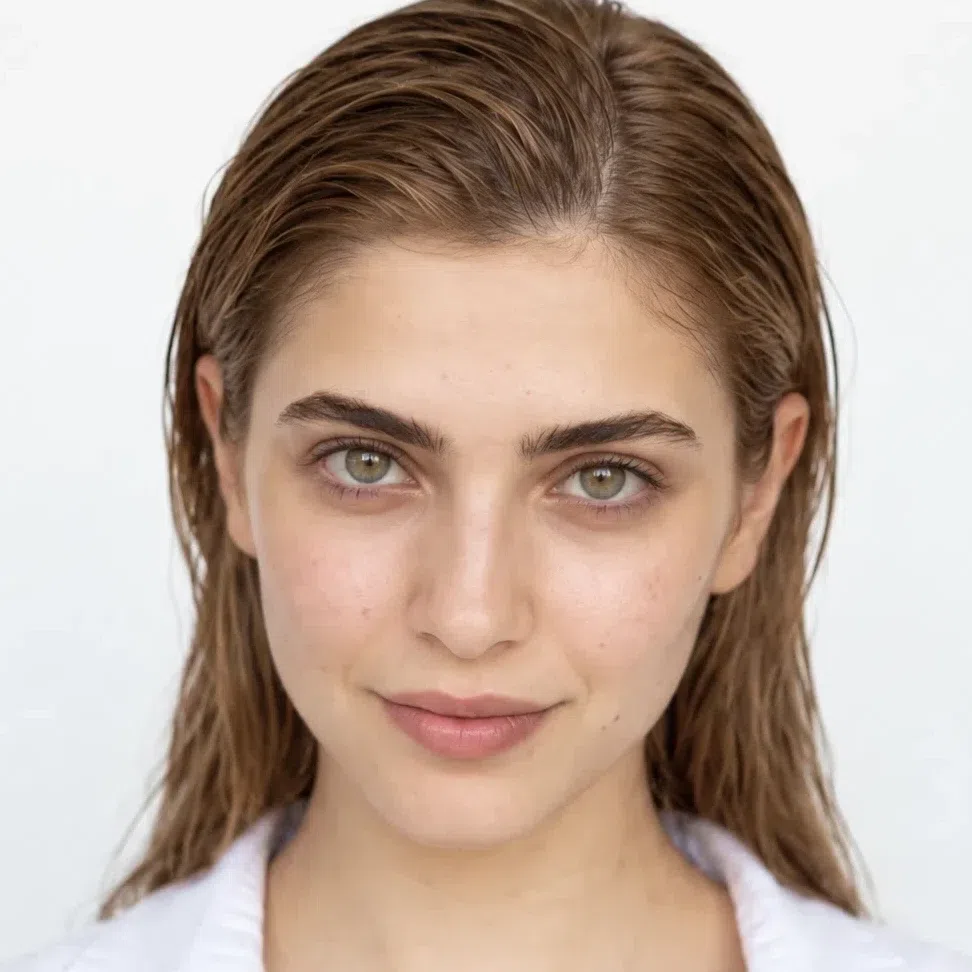 6.0 Natural
Nothing wrong with it on the day. Next to the two above, the glow has gone.
-
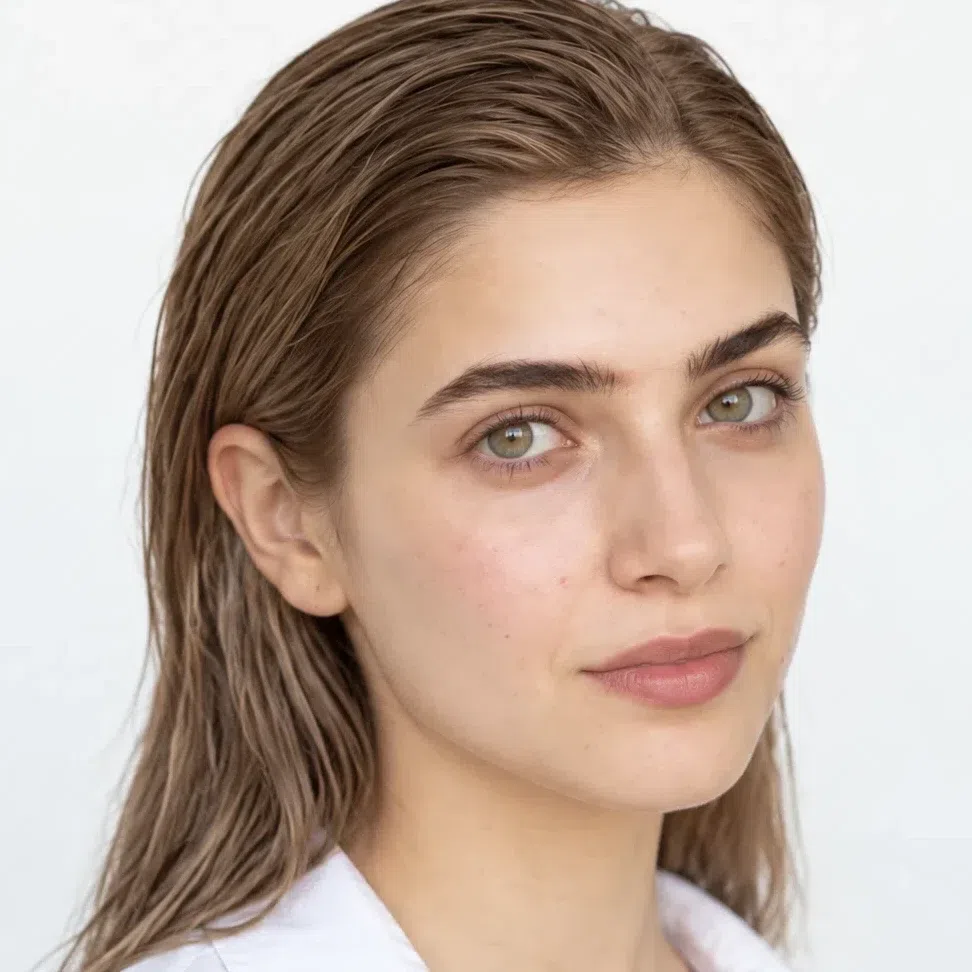 6.1 Ash
The same depth with the warmth taken out. Her skin turns sallow and the rosiness looks like redness.
- 6.34 Gold copper The center of your palette. The chip is your bronze brown, which the parent palette names at exactly level 6. Gold leads, copper follows, and the result reads brown first and warm second - which is what a Warm Autumn’s own hair tends to do in sunlight.
- 6.3 Gold Gold on its own: caramel and sunlit chestnut territory. The chip is your caramel’s level 6 value. Softer than the 6.34, and the safest digit on this page if you are unsure.
- 6.4 Copper The red half of the palette. The chip is your ginger red, named at level 6. It works, and it is the digit that fades fastest - read the keeping-it section before choosing it.
- 6.0 Natural No added direction at all. Mixed onto most heads it comes out a quiet beige-brown that varies from brand to brand. Harmless on the day, but it leaves your skin to do all the warming by itself.
- 6.1 Ash The anti-warmth digit, built on blue. It is what usually gets mixed when someone asks to look less brassy, and on this coloring it removes your warmth as well as the brass. Ash blonde appears by name among your avoid shades.
- 6.2 Violet, or matt The digit that changes meaning between brands - violet at one, a greenish matt at another - so name it out loud. Both versions are there to mute gold and red, which is also why plum black and cool mahogany sit among your avoid shades.
Where the chips come from: .34 is your bronze brown, .4 your ginger red - both named on the palette at level 6 - and .3 is the caramel ramp at that rung. The three cool chips are borrowed from your avoid list (ash blonde, plum black) plus a bronze with the color drained, each set to the same lightness, so that only the digit differs from row to row.
The whole chart, and the part of it that is yours
Every salon keeps a swatch board: rows for depth, columns for tone. Strip out everything that does not belong to this season and what remains is below - levels 8 to 2, crowded onto the warm edge, with a few cool squares left in for comparison.
Outlined: gold, from level 8 to level 2, second from the right. Copper, on the far right, is nearly as full - golden copper up top, ginger red from 6 to 4. On the cool half every square is either an avoid shade or a salon code from the table above; nothing there is a recommendation.
A few caveats before you hold your phone up to a color board. These squares are our swatches, measured off your palette - a brand’s 6.3 will not match them exactly, which is why the word matters as much as the number. The outline marks gold only because the salon script leads with it; the copper column is just as much yours, and your most characteristic shade, bronze brown, lives in the gap between them as a 6.34. Nothing sits above level 8 in either warm column, and that is the palette talking, not a lack of space.
And how it is placed
Two ways to put one bronze on one head - the only change is where the lighter pieces go. Below them, a different woman with a natural level 4, shot from above at three weeks, since the parting is where a color job shows its age.
-
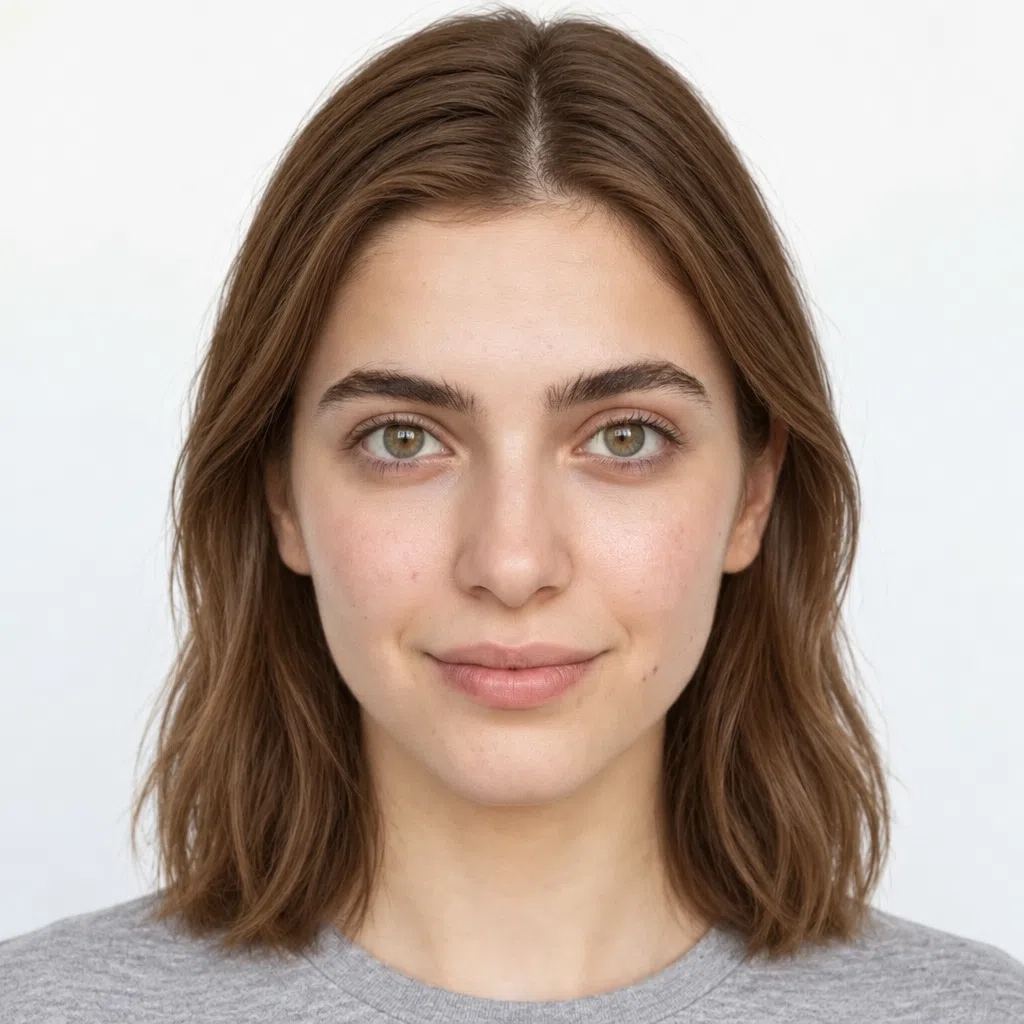 One flat block
The shade is right, but every strand is the same value, so the hair reads as a helmet of color and loses the depth this coloring is built on.
-
 Caramel ribbons
The same bronze at the root, with fine caramel and golden copper ribbons through the lengths. Deeper at the scalp, lighter where it moves - this is what most people mean by highlights on a Warm Autumn.
-
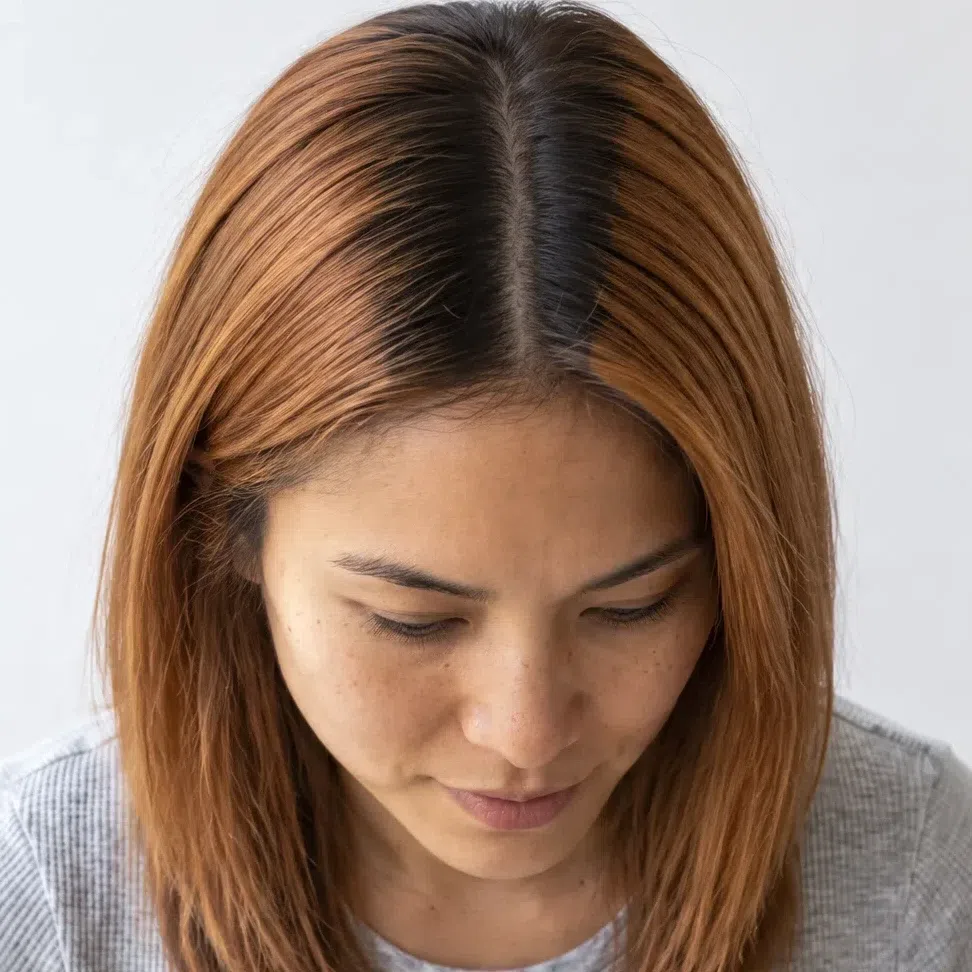 A hard regrowth line
Copper painted flush to the scalp. By week three her darker level 4 has grown in as a straight, solid stripe.
-
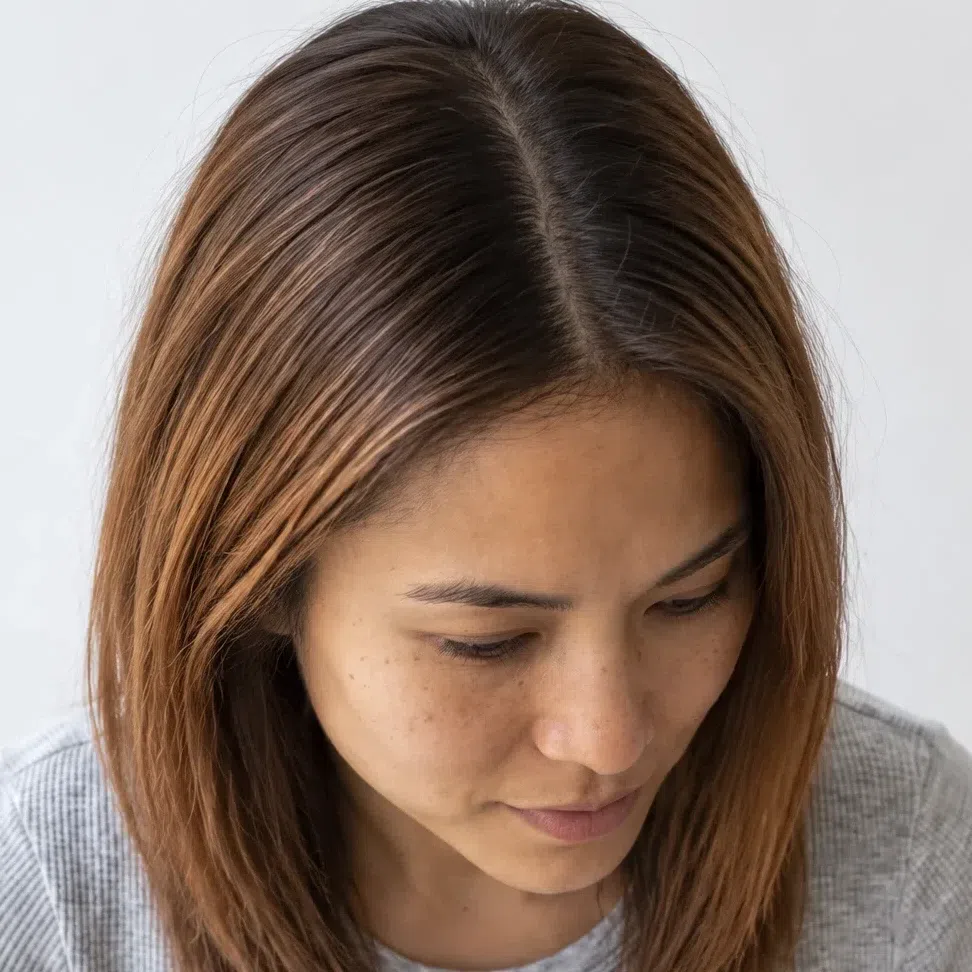 A root smudge
Identical copper, but her own depth was left at the root and feathered into it. Same three weeks, no stripe.
And what the distance costs you
This is the reason the script keeps the move small. Regrowth is only as visible as the gap between the dyed length and what is coming in. The same natural level 4 twice, both at three weeks, one gap two levels wide and one four.
-
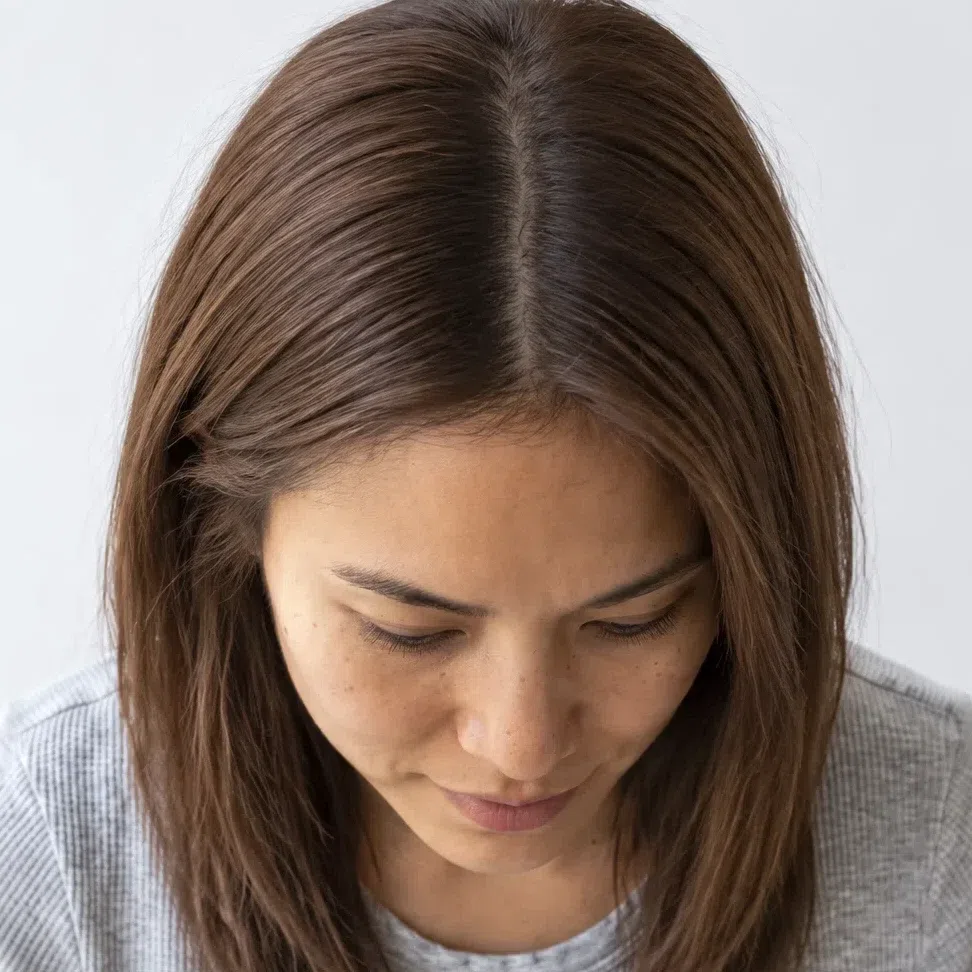 Two levels from natural
Sunlit chestnut at level 6. The new growth reads as a shadow, and a faint one.
-
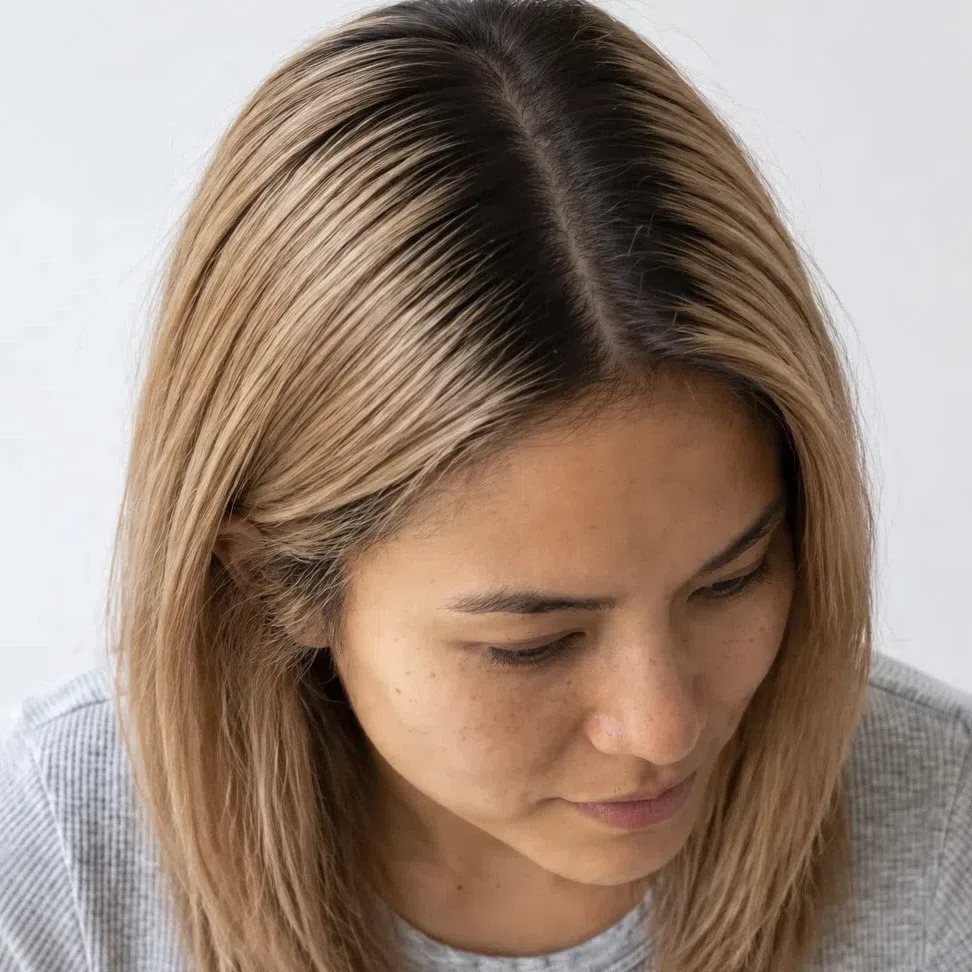 Four levels from natural
Level 8, the very top of the range. The same three weeks have left a stripe down the parting.
The phrasebook
Say this
- “Level 6, gold-copper”
- A depth and a direction together, in the right order. The colorist has nothing left to guess.
- “Keep my own root, ribbons through the lengths”
- Depth stays where it grows, the light goes where it moves, and the grow-out reads as a choice.
- “A golden gloss to finish, no ash”
- Most salons tone lightened hair by default, and the default bottle is violet or blue. Saying this first is the only way to skip it.
- “Richer, not lighter”
- The right instinct when a color looks tired on you. More warmth at the same level does more than a level up.
And what these get you
- “Tone down the red”
- Usually a green or ash corrector, which takes your own warmth down with it. If the red is too much, ask for a 6.3 next time instead.
- “Something cooler and more expensive-looking”
- Mushroom and ash browns are the look behind that phrase, and both are on the wrong side of your palette.
- “A cherry or burgundy red”
- Red with blue in it. You can wear red, but these two sit on the cool side of it - ruby red and cool mahogany are both on your avoid list.
- “Blonde, like my holiday photos”
- Sun lightens the ends and adds gold for free. At the salon the same look means lightening to a level 8 or 9 all over, which is past the top of your range.
So the brief is short: your number, gold before copper, light in the lengths. Of the three, the number moves least on a Warm Autumn - which raises the question of how far up it can go at all.
How light can a Warm Autumn go?
Lighter than people expect, and not as light as the photos you have saved. Your palette tops out at level 8: the caramel and golden copper ramps both reach it, and nothing on your list goes past it. Whether you can get there depends on where you start. Two women, two starting levels, only the lightness changing.
Yes, to a golden caramel blonde - up to about three levels above your natural, and no lighter than level 8. Whichever limit you hit first is your ceiling. Past it the gold thins out, the hair gets lighter than your skin and brows can support, and what was warm starts to read as washed out.
A natural level 6, already near the top of the range. She reaches level 8 in two steps, and that is the end of the palette.
-
 Her natural, L6
Her own light brown - a sunlit chestnut on the palette, and more flattering than it gets credit for.
-
 One up, L7 caramel
Caramel. One level up is enough for her skin to pick up the warmth.
-
 Her ceiling, L8
Golden caramel blonde at level 8 - still warm, still her, and the lightest shade on this palette.
-
 Past it, pearl
Pearl blonde, from your avoid list. Lighter, and cooler, and her rosy cheeks start to read as redness.
Now a natural level 4 taking the same kind of steps. Her ceiling is a level lower, because she started two levels deeper.
-
 Her natural, L4
Her own warm dark brown, and every bit as Warm Autumn as the lighter heads on this page.
-
 Two up, L6 bronze
Bronze brown. Two levels up, and the gold in her skin comes forward.
-
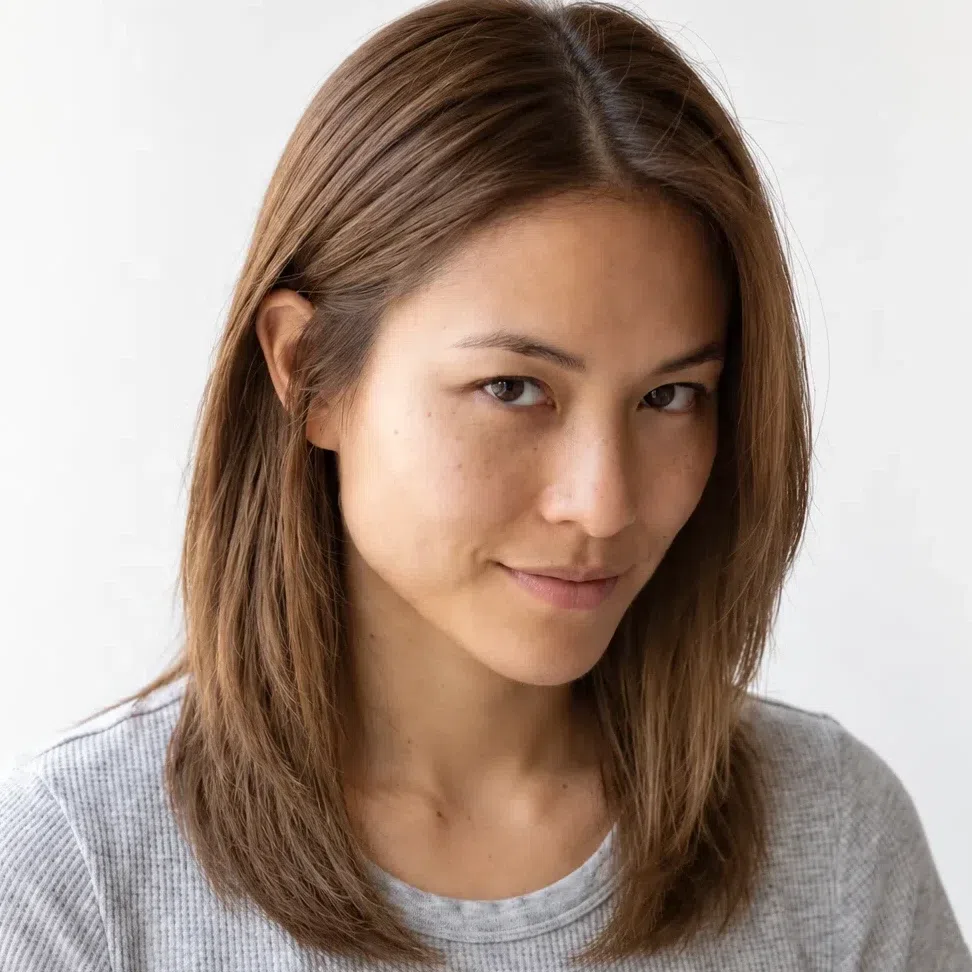 Her ceiling, L7
Caramel at 7, three rungs up - as far as a natural 4 goes before the root starts to show.
-
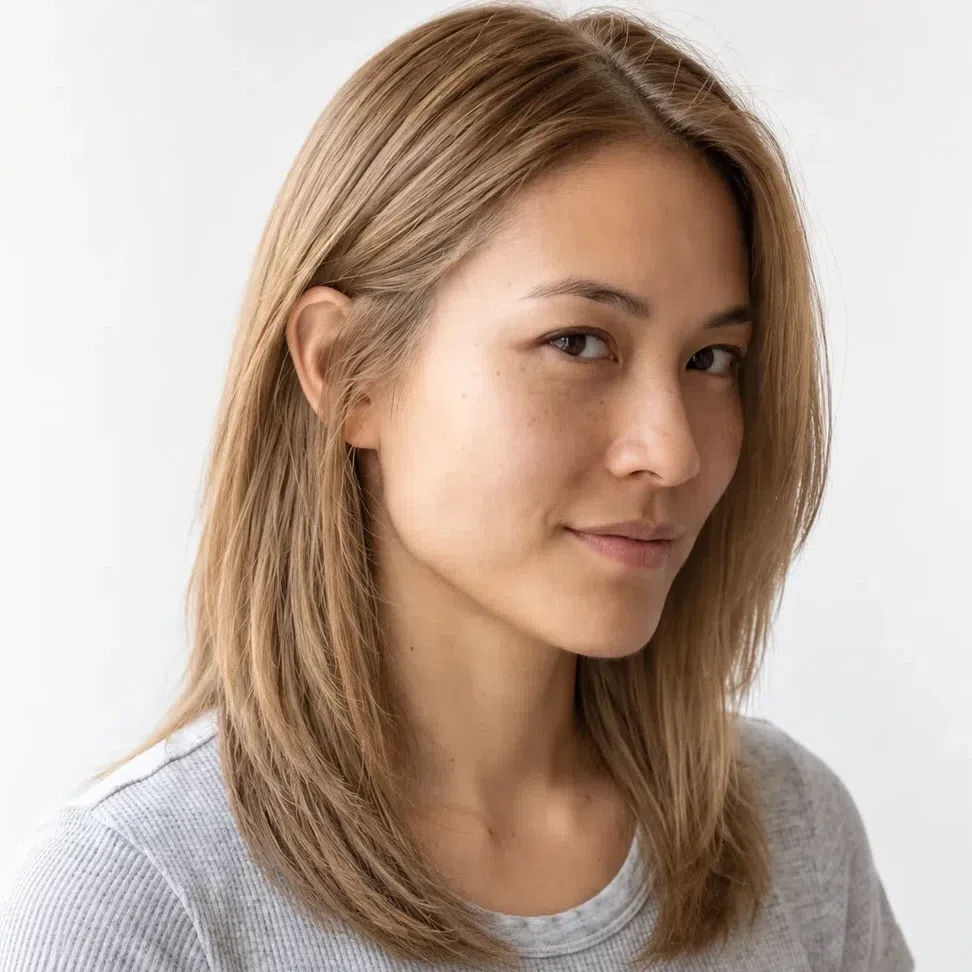 Past it, L8
The top of the palette, four rungs from where she began. Next to her dark brows it reads as a wig.
Put the top row’s third photo next to the bottom row’s fourth. Same hex, the level 8 caramel blonde at the top of your palette. On the woman who started at 6 it is a two-step move and looks like hers. On the woman who started at 4 it is a four-step move and looks borrowed - the shade is identical, only the starting point differs. A Warm Autumn’s best blonde is a distance from her own hair, not a color on a card.
The limit at the top has a physical reason. Lightener removes pigment, and the warm pigment in your hair is the last to go - which is why a lightened Warm Autumn head turns orange, then yellow, then pale. Stop at the orange-gold stage and a gloss turns it into caramel or golden copper. Push on to pale yellow and the only way to make it look finished is a violet toner, which lands you on pearl or ash: both on your avoid list.
If you have been told you look "washed out" as a blonde, this is usually why. It is rarely the blonde itself. It is a level past 8, or a toner that took the gold out.
If you want to go lighter anyway
-
Lighten the lengths, not the root
Caramel ribbons or a balayage give you most of the light a full blonde would, without moving the hair at your scalp. The regrowth question goes away.
Caramel through the lengths, my own color at the root. -
Stop at the orange-gold stage
Ask your colorist to stop lifting while the hair still carries warm pigment, then gloss it gold. That is the difference between a golden caramel and a toned-down pale blonde.
Stop at an 8 and gloss it gold - I want caramel, not pearl. -
Bring the brows along
If you do go to level 8, a brow tint a shade warmer than before keeps the face from looking unframed. Deeper brows on a light head are what make it look deliberate.
Can we warm my brows up a shade to match?
So blonde is possible, with a firm top at level 8. Red is the opposite story: there is no ceiling to worry about, only a direction.
Which red works on a Warm Autumn?
Red is on your palette - ginger, spiced auburn, golden copper - so the question is not whether you can wear it. It is which side of red. Every red leans one of two ways: toward orange, or toward blue. Your side is orange. Two women, both at level 5, only the direction of the red changing.
Yes - any red that leans toward orange: ginger, copper, spiced auburn. The line is not how red you go but which way the red turns. Once it leans toward blue - ruby, cherry, cool mahogany, burgundy - it stops working, at any depth and on any skin.
Olive skin, level 5 in all four frames. The red walks from orange toward blue.
-
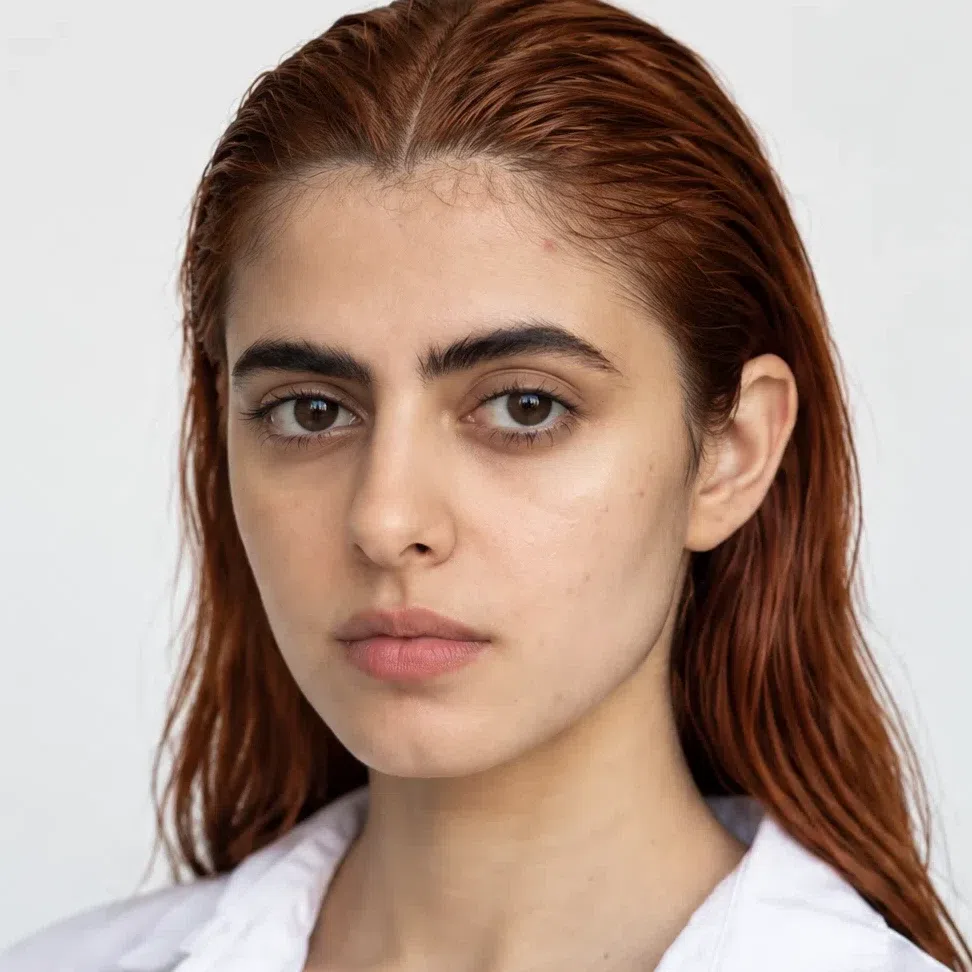 Ginger, deepened
Ginger at level 5. Her skin warms up to meet it, and the red reads as hers.
-
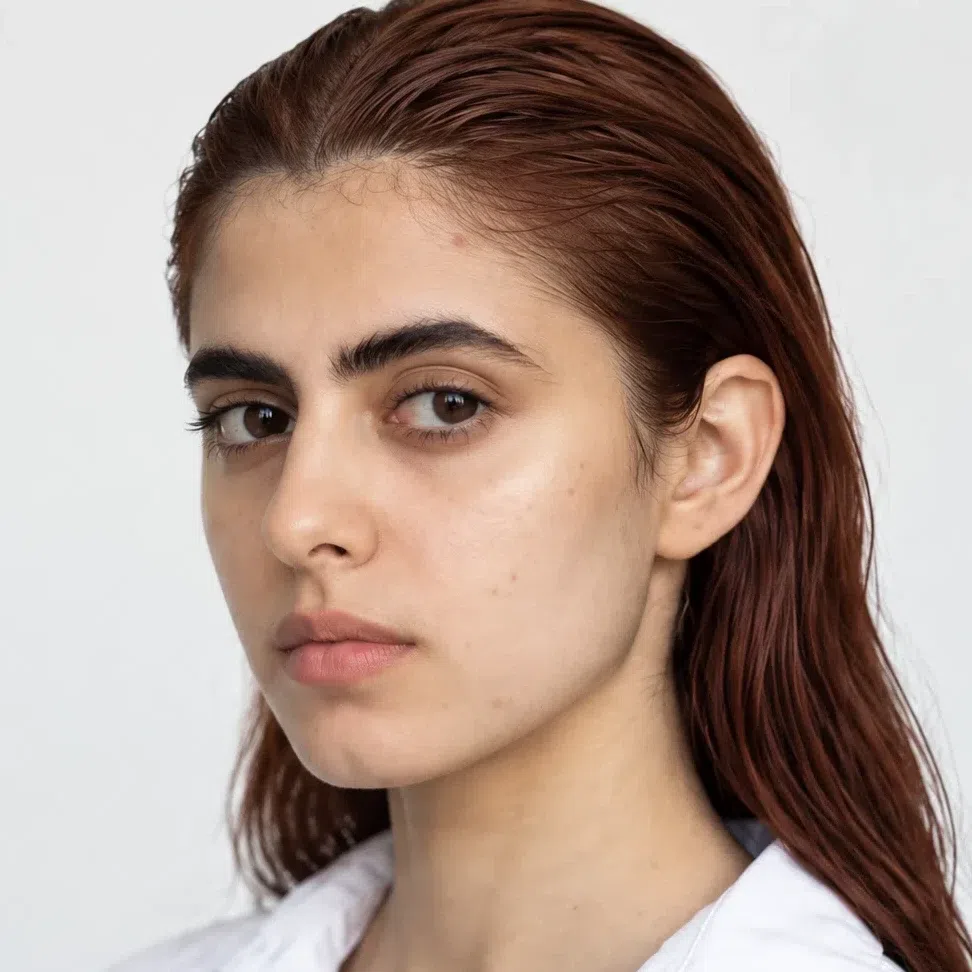 Spiced auburn
 - brown first, red second. The most forgiving red on the palette.
-
 Ruby red
The same depth, turned toward blue. The hair arrives first and the skin looks yellow beside it.
-
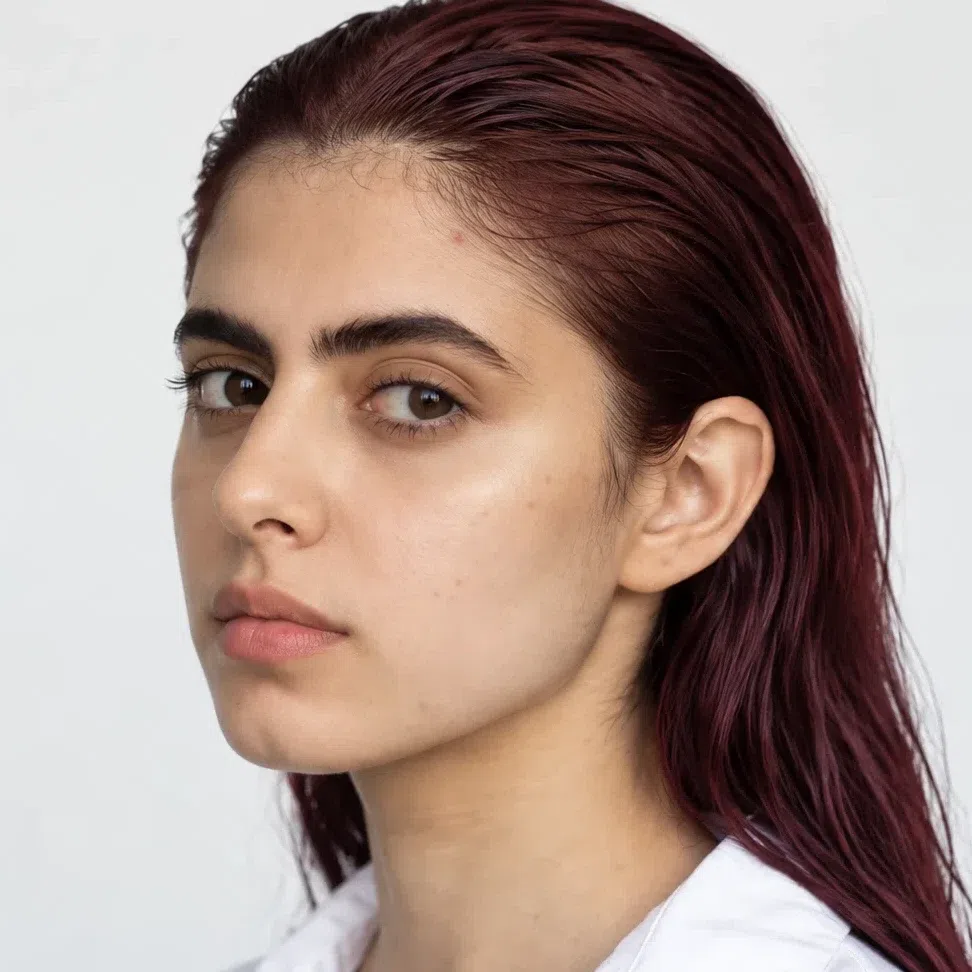 Cool mahogany
Violet in the red. Deeper, quieter, and it still pulls the warmth out of her face.
Deep bronze skin, the same level 5, the same four reds.
-
 Ginger, deepened
Ginger at level 5. Her skin warms up to meet it, and the red reads as hers.
-
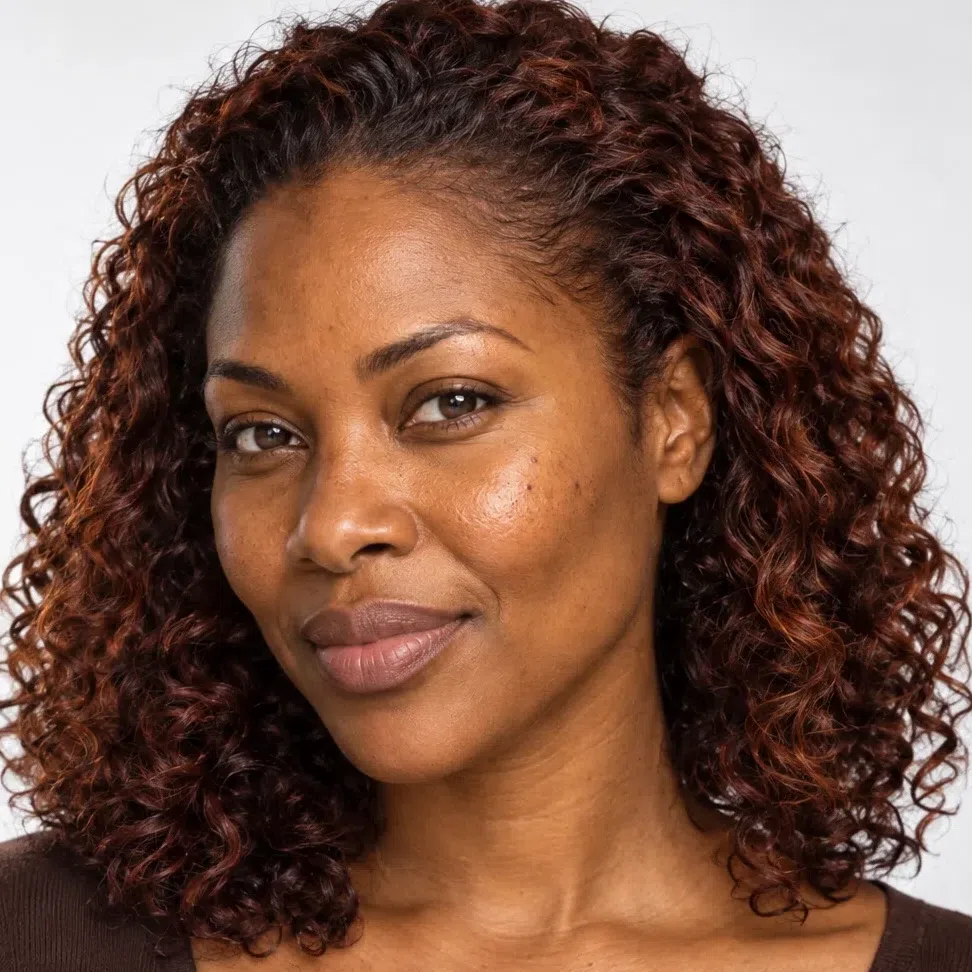 Spiced auburn
 - brown first, red second. The most forgiving red on the palette.
-
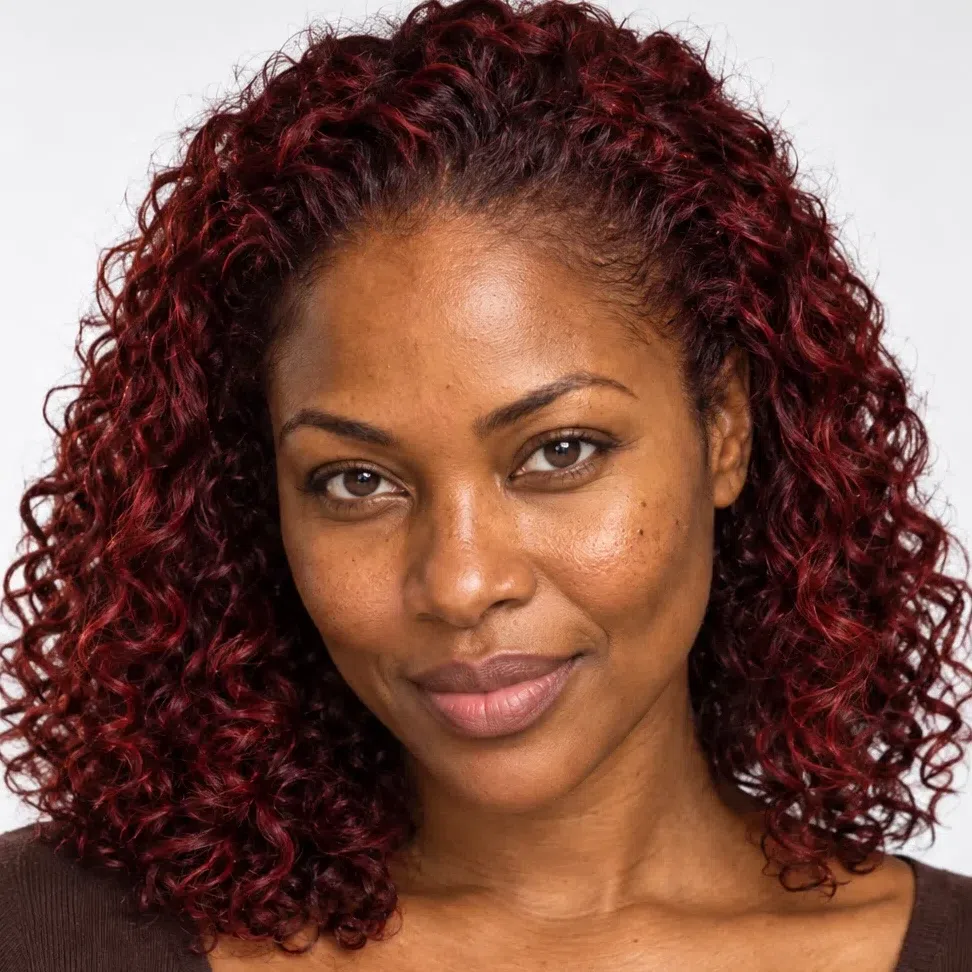 Ruby red
The same depth, turned toward blue. The hair arrives first and the skin looks yellow beside it.
-
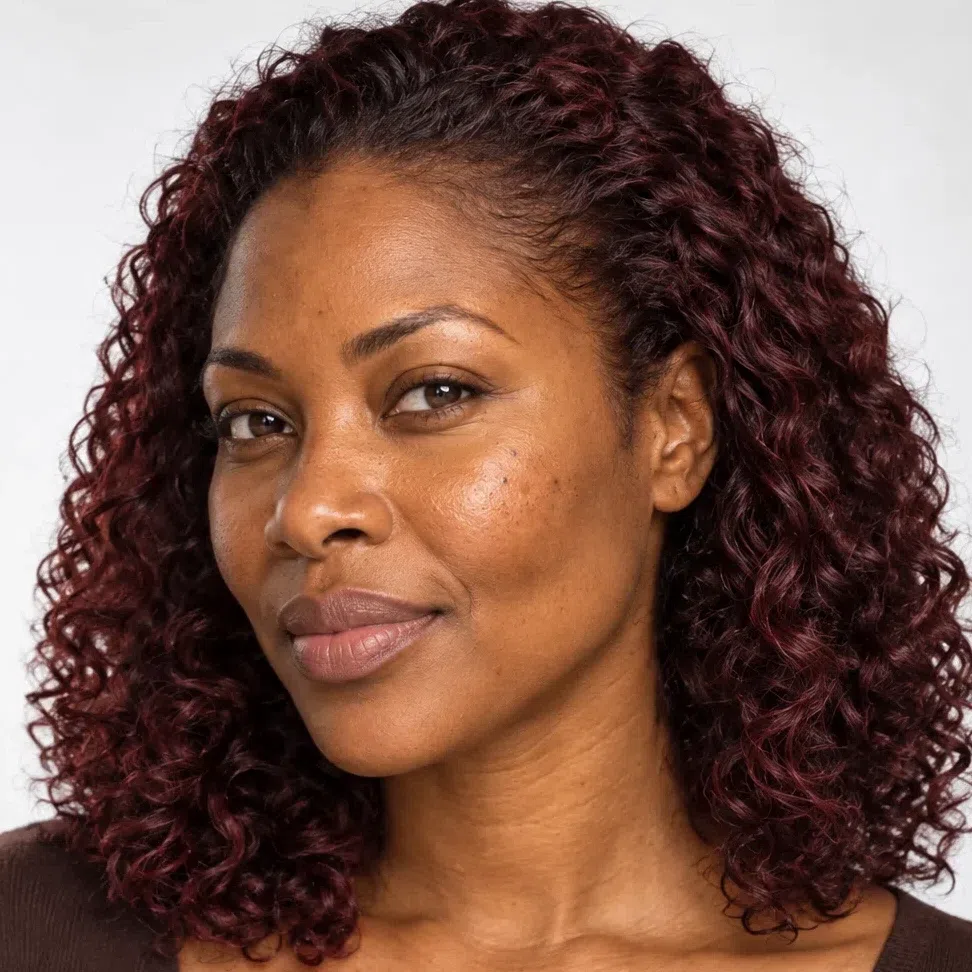 Cool mahogany
Violet in the red. Deeper, quieter, and it still pulls the warmth out of her face.
Compare the second and third frames in each row. Spiced auburn and ruby red sit within four points of each other in lightness on the parent palette - one of them is on your list and the other is on your avoid list. The only real difference is which side of red they fall on. Now compare the two rows: olive skin and deep skin, and the line falls in the same place. That is what makes red different from blonde. Blonde has a ceiling that moves with you. Red has a direction, and it is the same for every Warm Autumn.
Salon codes make this easy to say. .4 is copper and .6 is red in most systems, and both lean warm. .5 is mahogany, and in most brands it sits between red and violet - ask what a mahogany is paired with before you agree to it. A 5.46 or a 6.46 is copper-red, and sits right in your range. Anything with a .2 in it is violet, and ruby and burgundy shades usually carry one.
Depth is free. Your palette carries red from a level 7 golden copper down to a level 5 auburn, and the ramps run to level 4. Go as deep as looks right on you; it is the direction that decides it.
Copper and ginger are the boldest colors on this palette, and they are the first to fade - more on that in the keeping-it section. First, the question every Warm Autumn eventually gets to: gray.
Going gray as a Warm Autumn
This is the hardest question on the page, and it deserves a straight answer. Gray hair has no pigment left, so it reads cool, and your coloring is warm. That does not make gray wrong. It means gray is the one hair color that asks your face to supply all the warmth itself, and some faces can and some cannot.
Blend it with warm lowlights first; go fully silver only if the contrast suits you. On a Warm Autumn, gray is a real trade-off rather than a free win. A warm blend buys the most time, and whether full silver works depends more on your skin depth than on your season.
Light warm skin, in her mid fifties. Four ways to handle the same gray.
-
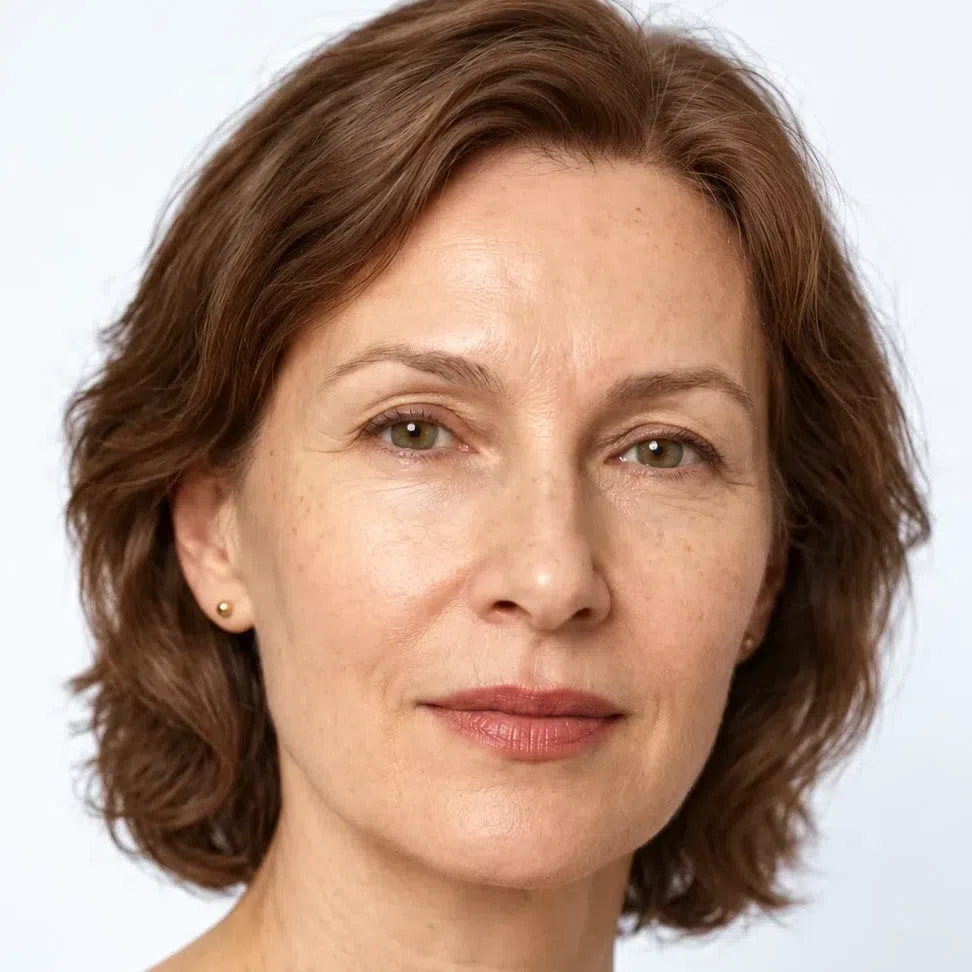 Covered
Golden chocolate from root to end. It works, and it is a choice you have to keep making every four to six weeks.
-
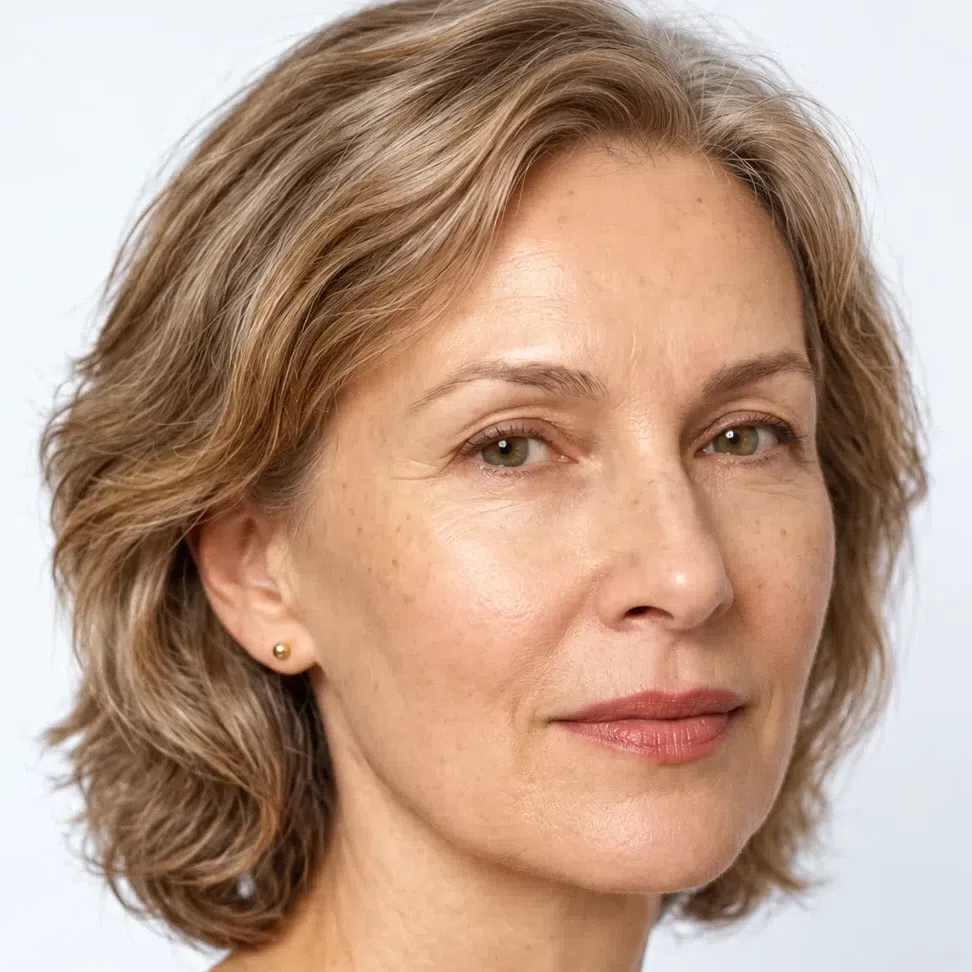 Blended
Warm lowlights woven through the gray. The silver reads as light in the hair rather than as gray.
-
 Growing it out
Gray root, faded brass below it. The hardest stage, and the one worth planning around.
-
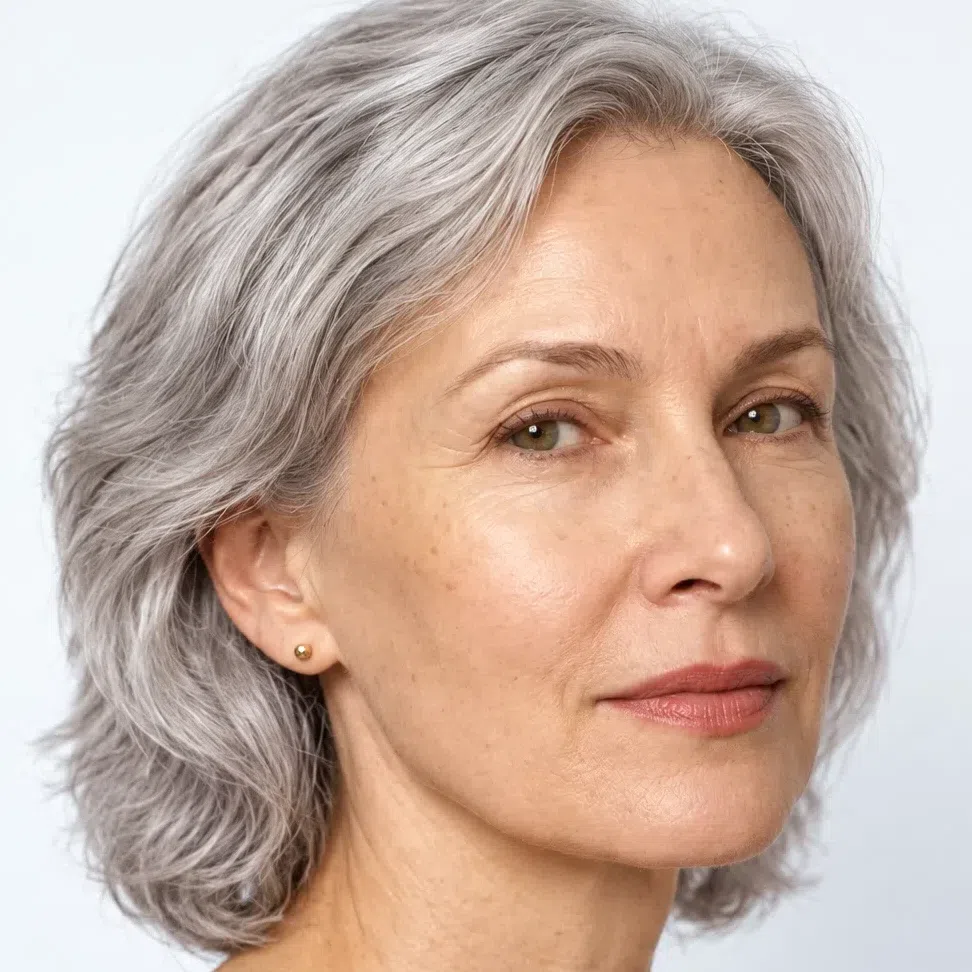 Full silver
Clean and pretty, and cooler than anything else on her face. Beside light warm skin, the silver takes the color out of her cheeks.
Deep bronze skin with a golden undertone. The same four choices.
-
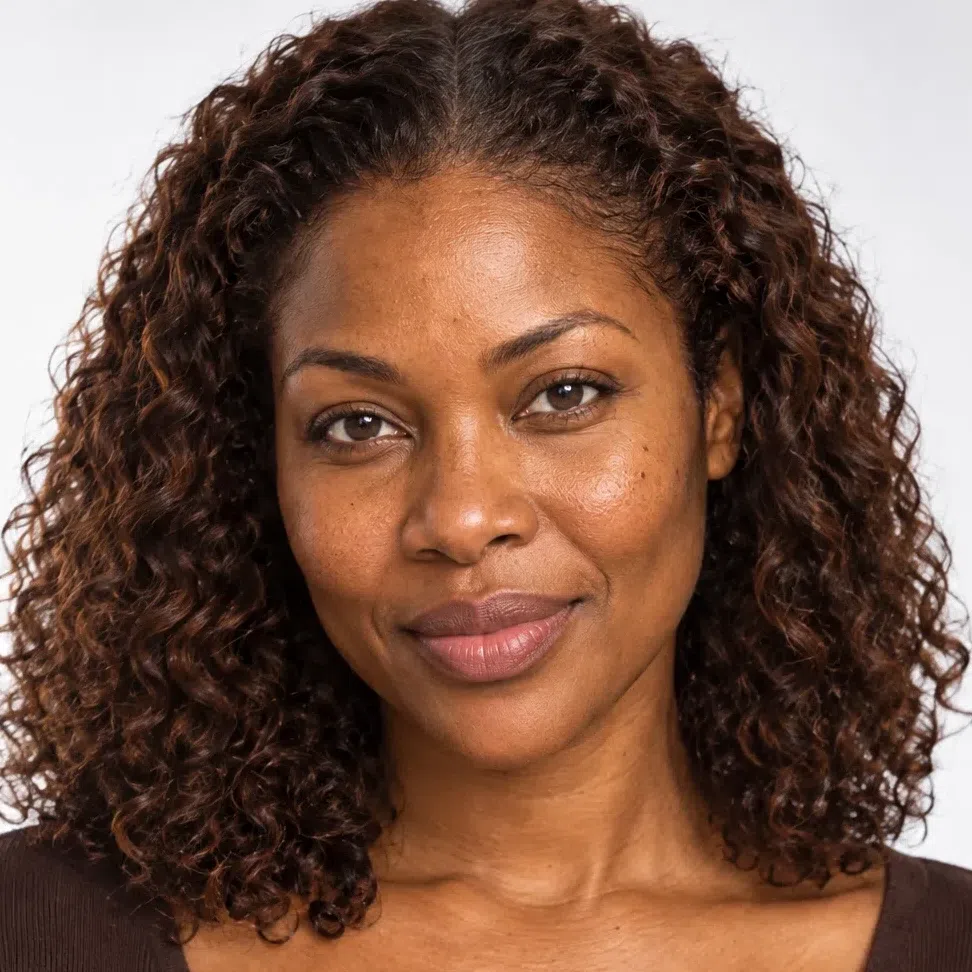 Covered
Golden chocolate from root to end. It works, and it is a choice you have to keep making every four to six weeks.
-
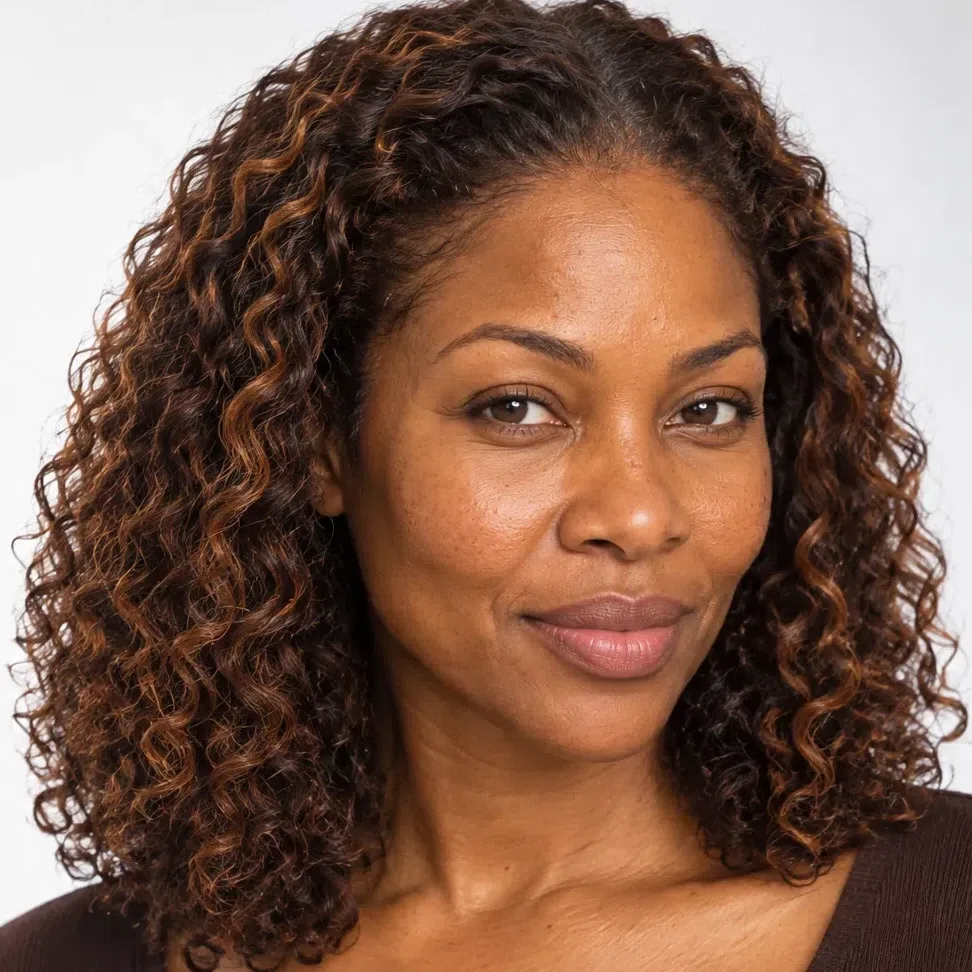 Blended
Warm lowlights woven through the gray. The silver reads as light in the hair rather than as gray.
-
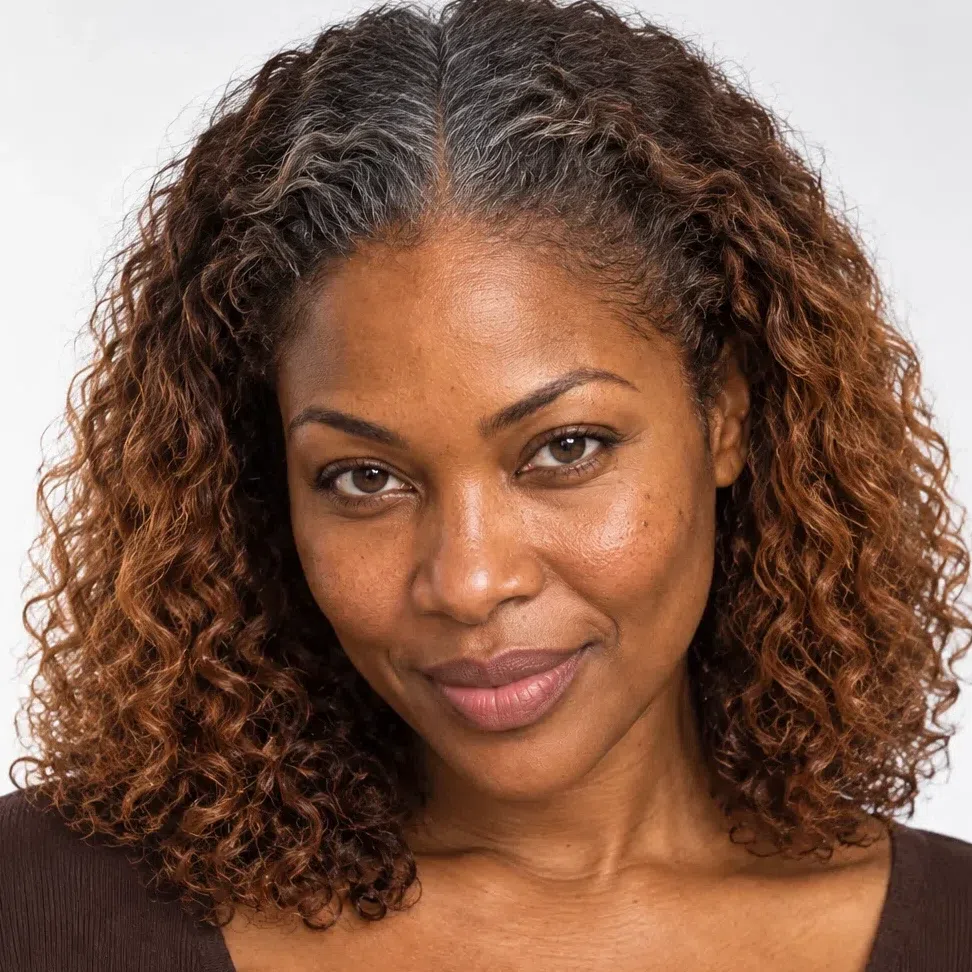 Growing it out
Gray root, faded brass below it. The hardest stage, and the one worth planning around.
-
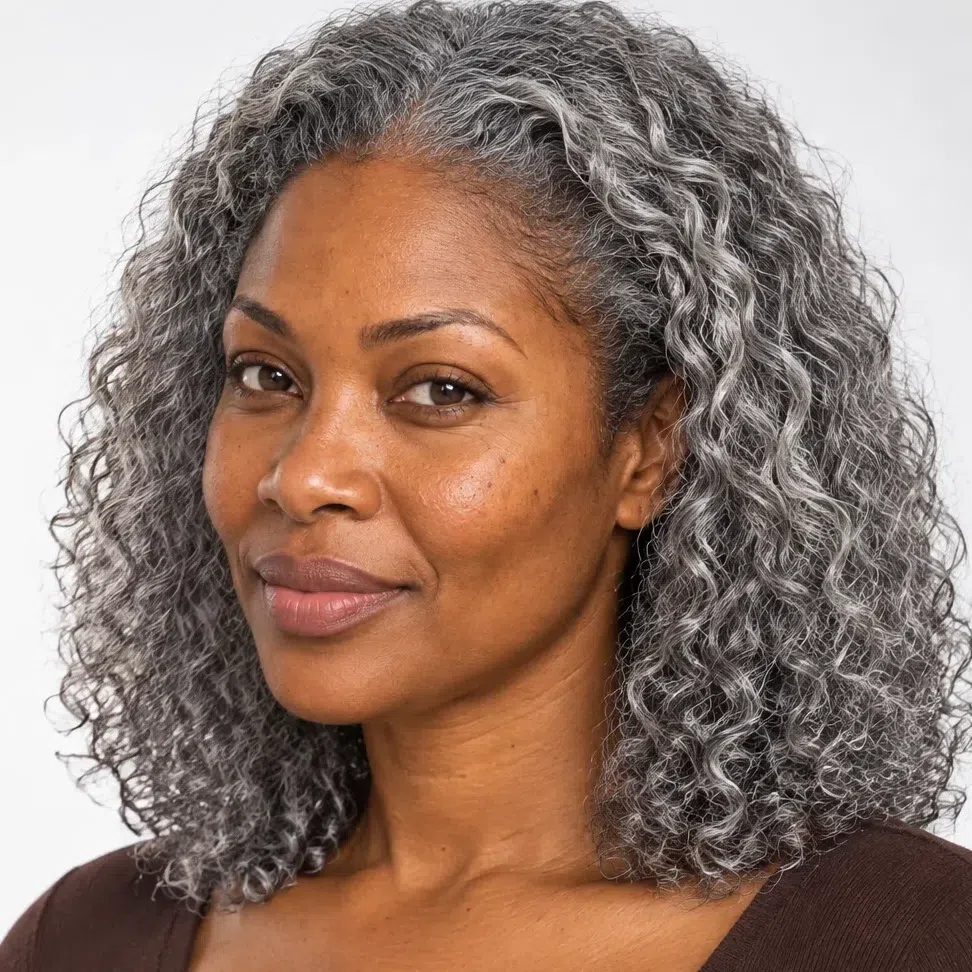 Full silver
The same silver, and it lands differently: against deep skin it reads as a deliberate contrast, and the warmth of her skin holds it.
Compare the last frame of each row. The same full silver. On light warm skin it sits close to her own value and cools everything around it, so the face looks paler than it is. On deep bronze skin the same silver is the lightest thing in the picture by a long way, and a warm, deep face carries that kind of contrast well - the way it carries gold jewelry. The blended frame works in both rows. Full silver depends on you.
The study quoted above showed people the same faces with and without gray hair: with gray they were rated older and less attractive. That is one study, with digitally changed photographs, and it tested plain gray against plain color - not a blend. It is still the honest answer to the question most people are really asking.
If the question is what hair color makes you look younger, the practical answer on this coloring is a warm blend at about your old natural level, or one lighter: caramel or golden light brown woven through the gray, never a solid dark dye. Solid dark over gray grows out as a stripe within weeks, and dark hair next to skin that has lost some depth reads harsher than it did at thirty.
Silver has its own upkeep. With no pigment to protect it, gray picks up yellow from sun and styling heat faster than colored hair does. On a warm coloring, a little of that creaminess is fine - a clear gloss is enough. A strong violet shampoo makes it steely, which is the version that suits you least.
Linear mixed-effects models indicated that faces with gray hair were perceived as older and less attractive.
Whether it is copper, caramel or silver, what you are protecting between appointments is the same thing: the tone. That is the next section.
Keeping it, between appointments
Copper looks its best on the day it is done and a little less every week after. For a Warm Autumn, whose palette leans on copper and ginger, what happens between appointments matters as much as the appointment.
Your color is not getting lighter. It is losing its copper, and heading for ash. The red goes first, then the gold thins, and what is left at week ten is a sandy beige that measures within a few degrees of the ash blonde on your avoid list. People call it fading. On this coloring it is closer to drifting to the wrong side of your palette - and the fix is to put warmth back, not to go lighter.
Golden copper at level 7, shot at the same spot behind the ear four times over ten weeks. Every frame is exactly as light as the first; what drains away is the copper.
-
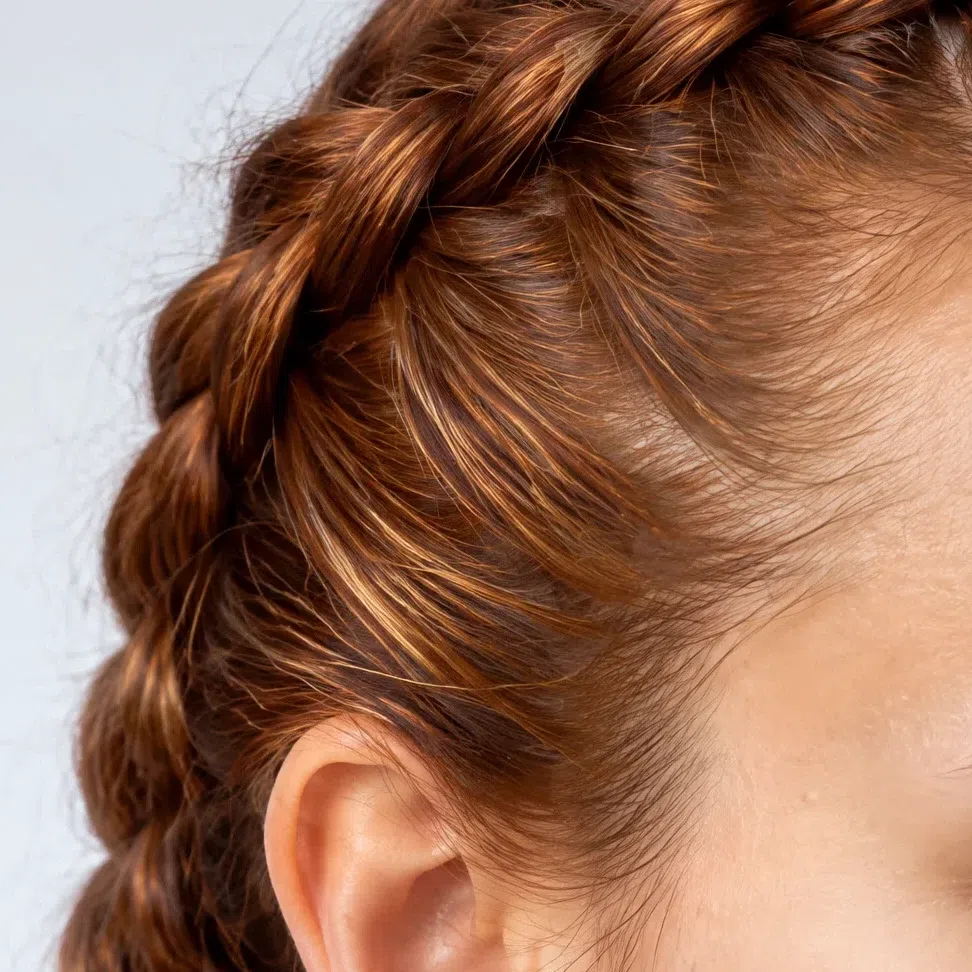 Day one
New copper, several warm values moving through it, light coming straight back off it.
-
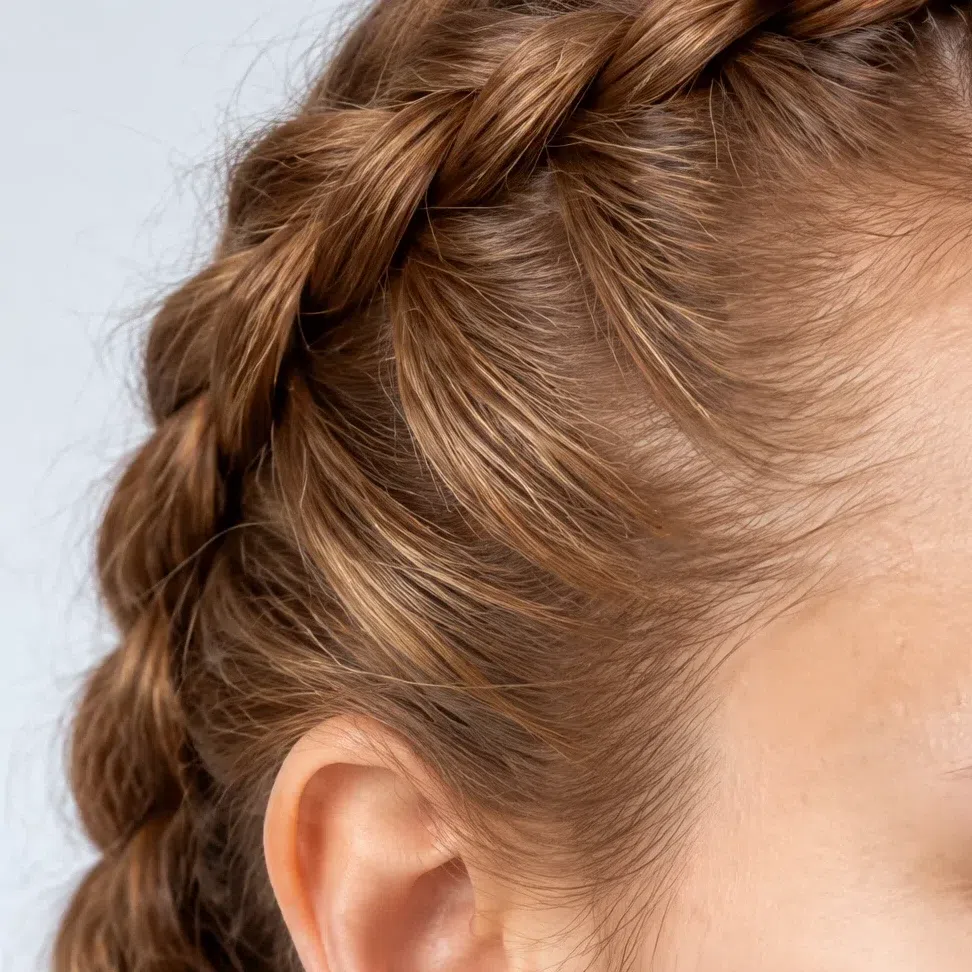 Three weeks
More gold than copper now - and not one shade lighter than day one.
-
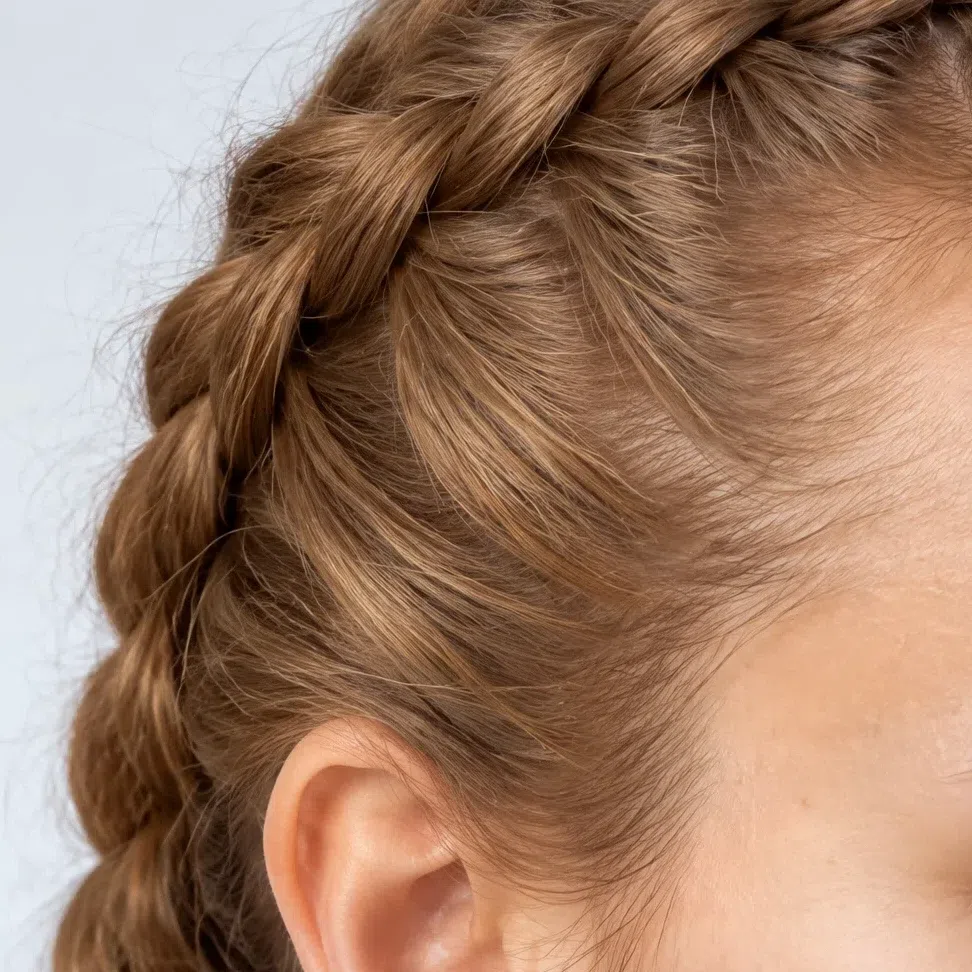 Six weeks
A flat ginger-gold, one value all the way down. The shine has gone with the red.
-
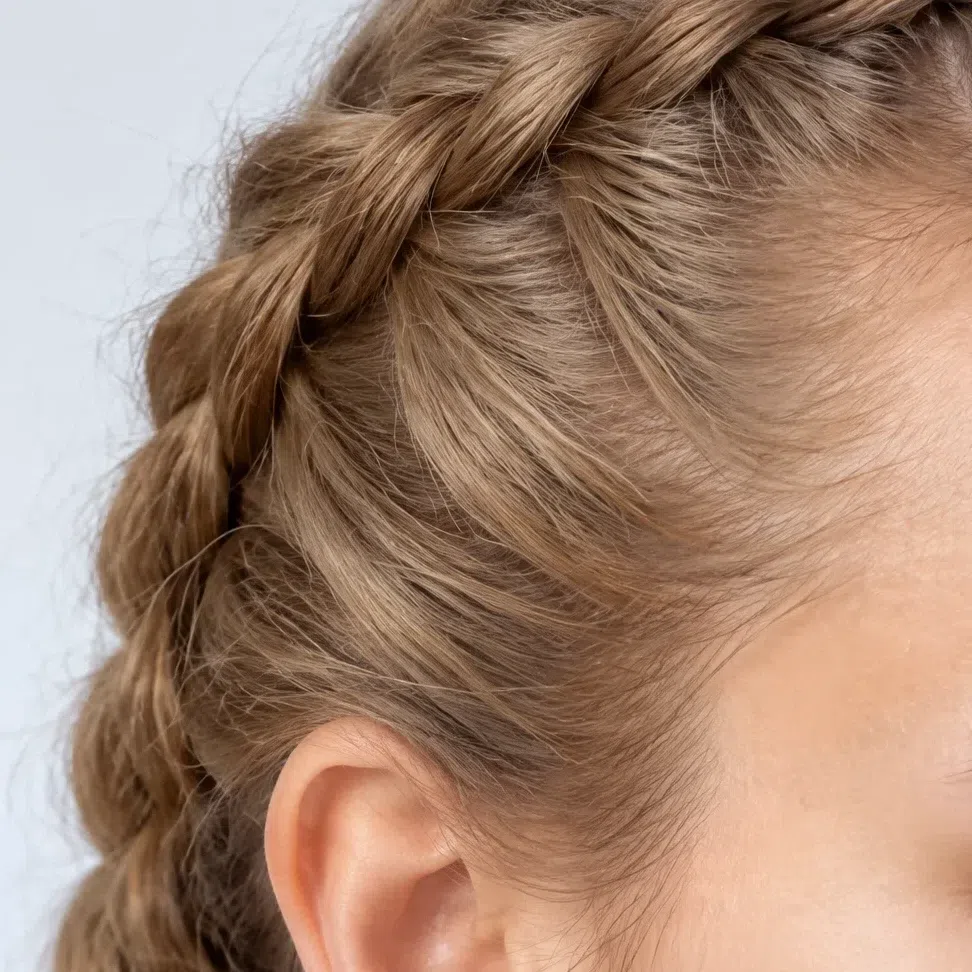 Ten weeks
Sandy beige, still level 7. Nothing got lighter; the warmth left.
Read the row as the same depth four times. The chips under the frames share one lightness; what drops is how much color they carry. By week ten the hue has drifted toward yellow-beige and the saturation has fallen to a third, which puts the fade right next to the ash shades on your avoid list. That is why tired copper looks so wrong on a Warm Autumn, when the same fade on a cool season barely registers.
Dye leaves hair mostly by dissolving into water, which is the one thing every wash has plenty of. Fewer washes and cooler water are therefore the two cheapest ways to keep the color, and they do more than any product.
When copper dulls, most people either ask the salon to "take the orange out" or go a shade lighter to brighten it. On this coloring both backfire. A blue or violet toner smothers what warmth is left; more lightener removes the pigment you are trying to hold on to. The fix is warmth at the same depth.
The fading occurs primarily through hair dye solubility in water.
Four things that keep the copper
-
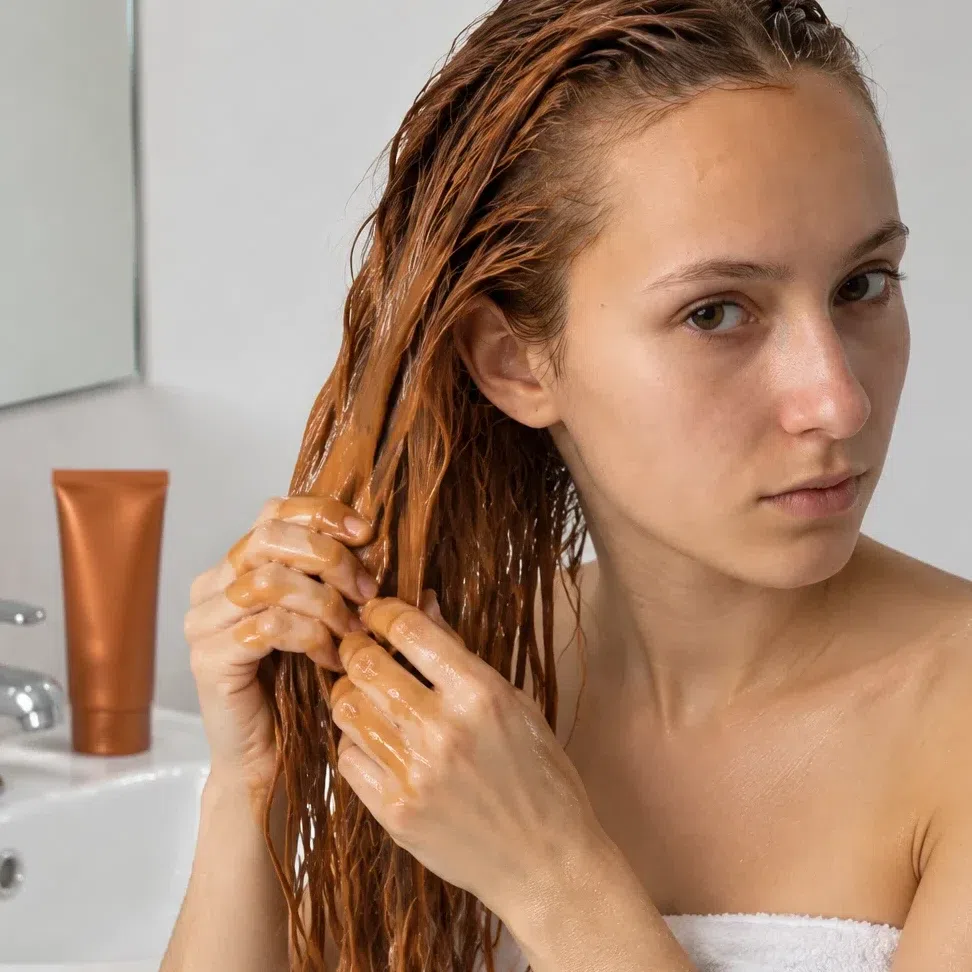 Feed the copper
A copper or gold color-depositing conditioner once a week puts back what the washes take out. Check the bottle: purple and blue ones are made for blondes and do the opposite here.
Copper conditioner on Sundays, left on for five minutes. -
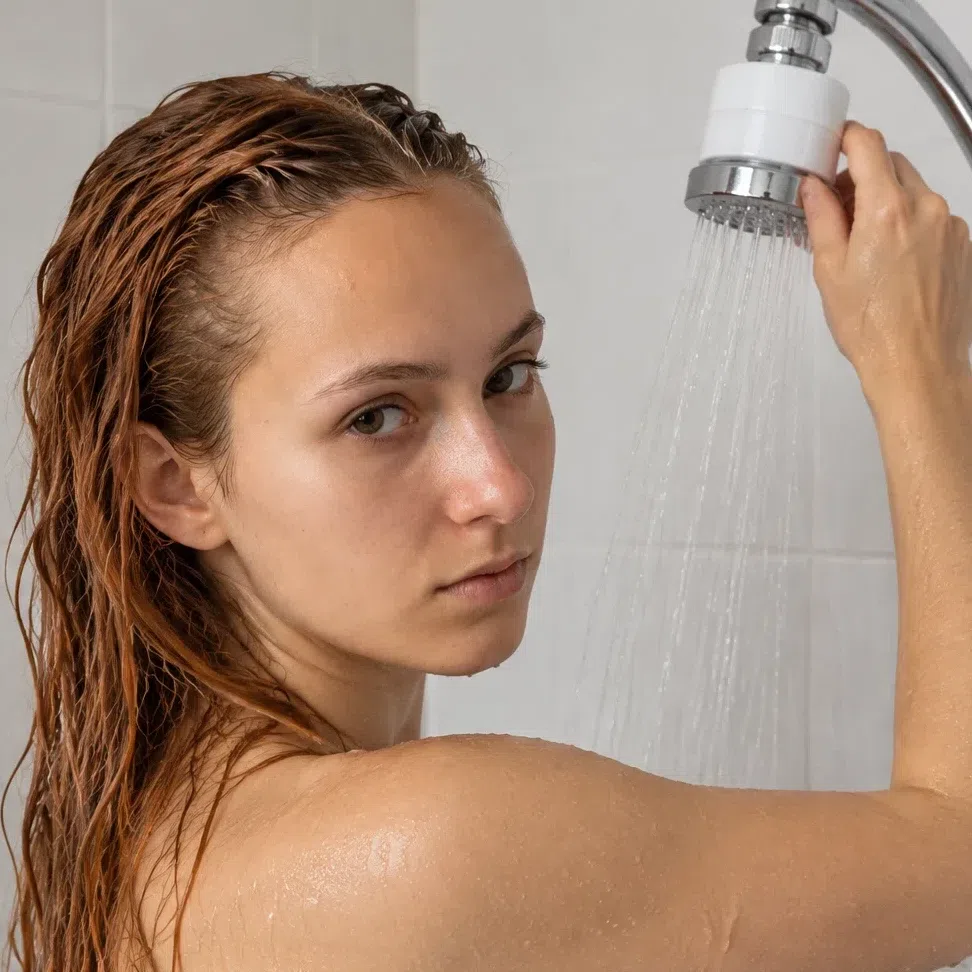 Wash it less
Every wash dissolves some dye. Going from daily to every third day is the biggest single change you can make. A shower filter will not hurt, but it is the number of washes that counts.
Every third day, dry shampoo in between. -
 Rinse cool
Hot water opens the hair surface and lets more dye out with every rinse. Lukewarm to wash, cool for the last rinse.
The last thirty seconds cold. -
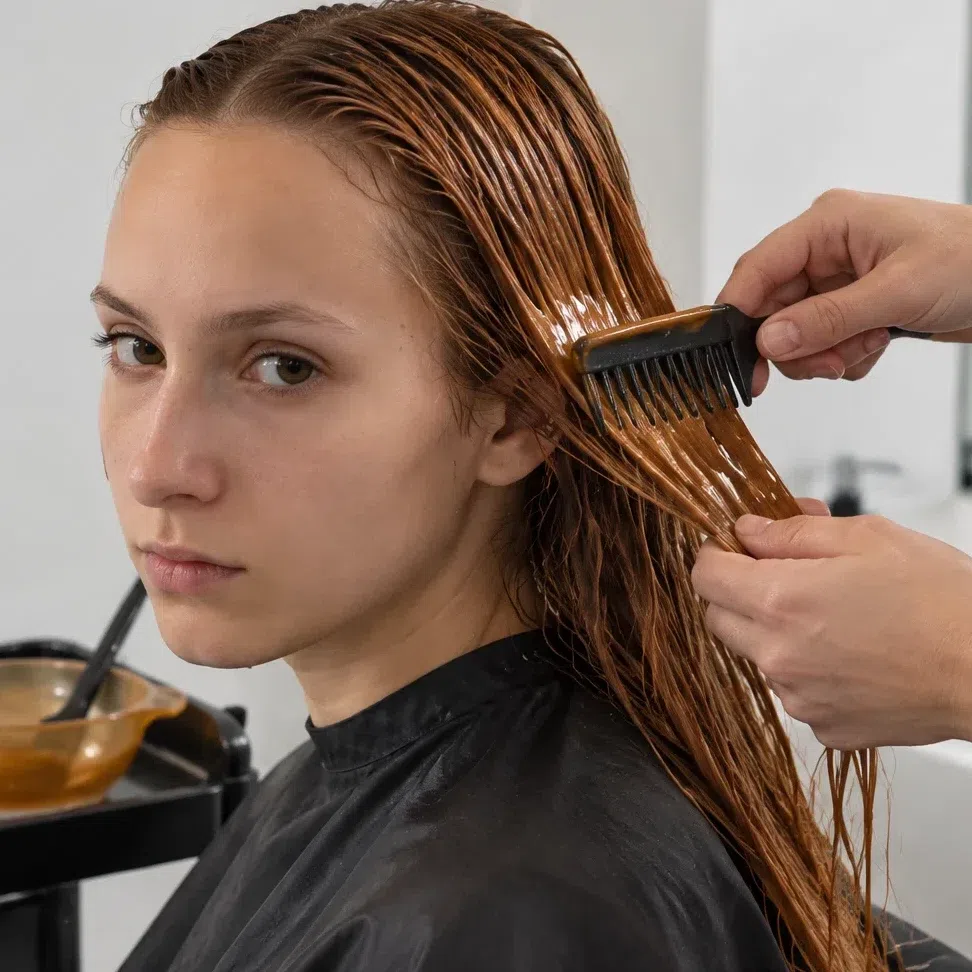 A golden gloss at week six
A gloss is a short, cheap appointment that puts tone back without lifting anything. Ask for golden copper, and it resets week six to day one.
Just a golden copper gloss, no lightener.
That is how a warm color stays warm. The next section covers the reverse: the shades that never did suit this coloring, and the two ways a Warm Autumn head goes wrong.
What goes wrong, and why
Two diagnoses first - they look alike in the mirror and are fixed in opposite ways. After them, twelve shades that cause them, photographed on an ordinary face outdoors on a gray afternoon, because studio light flatters every hair color and would hide the difference.
The two mistakes
The hair wears you
- How you can tell
- Friends comment on the color, not on you. In photos the hair takes the focus and your face seems to recede behind it.
- Why
- The hair has moved too far from your own depth: a level 9 blonde over a natural 5, or near-black over a natural 6. Warm Autumn coloring sits in the middle of the scale, with medium contrast, and a head of hair at either end of the scale outweighs it.
- Fix
- Close the distance. Step one or two levels back toward your own color with the same warm tone. Trading one extreme shade for another at the same depth fixes nothing: the depth is what went wrong.
It went flat, and you look tired
- How you can tell
- Nothing looks obviously wrong, but your skin looks sallow and a little gray, and the shadows under your eyes come forward. The hair looks fine up close and dull from across the room.
- Why
- The warmth went out of it: an ash or violet toner, a "natural" beige, a copper that faded to sand, or one flat single color with no dimension in it. Your skin is warm and needs warmth beside it to look well.
- Fix
- Put warmth and depth back. A golden or copper gloss at the same level, and a few deeper caramel or bronze ribbons for dimension. Do not go lighter to freshen it up - that lifts out more of the warm pigment you are missing.
The twelve shades, on a real face
Your palette page lists seven shades to avoid, and they are all here with their swatches, plus the ash brown from the salon table. The third group is new: four warm colors that still fail. One ordinary woman on one gray street throughout; only her hair color changes.
Cold, ashy blondes
-
 Platinum blonde
warm
-
 Ash blonde
warm
-
 Pearl blonde
warm
-
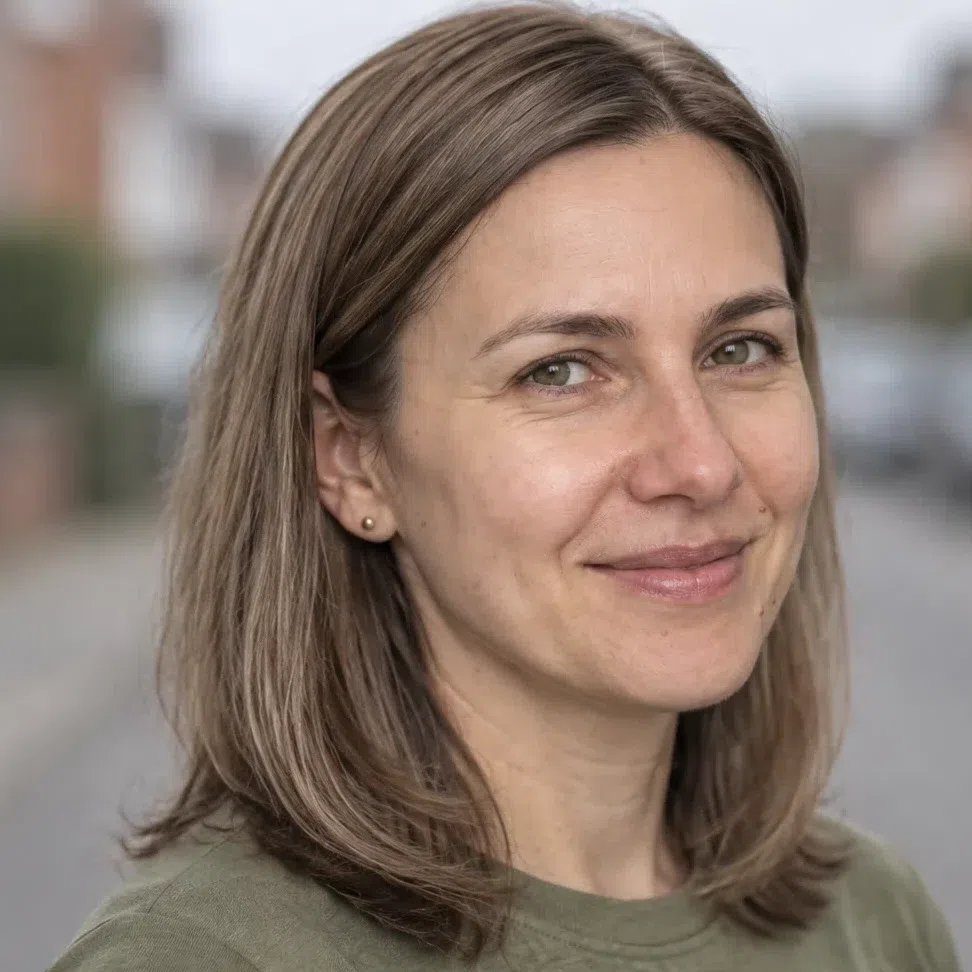 Ash brown
warm
No warmth anywhere in them. Next to a golden face they do not merely clash - the skin itself goes grayer.
Harsh and artificial
-
 Blue-black
hard
-
 Plum black
warm
-
 Cool mahogany
warm
-
 Ruby red
clean
Blue-black, violet and blue-red. Colors hair does not grow in, and on this coloring they look applied rather than worn.
Warm, and still wrong
-
 Golden chocolate, taken to level 2
hard
-
 Golden blonde, taken to level 9
hard
-
 Raw brass
clean
-
 Faded copper
warm
For anyone who has read the rest of this page. All four started warm; each one fails on something else - two are too far from your level, one is too raw, and one has faded out of its warmth.
What the tags mean
- warmNo warmth
- Ash, pearl, platinum, violet, blue-leaning red, and copper faded to nothing. The makeup page shares this tag; for a warm season its meaning turns around and it flags shades with no gold or red to meet your skin.
- cleanToo synthetic
- More vivid than hair grows: ruby, neon copper, raw brass. Warm Autumn is a rich coloring rather than a clear one, so this tag flips from its meaning on the muted seasons - what fails here is color that looks brighter than anything else on your face.
- hardToo far
- Several levels away from your own hair, up or down. This one reads the same for every season, because contrast is a matter of distance rather than warmth.
Tally the tags: no warmth takes seven of twelve, so for this season the list is mostly a temperature list - the palette page says the same. The warm group is the one to reread. Golden chocolate is a shade you own at level 4 and a burden at level 2; faded copper is simply week ten from the upkeep row, now sitting with the ashes. Those four swatches are calculated from your palette’s ramps, not printed on it. The shades that do work are gathered in the next block.
Your shades, and the numbers to say
Everything above, reduced to what fits on a phone screen at the salon: eight shades with their levels, then the six tone digits you are likely to hear. Save it before the appointment.
The shades, with the level to ask for
- Golden copper L7 #D48A4D
- Ginger red L6 #B4532E
- Spiced auburn L5 #7F3F2C
- Bronze brown L6 #9C6A3C
- Caramel L7 #AF8855
- Sunlit chestnut L6 #8C6546
- Caramel ribbons L5 #7B5337
- Golden chocolate L4 #5E3C28
The numbers
- Gold copper 6.34 #9C6A3C
- Gold 6.3 #8C6C44
- Copper 6.4 #B4532E
- Natural 6.0 #7D6B5B
- Ash 6.1 #7A6F5E
- Violet 6.2 #835575
Ask for 6.34, 6.3 or 6.4 - bronze, gold, copper - and flip the first to 6.43 if you want the red to lead. The bottom three are here only so you can say no to them: 6.0 drifts beige and varies by brand, while 6.1 and 6.2 exist to take warmth away. The number in front of the point changes from one Warm Autumn to the next; the digits behind it do not.
Or read out the full brief: “I am about a level 5 naturally. I would like a level 6 gold-copper - a 6.34 - with caramel ribbons through the lengths and my own depth left at the root. If it needs toning at the end, a golden gloss, not an ash toner.”
The full Warm Autumn palette →
Questions people ask
What hair color looks best on a Warm Autumn?
Is True Autumn hair color the same as Warm Autumn?
What are the worst hair colors for a Warm Autumn?
What hair color makes an older Warm Autumn look younger?
Should a Warm Autumn get highlights?
Can a Warm Autumn be blonde?
What hair color suits an Asian Warm Autumn?
Can a Warm Autumn have red hair?
What should I ask for at the hair salon?
Why does my copper hair fade so fast?
Which box dye is best for a Warm Autumn?
Where this came from
The sources behind the factual claims on this page: salon numbering, the two pigments in hair, what lightener does to them, why one color cancels another, why dye fades, and how gray hair is read.
-
International Colour Charts for Hairdressing (opens in a new tab)
Hair & Makeup Artist Handbook, 2023
The level-and-tone numbering in the salon section, and the rule this page leans on hardest: with two digits after the point, the first is the primary tone and has more influence on the result than the second. That is the whole difference between a 6.34 (gold first, copper behind it) and a 6.43 (copper first). It is a trade convention, and the source notes that not every brand follows it - which is why this page asks you to say the word as well as the number.
-
Diversity of human hair pigmentation as studied by chemical analysis of eumelanin and pheomelanin (opens in a new tab)
Ito & Wakamatsu, Journal of the European Academy of Dermatology and Venereology, 2011
Background for the blonde and keeping-it sections. Hair color comes from the amounts of two pigments, the black-brown eumelanin and the reddish-brown pheomelanin, and the study finds that what is measured chemically matches what is seen. The warm, reddish pigment is the one a Warm Autumn head has plenty of.
-
Mechanistic insights into the bleaching of melanin by alkaline hydrogen peroxide (opens in a new tab)
Smith, Garrett, Naqvi et al., Free Radical Biology and Medicine, 2017
What lightener actually does, behind the blonde section: alkaline hydrogen peroxide breaks melanin down, it does not recolor it. Lightening is removal, which is why a Warm Autumn head that keeps being lifted eventually has no warmth left to show and needs a toner to look finished.
-
The Art of Color: the subjective experience and objective rationale of color (opens in a new tab)
Itten, Reinhold (Internet Archive), 1961
Behind the rule that neutralizing works on color-wheel opposites - violet against yellow, blue against orange. It explains why "take the orange out" ends in an ash or violet toner, and why on this coloring that cancels your own warmth along with the brass.
-
Protection of oxidative hair color fading from shampoo washing by hydrophobically modified cationic polymers (opens in a new tab)
Zhou, Foltis, Moore & Rigoletto, Journal of Cosmetic Science, 2009
Behind the keeping-it section: the study finds that oxidative hair color fades mainly because the dye dissolves out into water during washing. That is why fewer washes and cooler rinses come first in the four steps, ahead of any product.
-
Gray hair influences perceived age and social perceptions (opens in a new tab)
Nutt, Thorstenson & Yorzinski, Frontiers in Psychology, 2025
Behind the gray section and the FAQ answer on looking younger. 120 participants rated the same faces with their own hair color and edited to gray; with gray they were rated older and less attractive. It is one study with digitally changed photographs, and it did not test blended gray - the page says so rather than stretching it.
-
Dedifferentiation maintains melanocyte stem cells in a dynamic niche (opens in a new tab)
Sun, Lee, Hu et al., Nature, 2023
Background for the gray section. Hair loses its color because melanocyte stem cells stop supplying new pigment; the study tracks them becoming stranded in the follicle with age. It is research, not a treatment, so for now gray is a decision about what to do rather than a condition to fix.
-
Color Me Beautiful (opens in a new tab)
Jackson, Ballantine (Internet Archive), 1980
Background on the four-season system this site is built on. Color Me Beautiful (1980) took seasonal color analysis to a general readership. The twelve-season split that separates a Warm Autumn (True Autumn, in some systems) from a Soft or Deep one came later, but Autumn’s description as warm, rich and earthy starts here.
The numbering, the chemistry, the color theory, the fading and the gray-hair study above are sourced. Which shades suit a Warm Autumn, where the blonde ceiling sits, which side of red is yours, and how silver looks on light and deep Warm Autumn skin are our own analysis, drawn from the palette on the parent page rather than from any of these references. The measurements - the saturation ranking against the other eleven seasons, the lightness figures in the red section, and the fade landing next to ash - are ours too, taken from this site’s own published swatches. Two statements are colorists’ practice rather than measured findings: that red is the first tone to wash out of a dye, and that lightener lifts the dark pigment before the warm one. We have not found a study that measures either, and we would rather say that than present an opinion as a citation.