
Warm Autumn color palette (True Autumn): the shades for your clothes, and the ones to avoid
Warm Autumn - True Autumn in older charts - is the warmest of the three autumns: golden skin, copper in the hair, and colors that look sun-baked rather than dusty. Below: all 17 shades, the 7 that turn the skin sallow, and the terracotta test that separates you from Warm Spring.
Put a Warm Autumn wardrobe on her, one shade at a time
This row is the part of the palette that sits against the face. Five neutrals run from Eggshell down to Coffee, which does the work black does for other people. Six earth tones come next - ochre, sienna, rust, ivy - and they are fully saturated, not dusty. The last circle is Teal green, the single blue-green this coloring keeps. Check her cheeks and the corners of her mouth as the top changes: a shade that belongs leaves them warm and even, and a cold or neon one pulls a gray shadow in under the skin.

Warm Autumn in 30 seconds
Warm Autumn, also sold as True Autumn, is the hottest of the three autumns: fully warm with no cool note, rich rather than muted, and medium in contrast. The Warm Autumn color palette is made of colors that look sun-baked - rust, camel, olive brown, mustard - and yellow gold, bronze and copper suit this skin where silver goes flat.
| Skin | Golden, peach or honey undertone from ivory to bronze; freckles run ginger or copper. |
|---|---|
| Eyes | Warm brown, amber, olive green or hazel, flecked with gold - never icy. |
| Hair | Copper, auburn, golden chestnut or honey blonde - the red shows even in dark brown. |
| Contrast | Medium - features blend into one warm picture with nothing sharp in it. |
| Metal | Yellow gold first, then bronze and burnished copper; silver dulls the skin. |
Wardrobe base:
Wear with care:
Heat is the whole rule: nothing on the list below is cool, and even its one blue-green leans toward green. Torn between this and Soft Autumn, Deep Autumn or Warm Spring? A photo settles it.
Am I a Warm Autumn? Five ways to tell
Mirror, window light, ten minutes
Warm Autumn is the most openly warm of all twelve colorings, so a cool season is rarely the mistake. The trouble is sideways. Plenty of people with red or copper hair assume they are Warm Autumn when they are Soft Autumn, whose warmth is muted, or Warm Spring, whose colors are lighter and clearer. What marks this season is warmth with richness: colors that are saturated and earthy at the same time, never dusty and never pale. The five checks below run from undertone to a direct color test, starting with the one that eliminates the most seasons.
Skin depth does not decide this season - undertone and contrast do. Warm Autumns range from freckled ivory to deep bronze and share one golden undertone, one rich, earthy intensity and one medium contrast.
11. Skin: warmth you can see from across the room
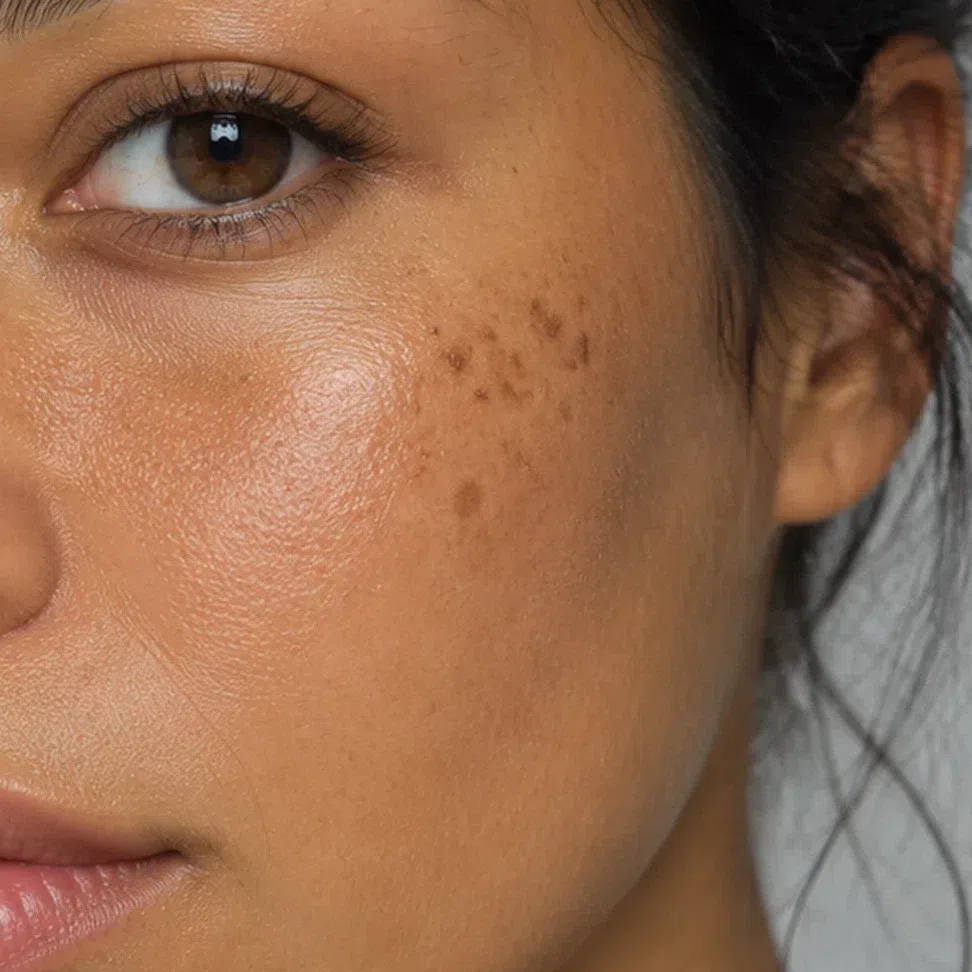
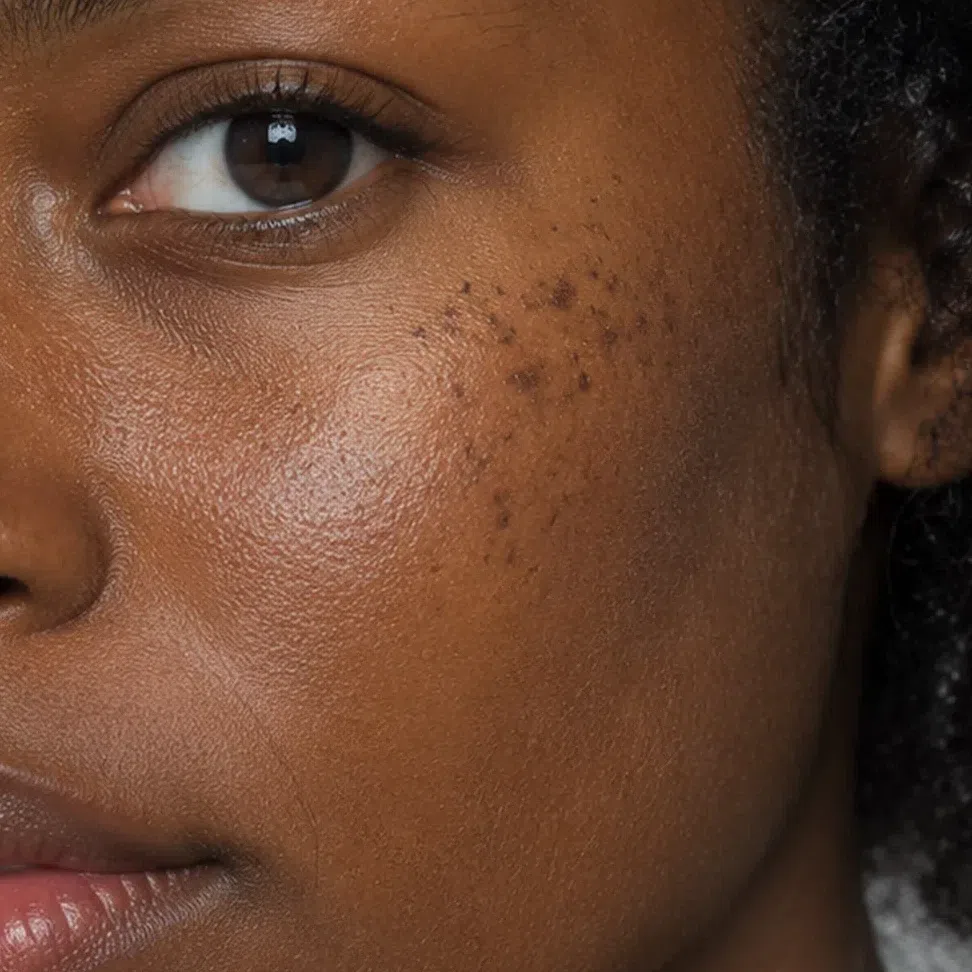
A Warm Autumn undertone is not subtle and not neutral. It is golden, peach or honey, and it shows on light skin and dark skin alike.
Skin here has an open glow, as if warmth were coming up from underneath. Even at its fairest it never reads porcelain or alabaster with a pink or bluish sheen; at its deepest it is bronze with a red-gold cast rather than an ashy one. How light or dark the skin is tells you nothing about this season - the undertone does all the work.
What rules the season out is a gray film over the skin, or an olive cast that looks green rather than golden - that grayed version of warmth is the mark of Soft Autumn. The full shade range, freckles and how the skin tans are cataloged in the next section.
Three ways to read your undertone
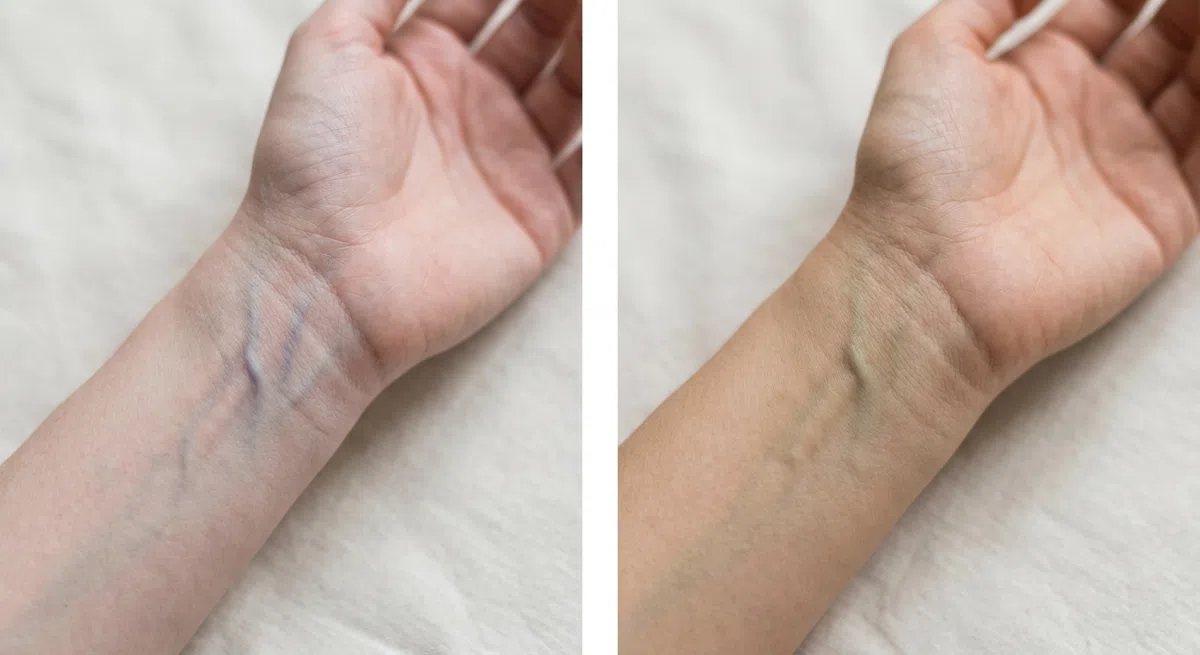
Turn your wrist palm-up beside a window around midday. Room lighting ruins this one: a warm bulb yellows the skin and a cold LED blues it. After a few seconds, look at the veins together - their general cast, not the single darkest line.
- Greenish or olive - warm. Warm Autumn, and every other warm coloring, stays on the list.
- Blue or purple - cool. The autumns are out; look at the summers and winters.
- You genuinely cannot tell - likely neutral, which leans toward Soft Autumn more than this page.

Clean face, hair pulled off the forehead and cheeks, window light in front of you. Bring a sheet of printer paper up close under the chin. It must be truly white - cream or recycled paper is warm on its own and will tilt the answer. Look only at the edge where paper meets skin.
- The skin reads golden or peachy next to the white - a warm undertone, and the result a Warm Autumn gets.
- It reads pink or faintly blue - the undertone is cool.
- It goes a little gray or khaki - neutral with an olive note, which points at Soft Autumn.
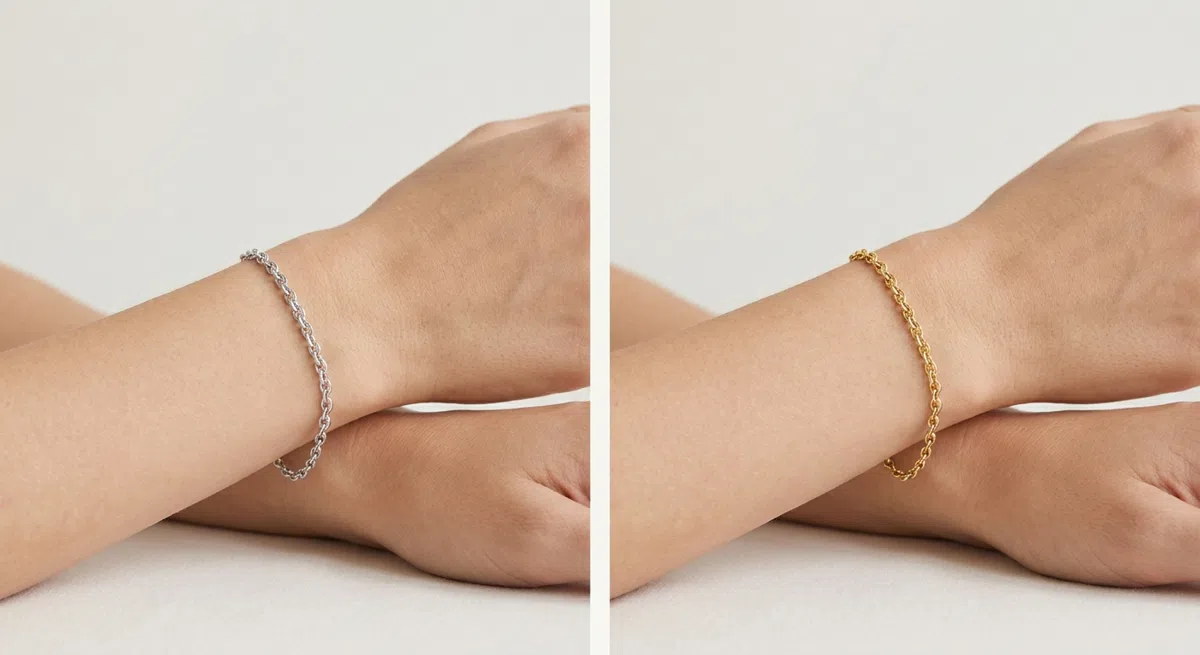
Rest a silver ring on bare skin at the wrist, then swap it for a gold one - daylight, and no shimmer lotion. Ignore the metal itself and study the skin right next to it. Does one metal make it look smoother and more alive while the other leaves it sallow or gray?
- Gold wins, and not narrowly - warm. For a Warm Autumn this is usually the clearest of the three results.
- Silver wins - a cool undertone, and not this coloring.
- Both look fine - neutral; Soft Autumn is the likelier page.
Paper golden, gold beating silver: you are warm, and every summer and winter is off the list. Now the question is which warm season, and the next three blocks answer it.
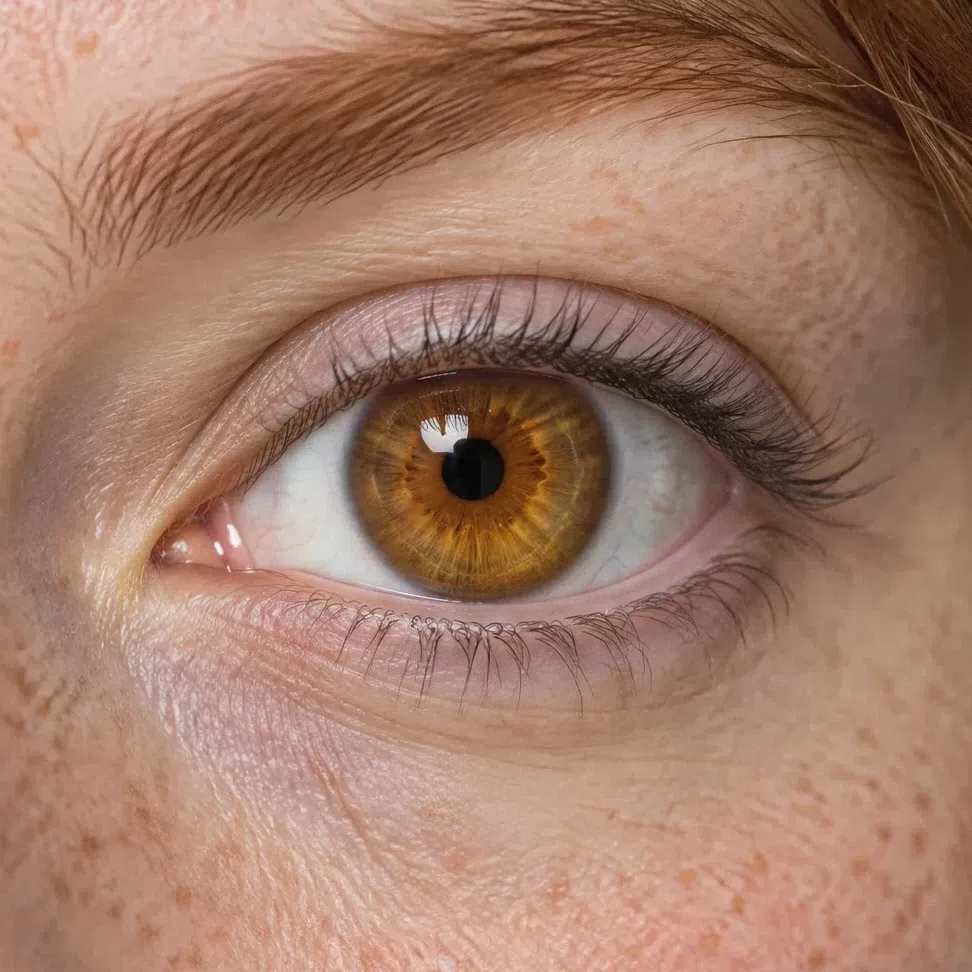
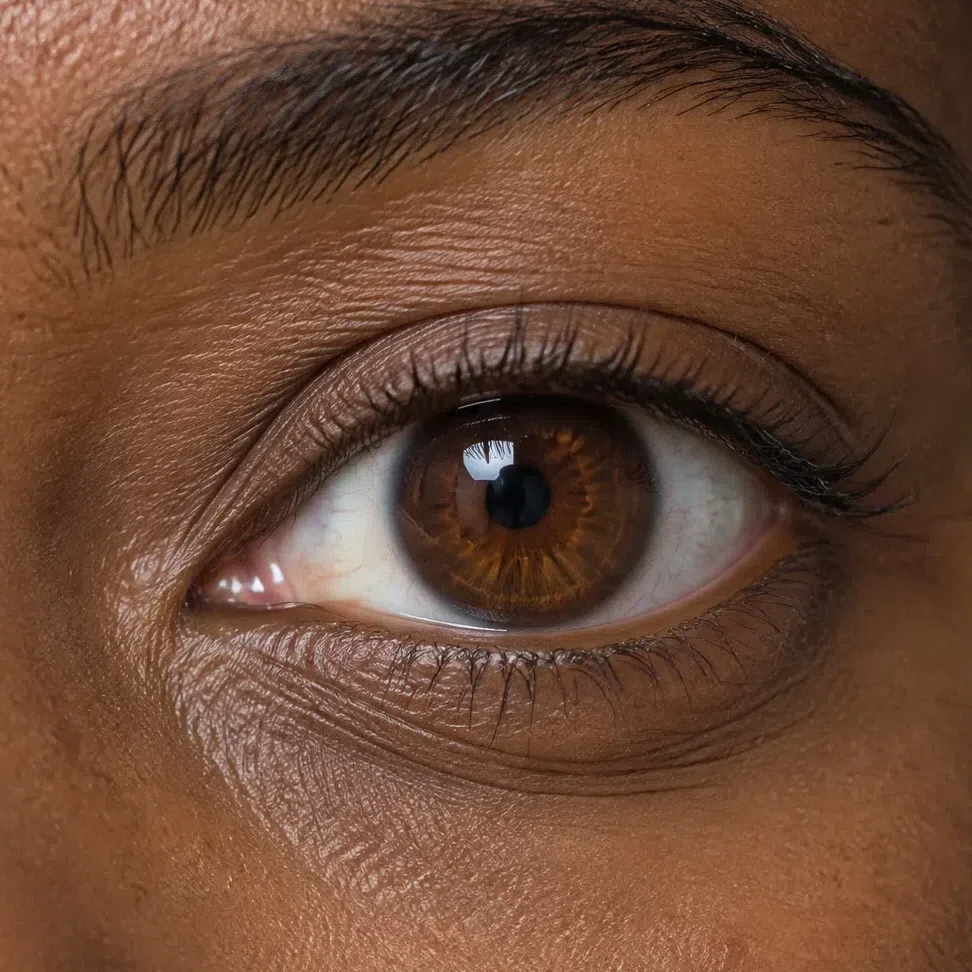
22. Eyes: warm, rich and flecked with gold
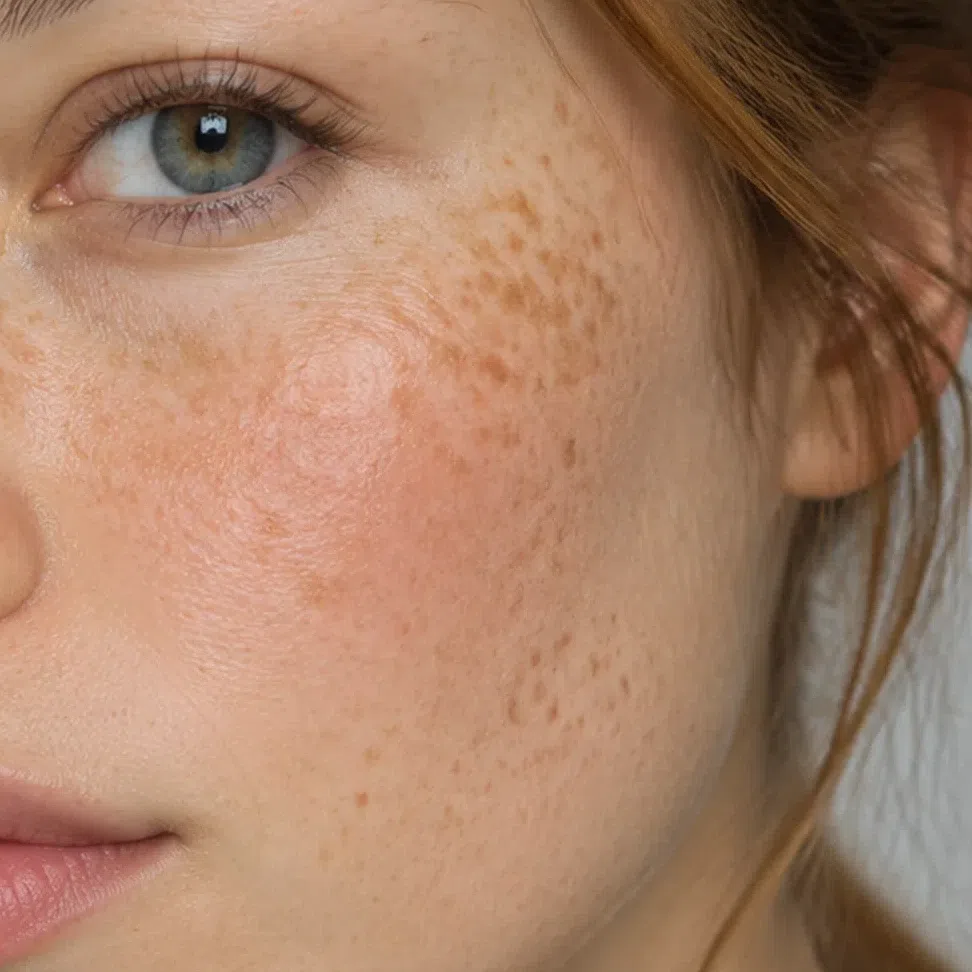
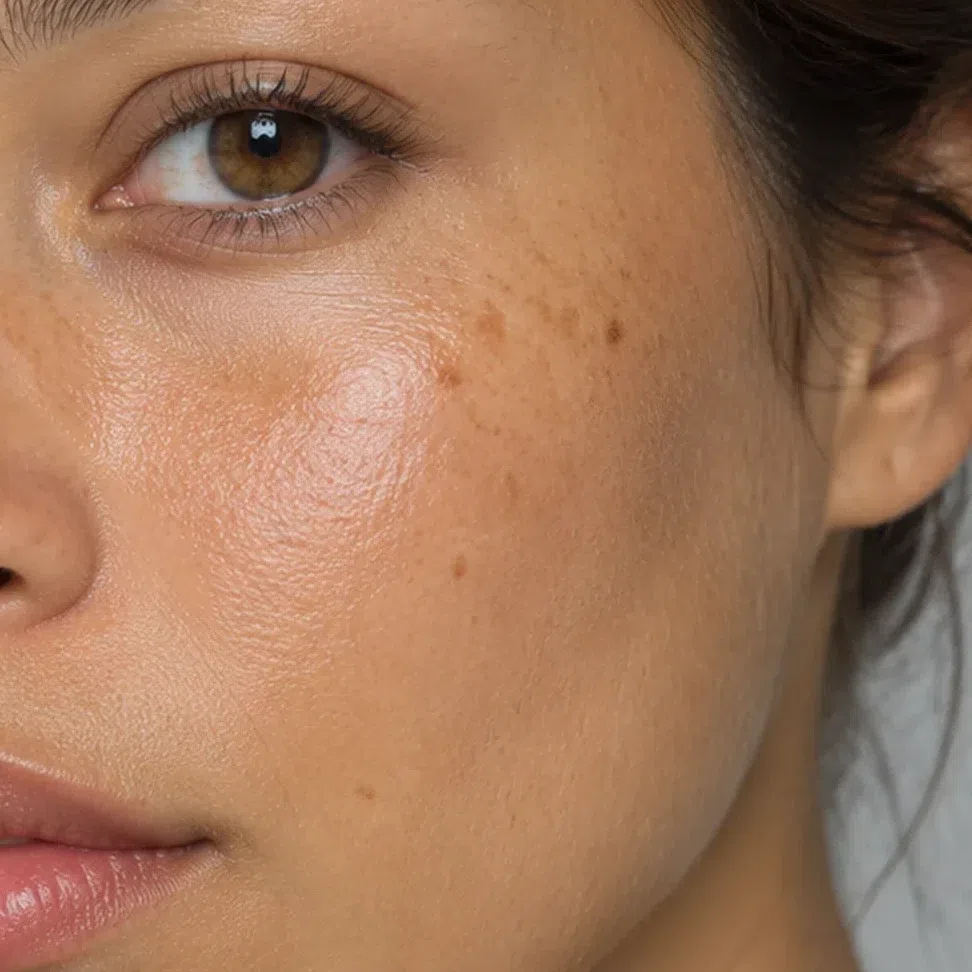
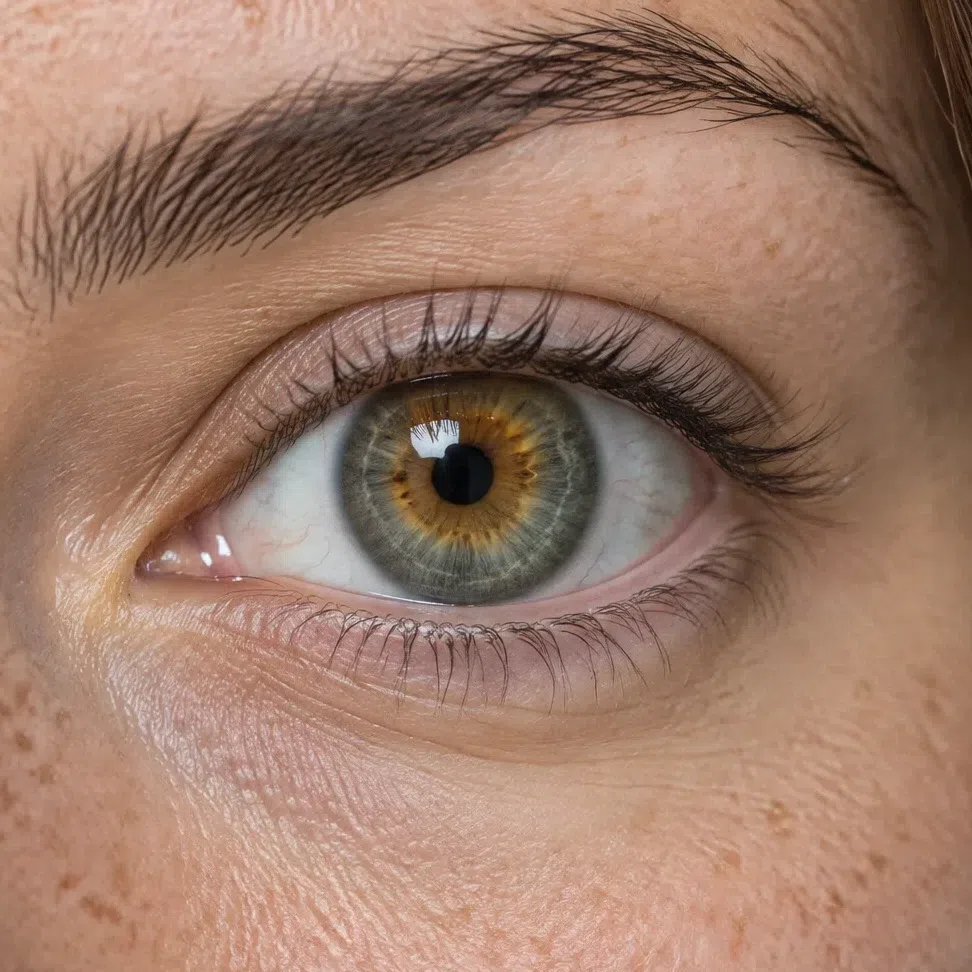
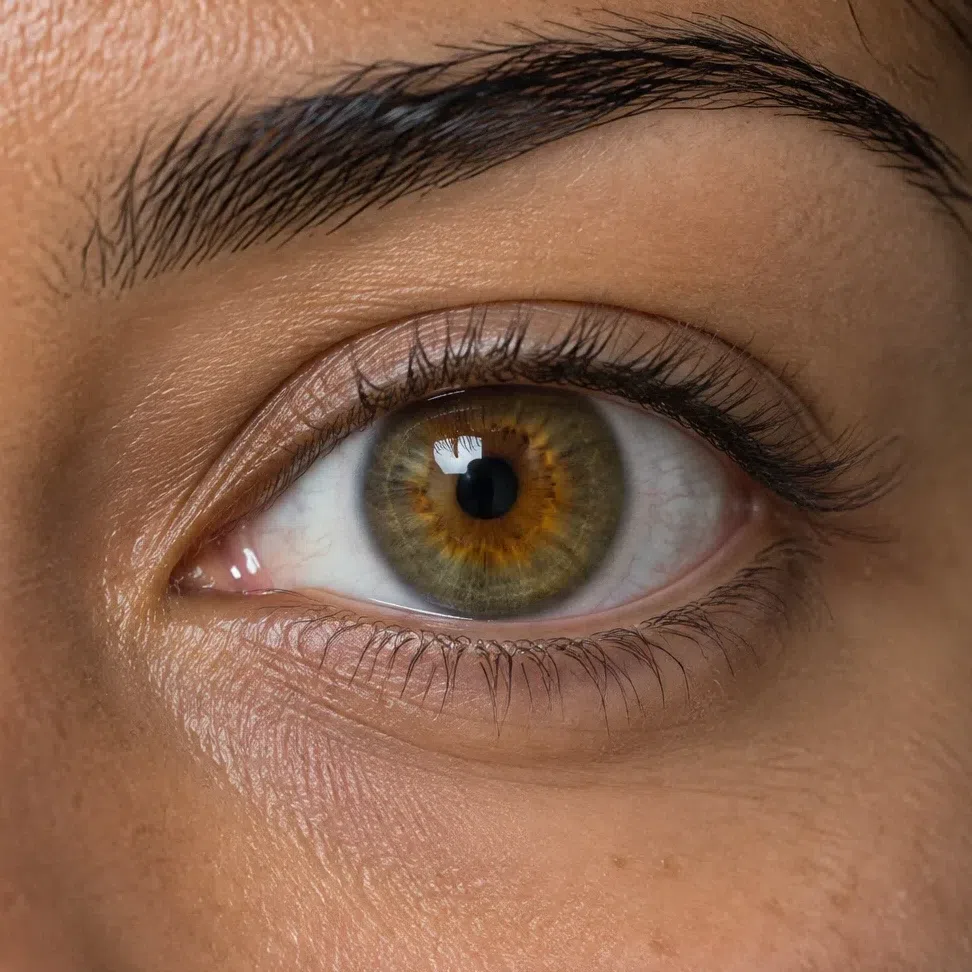
Warm Autumn eyes have depth to them. They are rarely pale or glassy, and there is never a steely or icy note anywhere in the iris.
The color itself can be brown, olive green, amber or hazel - light or dark, all four belong, and the next section shows each one close up. The color name is the least useful part of the check.
What ties the four together is what sits around the pupil: gold, copper or tobacco-colored flecks, sometimes a ring of them. The edge of the iris is soft, with no dark outline, and the white of the eye tends toward a soft cream rather than a bright blue-white.
Blue eyes are unusual in this season. When they do occur, they carry green or yellow in them - a teal or sea-green rather than a clear sky blue. A clean, cool blue in an otherwise golden face usually points to Warm Spring instead.
Look for the gold at the pupil before you name the color. Brown, green, amber or hazel, the flecks are what make an eye Warm Autumn.
33. Hair: red shows through, even in dark brown
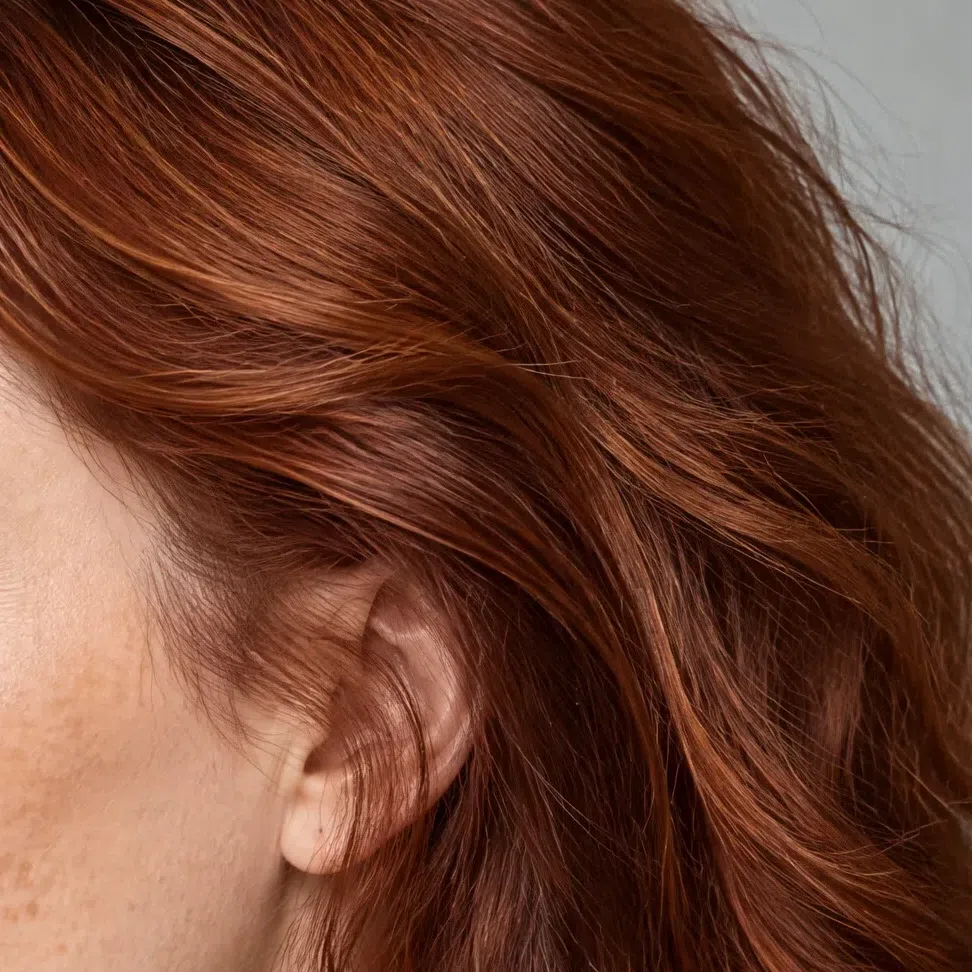
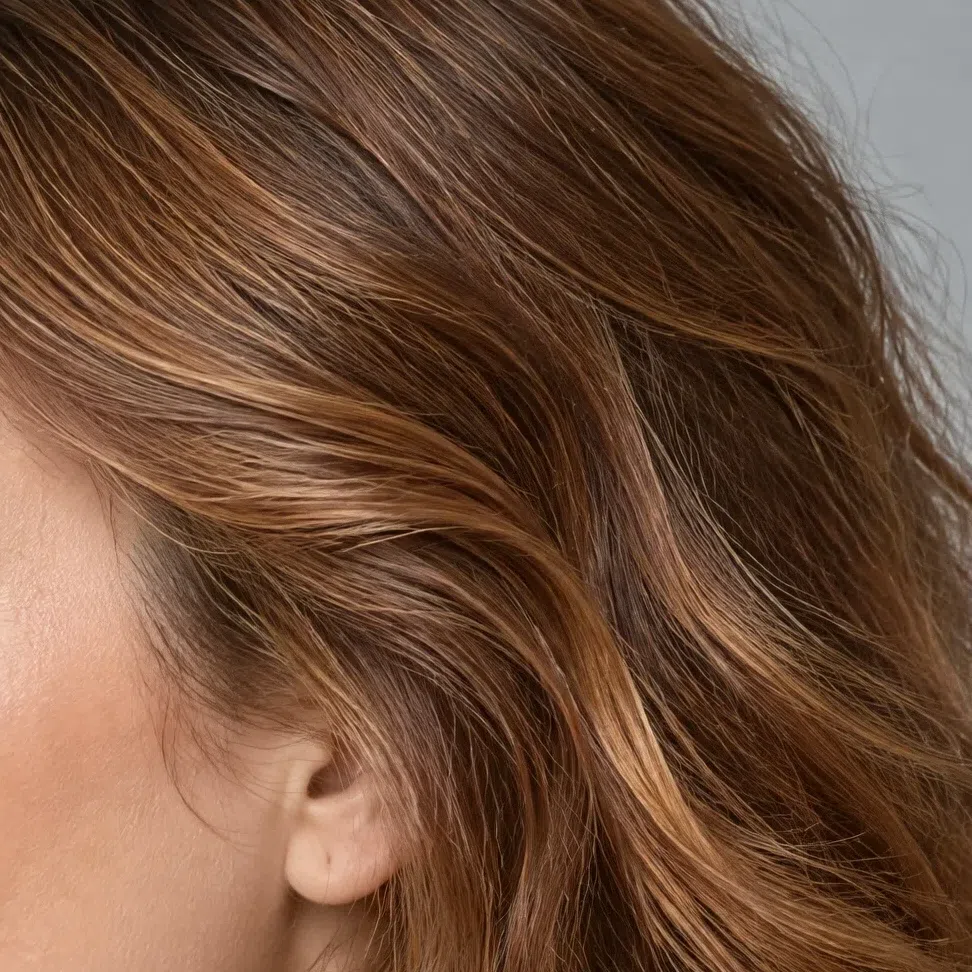
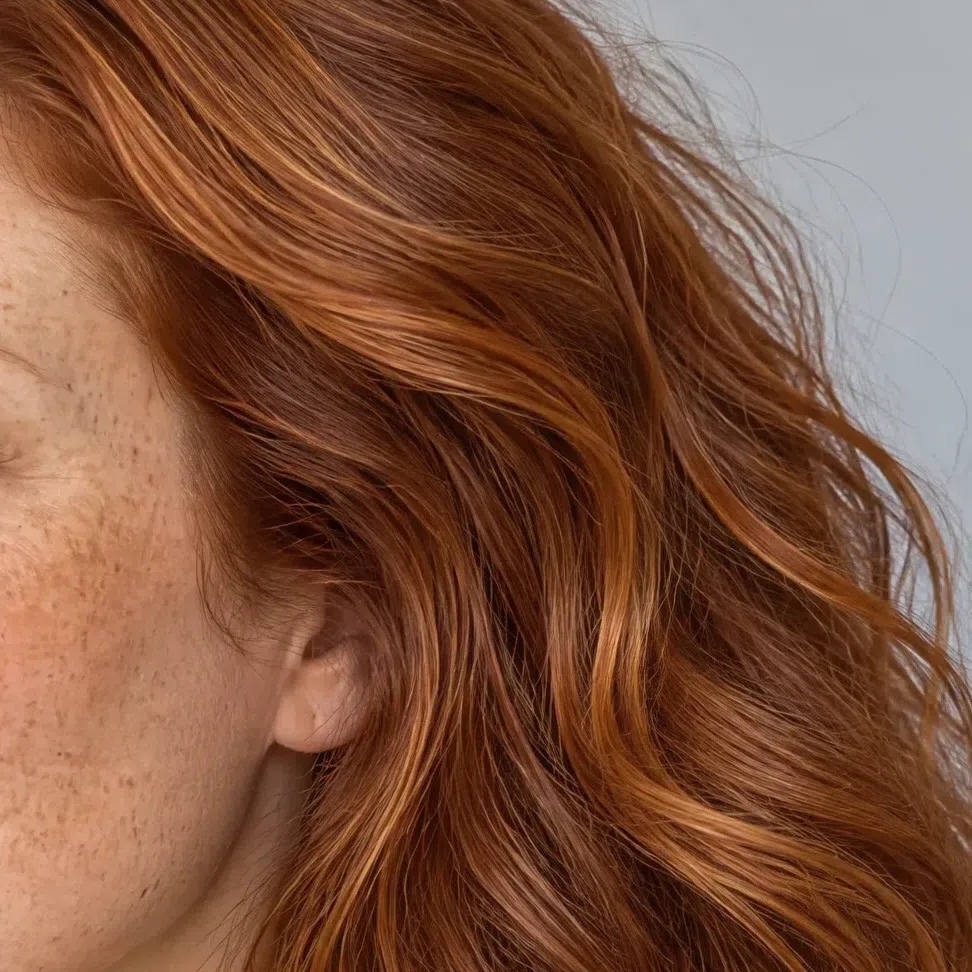
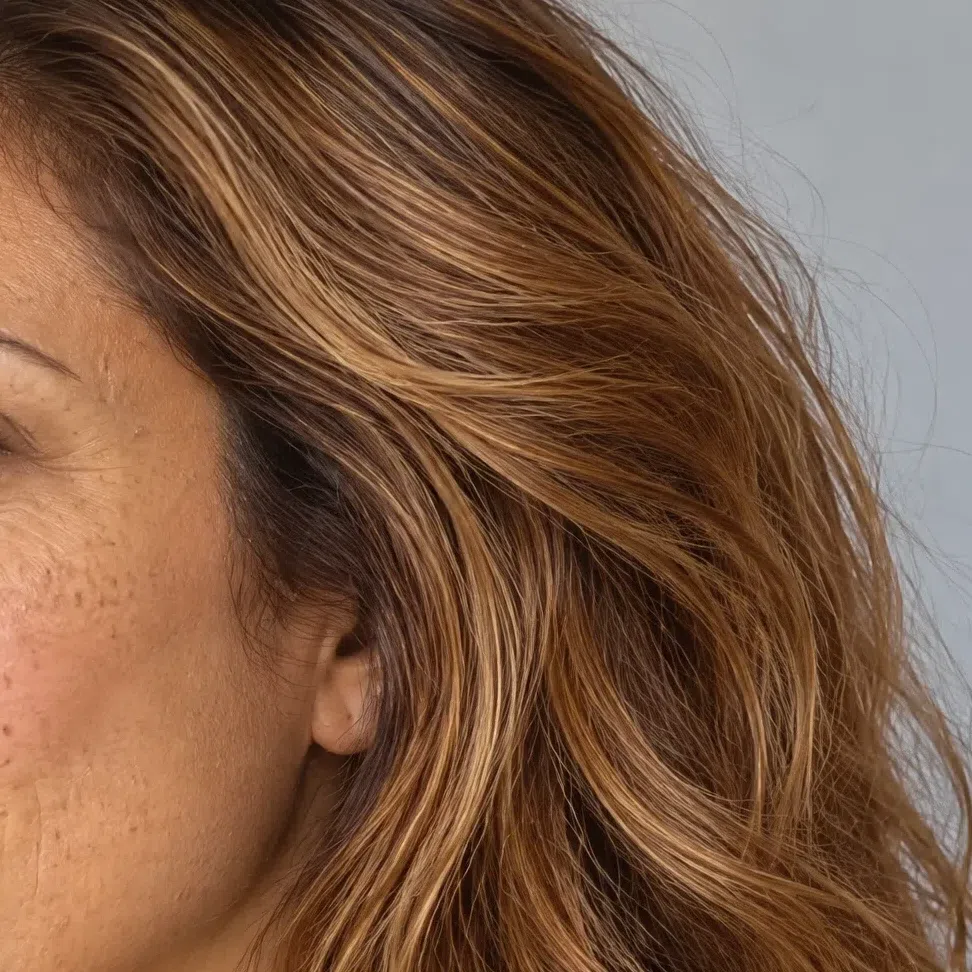
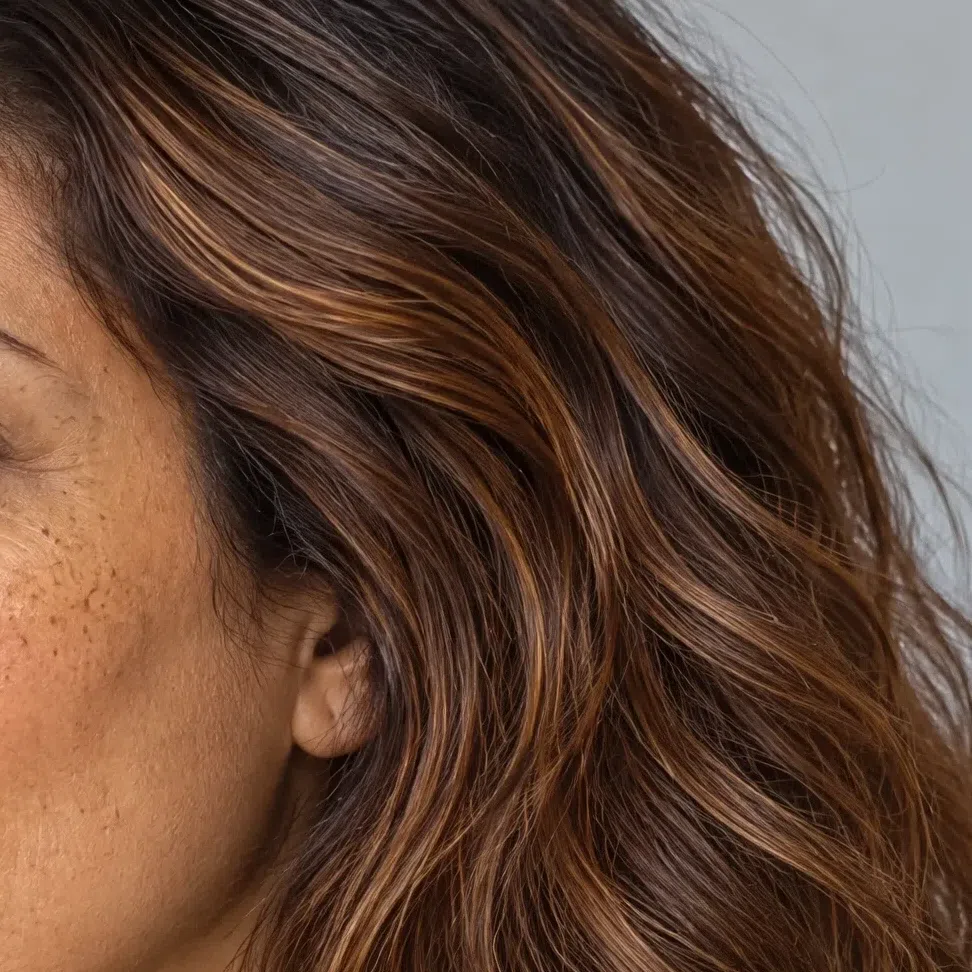
Hair is the easiest trait to spot on this season. Whatever its depth, it carries red, copper or gold, and daylight brings it out.
The depth runs anywhere from honey blonde to a dark bronze brown. What stays constant is the pigment: even hair that looks plain brown indoors throws red, copper or gold sparks in the sun, and that is the tell to look for.
Hair with no warmth in it at any depth is the clearest single sign that this page is not yours.
Texture is no help: this hair can be straight, wavy or tightly curled, and it is often thick. If you have colored it for years, find a childhood photo, or look at your brows - they usually match your natural shade or sit a step darker, and a red or golden cast in them is a strong Warm Autumn sign.
Hold a strand up to a window. If red, copper or gold appears, the season fits; if it turns gray-beige, it does not.
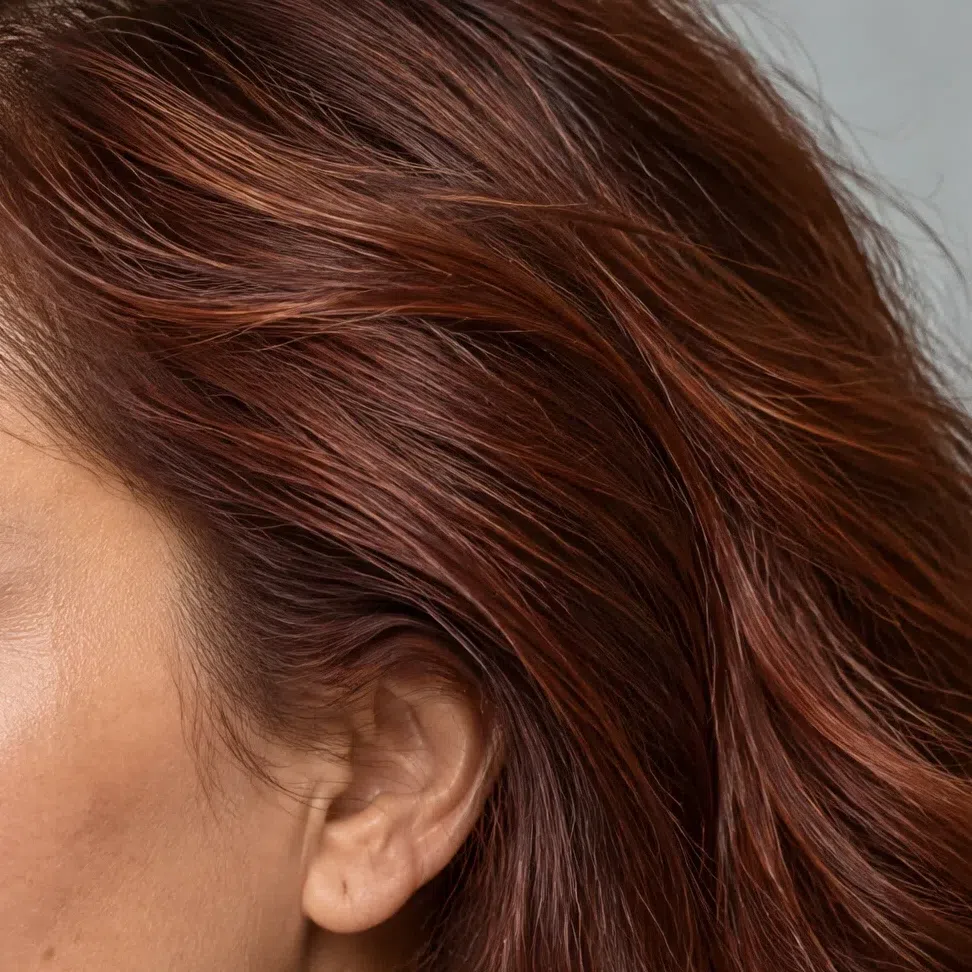
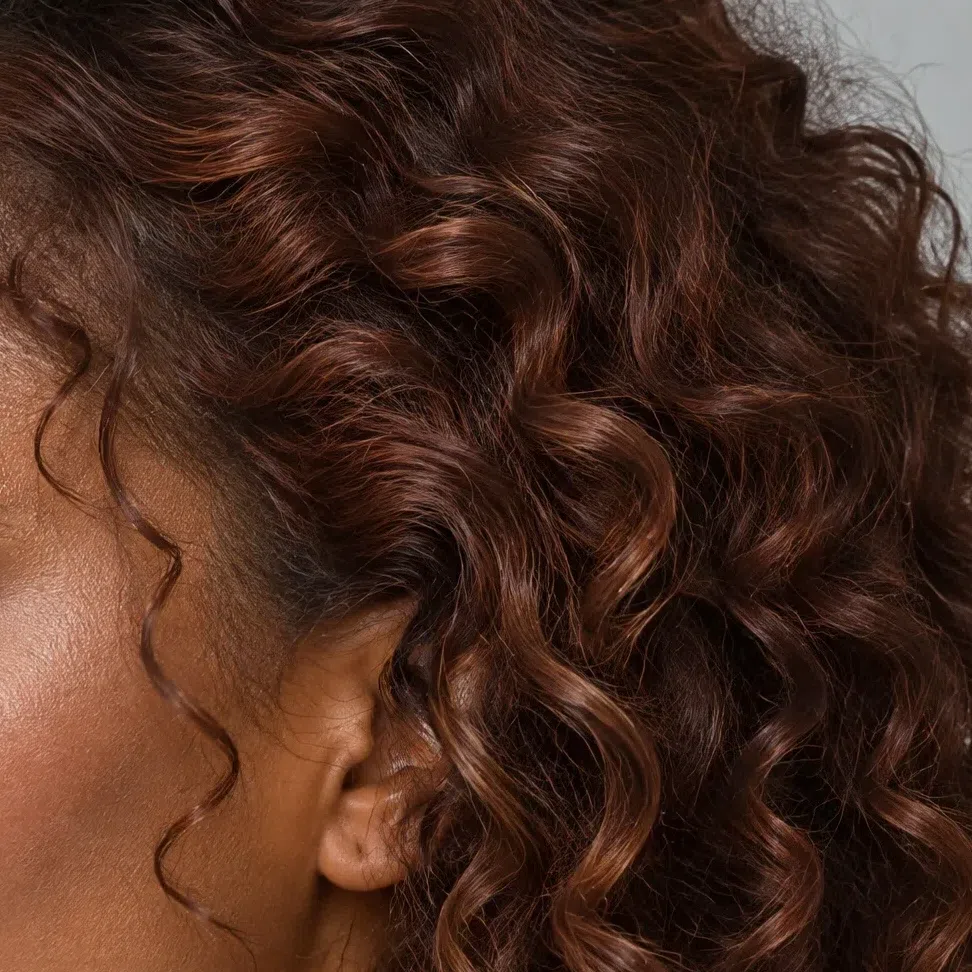
44. Contrast: medium, and all of a piece
Contrast is how far apart hair, skin and eyes sit in lightness. On a Warm Autumn they sit at a moderate distance, and they read as one warm picture.
Nothing in this face is dramatic. Golden skin, copper hair and hazel eyes land at roughly the same richness, so the features flow into each other instead of competing. At the fairest end the contrast can drop to low; it does not climb to high.
That rules out the winters, where dark hair cuts hard against light skin. It also separates this season from its dark neighbor: Deep Autumn has noticeably higher contrast, with dark hair and eyes set against lighter skin. Soft Autumn sits lower still, and everything in it looks slightly grayed.
Medium contrast places you between Soft Autumn and Deep Autumn. Richness settles which one, and the color test below shows it directly.
- Photograph your bare face by a window, then remove the color from the picture. A Warm Autumn turns into a handful of neighboring grays, no jump from very light to very dark. Hair or brows that fall to near-black against pale skin point to Deep Autumn or a winter.
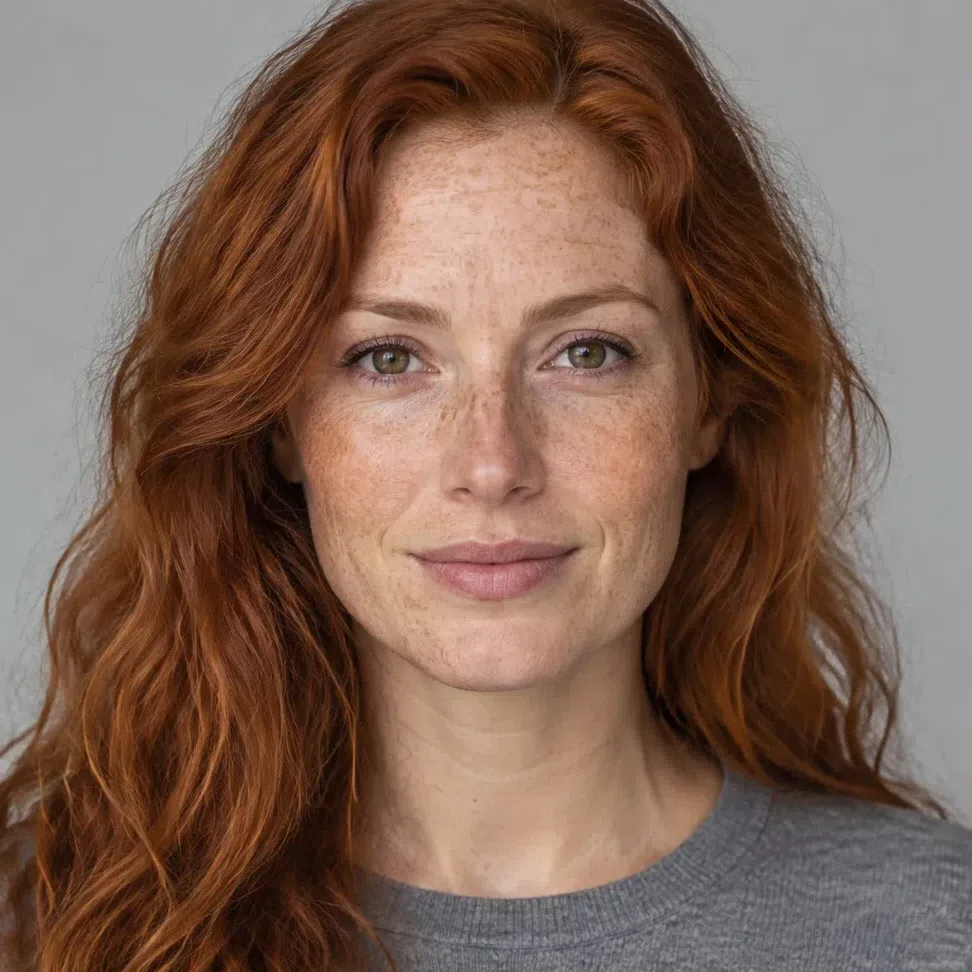
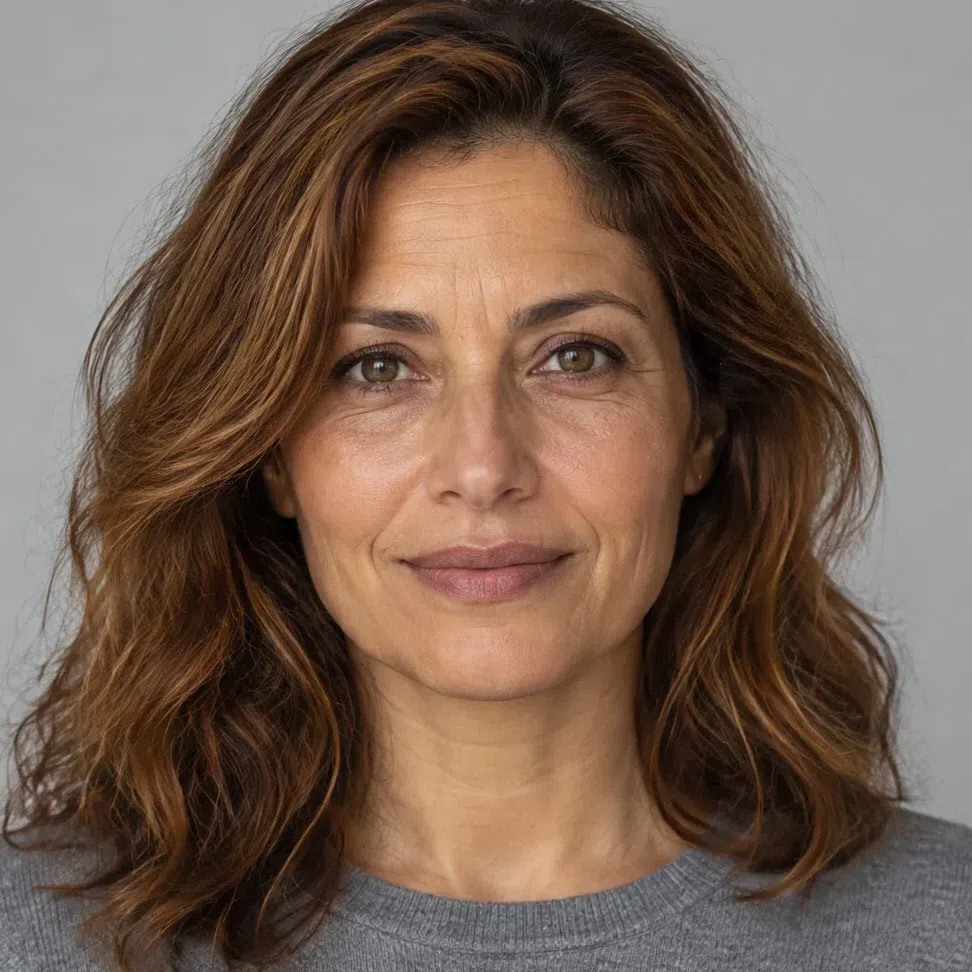
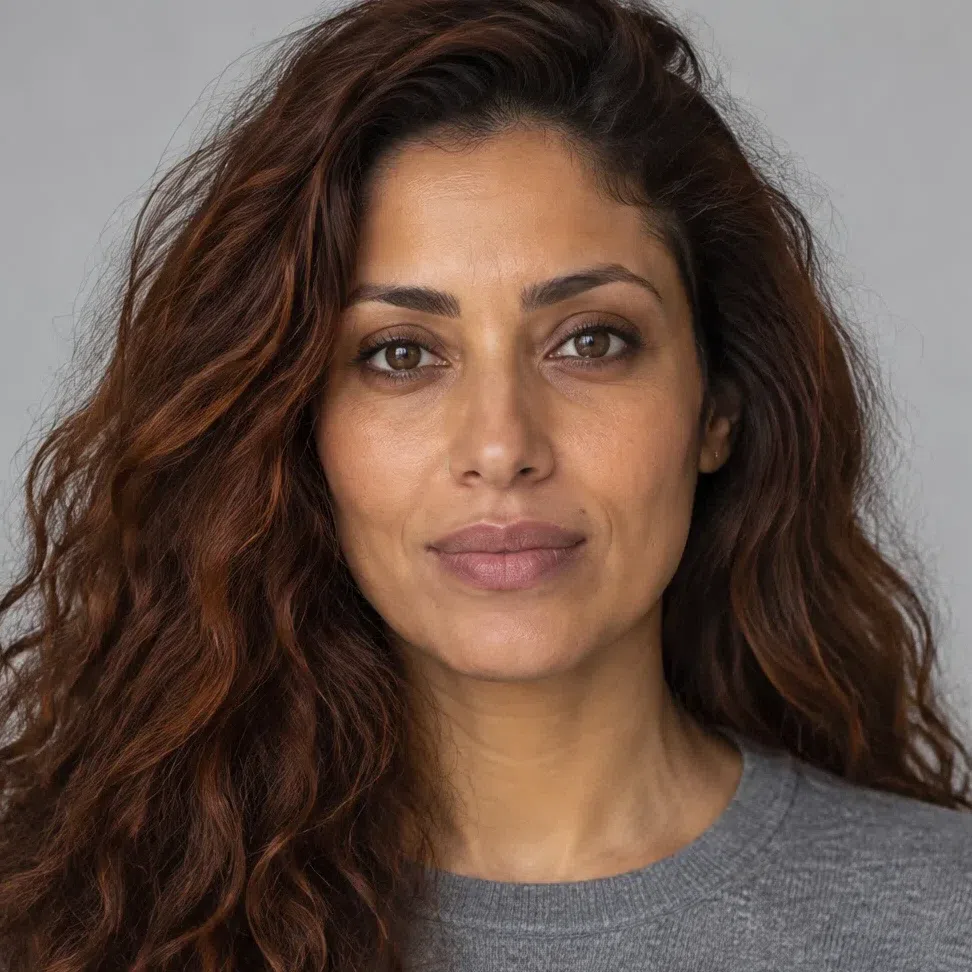

Left, a Warm Autumn in full color. Right, that same photo converted to grayscale, leaving only lightness to judge - and her copper hair lands only a moderate way below her skin, not at the dark end of the scale.



Hair Skin Ramp runs black to white
Read how far apart the two markers are and ignore how high or low they sit. The markers' position shows depth; the space between them shows contrast - and that gap is not a score for ranking faces. Look at the deep Warm Autumn: her curls read even darker than the Winter's hair, yet the two faces are nothing alike, because her skin sits much closer to her hair. On the Winter, the skin holds high on the ramp and the hair drops far below it.
55. The color test: hold the shades up to your face
The clearest check of all. Take a few garments or scarves, stand at a mirror in good daylight, and hold each one under your chin in turn.
Some colors will make the skin look lit and even; others will make it dull and bring out every shadow. If a favorite ends up on the wrong side, keep it away from the face rather than out of the wardrobe - a fuchsia bag does no harm, while a fuchsia blouse right under the chin can wipe out the warmth. A scarf or earrings from the list below will rescue a color near the face that is not yours.
Colors that make you glow
If these make the skin fresh and rested and the eyes brighter, you are on the right page:
- Sienna
- Olive brown
- Mustard
- Rust
- Teal green
- Eggshell
- Pumpkin
- Camel
Colors to keep away from the face
If these turn the skin gray or sallow and put shadows under the eyes, they are not your palette:
- Fuchsia
- Jet black
- Silver
- Royal blue
- Bubblegum
Warm Autumn vs Soft Autumn vs Deep Autumn
Every autumn is warm, so the season is seldom the question - the subtype is. Every subtype takes its name from its strongest trait, so settle the top row before any other. (True Autumn is the older twelve-season name for this same coloring; Dark Autumn is the older name for Deep Autumn.)
| Warm Autumn | Soft Autumn | Deep Autumn | |
|---|---|---|---|
| Leading axis | Warmth. Golden through and through | Softness. A gray veil over warm coloring | Depth. Dark first, warm second |
| Temperature | Fully warm, with no cool note anywhere | Neutral-warm | Neutral-warm, with a trace of cool |
| Depth | Medium, from golden ivory to bronze | Light to medium | Dark, with more black in the colors |
| Clarity | Rich and saturated, never dusty | Muted and dusty | Deep and heavy |
| Contrast | Medium - features flow together | Low - one tone across the face | High for an autumn - dark hair against lighter skin |
| Skin | Golden, peach or warm beige, often freckled | Neutral beige or ivory with a little warmth | Light to olive or bronze, warm or olive-toned |
| Eyes | Amber, warm brown, olive green, hazel | Gray-green, light brown, muted hazel | Dark brown, black-brown, dark hazel |
| Hair | Copper, red, golden chestnut | Light to mid brown with a soft golden cast | Dark chestnut to black with a warm cast |
| Metals | Yellow gold, copper, bronze | Matte yellow gold, rose gold, brass | Antique gold, dark bronze, brass |
If two columns still both sound like you, do not decide on skin or eyes. Go back to the first row and ask which single word fits your coloring before any other - warm, soft or deep. That word is your subtype.
Warm Autumn coloring, up close
A close-up catalog across four skin depths
The checks above decide whether this season is yours. This part is the catalog: how the skin behaves, what the eyes look like and where natural hair lands - twelve cards, each on a different woman at a different depth. Nobody lines up with every card, and nobody needs to - sitting inside the range is what counts.
Warm Autumn skin: a golden glow from ivory to bronze
Every version of this complexion carries a golden, peach or honey warmth that makes it look healthy rather than pale. The warmth is the same on ivory skin and on deep bronze skin; only the depth moves.
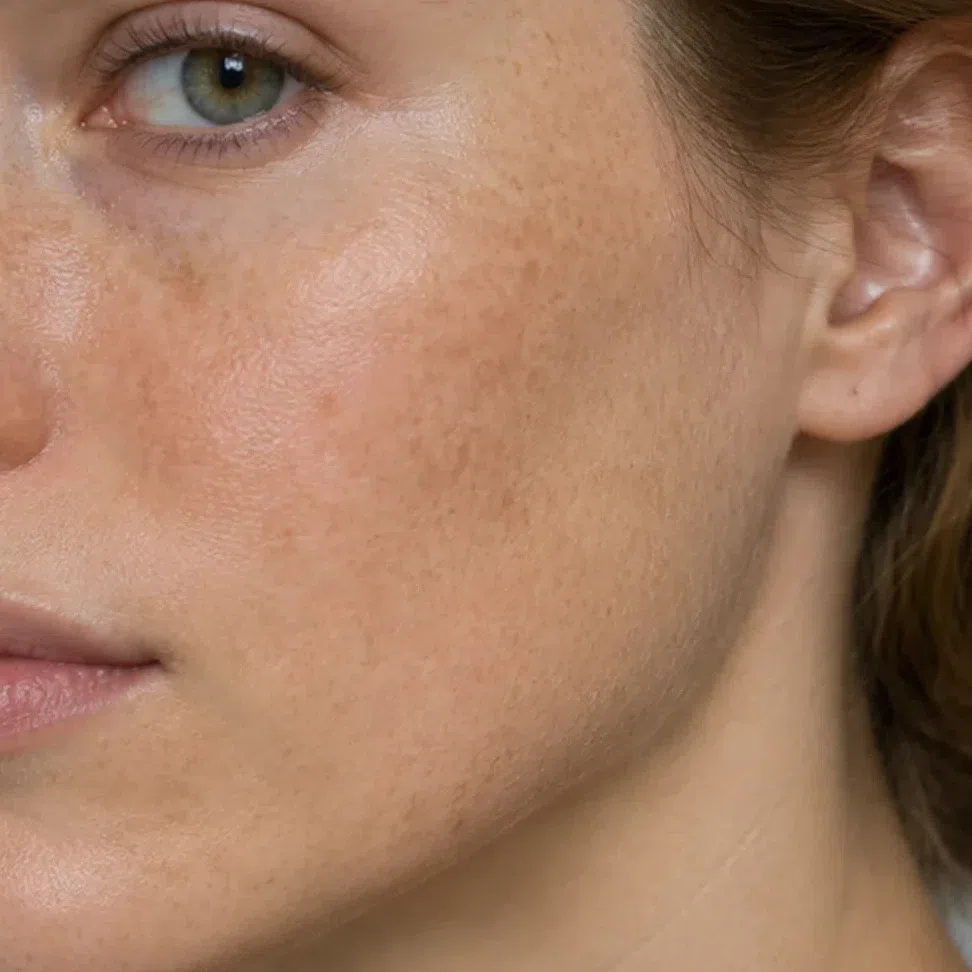
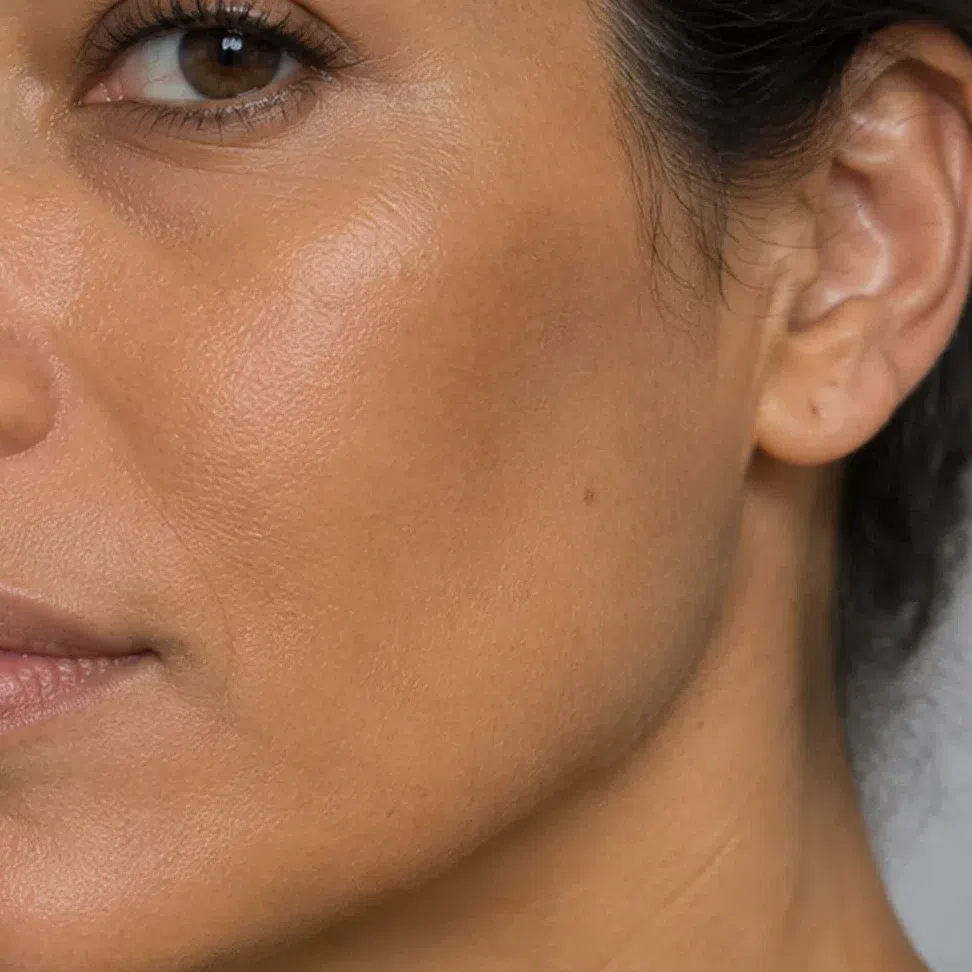
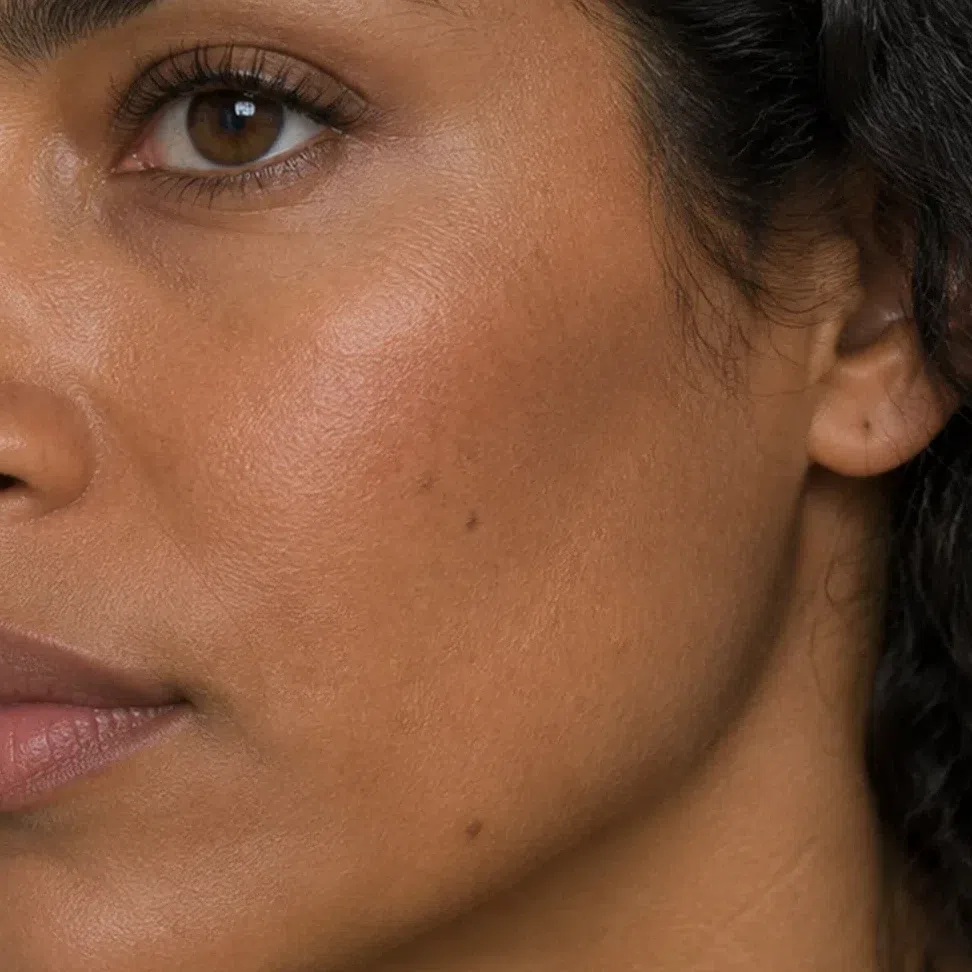
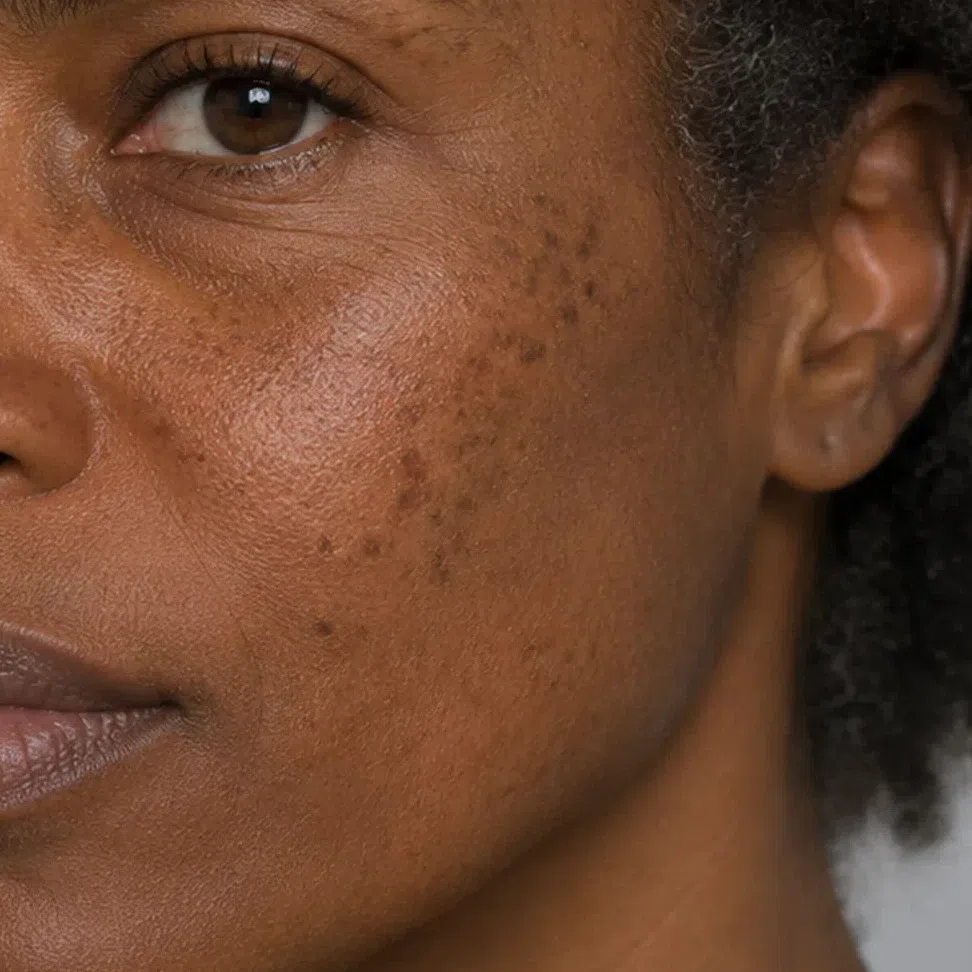
Yes. Freckles are common in this season, not required. Go by the undertone instead: it stays warm all year, whether or not freckles come and go with the sun.
The first place the undertone earns its keep is the makeup counter. Foundation and blush for this skin need a golden pigment in them, because a pink-based formula sits on top of warm skin instead of disappearing into it.
Warm Autumn eyes: four warm families
The iris can be light or dark, green or brown. The one thing it never is in this season is cold - no steel, no ice, nothing gray-blue.
The four eye colors
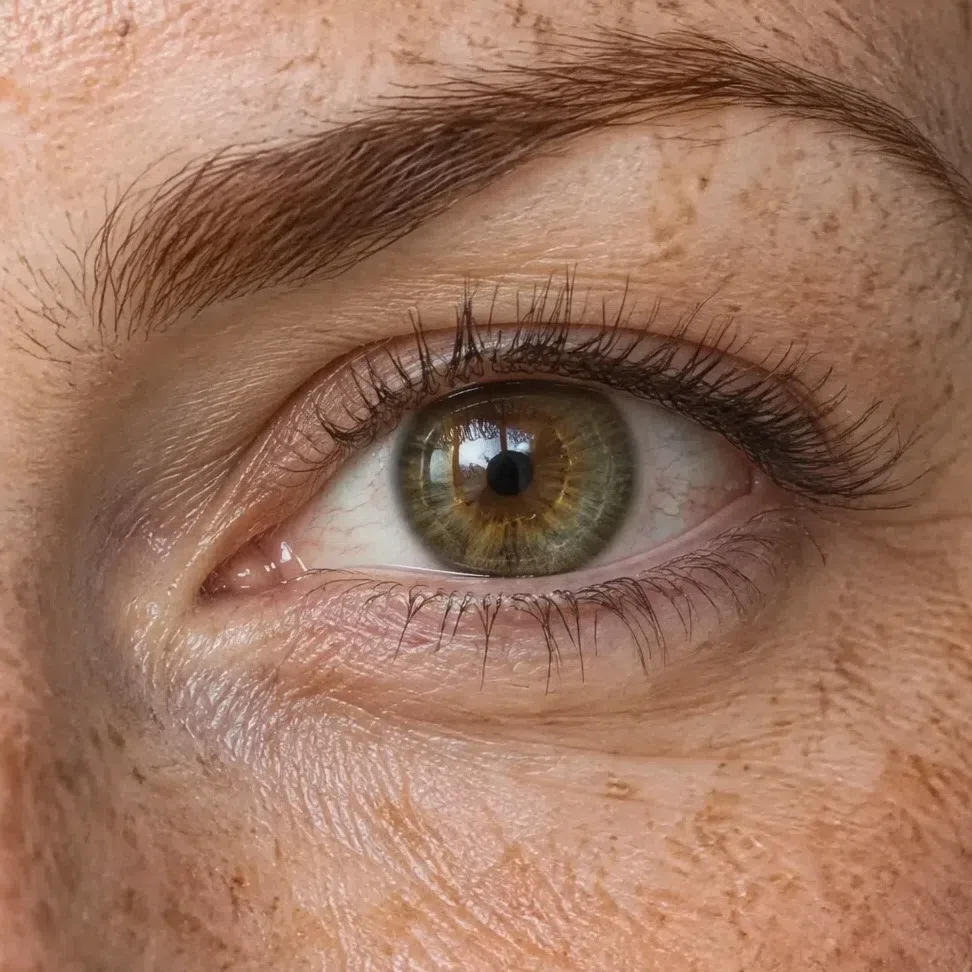
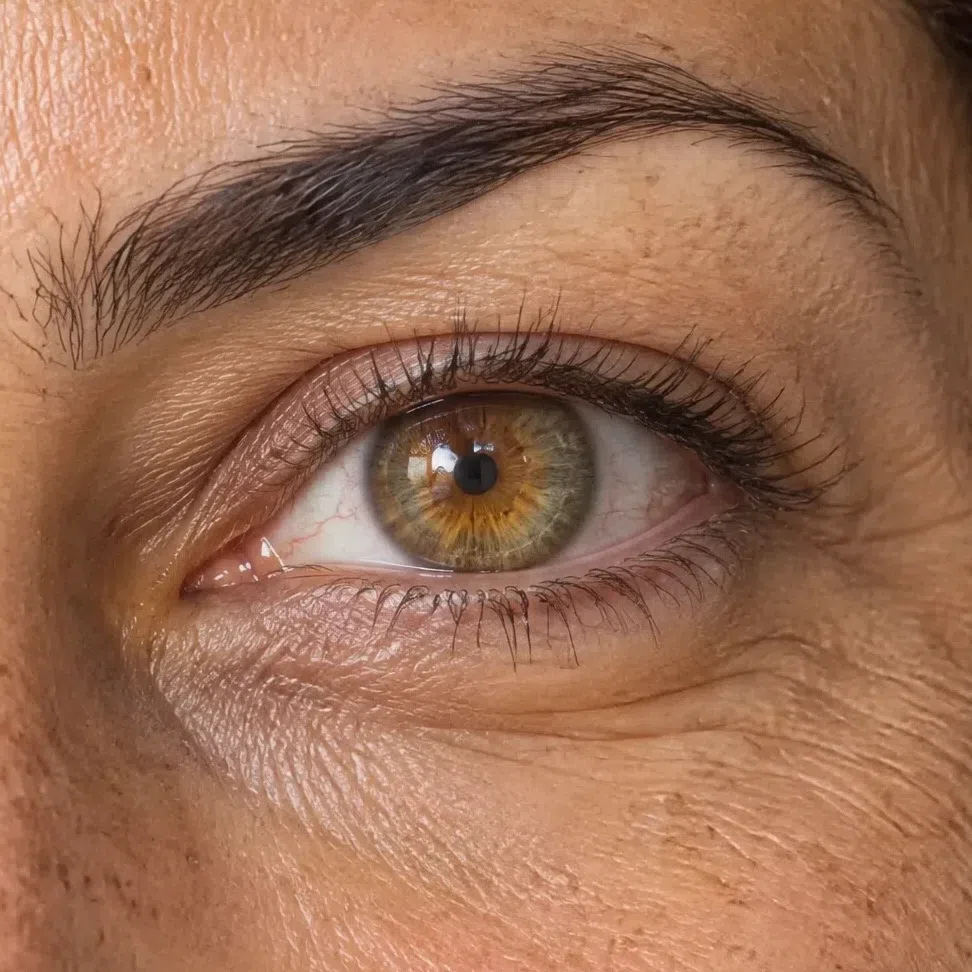
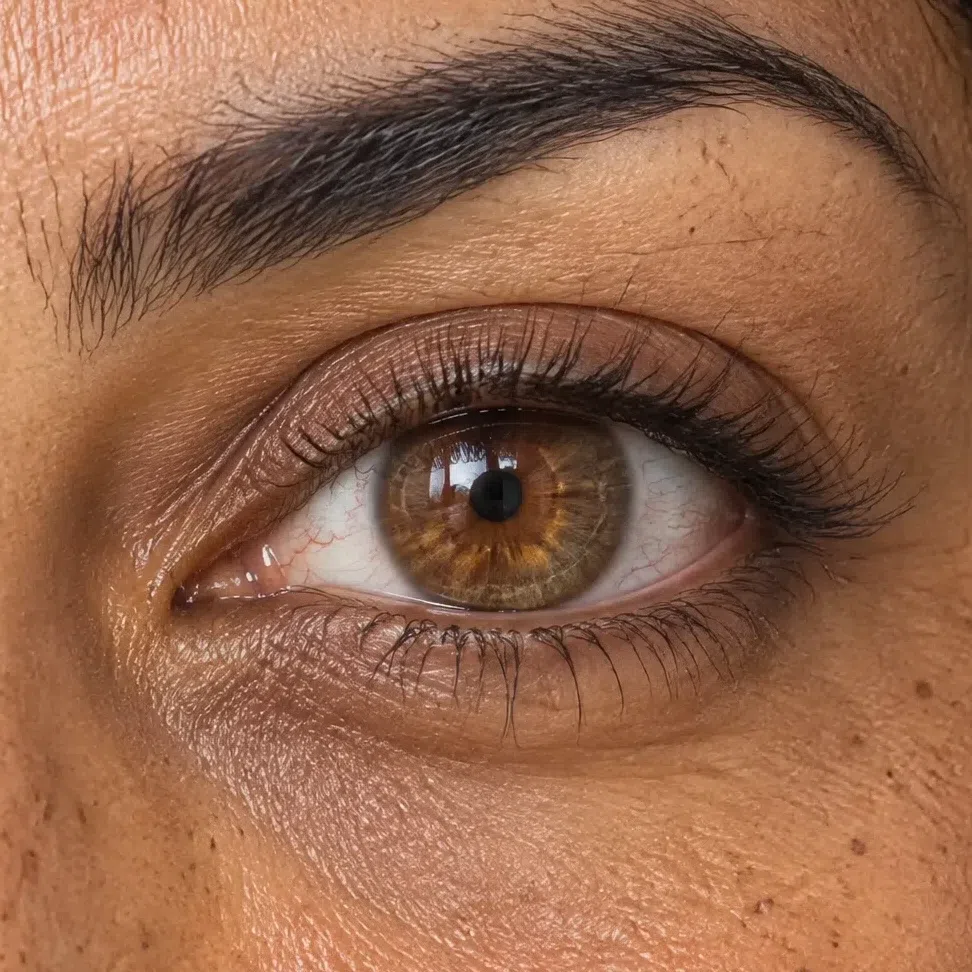
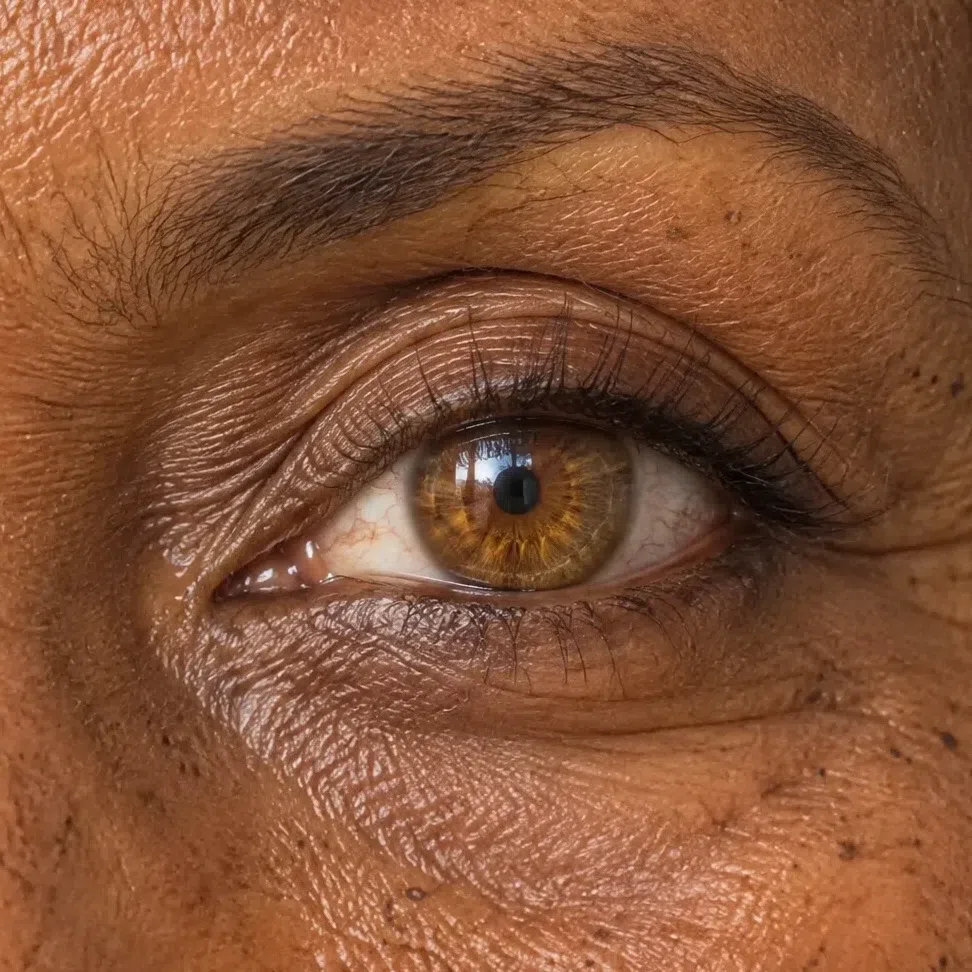
Eyes this warm carry earthy, spiced shadow colors - bronze, copper, olive, warm brown - better than almost anyone, which is why the makeup further down stays in that family.
Warm Autumn hair: every shade of copper and bronze
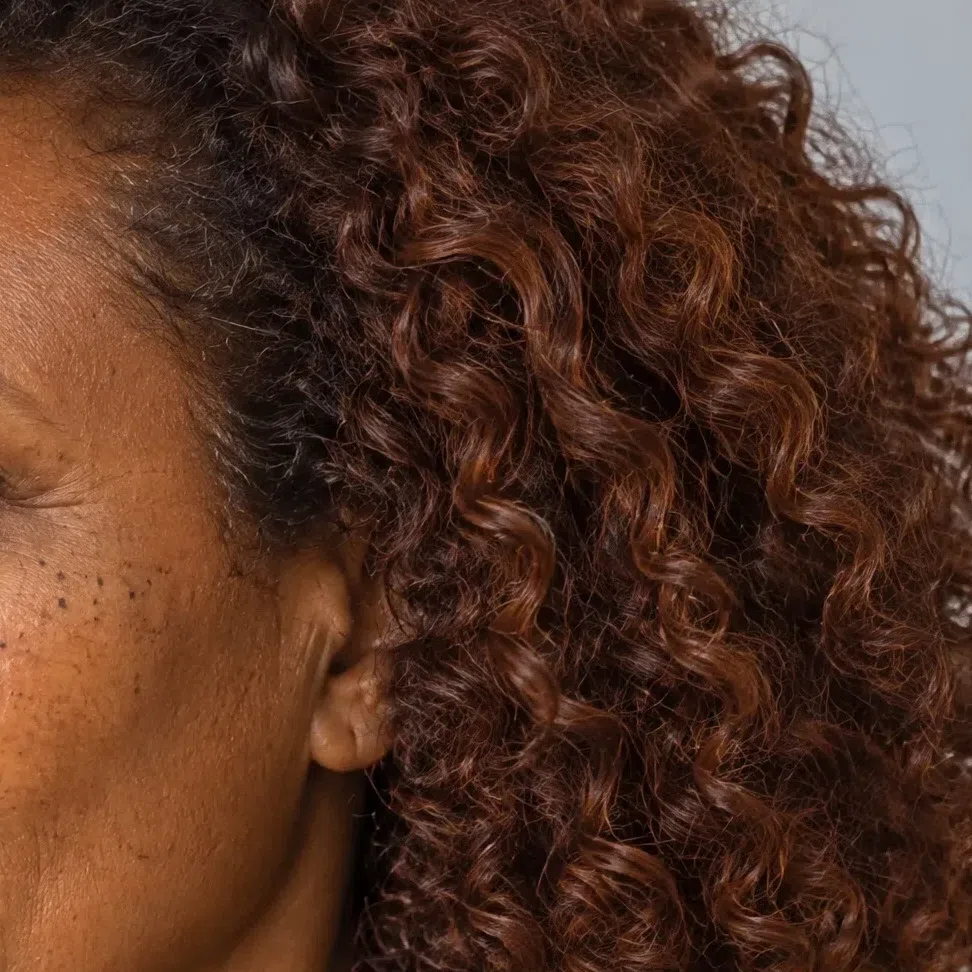
This is the season's most visible trait. At every depth the hair carries a red, copper or golden pigment, and in daylight there is no hiding it.
The four natural shades
What Warm Autumn hair never is
- Ash or platinum. Any gray or silver in the pigment. Natural Warm Autumn hair is never an ash blonde, and it does not go platinum on its own.
- Blue-black. That depth belongs to the winters. An autumn's darkest natural shade is a very deep brown with a warm cast.
- A cool, mousy brown. A gray-brown, or a light brown with no gold or red in it anywhere, does not occur in this subtype.
Texture is no guide at all - straight, wavy and tightly curled hair all turn up here, and it is often thick. How to keep the pigment warm once you start coloring it is its own topic, handled lower on this page under hair color.
The Warm Autumn palette: 17 rich shades, tried on a real face
Earthy, saturated, and never cool
Seventeen shades to wear, grouped the way a wardrobe gets built: five neutrals for the pieces you buy once, six earth tones that carry most of the color, and six accents for the moments that want more.
After them come the seven shades that work against this coloring, each paired with a replacement, and five combinations ready to wear as written.
Each card is a photograph rather than a paint chip. It is one woman on every card, and only her top changes color between them while her face and hair stay exactly as photographed. Read each card for what the shade does to her skin, not for how the shade looks by itself.
Base colors: building a Warm Autumn wardrobe
Eleven shades carry the everyday load. Five neutrals give the wardrobe its structure, and six earth tones supply the color that makes it recognizably autumn.
Neutrals: five that replace black and white
Coats, trousers, suits, boots - the pieces bought to last several seasons. None of these five is black, gray or bright white, and that is deliberate: Warm Autumn keeps the idea of a neutral wardrobe and swaps both ends of the scale for warm versions. Can a Warm Autumn wear black? Yes, as long as it stays away from the face. Black trousers, a black skirt or a black bag cause no trouble, because nothing dark is sitting against the skin. A black turtleneck is a different story - it strips the warmth from the face within seconds. Put Coffee at the collar and the depth stays while the drain disappears.
How to combine the neutrals
- Go tonal. Camel through Tan to Coffee, light to dark, reads expensive because nothing interrupts the line.
- Mix fabrics, not temperatures. Every neutral here is warm, so any two agree. Wool, suede, leather and silk in the same family keep a tonal outfit from going flat.
- Rebuild the classic pair. Eggshell with Coffee is this palette's black-and-white: the same crisp read, without the chill.
- Use them as a canvas. Any of the five sets up an accent - Pumpkin, Teal green, Cordovan - and steps back to let it work.
Earth tones: the color inside the base
More color than the neutrals, still calm enough to build an outfit around. These six are what make a wardrobe read as Warm Autumn rather than simply as beige: saturated, earthy and sun-warmed, never dusty. The Warm Autumn green is Ivy, with Olive brown as its quieter partner, and the Warm Autumn pink is Grapefruit - a warm pink-orange you will find among the accents below.
Accent colors: spice, used sparingly
Six shades to use in doses, then the metals, then the places a bright can go without taking over.
The six with the most heat
These are the juiciest shades in the palette, yet even the loudest keeps a brown note underneath it. Use them in measured amounts - an accessory, a single piece, or one strong color for an evening. Each card places the accent on a scarf and leaves the knit underneath pale instead of dyeing the whole top: spread over the entire torso, a shade stops being a detail and turns into the outfit itself.
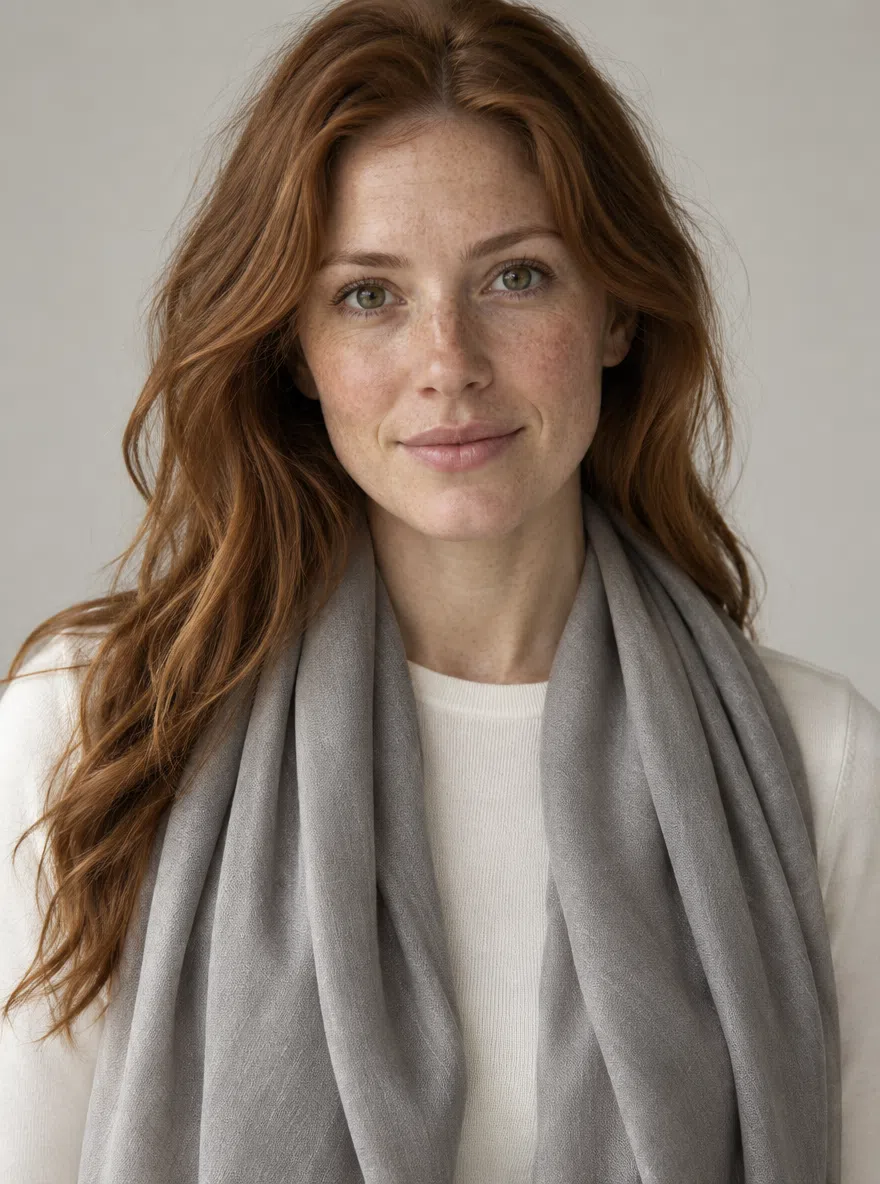
Metals and shine
Warm metals only. Silver, platinum and white gold strike a cold note against golden skin, so the rule covers hardware too: bag clasps, zips and belt buckles. The three below are drawn as gradients, because real metal never shows a single flat tone.
Where the warm metals go
- Jewelry. Yellow gold as the everyday default, bronze for chunkier pieces, burnished copper when the hair is red.
- Bags and shoes. Cognac and chocolate leathers rather than black - shop by Cinnamon and Coffee.
- Small hardware counts. A silver buckle at the waist is tiny, but it is still silver. Choose gold-tone fittings when there is a choice.
Where to wear a bright: four accessories, four pairings each
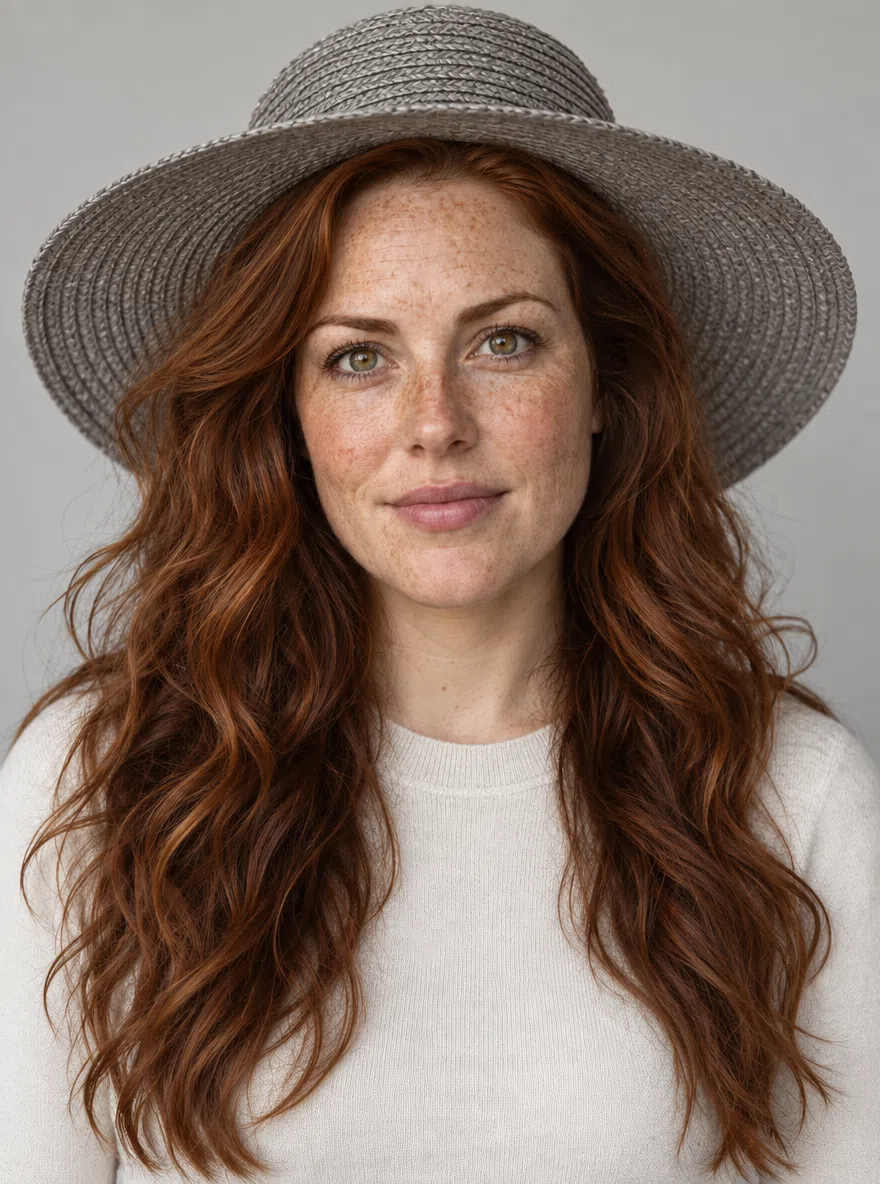
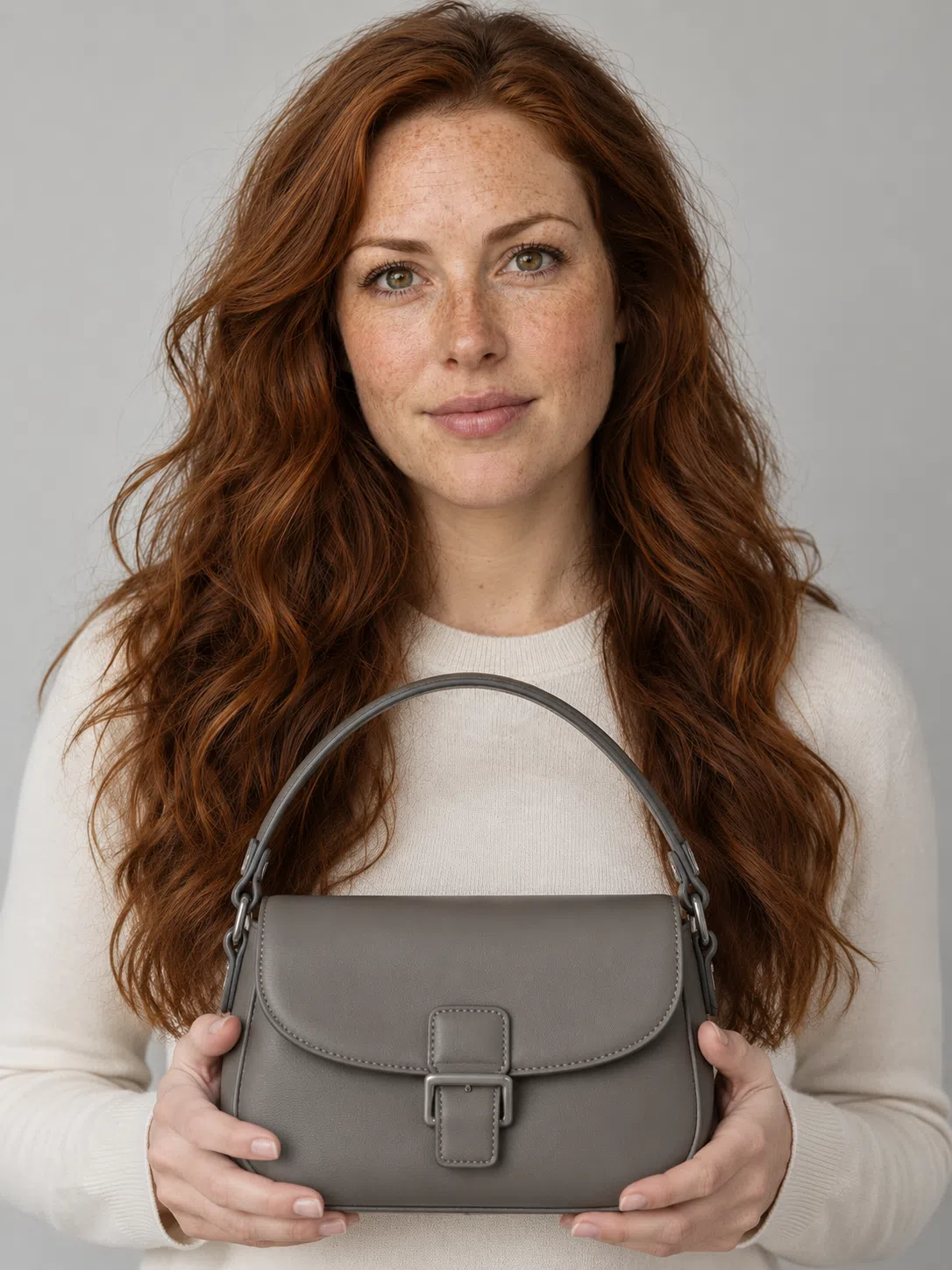
How close a color sits to the face changes what it does. Tap a pairing and the knit and the accessory repaint separately, so you can watch one shade behave differently on a hat, a bag and a knot at the throat.
Hat
A hat frames the face without lying against it, which is why the boldest shades on the page are safest up here.
Scarf
A scarf falls straight under the chin, so treat it as a drape test you wear all day - earth tones and warm brights only.
Bag
Held at arm's length from the face, a bag is the easiest place to try an accent you are unsure of.

Neck scarf
Tied right at the throat, it is the accessory closest to the skin. Keep it warm and rich - a cold knot there shows at once.
Warm Autumn colors to avoid
Seven shades, sorted into two groups by the way they go wrong. Every card shows the shade on the same face and names a keeper from this page to wear in its place.
Cold and icy
Blue-based and gray-based shades - staples of most basics aisles, which is exactly how they end up in a Warm Autumn closet.
Why this group does not work
- The base is blue or gray. A cold base beside a golden undertone reads as two different light sources, and the skin loses its glow.
- Your natural color fades. The peach flush and the warmth in the cheeks recede next to cold shades, so the face looks tired or unwell.
- The edges turn hard. Pure white and black at the collar draw a sharp line against a face that is built from soft, warm transitions.
Neon and doll-bright
Artificial, electric brights. The trouble is less their temperature than how synthetic they look.
Why this group does not work
- There is no earth in them. Every keeper here has a brown base; neon has none, so it sits on the skin like a sticker instead of belonging to it.
- They outshine the face. Synthetic saturation pulls the eye to the fabric, and copper hair and golden skin look dull by comparison.
- Two are cold as well. Fuchsia and Barbie pink are blue-based, which adds a temperature clash on top of the saturation one.
Warm Autumn color combinations
Five outfits made only from shades on this page. The chips in each row follow the order you would put the pieces on.
Five to wear as written
Two use three pieces and three use two. Once the pattern is clear, the five turn into a method rather than a list.
A walk in the park
Olive brown trousers, a Camel sweater, a Pumpkin scarf. The classic autumn trio, and a fair summary of the whole palette.
Office, rich but quiet
A Coffee suit, a Sienna blouse, yellow gold at the ear. Elegant, expensive-looking and warm from collar to hem.
Evening, bold
A Mustard dress with a Cordovan bag and shoes. A striking pairing that still reads unmistakably autumn.
Light and fresh
Eggshell jeans with a Teal green sweater. The palette at its lightest, and a good fit for spring and summer.
Earthy weekend
A Rust sweater over an Ivy skirt. Natural and relaxed, with a boho streak.
The idea behind all five is an autumn forest: yellow, red, green and brown growing side by side without ever clashing. Your palette works on the same principle, so most of its shades sit well together. What breaks an outfit is one cold or neon piece, not an unexpected pairing.
Warm Autumn clothes: a wardrobe that works with your coloring
Eight staples, each shown on four complexions
Wearing your own colors does more than look coordinated - the skin looks fresher and the whole face more rested. This part turns the palette above into real garments: the shortest set that covers an ordinary week, from a coat to a velvet skirt.
Every piece appears on four different Warm Autumns, fair through deep. The garment and its color stay the same across the four photographs; only the woman wearing it changes.
The Warm Autumn capsule: eight earthy staples
Eight garments in warm, rich, earthy shades, and nearly any two of them work as a pair. Each is photographed at all four complexion depths, because a capsule that only works on one of them is really just an outfit.
The logic here is color: every piece exists because the Warm Autumn palette asks for it. Capsule-building as a method - the right number of pieces, counting outfits, what to buy first - is a separate subject this page leaves alone.
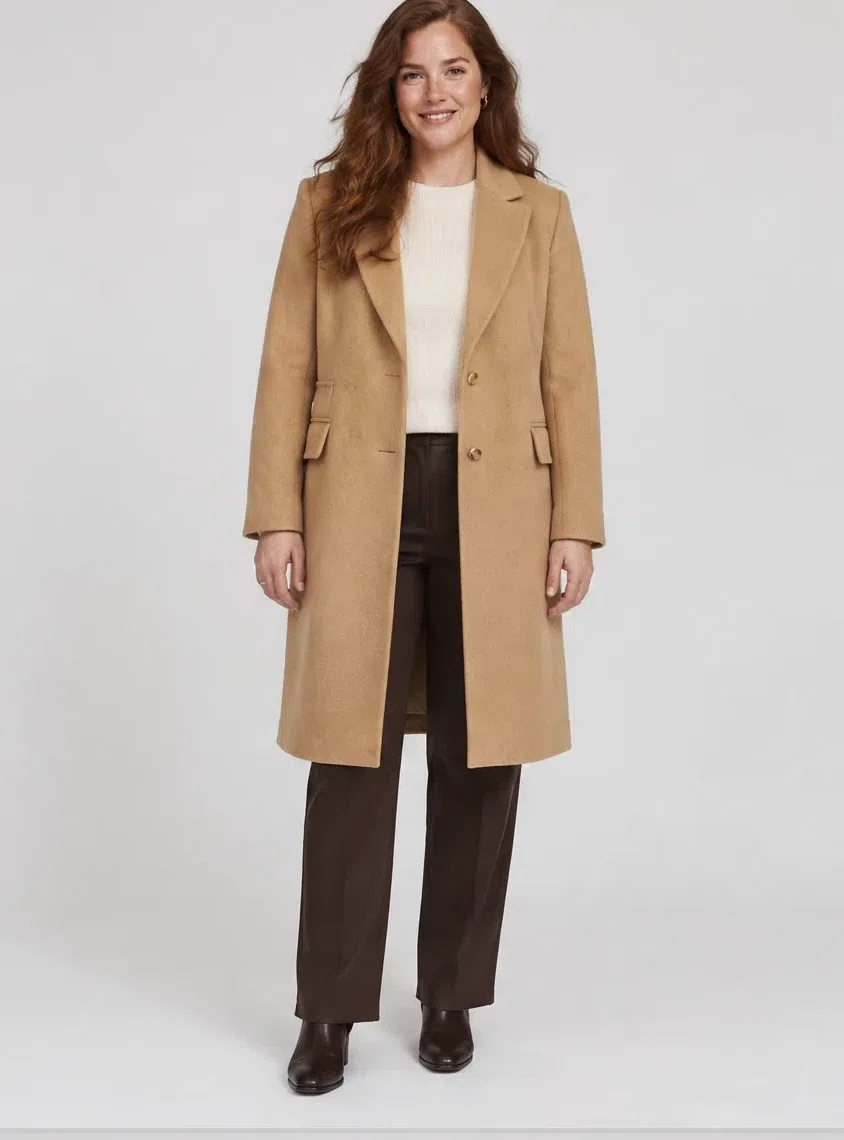
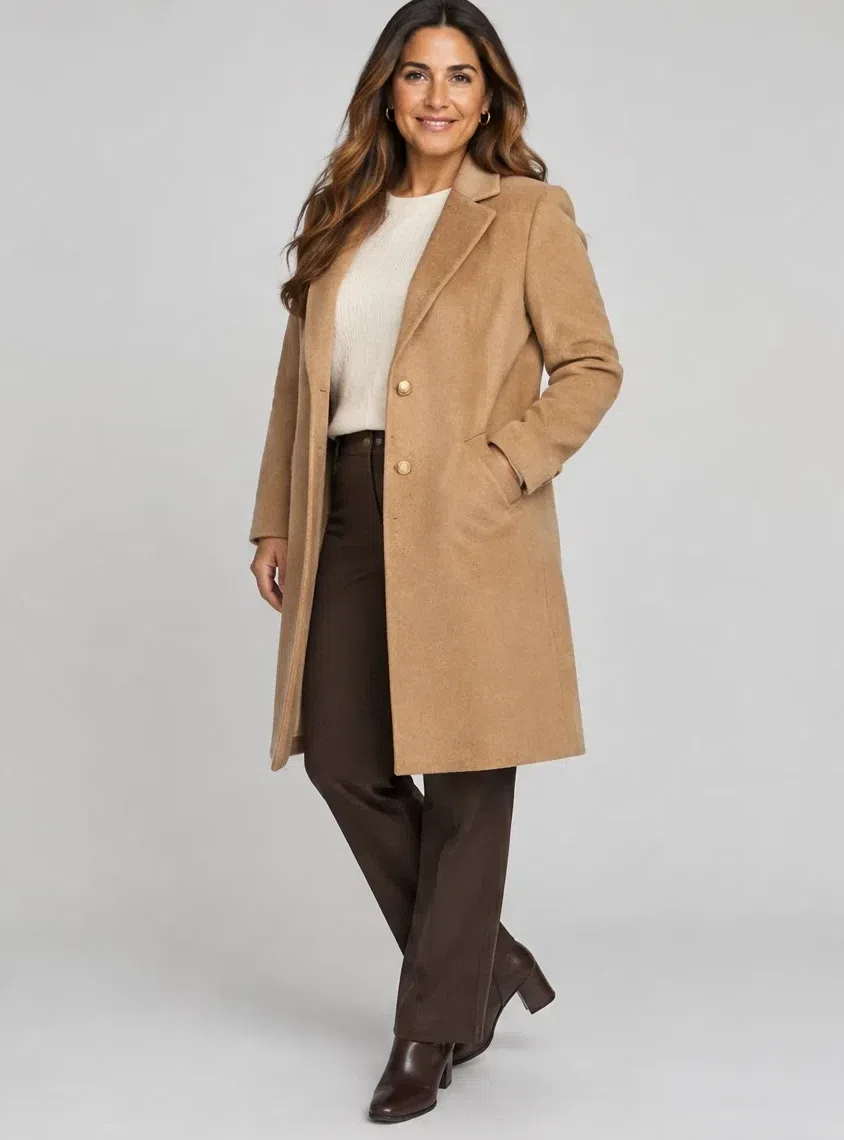
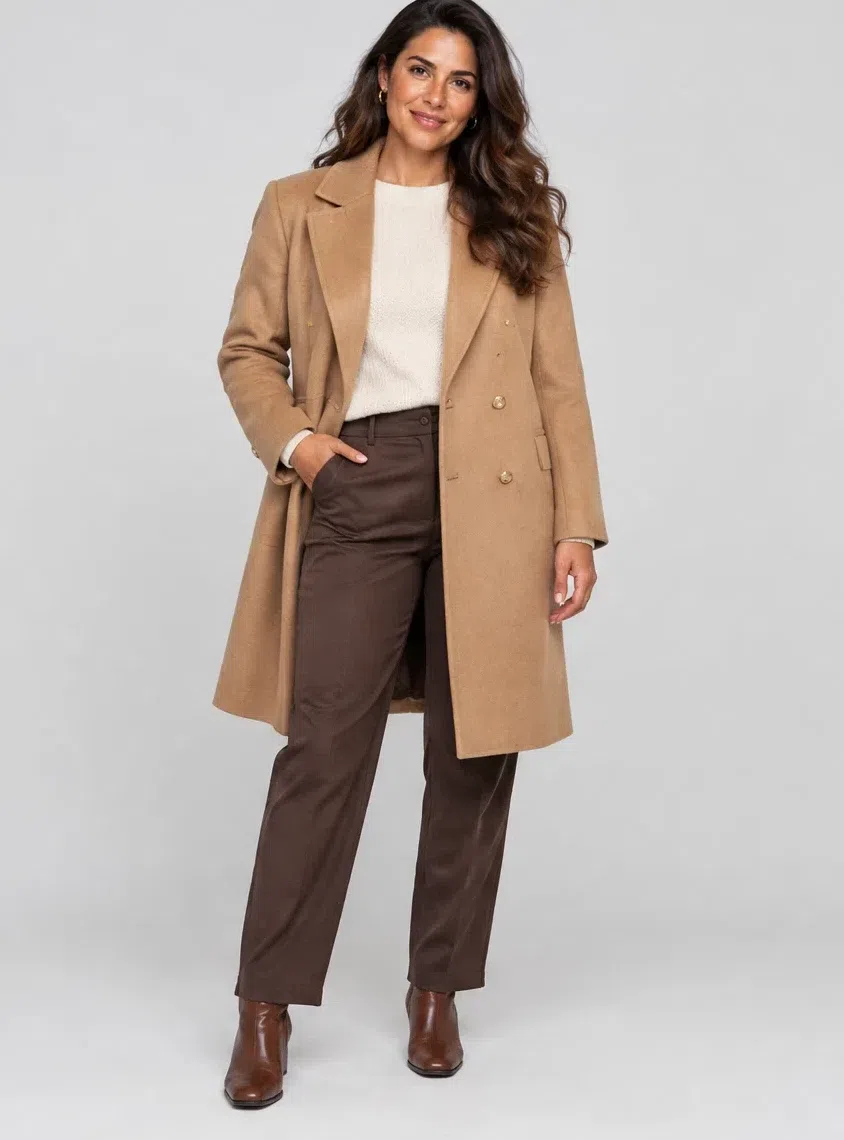
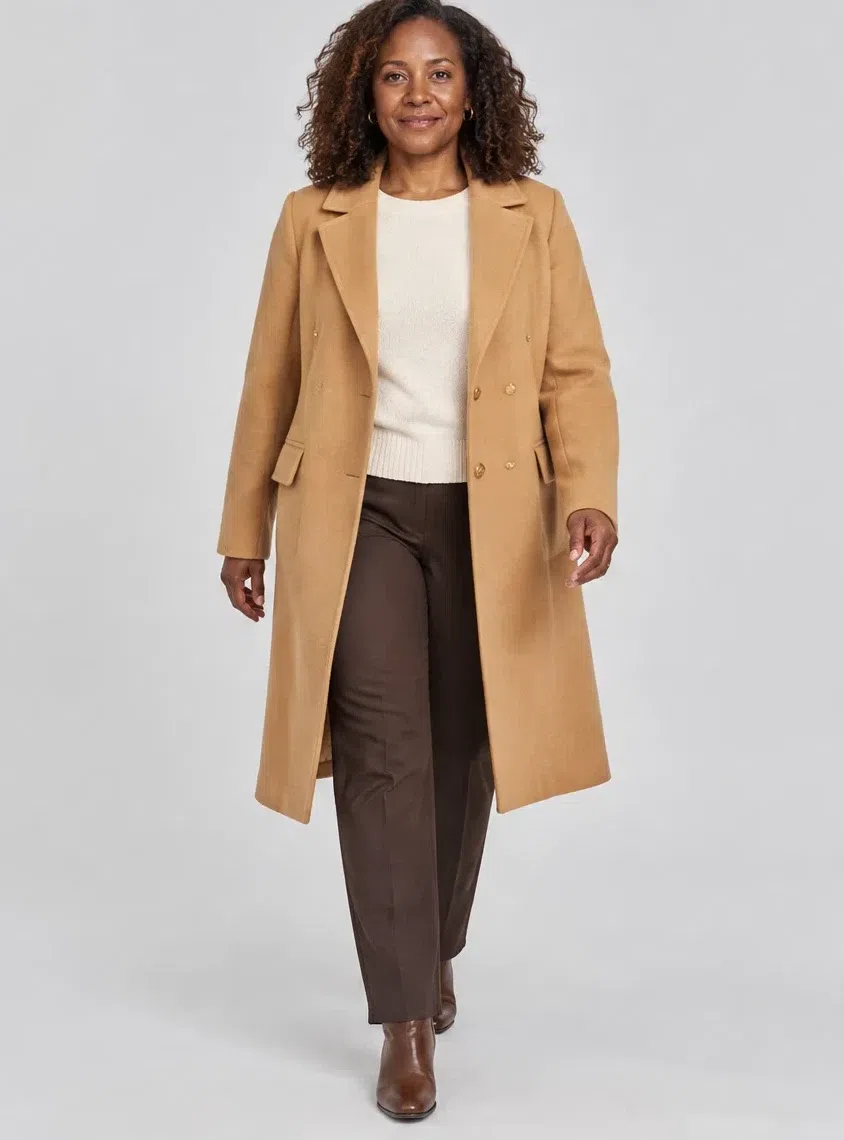
1Camel wool coat
The outer layer everything else has to agree with. A rich, warm camel sits naturally beside copper, auburn or chestnut hair and golden skin, so the outfit reads as one idea rather than several. Keep the cut classic - straight or gently shaped at the waist, midi length, in soft wool or cashmere - and it will go over dresses, trousers and jeans alike. Walk past the grayish beiges sold as the safe version of camel; next to this skin they look dull.
Tip Look for wooden or gold-tone buttons. They put warmth exactly where the eye lands first.
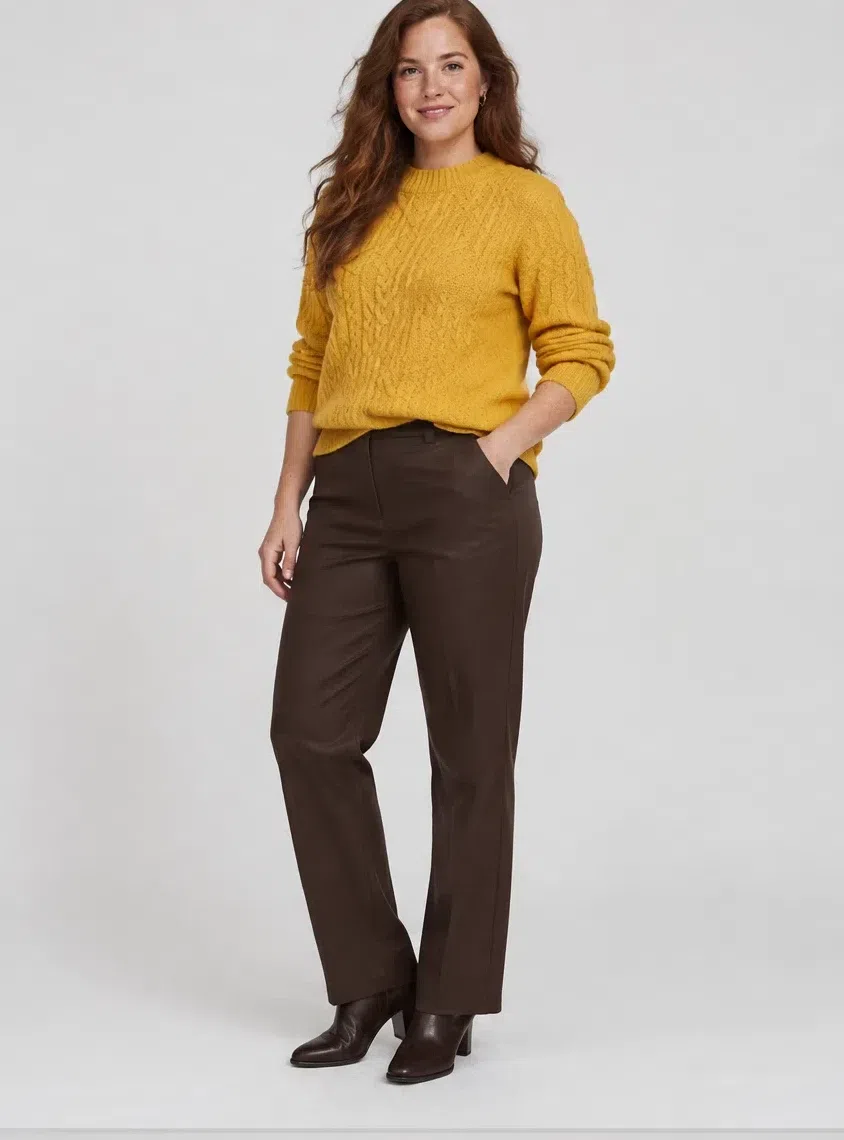
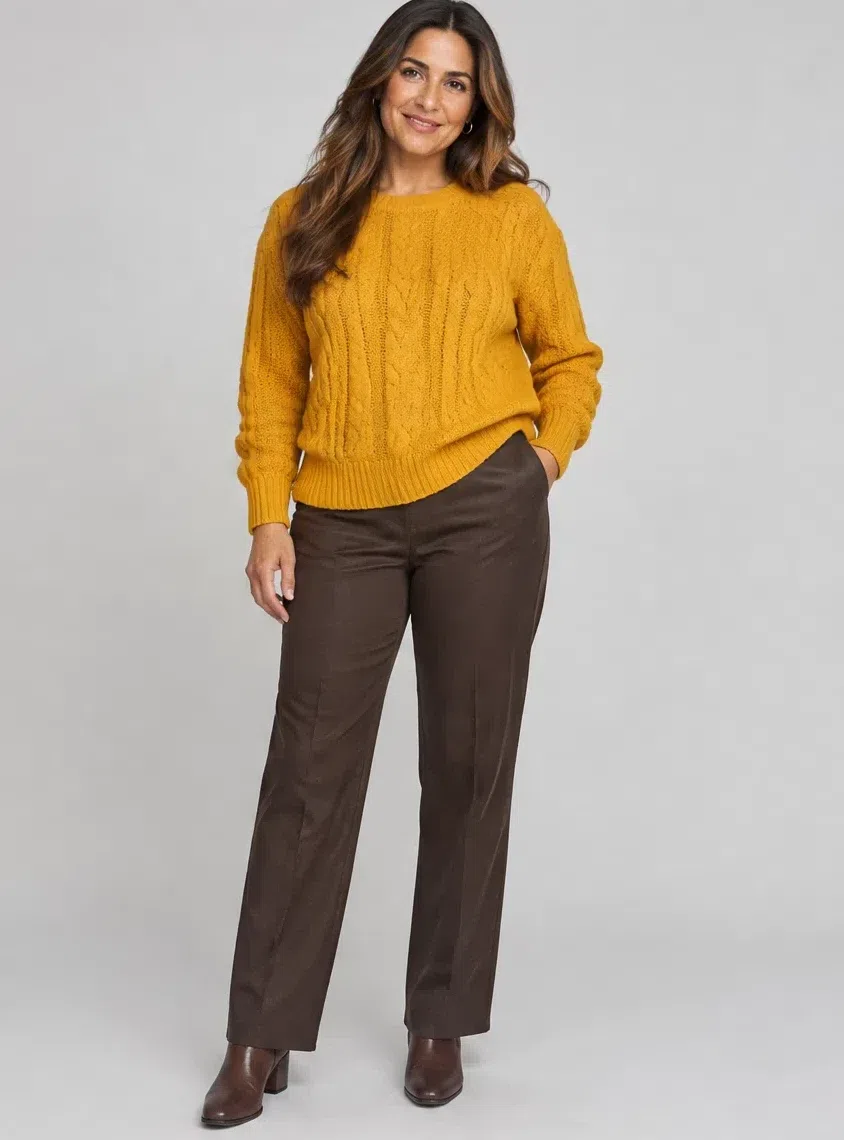
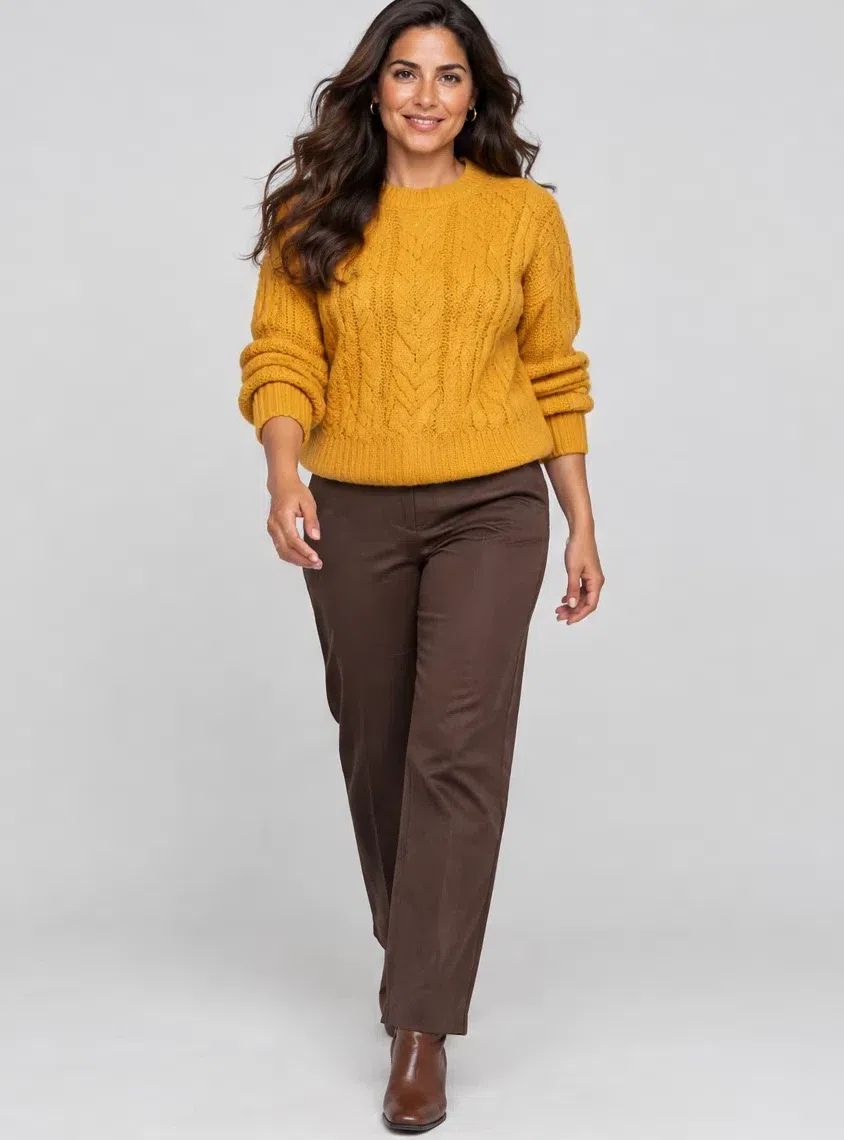
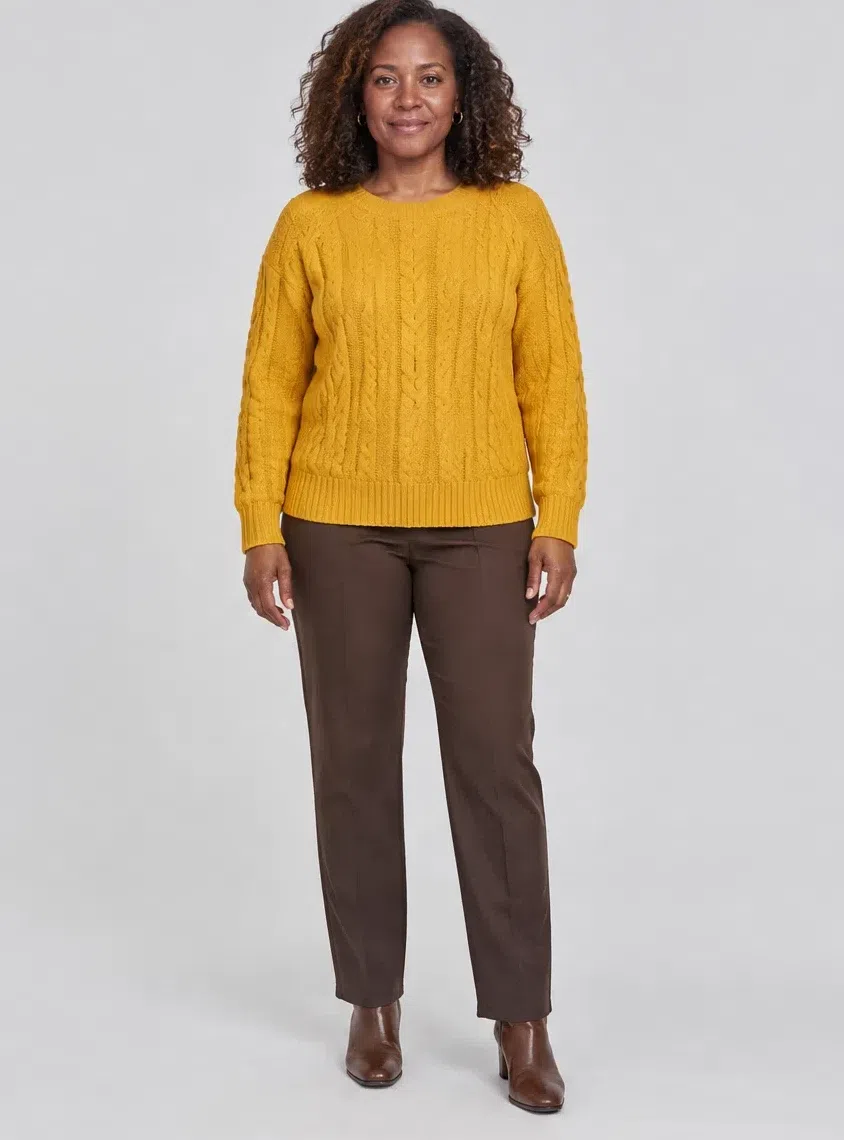
2Mustard cable-knit sweater
A roomy sweater in soft merino or cashmere, in a spiced warm shade, is the backbone of cold-weather dressing for this coloring. Mustard, rust or a ripe pumpkin orange all lift the face and bring up the gold in the skin. Pick a textured knit with cables or aran stitches, or a plain relaxed shape, and wear it with skirts, jeans or khaki trousers.
Tip Mustard knit, relaxed jeans, brown boots: the easiest everyday outfit this palette makes.
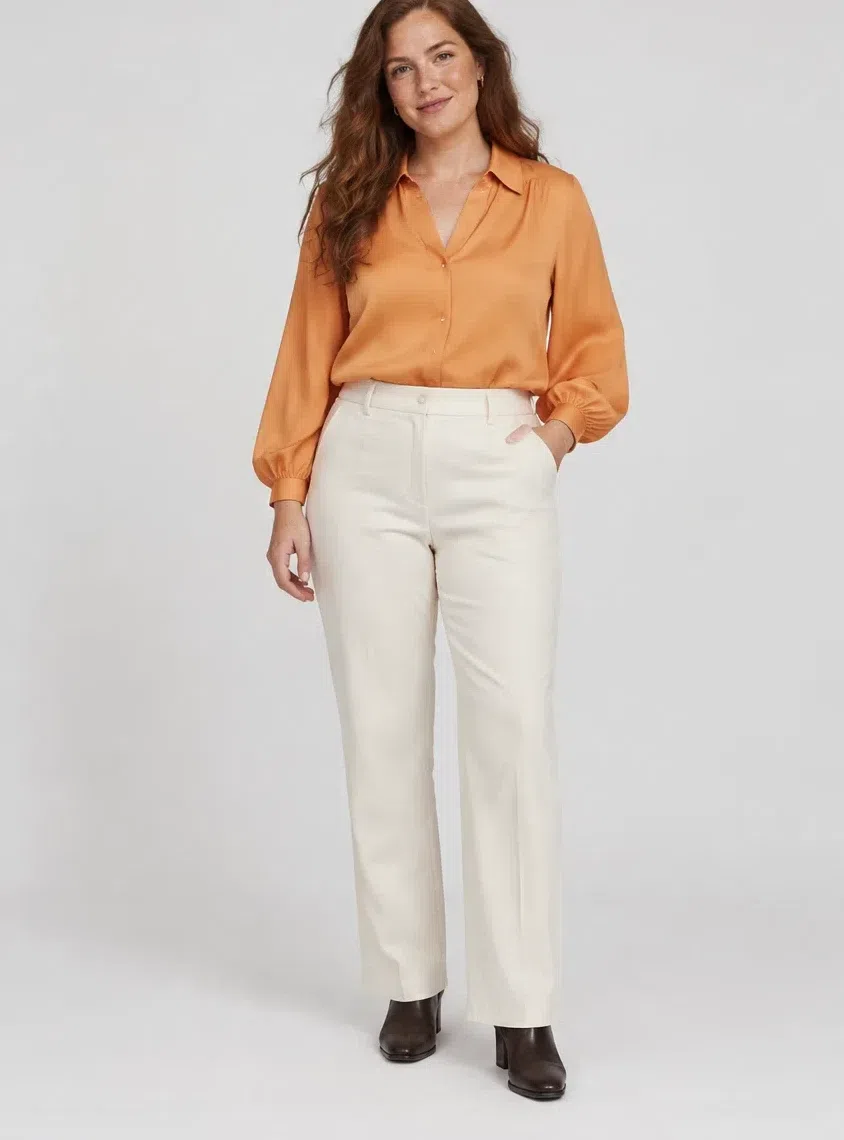
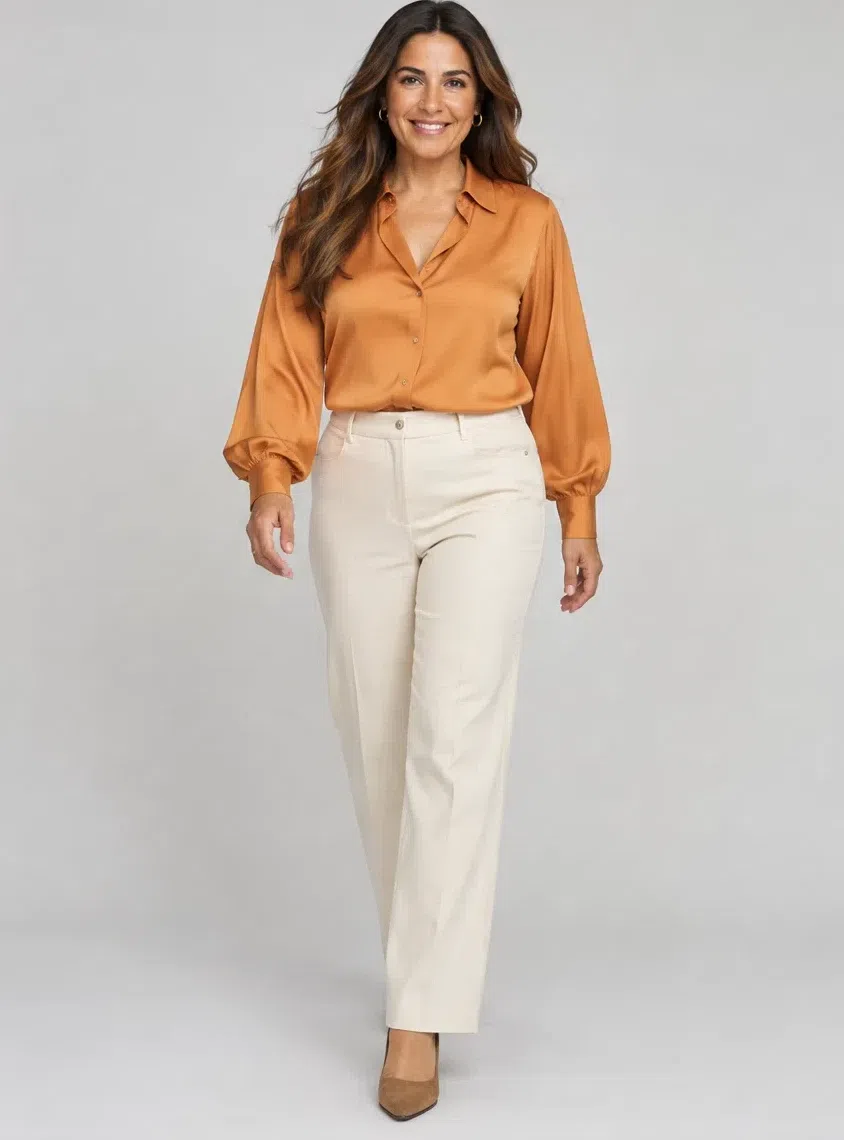
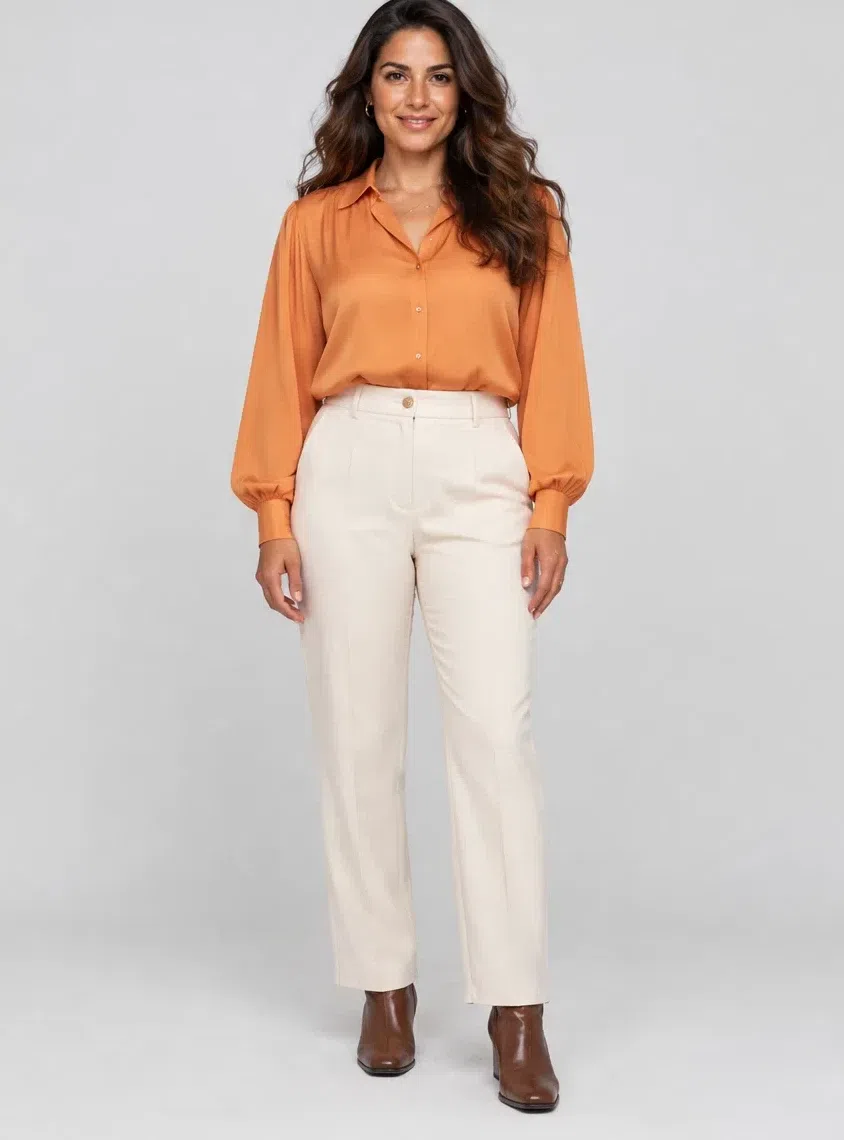
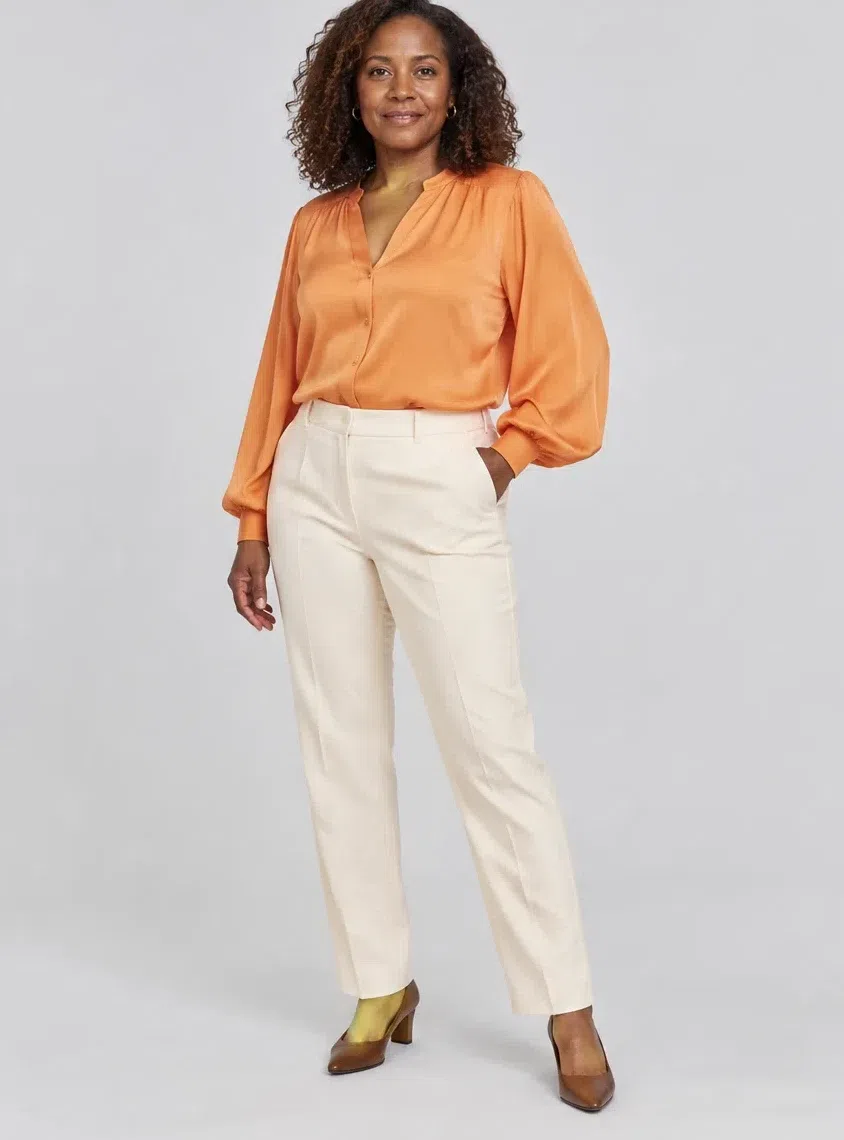
3Cantaloupe silk blouse
Silk is what turns a plain outfit into a dressed one. Warm ivory, peach or a light salmon all suit this coloring, and real silk throws a soft glow up onto the face that no synthetic manages. A loose cut keeps it easy: with straight trousers at the office, with jeans for an evening out.
Tip A shawl collar or fuller sleeves soften the look, which suits coloring this rich.
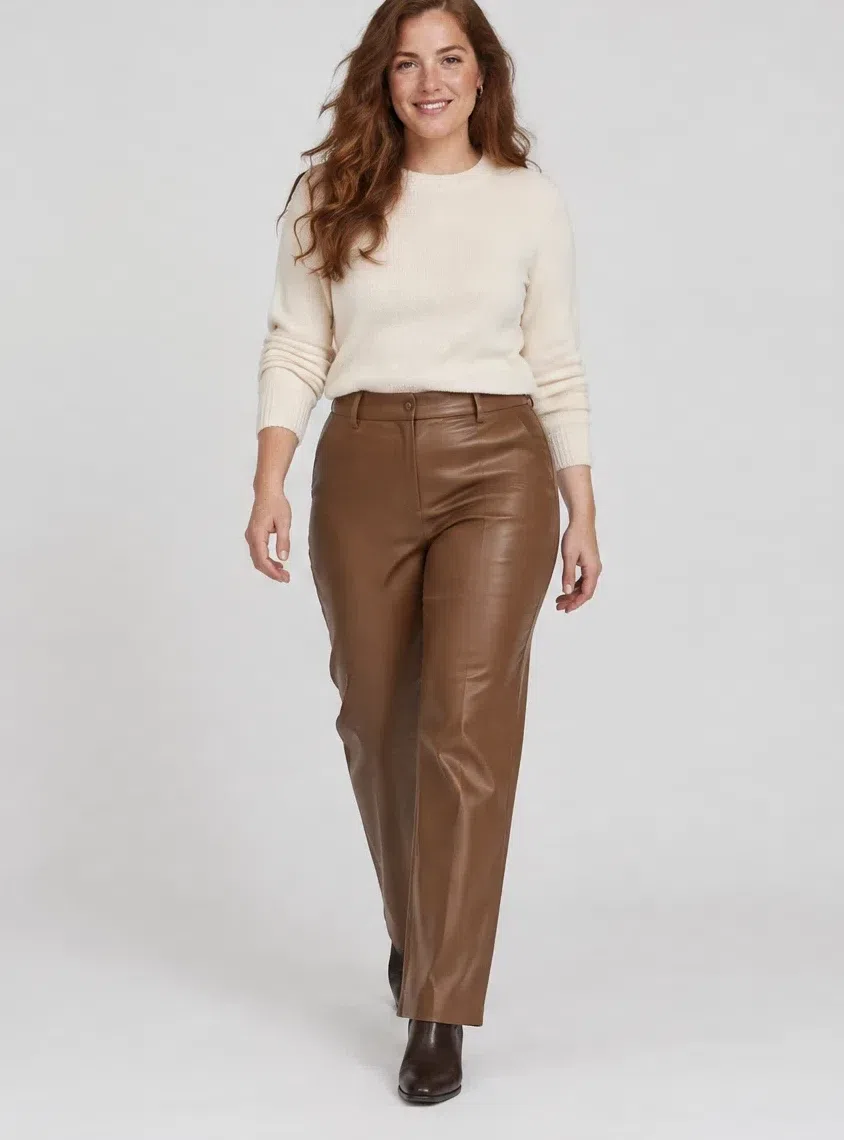
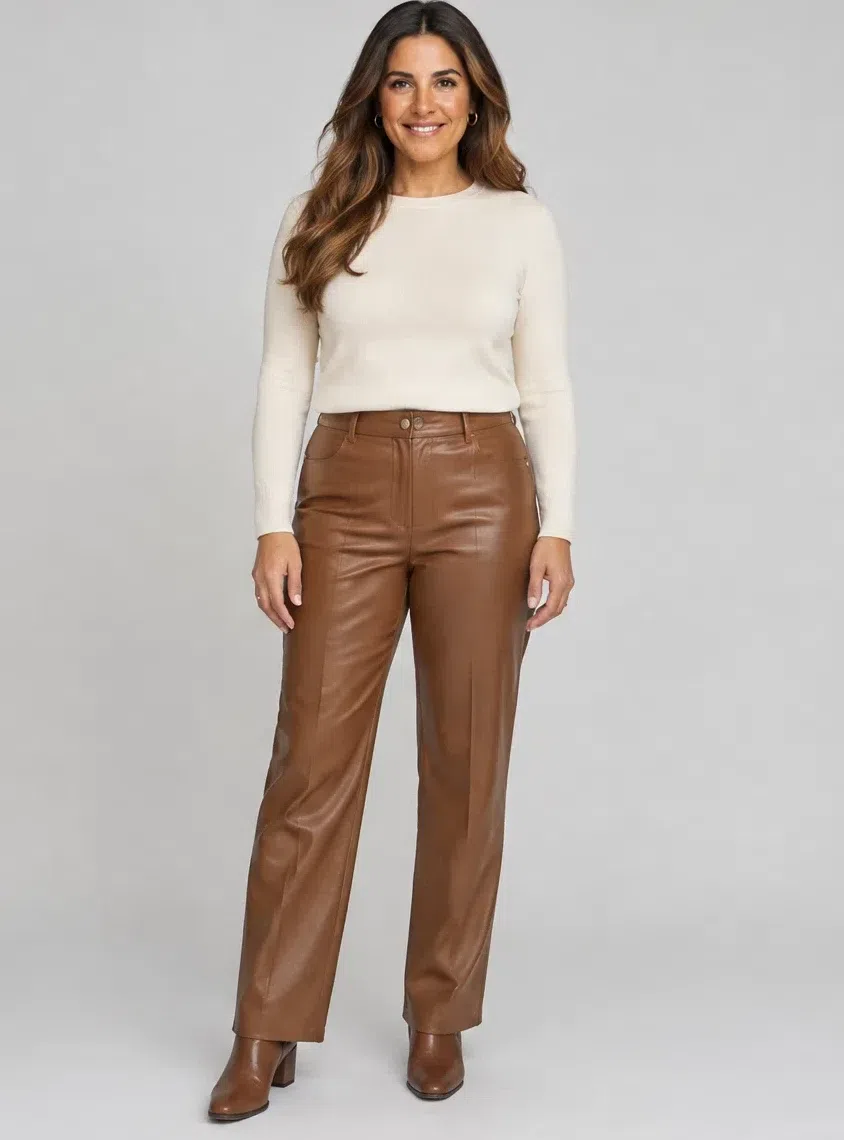
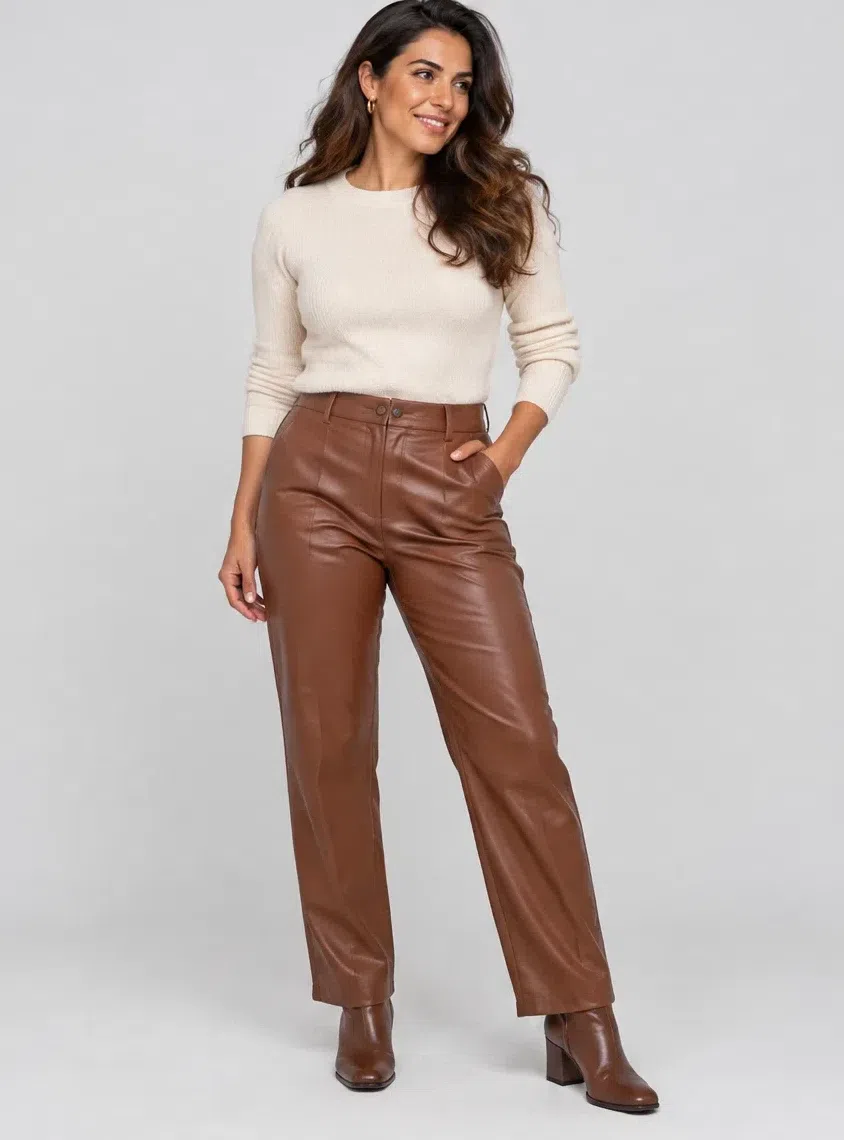
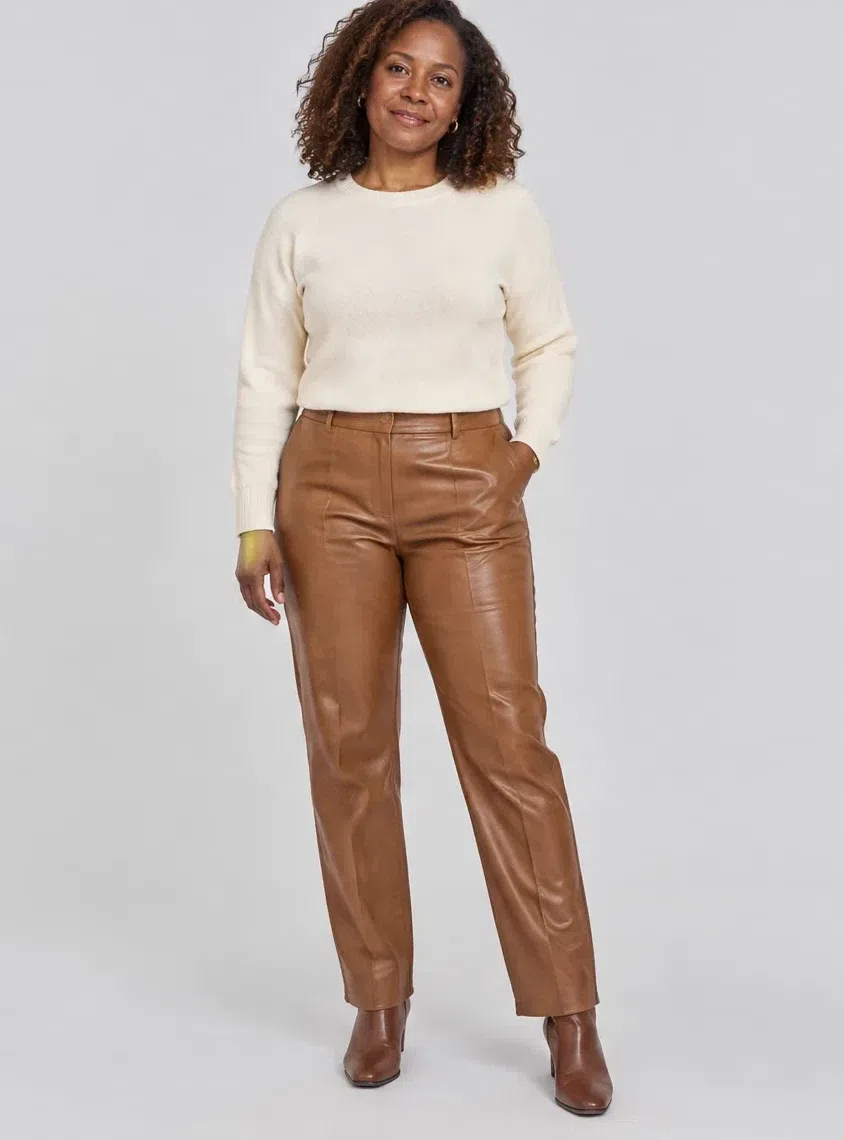
4Cinnamon leather trousers
Leather has a place in this wardrobe - just never in black. Straight or flared trousers in soft leather in a deep earthy brown, an olive or a dark wine shade give an outfit a bohemian edge. A suede midi skirt in a terracotta tone does the same job, and both sit well under a chunky sweater or a silk blouse.
Tip For evening, brown suede with the silk blouse and gold jewelry is hard to beat.
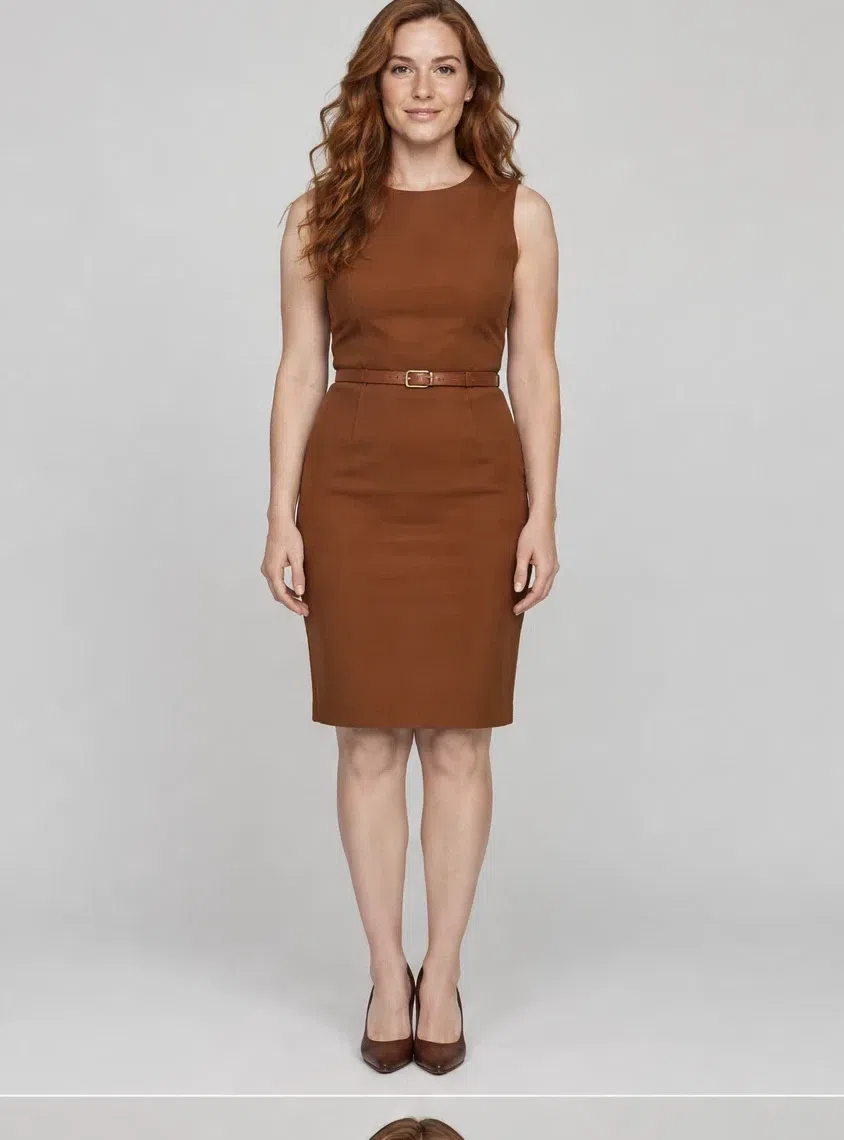
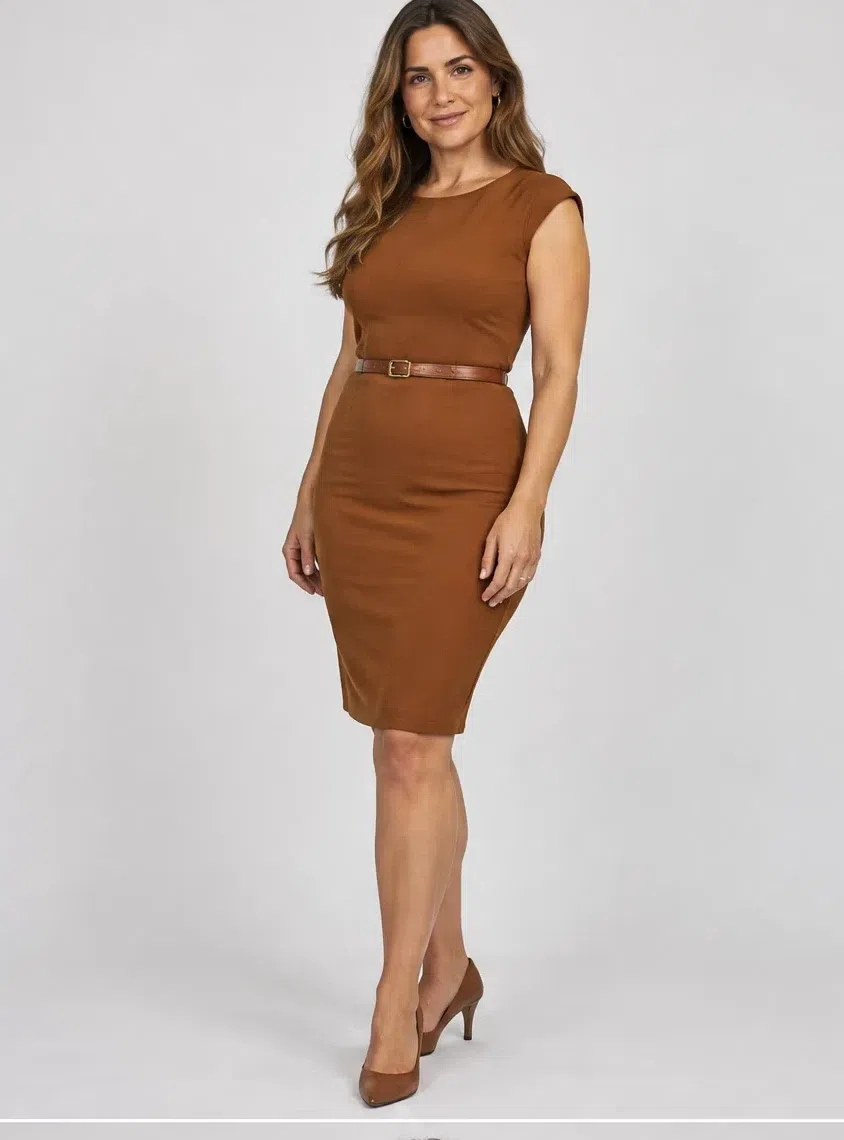
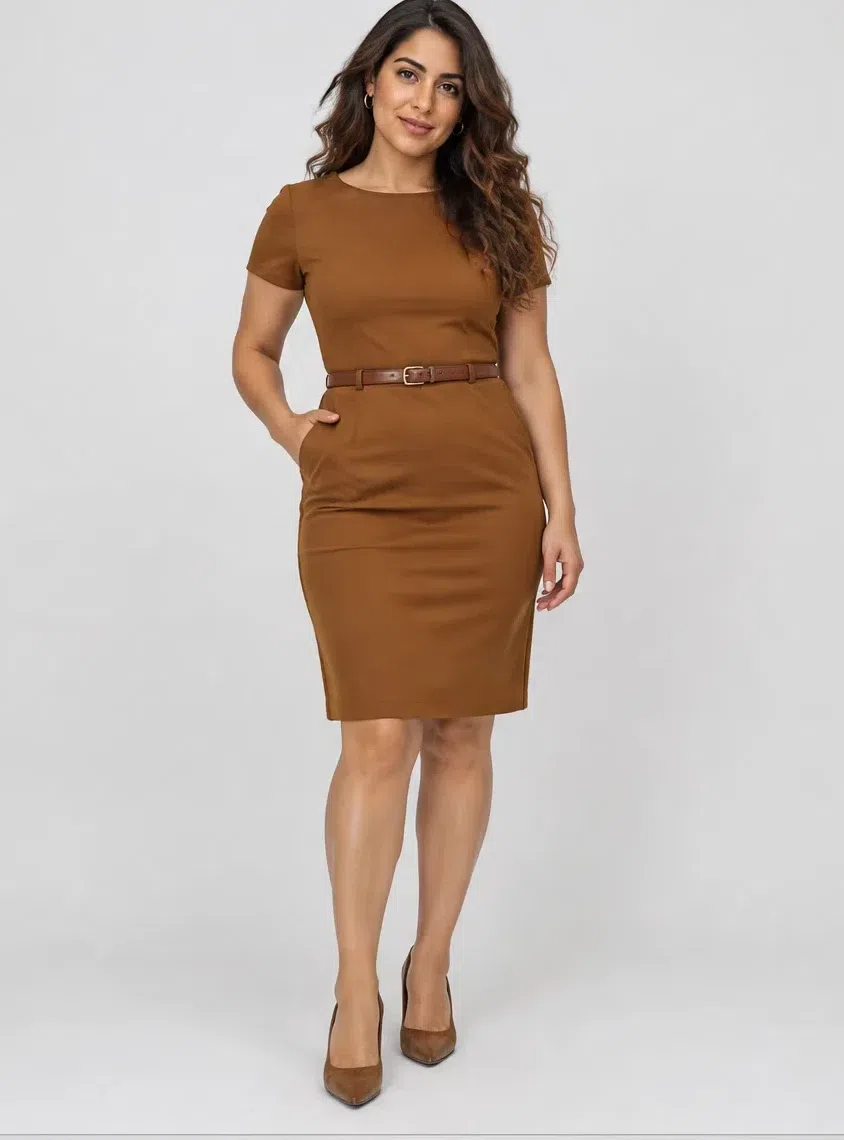
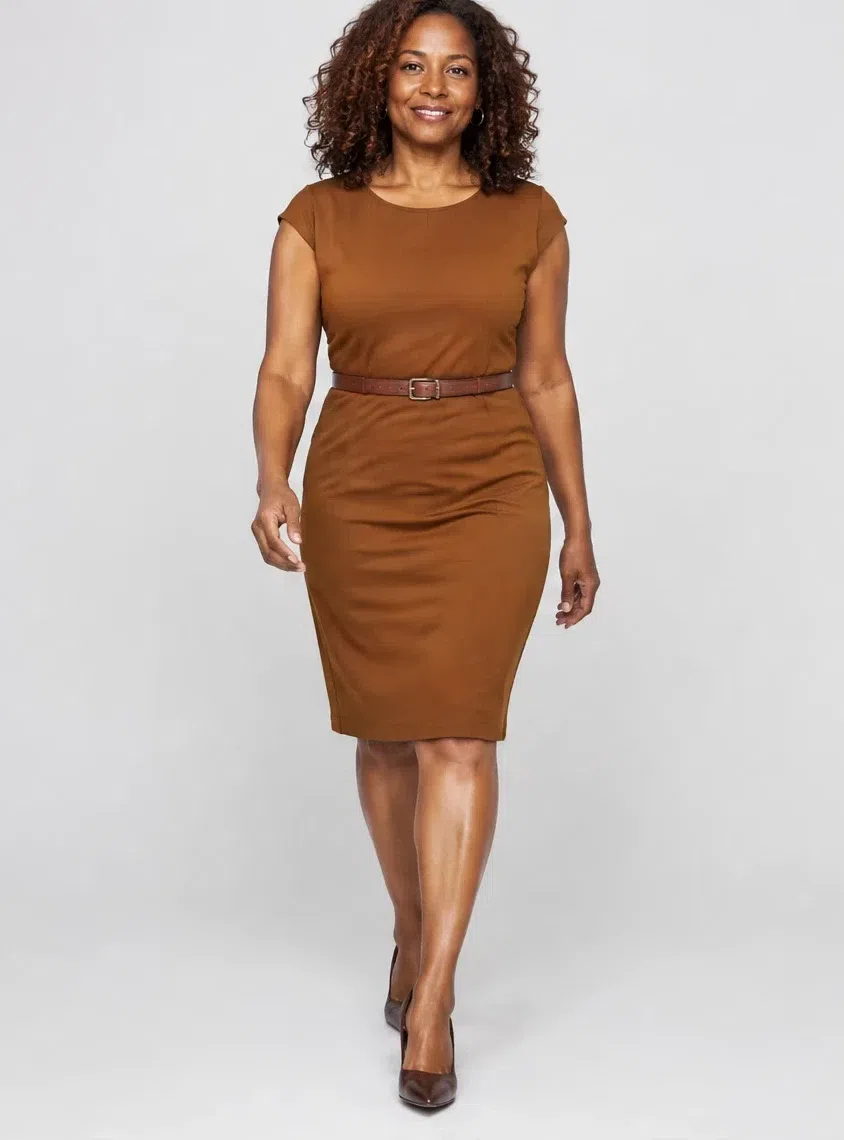
5Sienna sheath dress
A fitted or straight dress anchors both the work wardrobe and the evening one. Stay with rich but unflashy shades - terracotta, brick, mustard, a deep green - in twill, velvet, heavy silk or stretch cotton, at the knee or a little below. It takes a jacket, a coat, or nothing more than gold jewelry.
Tip A brown leather belt at the waist sharpens the silhouette.
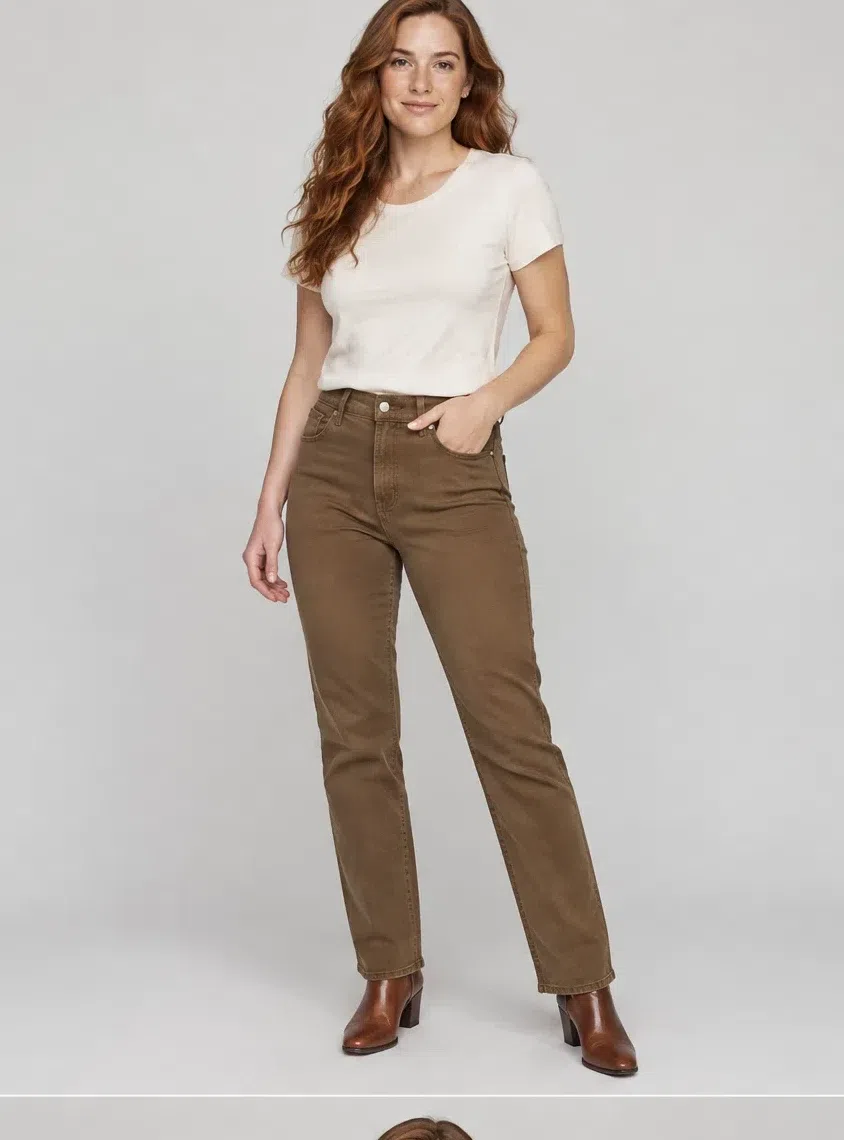
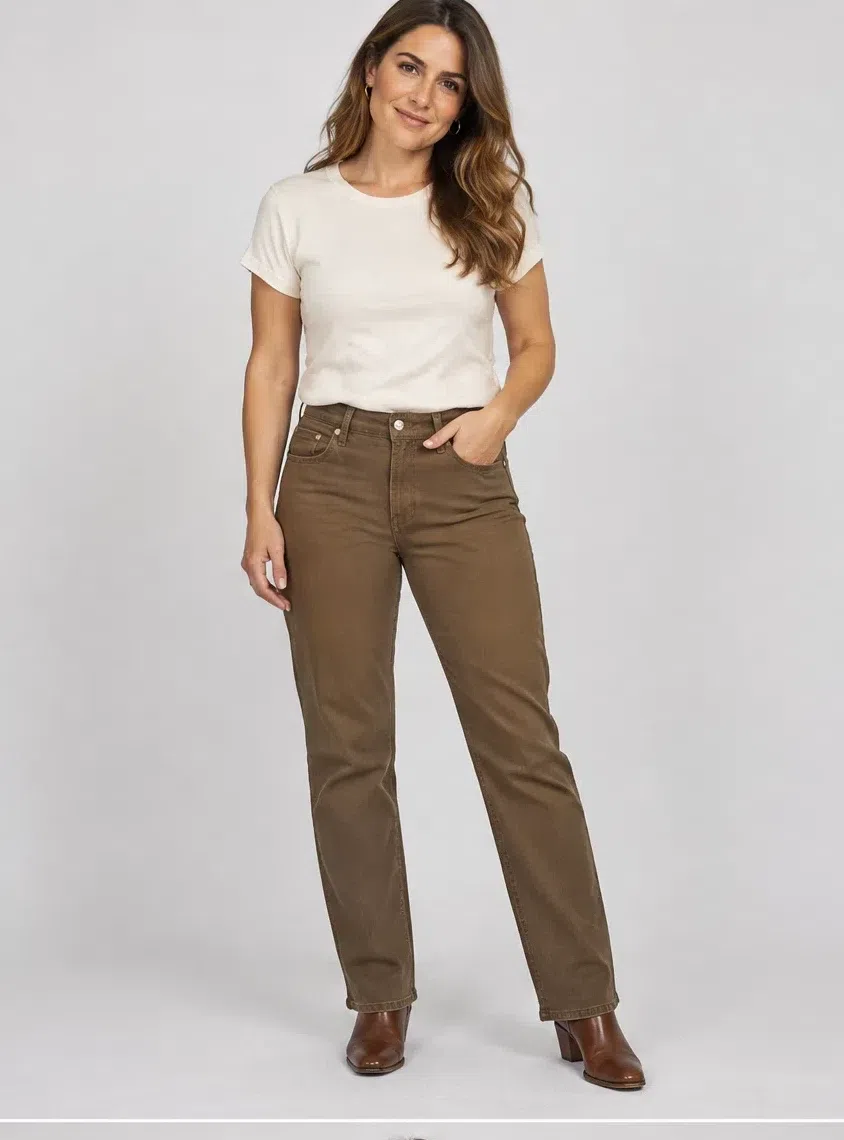
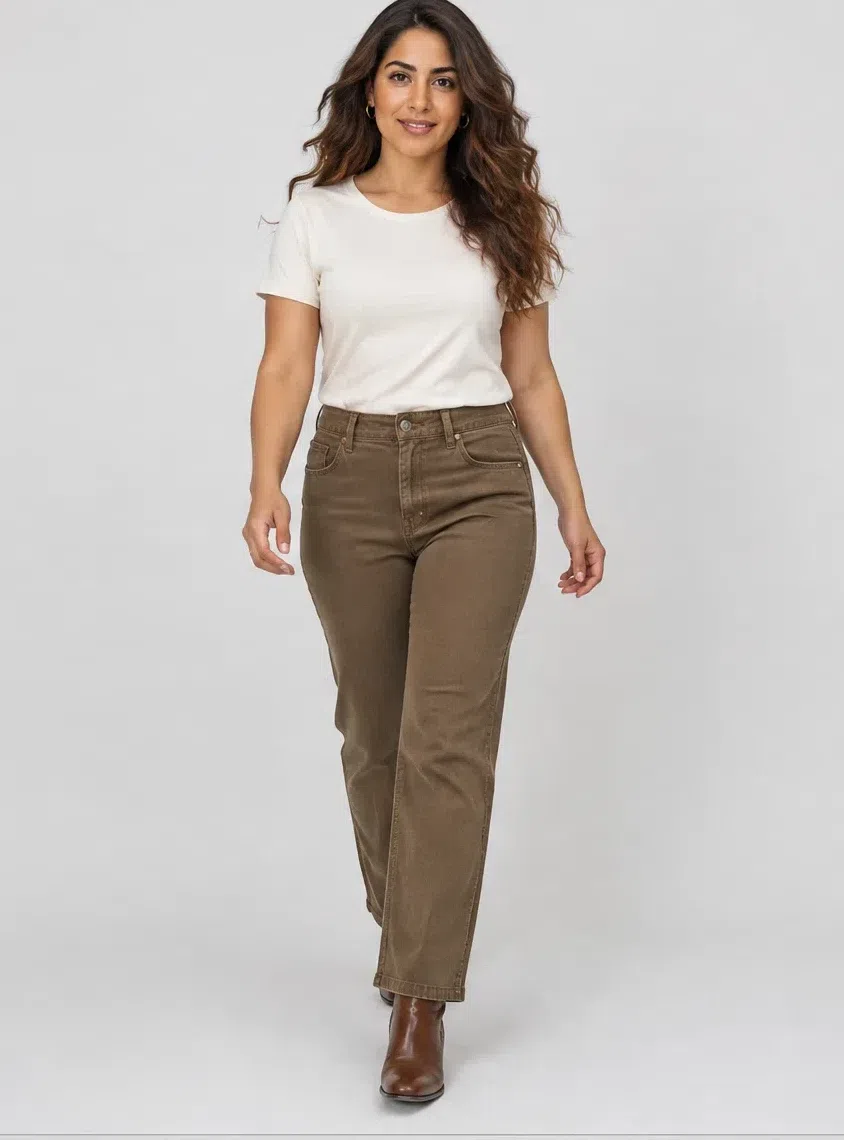
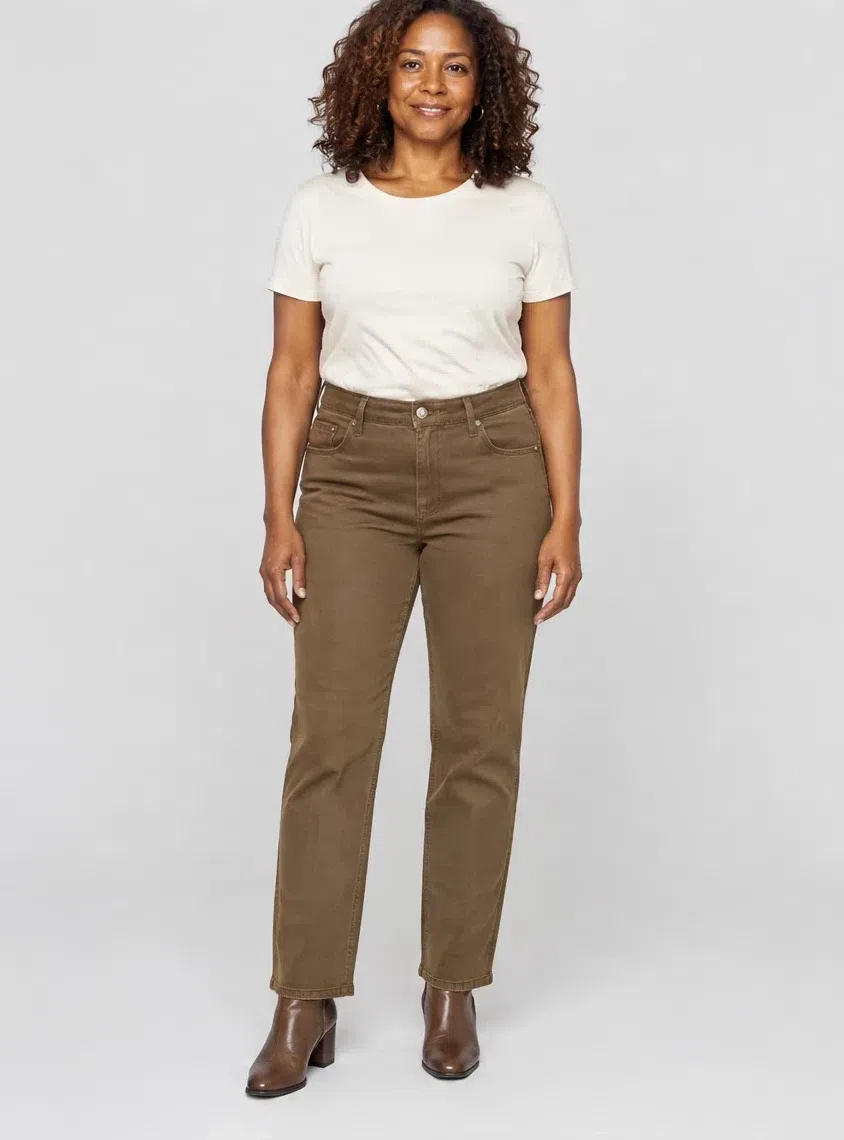
6Olive brown straight jeans
Blue denim is the one staple worth swapping out. Relaxed or straight jeans dyed khaki, dark olive, brown or even a wine shade make a better everyday base here, and they sit with every sweater, blouse and tee in the palette. Skip heavy contrast distressing; it brings back the harshness the color just took away.
Tip Olive brown jeans, a Rust sweater, brown boots - the classic Warm Autumn weekend.
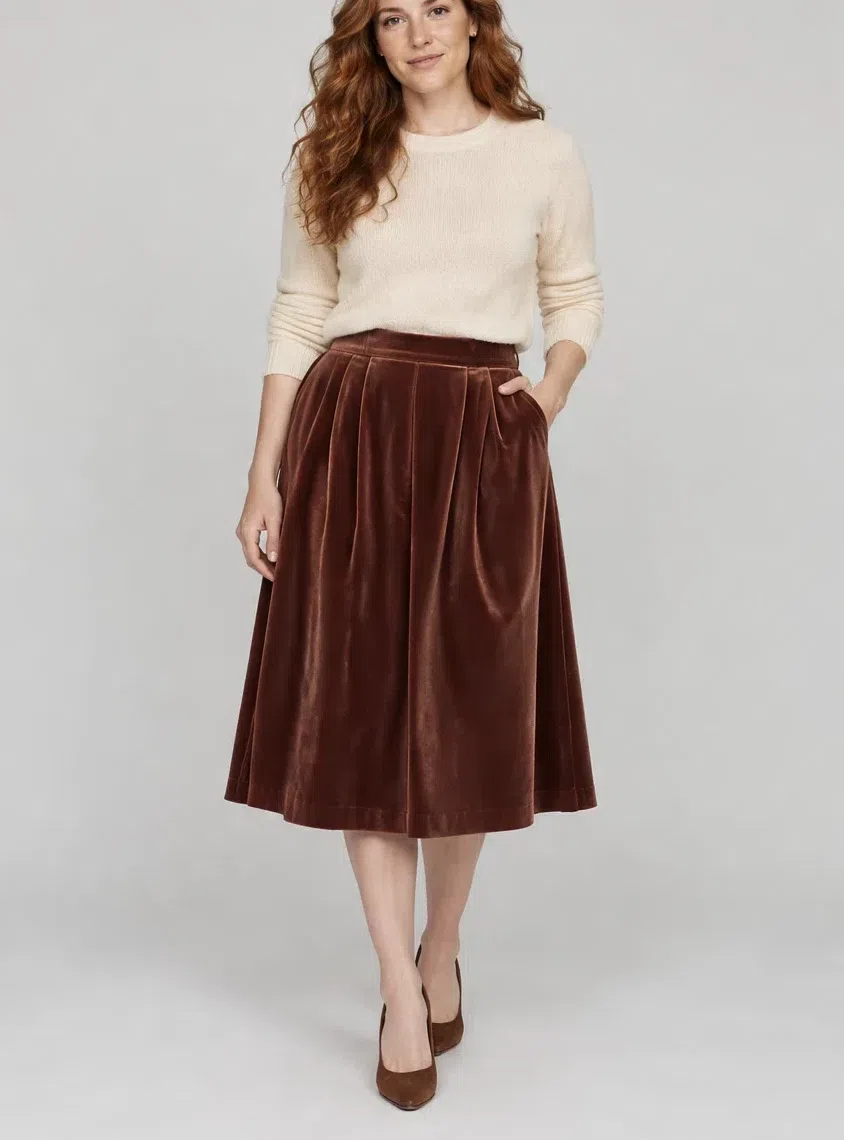
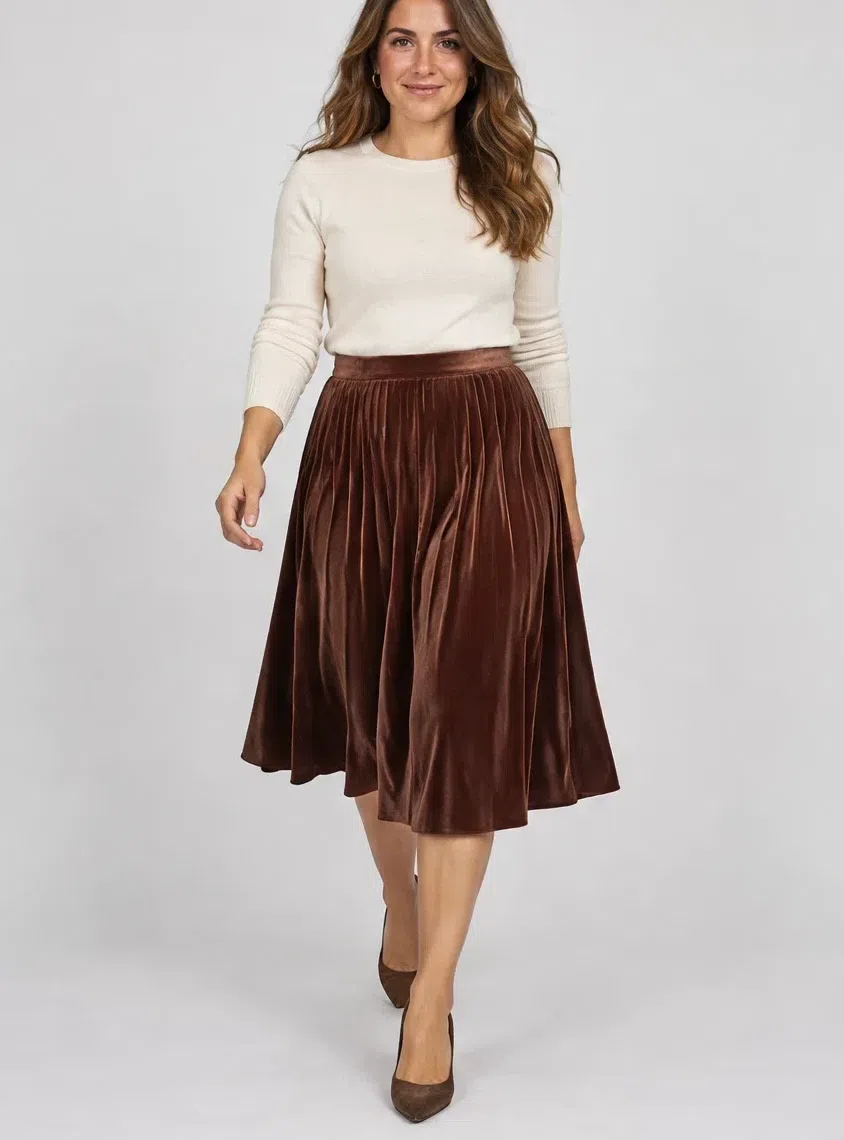
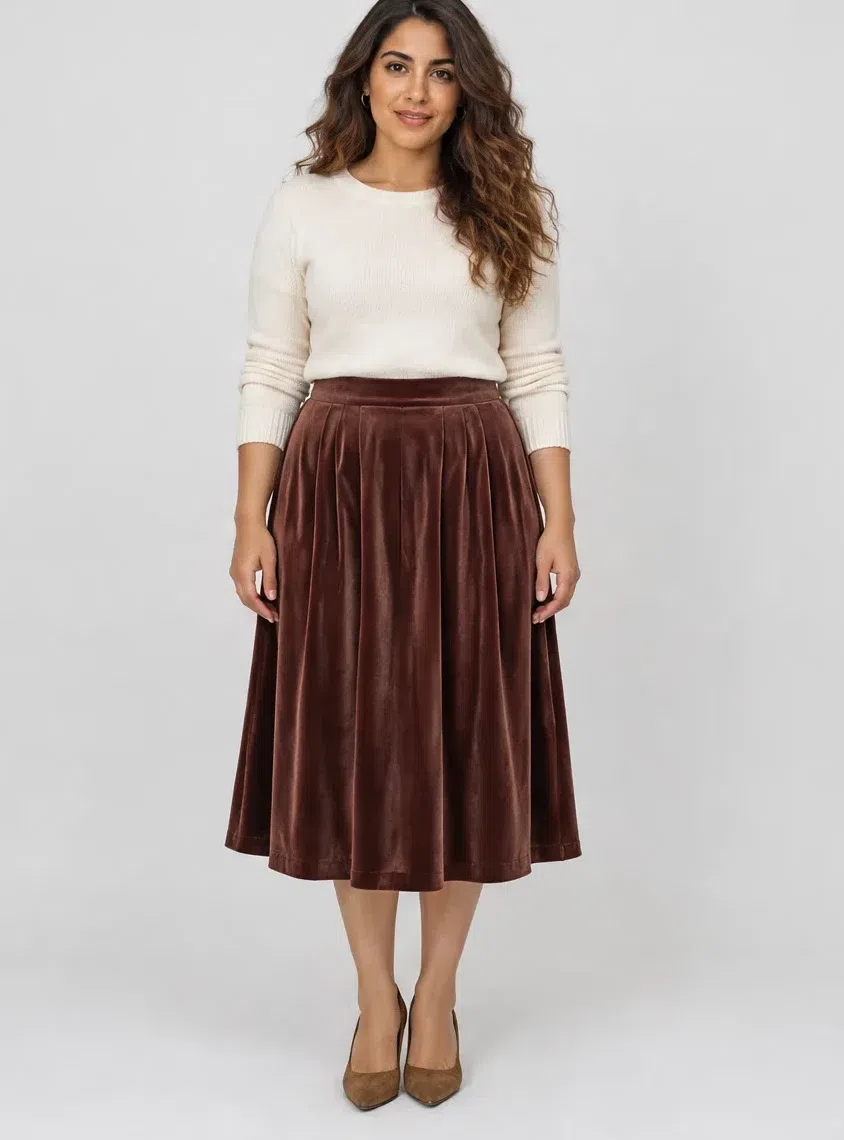
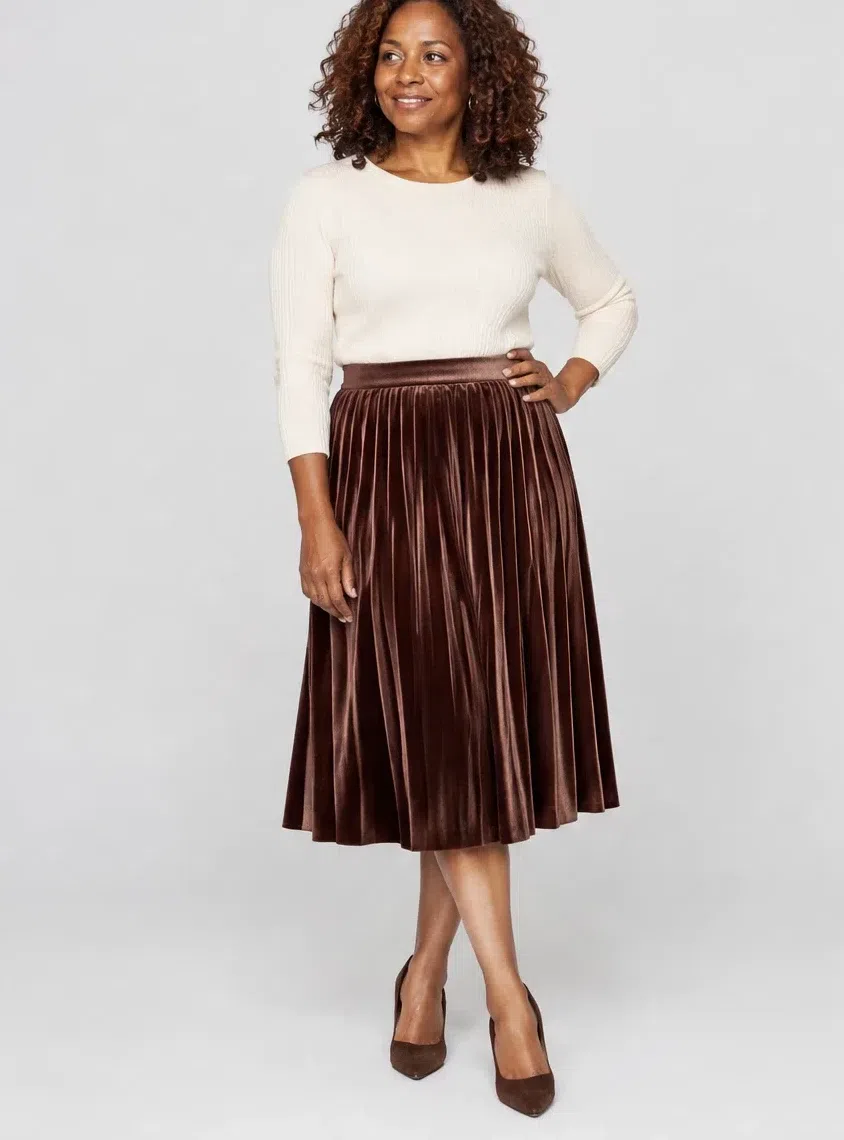
7Redwood velvet midi skirt
Velvet and corduroy suit this coloring better than nearly any other fabric, because their depth and low sheen match the richness of the palette. A pleated or straight midi in deep mahogany, a warm teal or a dark brown looks luxurious and relaxed at the same time. Wear it with chunky knits and turtlenecks by day, and with the silk blouse at night.
Tip With chunky boots and an oversized sweater, the same skirt turns bohemian.
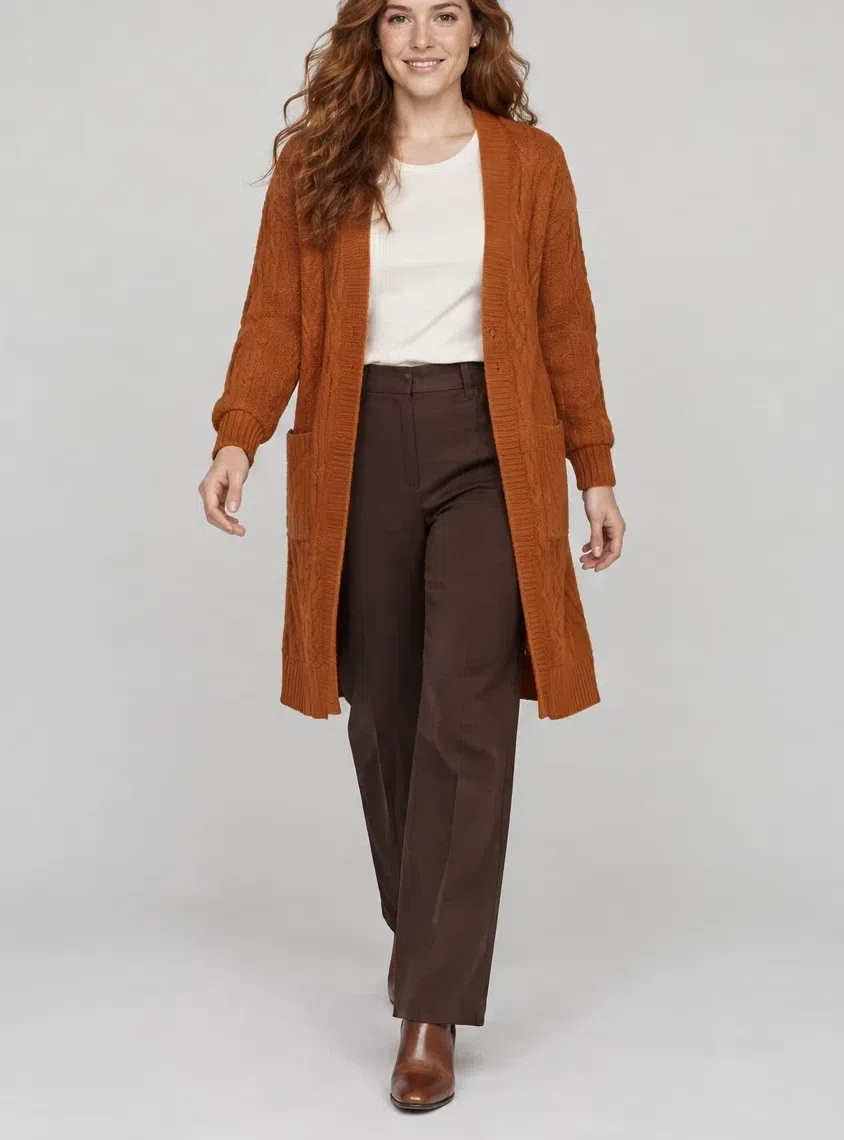
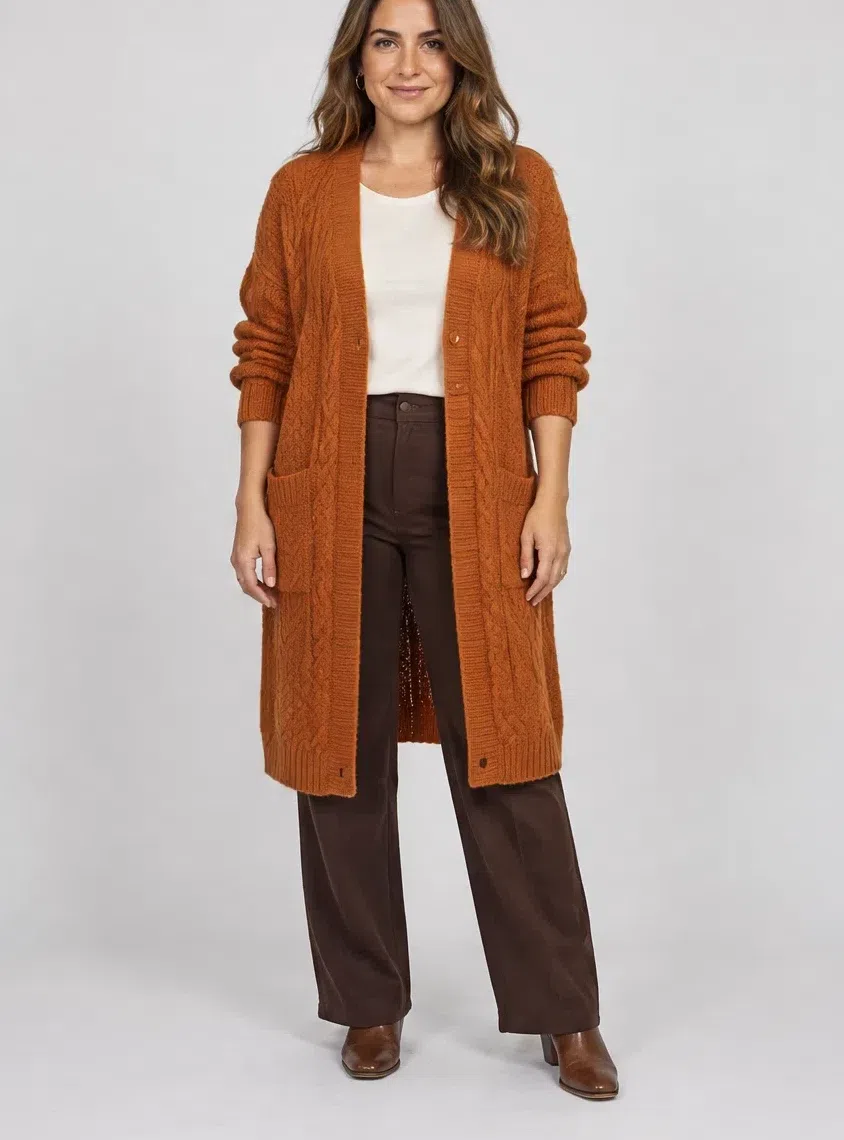
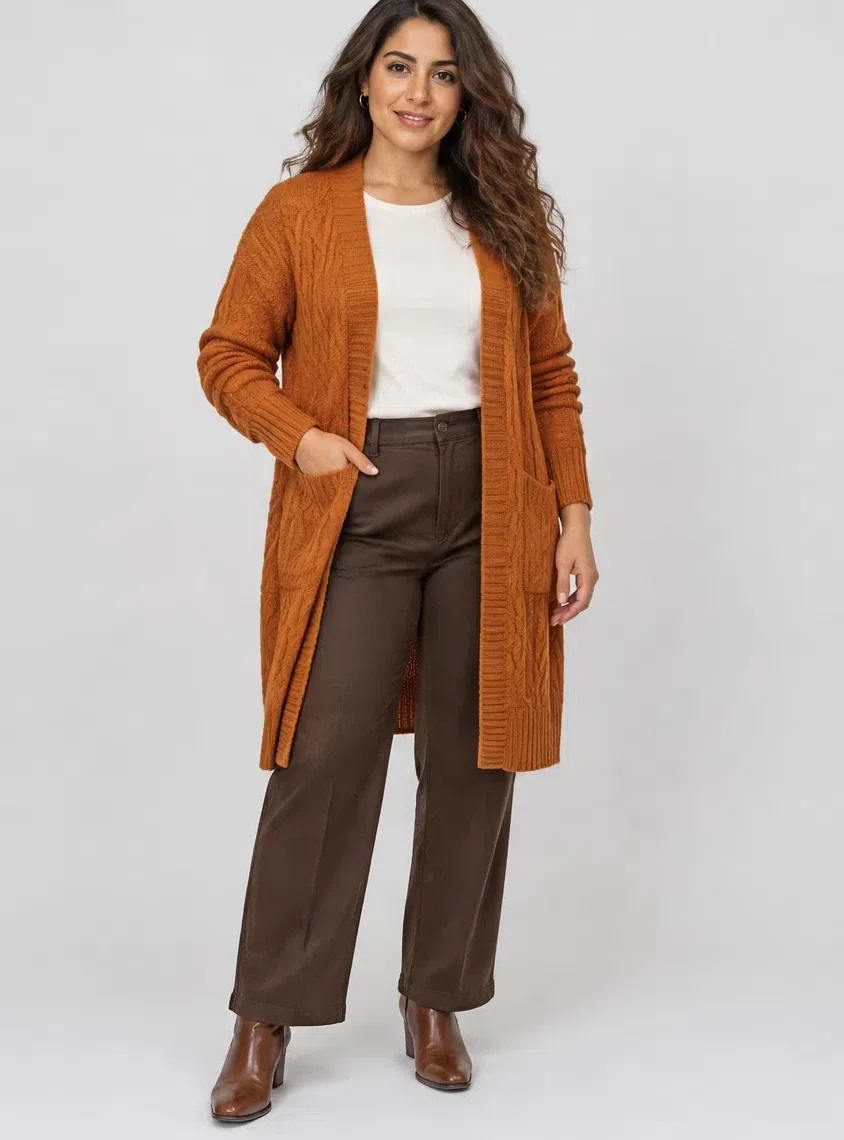
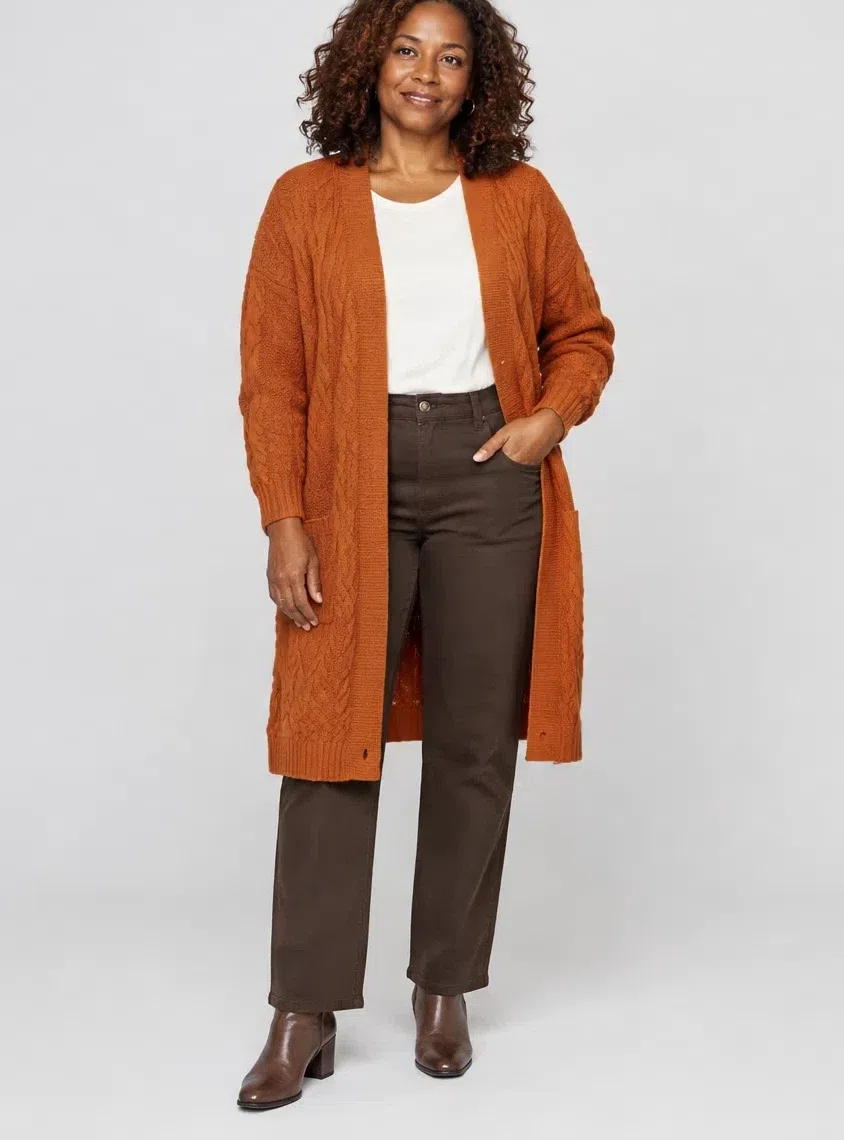
8Rust chunky-knit cardigan
A long, loose cardigan is comfort and style in one piece. Choose a chunky knit with cables or raised patterns in warm browns and rust, or a flecked yarn that mixes mustard, olive and terracotta. Between seasons it stands in for a coat; on cooler evenings it goes over the shoulders of a dress.
Tip Long cardigan, jeans, a plain tee and boots: the autumn uniform, done in your colors.
Five ways to combine them
- Tone on tone. A Mustard sweater with an Olive brown skirt - neighboring shades that stay calm together.
- Deep contrast. Light and dark earth tones set against each other, like an Eggshell blouse with Cinnamon leather trousers, give an outfit more definition.
- One bright accent. Add a single saturated piece to a neutral look: a Sienna scarf over a Camel coat and jeans.
- Mix the textures. Velvet against rough wool, silk against leather. Mixed materials make a one-color outfit look dimensional instead of flat.
- Add one print. Break up the solids with a single patterned piece, such as a check scarf over a plain coat and sweater.
Makeup shades
Three products shown at four depths, then a quick shade reference
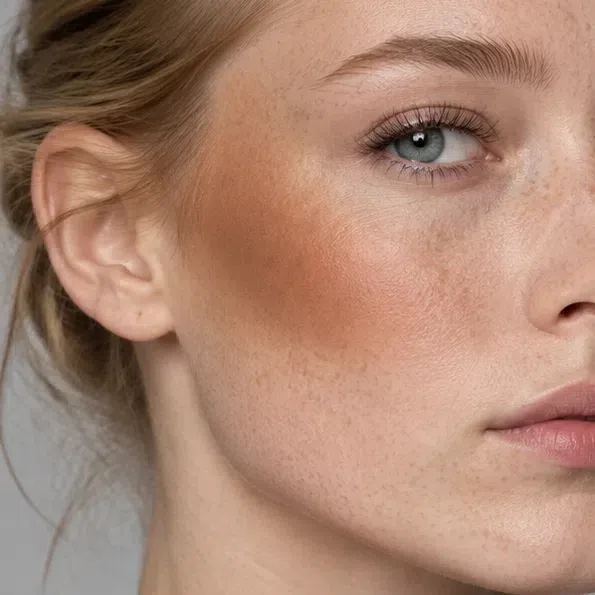
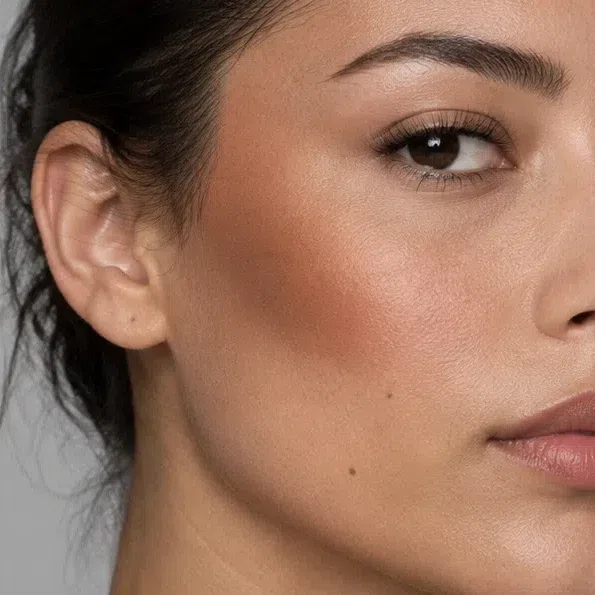
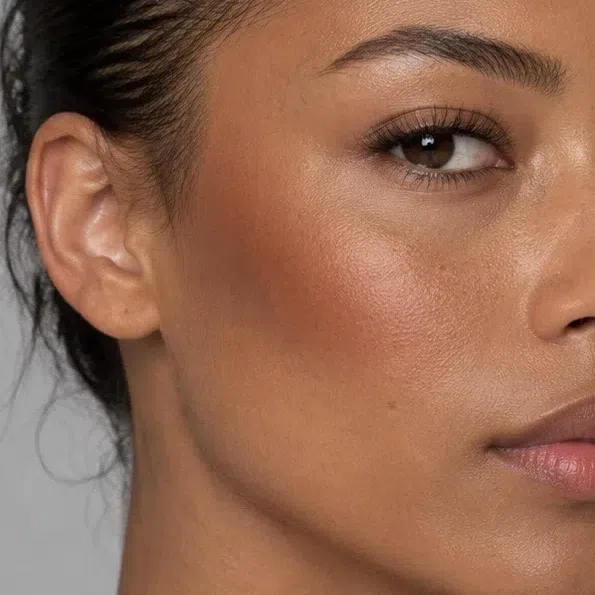
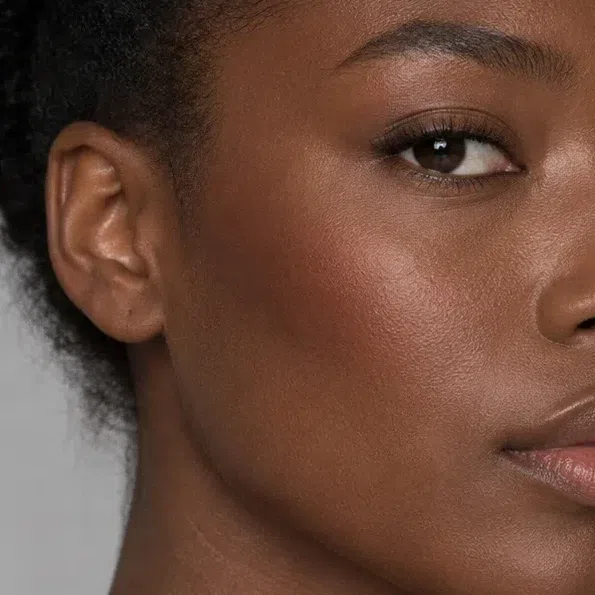
Foundation, bronzer and highlighter change with skin depth, so each one is photographed at all four depths. Everything after that is a reference list: the season fixes the family - golden, spiced, earthy - and your own depth picks the value within it.
Base: foundation, blush, glow and bronzer
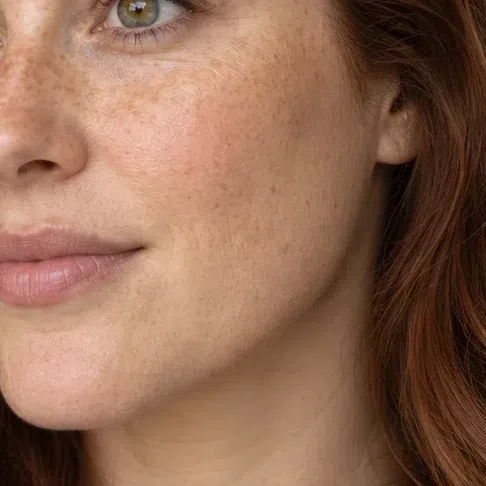
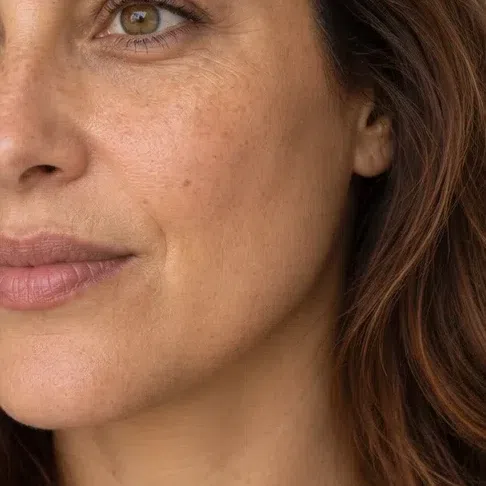
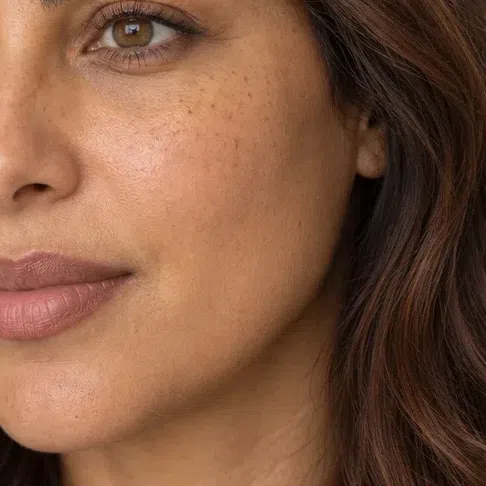
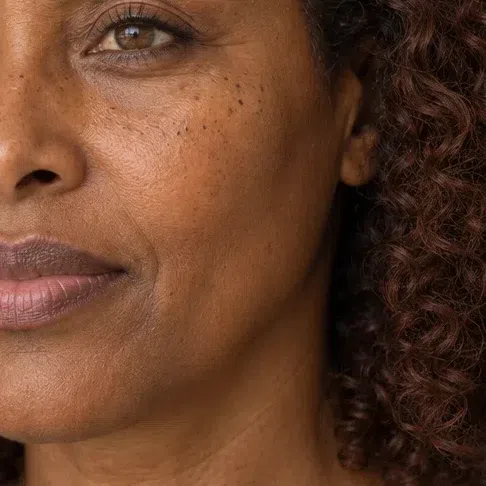
Foundation matched to your depth
Golden, peach or honey at every depth. A pink or grayish base is the most common mismatch on this skin, and it shows as a dull, tired cast rather than a line.
Blush
Apricot, terracotta, coral and golden peach. Cool pink, lilac, plum and fuchsia all look like a stain on warm skin.
- Apricot blush #F3B282
- Terracotta blush #C9714F
- Grapefruit #E57F5F
- Golden peach blush #F0BE8E
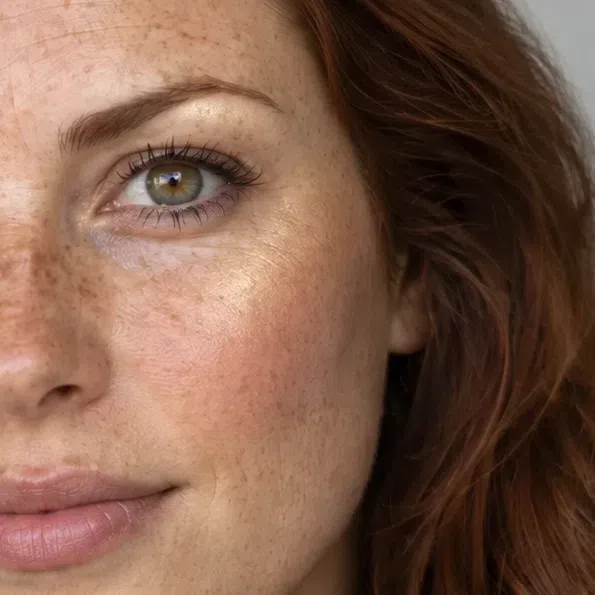
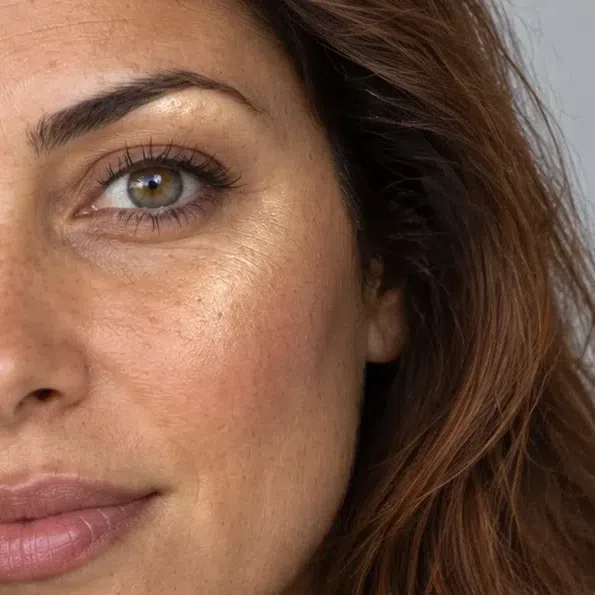
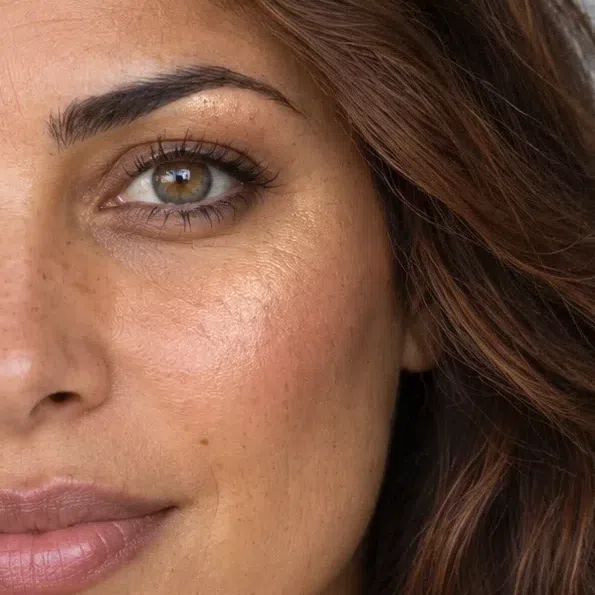
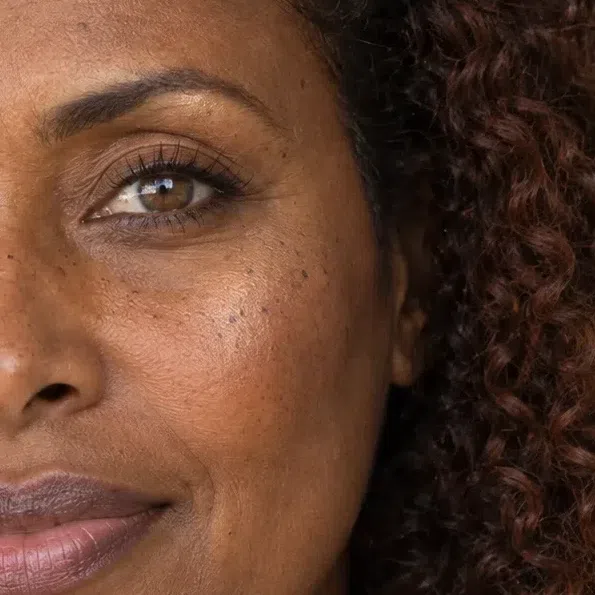
Highlighter matched to your depth
Gold, champagne, peach or bronze. Silver and icy pink pearls sit on warm skin like a layer of frost.
Bronzer matched to your depth
Warm golden brown or terracotta, one or two shades below your own skin. Gray-brown contour shades belong to a different family altogether.
Eyes: shadow, liner, mascara and brows
Everyday eyeshadow
Earthy neutrals with gold running through them.
- Golden beige lid #E0CBA8
- Ochre lid #C79A4E
- Khaki olive lid #8F8A5E
- Apricot lid #EAB183
Evening eyeshadow
The same family at full richness: copper, bronze, terracotta and a deep moss green.
- Copper shimmer #B5652F
- Bronze lid #96703C
- Terracotta lid #97472C
- Moss green lid #4E5B34
Eyeliner
Chocolate, bronze and dark greens do what black does here, and a teal liner picks up the palette's one blue-green.
- Chocolate liner #4A3122
- Antique bronze liner #8A6230
- Forest green liner #33452C
- Teal green liner #2A6158
Mascara
Browns in four depths, ending at a soft black-brown.
- Brown mascara #6B4A32
- Chocolate mascara #46301F
- Bronze mascara #8A6338
- Soft black-brown mascara #2B221C
Brows
Warm golden, copper and chestnut browns. Ash and gray-brown products look drawn on against this hair.
- Golden blonde brow #B99664
- Copper auburn brow #A0603A
- Chestnut brown brow #7A5334
- Warm dark brown brow #56392A
Lips: warm nudes and spiced reds
Nude lips
Caramel, peach, terracotta and honey-brown nudes - warm every time, never a beige-pink.
- Caramel nude #B9805E
- Peach nude #E9A98C
- Terracotta nude #B8705A
- Honey brown nude #A0724A
Colored lips
Brick, pumpkin, copper red and a wine with brick in it. Blue-based reds, fuchsia and cool berries are the ones to skip.
- Brick red #9E3B2C
- Pumpkin spice #D2571E
- Copper red lip #B94A2C
- Cordovan #842B2B
Hair shades
What suits this coloring, and what never will
Hair color on a Warm Autumn works best when it amplifies what is already there rather than replacing it. The shades below read as your own hair with more light in it - copper, bronze, caramel and warm chocolate, never ash.
Copper, red and bronze
The warmest end of the range, from golden copper to a deep spiced auburn.
Warm, saturated, glowing
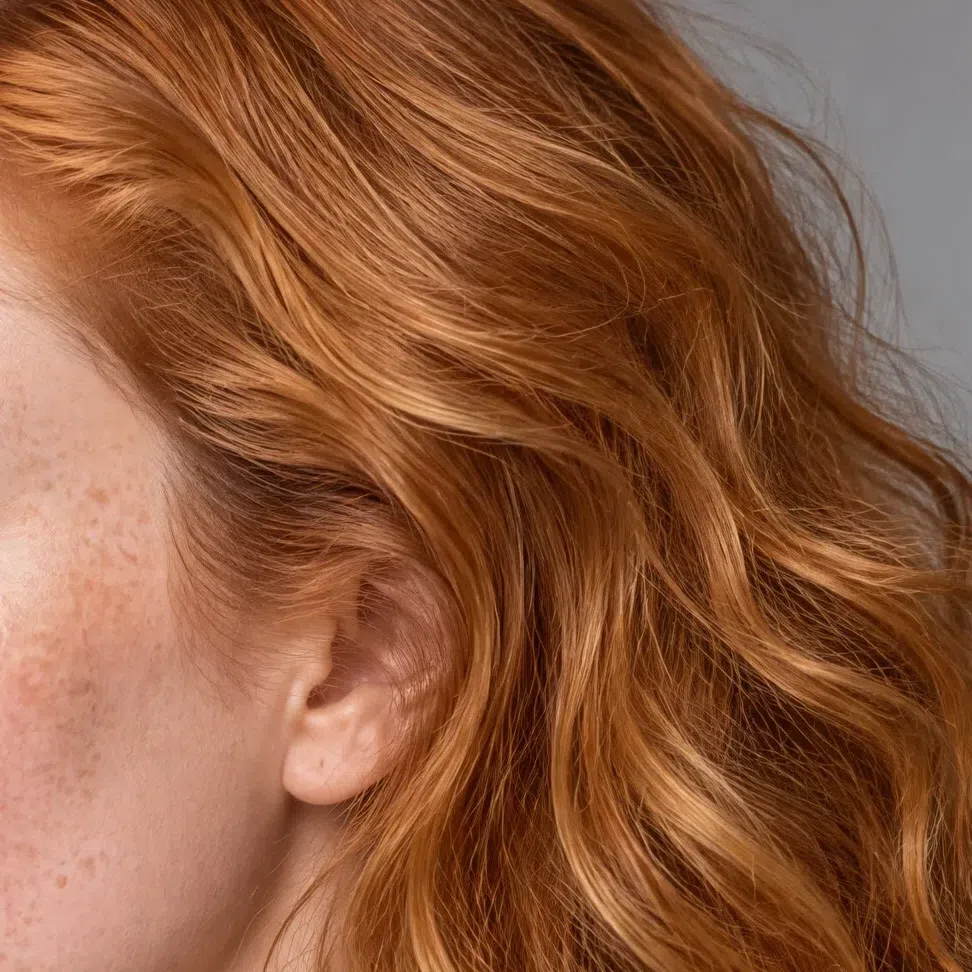
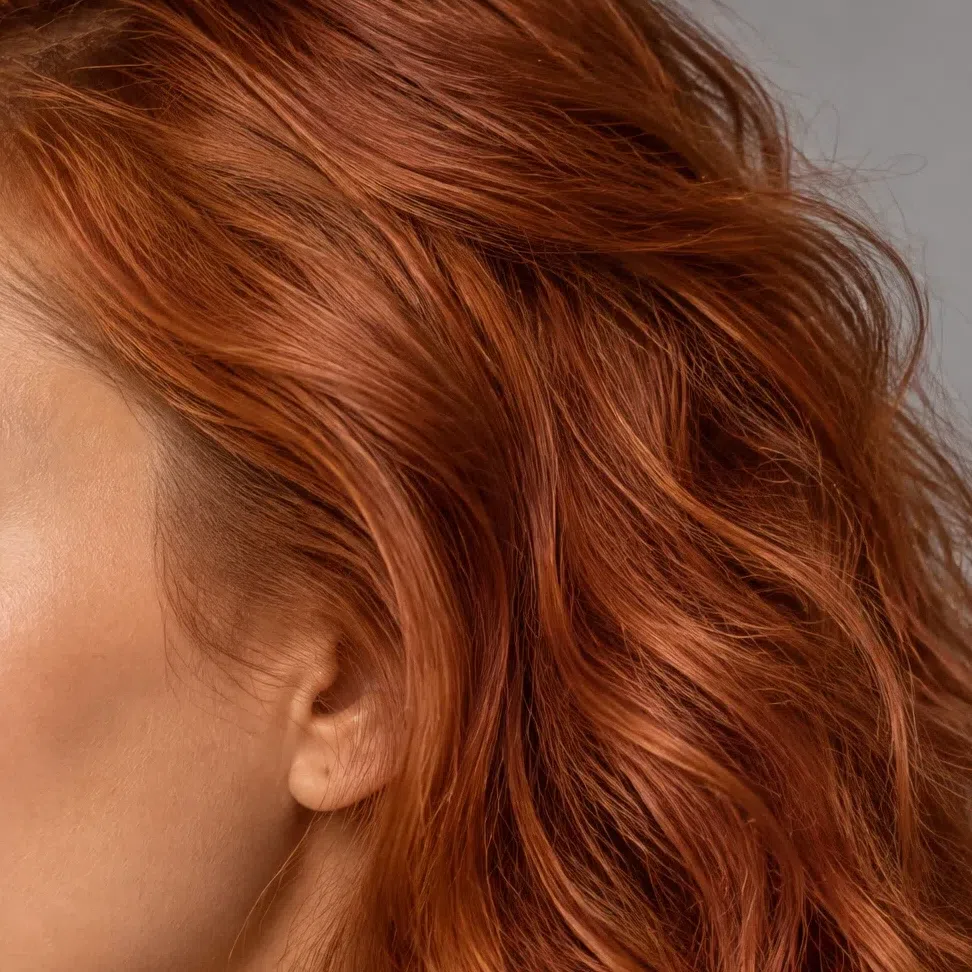
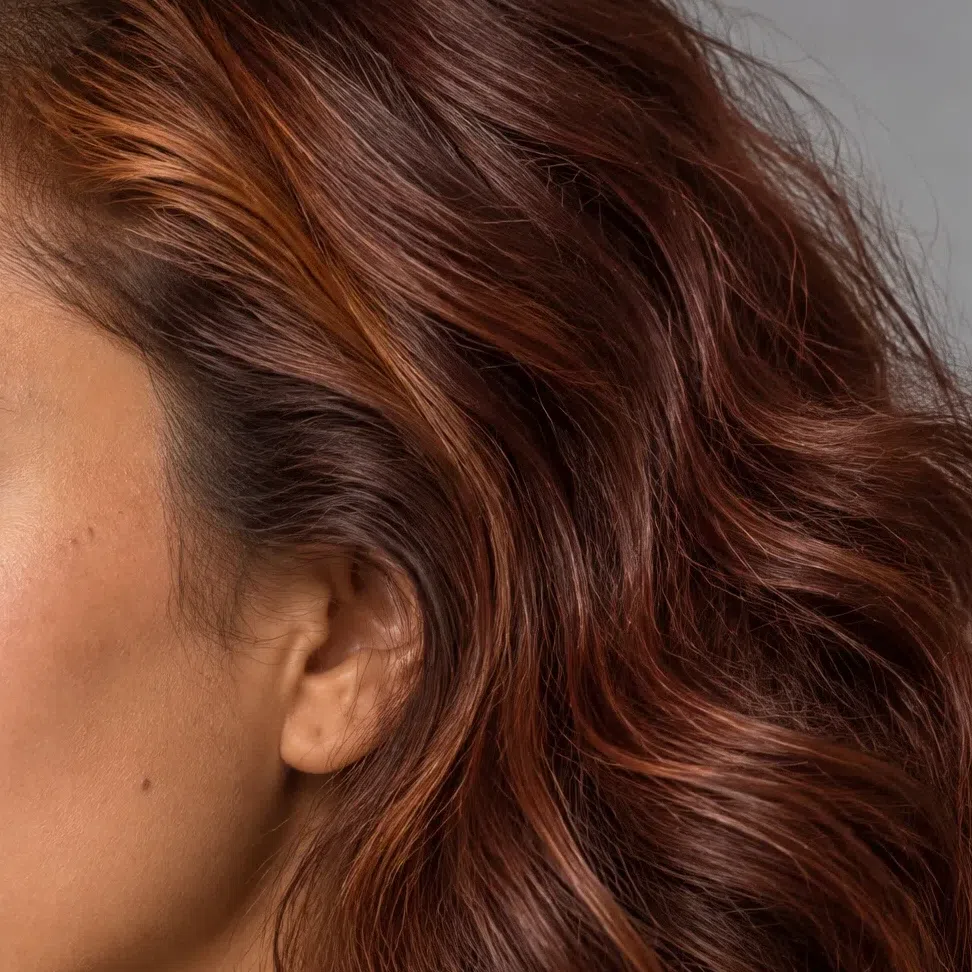
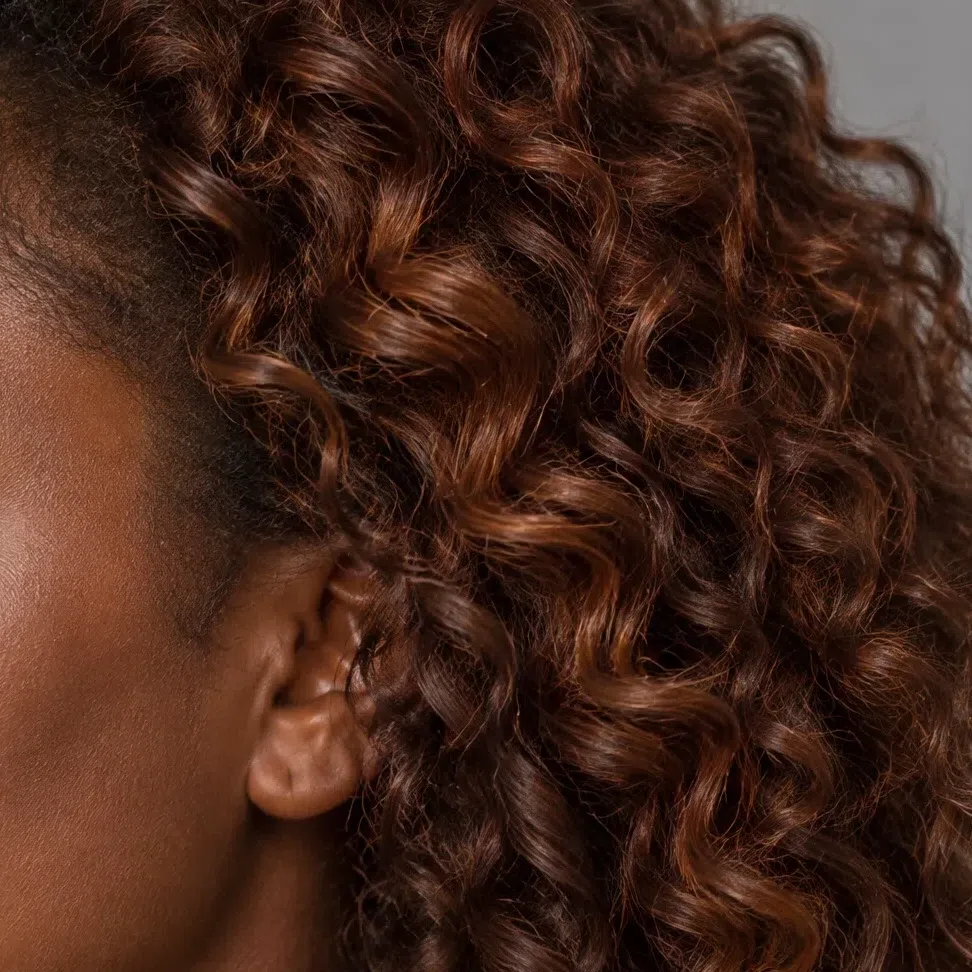
Each strip runs from one level lighter than the shade to two levels deeper. The L numbers follow the standard salon level scale.
Chestnut, caramel and chocolate
Quieter and deeper, for warmth without the red.
Warmth without the red
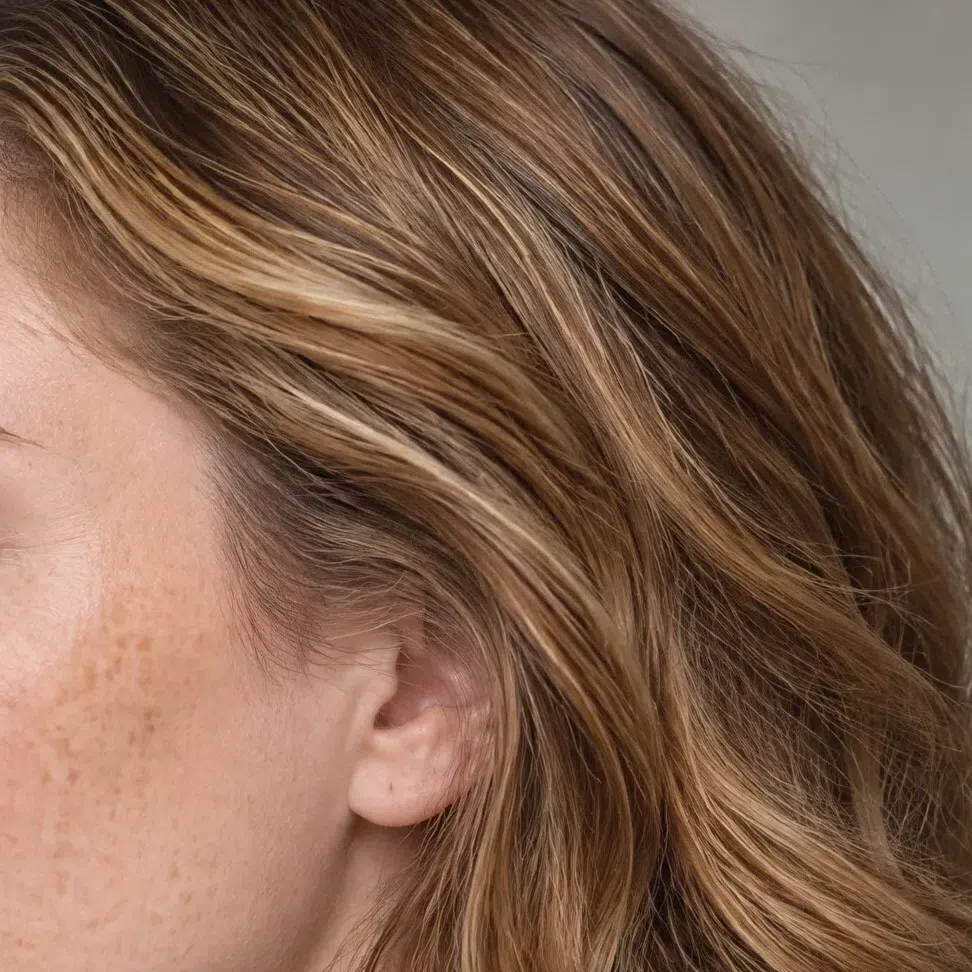
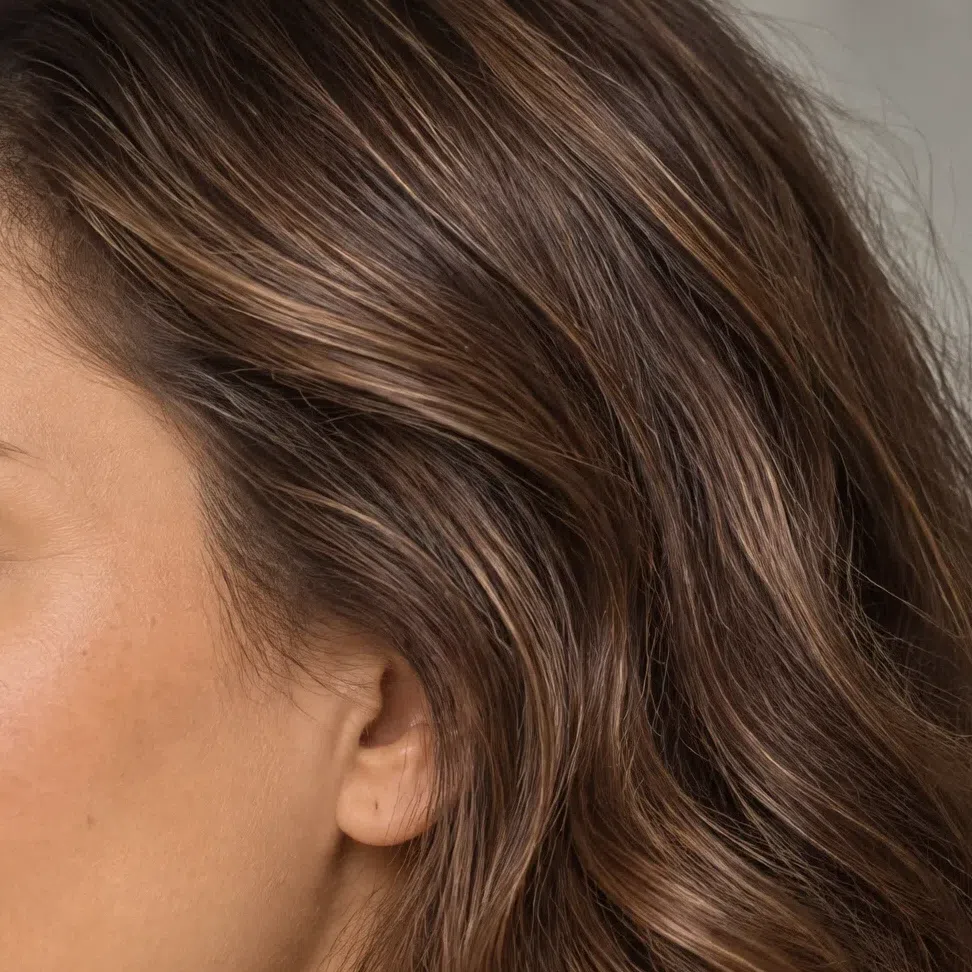
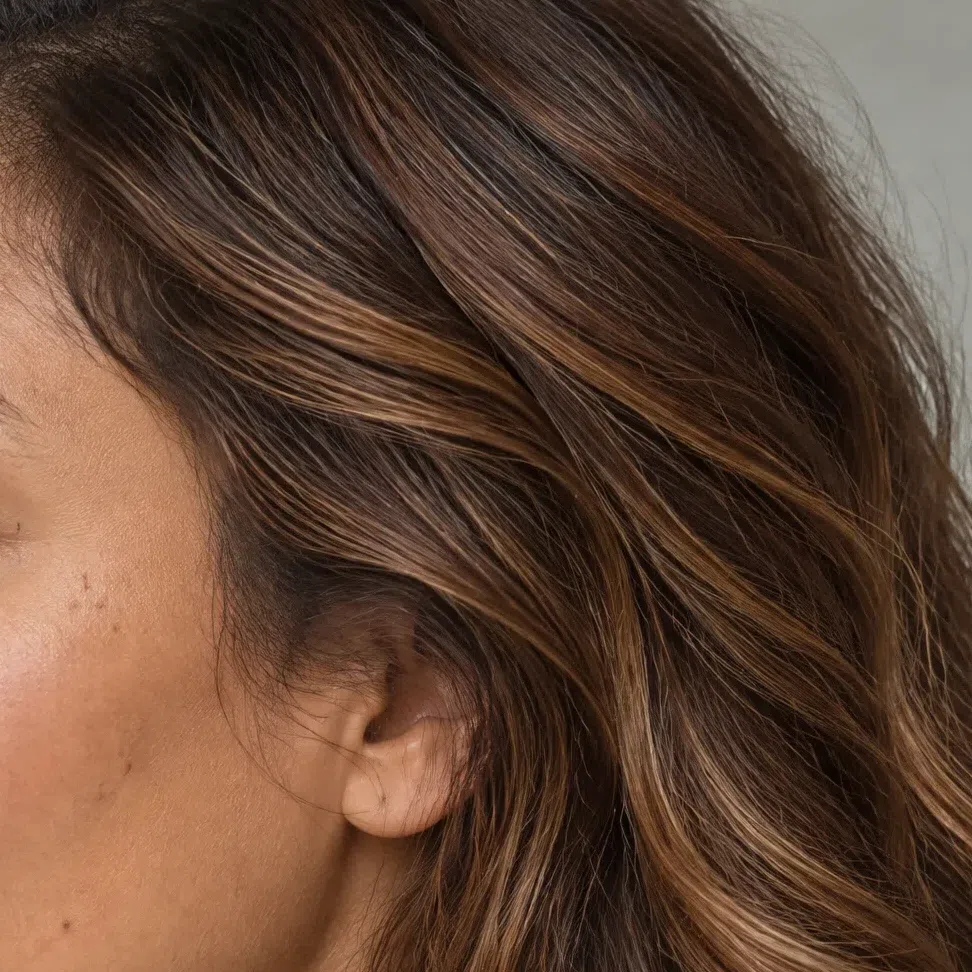
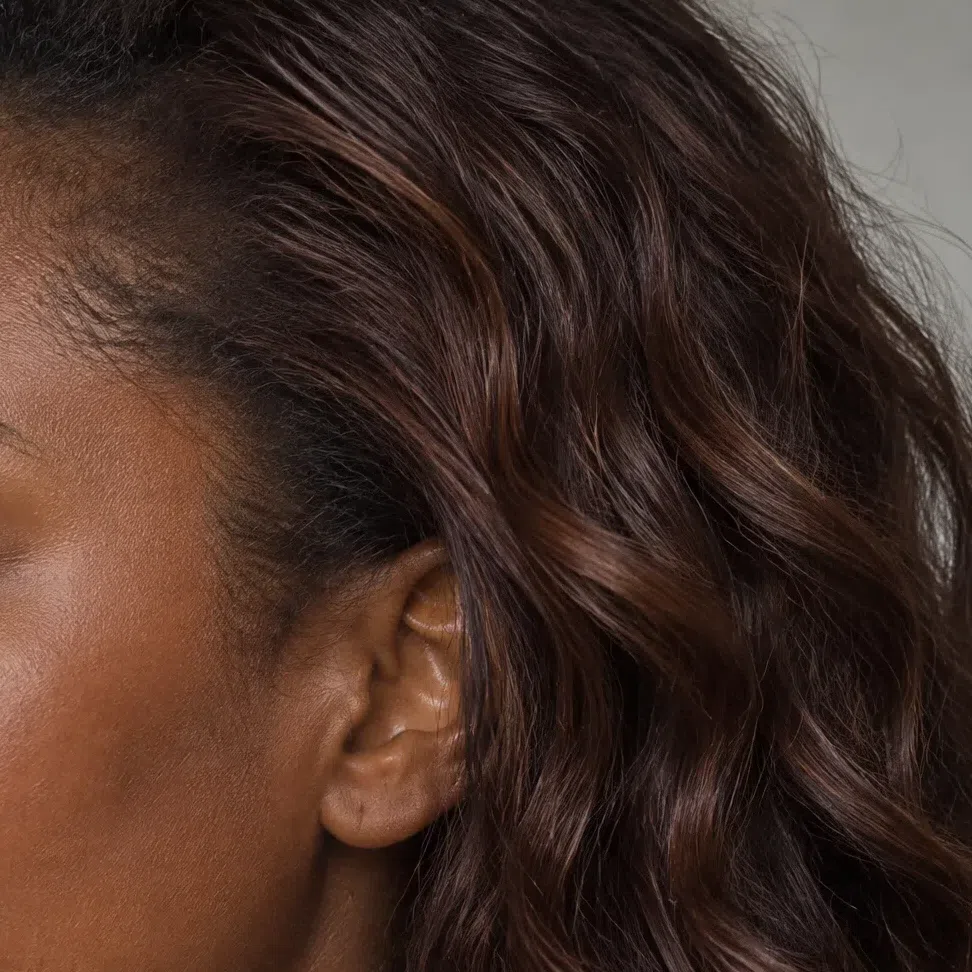
Each strip runs from one level lighter than the shade to two levels deeper. The L numbers follow the standard salon level scale.
Hair colors to avoid
Cool pigment is the common problem: ash, blue, violet and silver all dull this face and bring shadows forward.
Cold, ashy blondes
Harsh and artificial
Warm Autumn vs Soft Autumn, Deep Autumn and Warm Spring
Three neighbors, and a hands-on test for each
A subtype takes its name from whichever quality comes first in the coloring. Warm Autumn is led by warmth, Soft Autumn by softness, Deep Autumn by depth, and Warm Spring - the same heat, one season over - by clarity. Two colorings can share almost everything and still belong to different subtypes because a different quality is in charge.
The three autumns share a warm, earthy base, so their palettes look alike at first glance; saturation and depth are what split them. Warm Spring is the trickier case, because the warm-or-cool question gives both of you the same answer and something else has to decide.
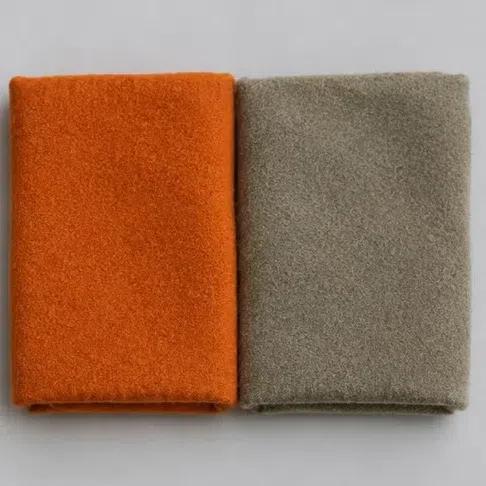
Hold two fabrics to your face: a clean pumpkin orange and a dusty khaki. Which one works?
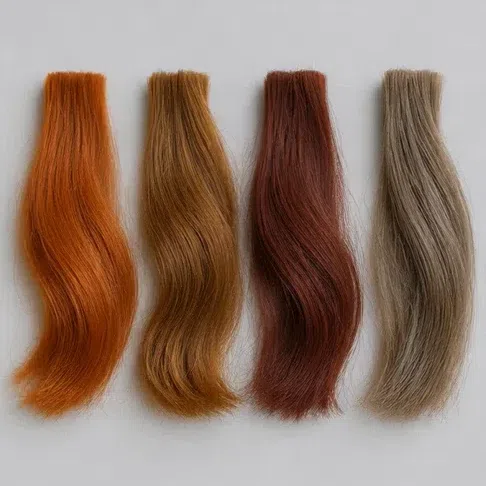
What color is your hair without dye?
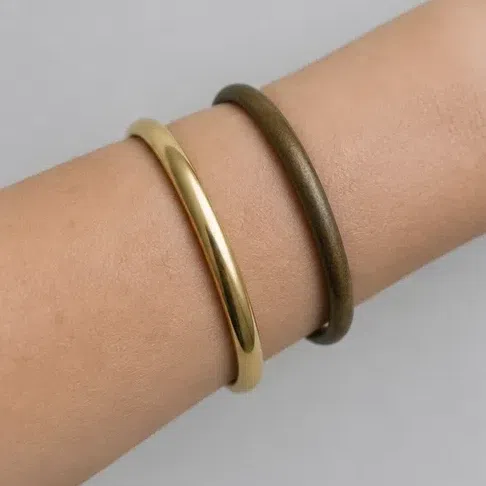
Which gold looks like yours when you hold it near your face?
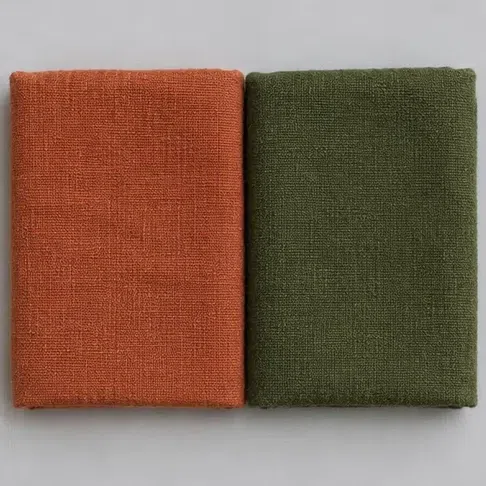
Which pair of colors suits you best?
The answers agree: strong warmth plus richness without darkness. This page is yours, and the palette is the place to begin.
The warmth is the same, but clean saturated shades are too loud for you and dusty ones work better. Your guide is Soft Autumn.
You need depth more than sunshine: dark, rich shades hold your face better than the golden-red ones. Your guide is Deep Autumn.
Same temperature, different depth: light, clear warm shades suit you better than earthy ones. Compare yourself with Warm Spring.
A signs check points a direction; it does not hand down a verdict. Most wrong answers happen right at the border between two neighbors, which is why a photo analysis settles what a mirror cannot.
Warm Autumn vs Warm Spring
Warm Autumn
Earthy. A brown base sits under even the brightest shade, the way it does in October leaves.
Medium and below. The palette lives in mid and deep tones, and light pastels wash it out.
Sienna, Rust, Ivy, Golden ochre, Pumpkin - anything you could fairly call baked.
Yellow gold, copper and bronze, warm and a touch subdued.
Golden-peach skin, copper or golden chestnut hair, often ginger freckles.
Warm Spring
Clear. No brown underneath - the first green of the year rather than the last leaves.
Medium and above. Whatever an autumn wears deep, a spring wears a couple of shades lighter.
Coral, turquoise, warm yellow, fresh green, peach - bright where autumn is baked.
Light, clear gold; dark bronze looks heavy on her.
Lighter skin with a warm flush, golden blonde or light red hair, paler freckles.
The test: terracotta, then clear coral Hold a terracotta fabric under your chin, then swap it for a clean coral of the same warmth. On a Warm Autumn the terracotta evens out the skin, while the coral looks plasticky and a little too light. A Warm Spring sees the reverse: the coral freshens her, and the terracotta adds weight that makes the face look older. Temperature cannot decide this pair - both of you are warm - so let depth do it.
Warm Autumn vs Soft Autumn
Warm Autumn
Rich. Clean, full-bodied color with no gray film - the most saturated of the autumns.
Medium. Hair, skin and eyes read as separate tones, with nothing sharp between them.
Sienna, Mustard, Olive brown, Rust and a brick-red lip, all sun-warmed.
Natural and earthy, with a boho or country streak - suede, corduroy, wool.
A golden October afternoon, the harvest in, a shelf of spices.
Soft Autumn
Muted. Colors look veiled, as if seen through a light haze; softness outranks warmth.
Low. Features blend into one tone, with no clear steps between them.
Khaki, gray-green, dusty rose, olive-gray, salmon - complex and grayed.
Relaxed and refined - draping cashmere, fine knits, matte silk.
A misty November morning, dry grasses, flowers past their best.
The test: two lipsticks Try a bright, warm brick-red lipstick, then a muted terracotta nude. The brick red makes a Warm Autumn glow and looks garish on a Soft Autumn. The terracotta nude flatters the Soft Autumn and leaves a Warm Autumn looking faded and flat. Both of you are warm; the lipstick is testing how much color your face can carry.
Warm Autumn vs Deep Autumn
Warm Autumn
Medium. Rich but never darkened - the palette is built on heat, not shadow.
Medium. A gentle step from hair to skin, nothing dramatic.
Copper, Pumpkin, orange, curry yellow - yellow and orange pigment underneath.
Natural, friendly and organic - simple shapes, folk touches, comfort.
A field at harvest noon, spice, maple syrup.
Deep Autumn
Dark. The defining trait: deep colors with black stirred in, the darkest autumn.
High. Dark hair and eyes against lighter, still-warm skin - a nod toward winter.
Burgundy, dark chocolate, plum, forest green, aubergine - red and black pigment underneath.
Dramatic and polished - velvet, leather, satin, strong accents.
Dusk in an autumn forest, gemstones, red wine.
The test: bitter chocolate, then black Hold a bitter-chocolate brown fabric to your face, then a pure black one. Black takes the life out of a Warm Autumn and makes her look tired, while the chocolate brightens her. A Deep Autumn can carry black near the face - not ideally, but without that drop - and comes fully alive in the dark, deep autumn shades.
If two subtypes still feel equally right after the tests, stop weighing details and go back to the leading quality: warm, soft, deep or clear - the word you would pick first for your own coloring points to the page. When the mirror still will not settle it, a photo analysis will.
Warm Autumn: common questions
How do you tell if you are a warm Autumn?
Is Warm Autumn the same as True Autumn?
What are the four types of autumn?
What colors look best on a Warm Autumn?
What colors should a warm Autumn not wear?
Should warm Autumn wear gold or silver?
Can warm Autumns wear black?
Can true Autumn wear navy blue?
What hair color is best for a warm Autumn?
What foundation undertone should a Warm Autumn look for?
How is Warm Autumn different from Soft Autumn?
How is Warm Autumn different from Warm Spring?
How is Warm Autumn different from Deep Autumn?
What should be in a Warm Autumn capsule wardrobe?
What if my favorite color is not in my palette?
Can my coloring change with age?
Which celebrities are Warm Autumns?
Sources
Of everything written above, four statements concern light, skin or aging rather than taste in color. Those four carry a citation, and each note names the sentence it stands behind.
-
Carole Jackson (opens in a new tab)
Wikipedia, 2026
The system this page subdivides. Color Me Beautiful (1980) sorted people into four seasons by undertone, and the article states that “springs and autumns had undertones of yellow” – the warm half that Warm Autumn sits at the center of. The split into three autumns is a later refinement this source does not cover.
-
Human skin color (opens in a new tab)
Wikipedia, 2026
Explains why the checks warn against trusting veins alone: light skin’s color is set largely by bluish-white tissue under the dermis and hemoglobin in its veins, while melanin dominates darker skin – so veins read bluer than the undertone on very fair skin and can be hard to see at all on deep skin.
-
Color temperature (opens in a new tab)
Wikipedia, 2026
Supports running every undertone and drape test by a window. The article puts daylight near 6,500 K and ordinary household lamps between roughly 2,550 and 3,000 K, so indoor light changes what a fabric does to your skin before your coloring has any say.
-
Aspects of Facial Contrast Decrease with Age and Are Cues for Age Perception (opens in a new tab)
Porcheron, Mauger & Russell, PLOS One, 2013
Stands behind the FAQ answer on aging, where it says contrast softens over the years. The study measured facial contrast falling with age and found lower-contrast faces are judged older – a finding about faces in general, not about any one season.
Only those four points are sourced. The seventeen shades, the seven to avoid, the metal, makeup and hair calls, and the tests that tell this coloring apart from its three neighbors are our own analysis; schools of color analysis draw these lines differently, and no study has ranked which palette suits a Warm Autumn.
What is color analysis, how do you find your season, and what are the 12 types?
The main guide covers all of it - the four axes your season is built from, all twelve subtypes side by side, and a free quiz that places you in about a minute.
What is color analysis? For women and men