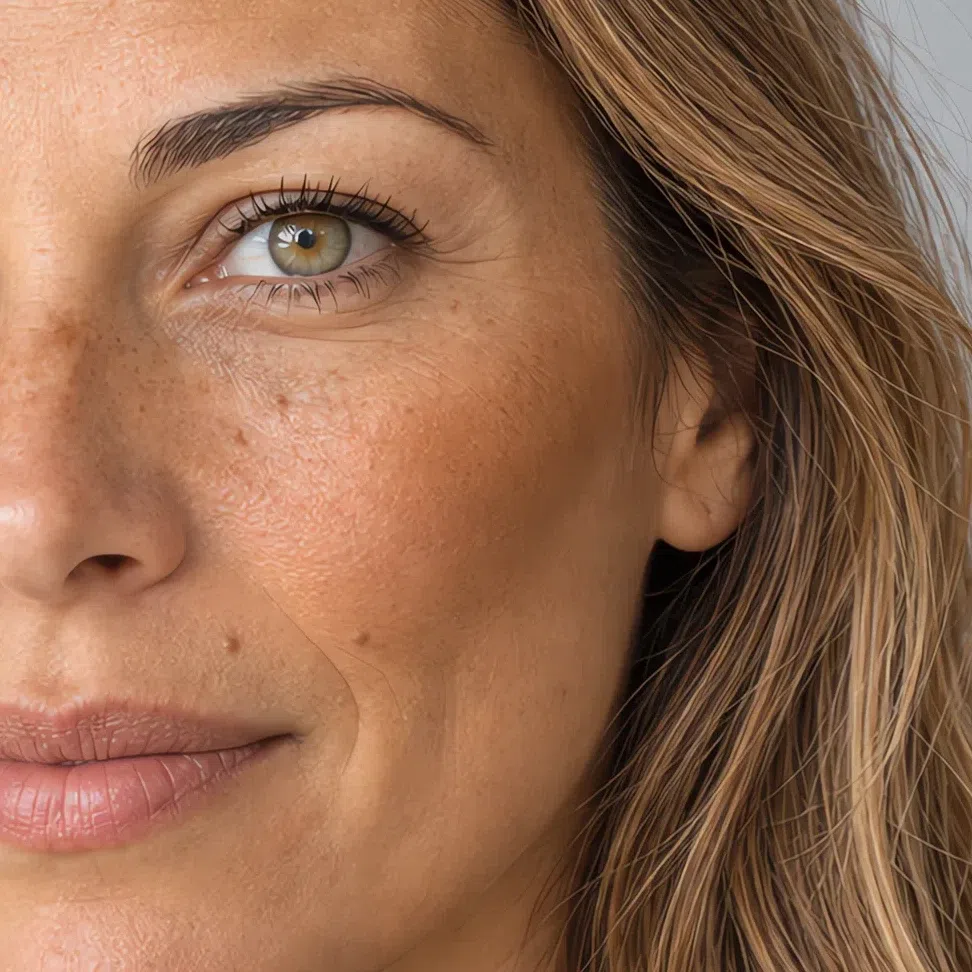
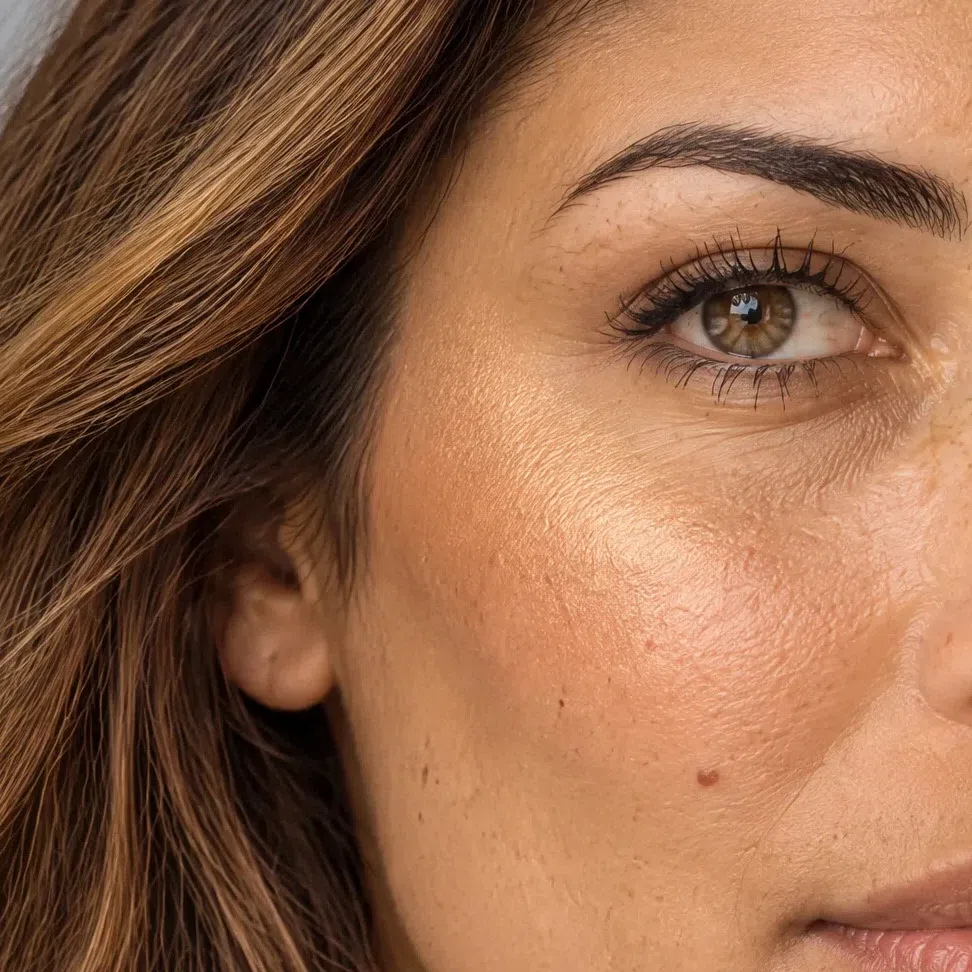
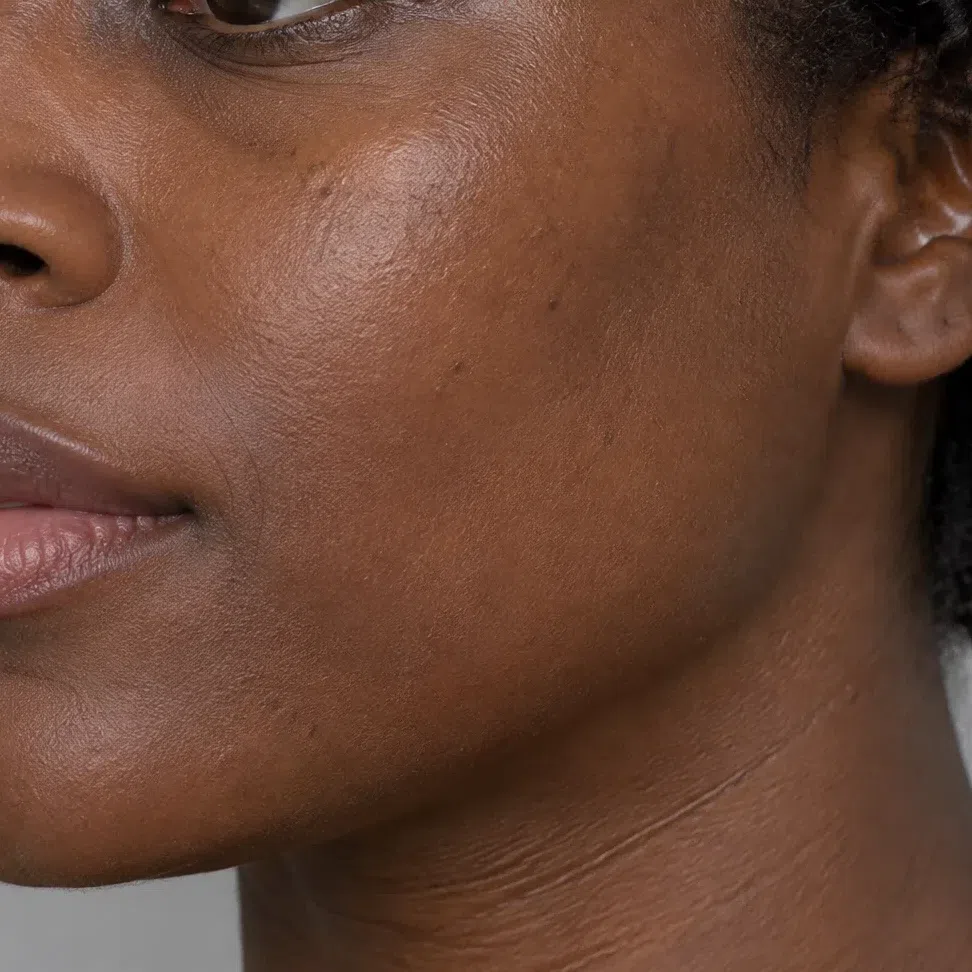
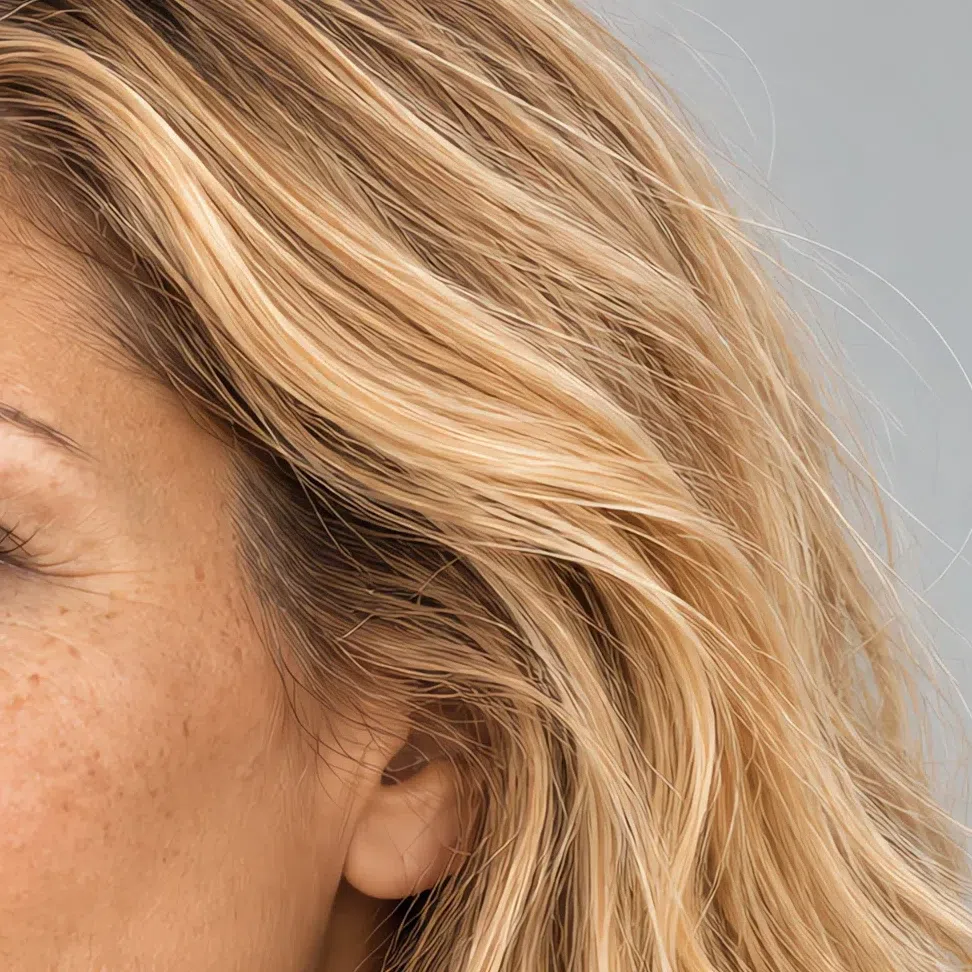
Spring color palette: are you a Light, Warm or Bright Spring?
Warm and clear at every depth, from ivory to deep golden brown. How to tell you are a Spring, which of the three Springs is yours, the shades every Spring can wear, and the ones that turn the skin gray - tried on a real face before you buy anything.
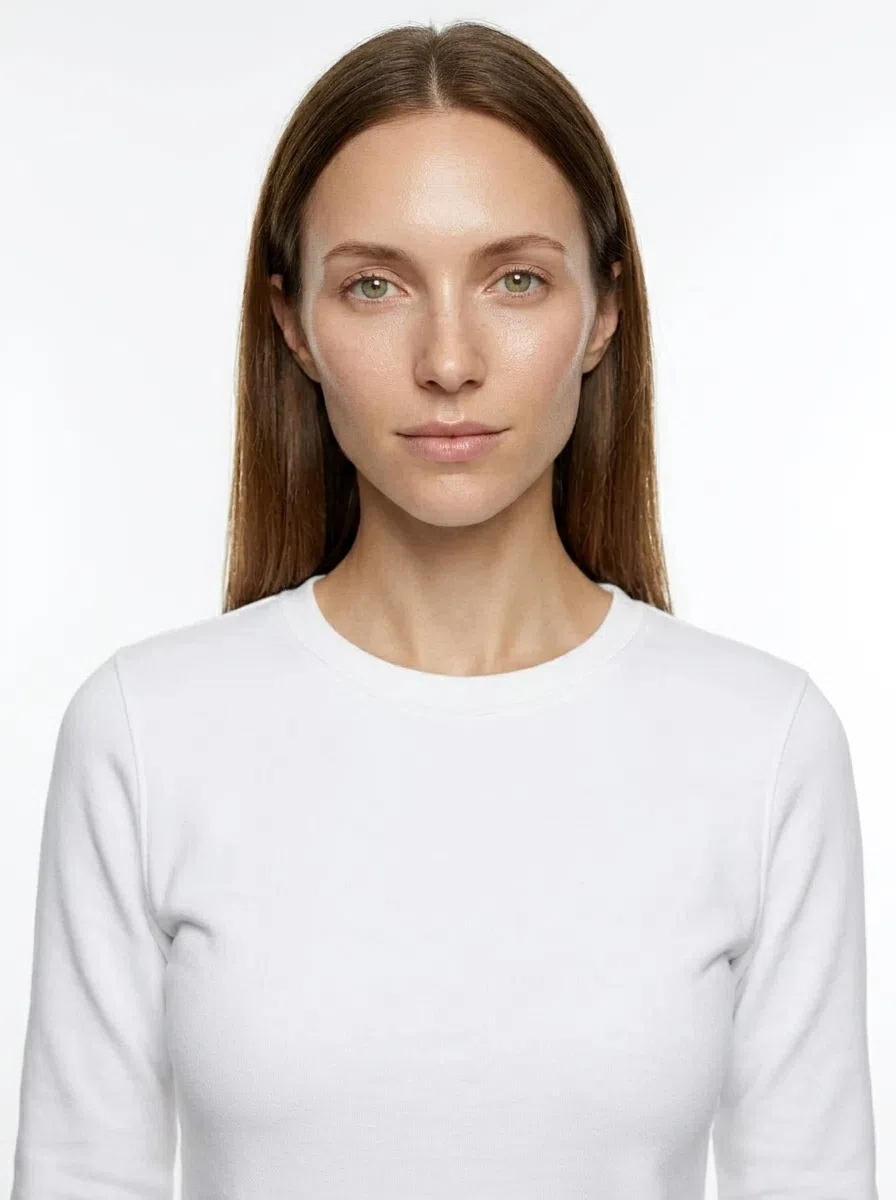
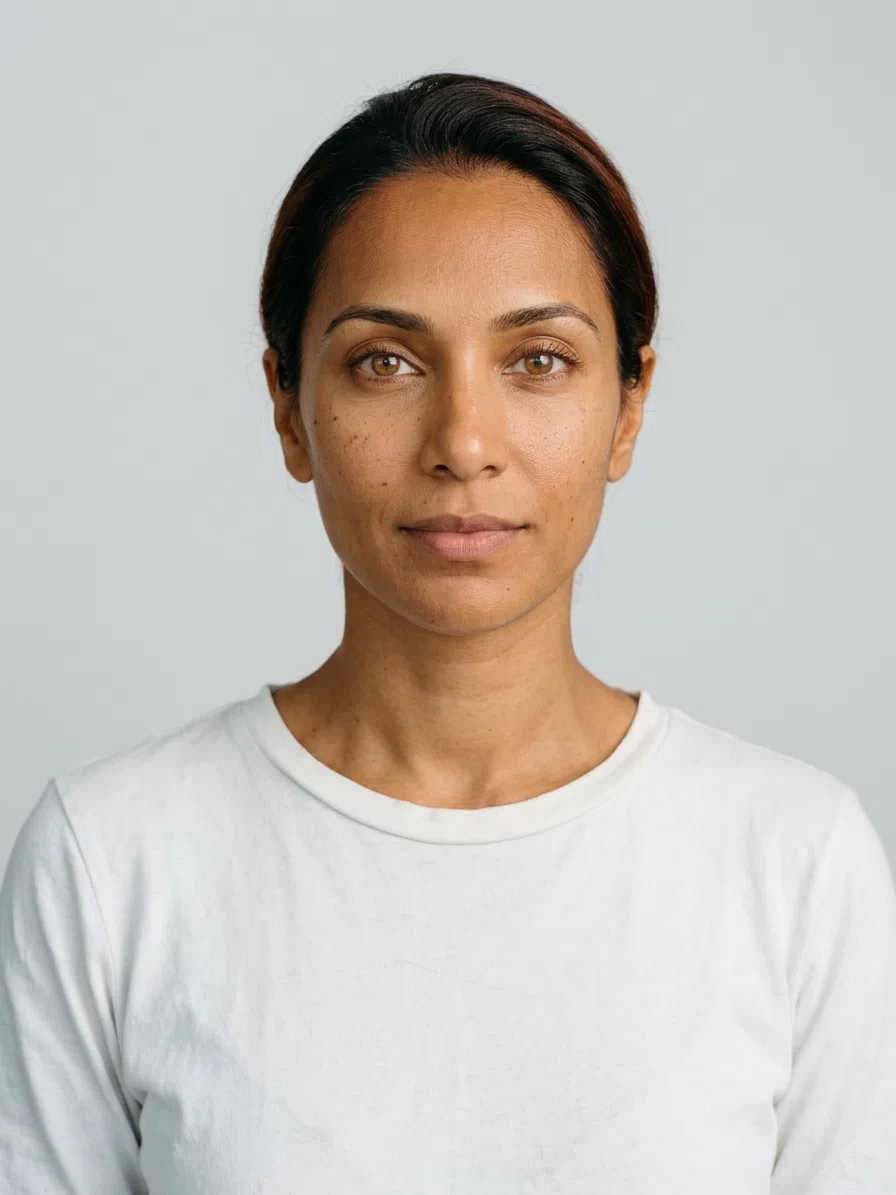
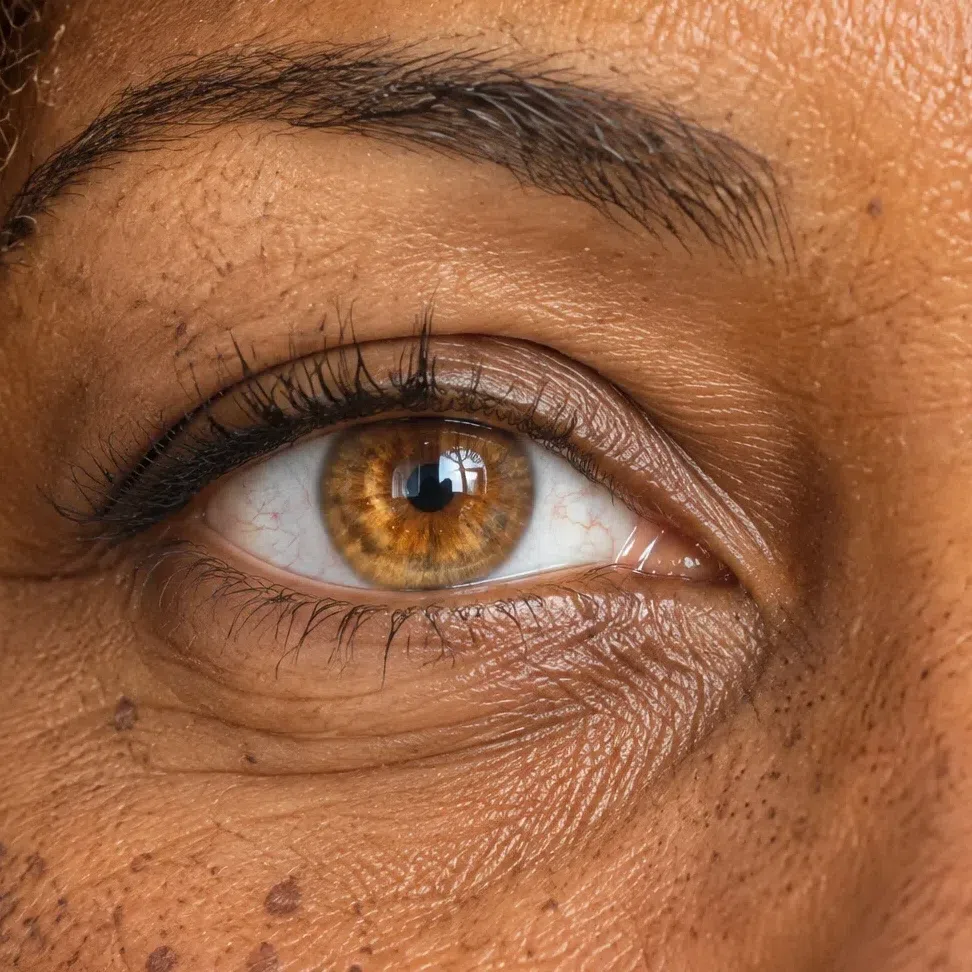
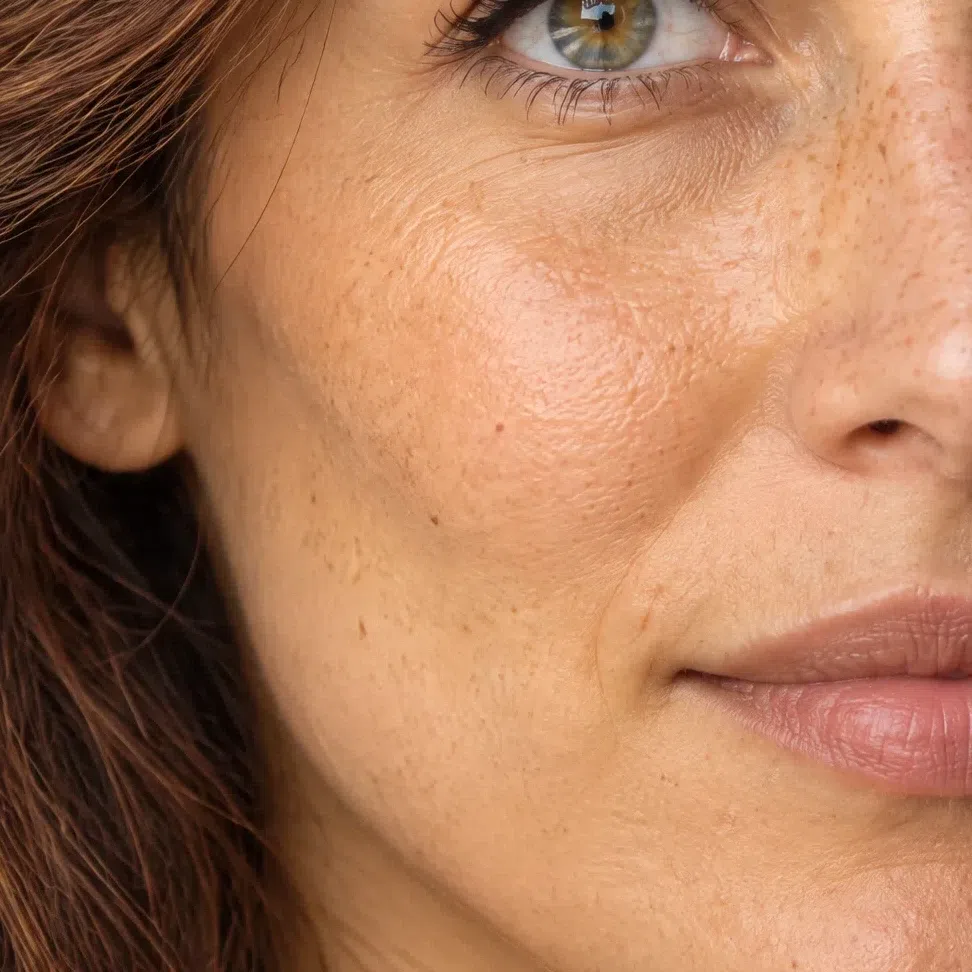
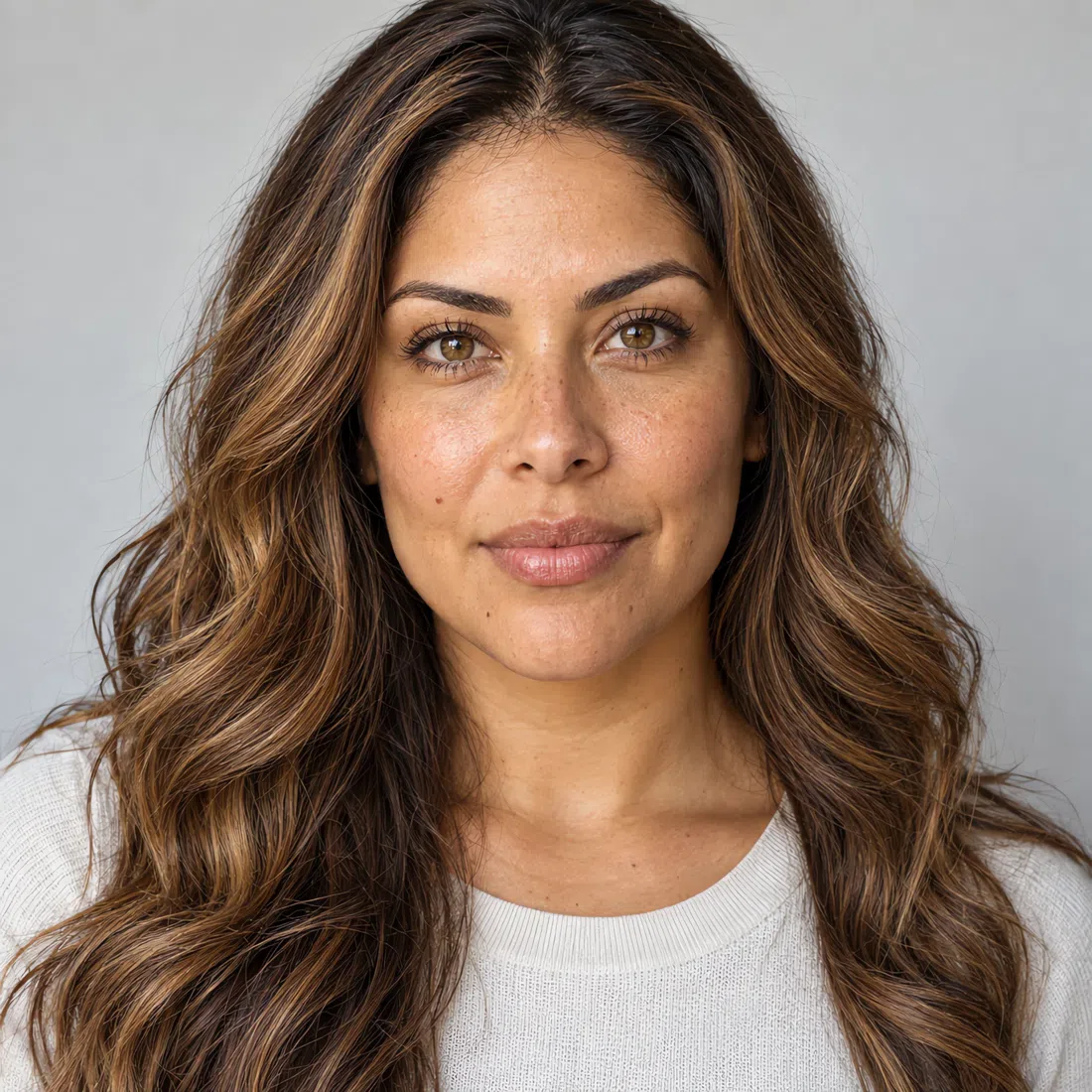
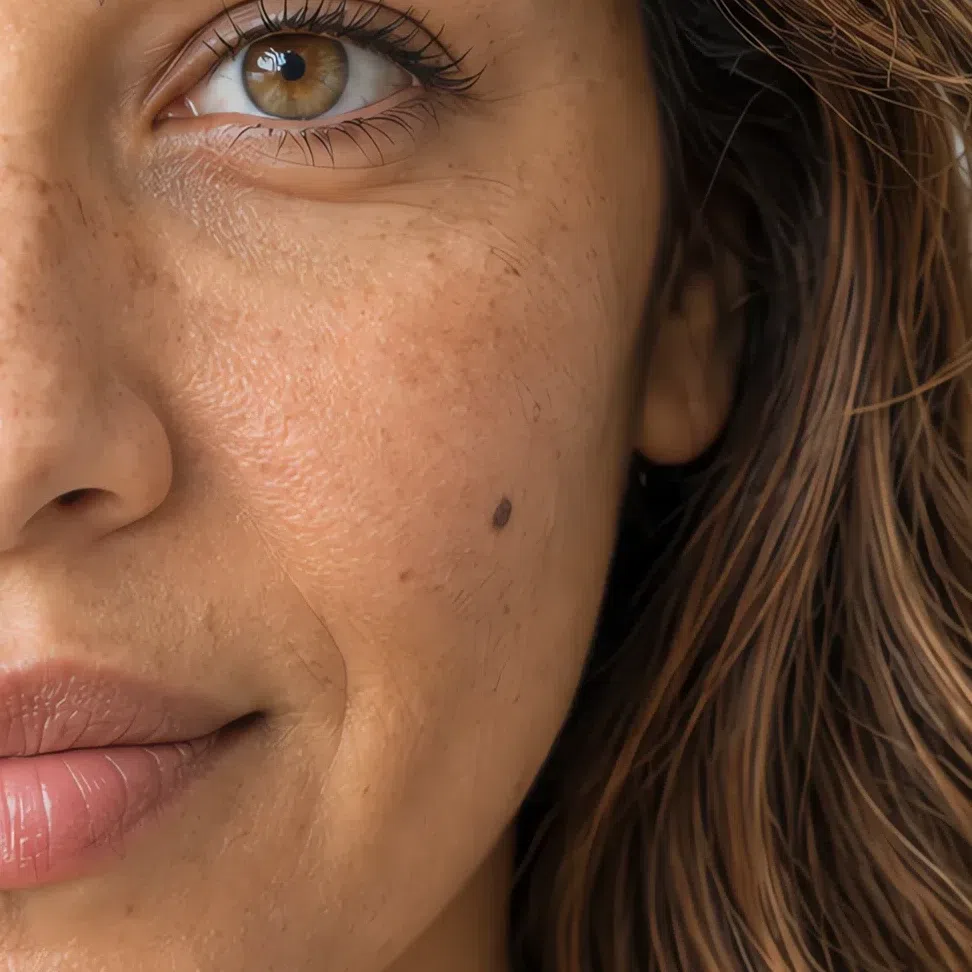
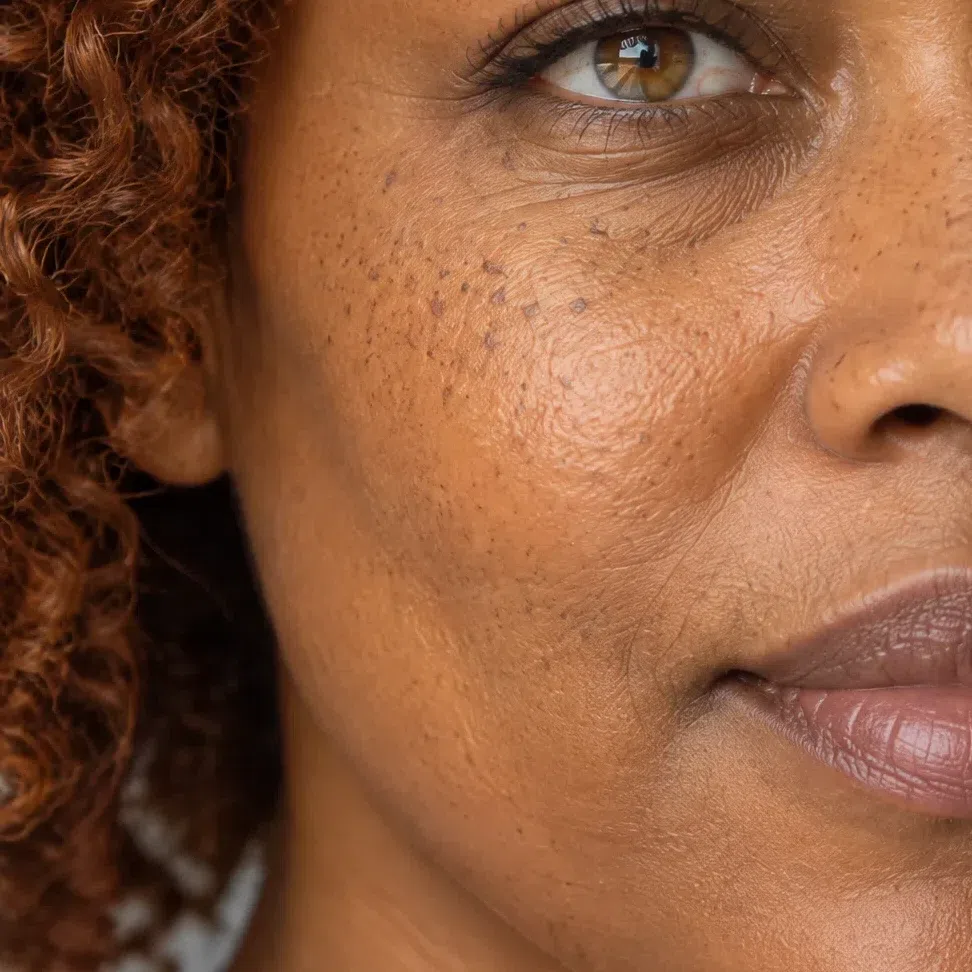
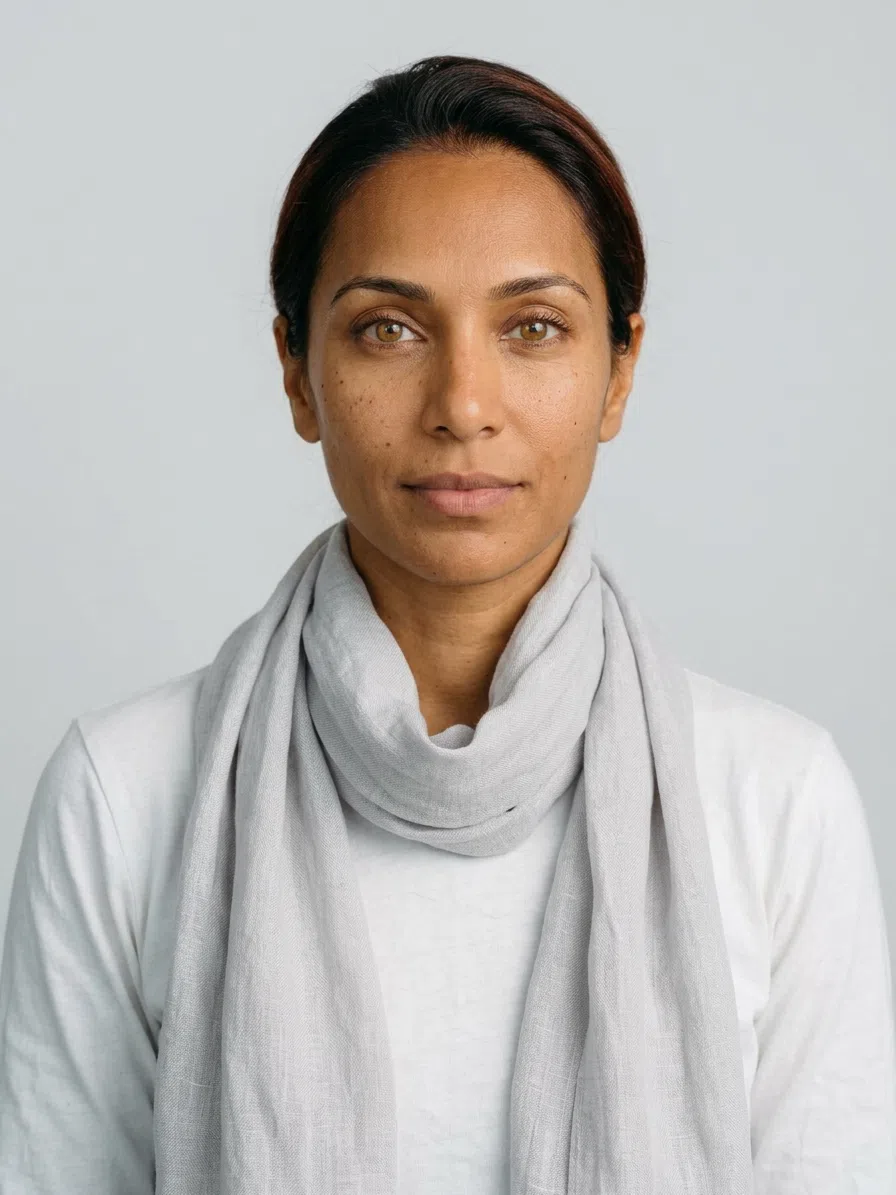
Every Spring is warm and clear: color that looks sunlit, with no gray or black in it. She is a Spring with a deep complexion, and she comes first on purpose. Tap the faces beside her to put the same twelve circles on a medium and a fair Spring: what leaves her skin golden and even does the same for theirs. The first six circles are the wardrobe neutrals, the next four are light shades for the neckline, and the final two are accents at full strength. Tap one and look at the skin along her jaw, not at the top: a Spring shade warms it, while anything cold or grayed makes it look dull and tired.
Every Spring is warm and clear - gold under the skin, color that looks lit rather than dusted or blackened - and the only thing left open is depth, which runs from ivory to deep golden brown. Light Spring, Warm Spring and Bright Spring are that one coloring at three settings: the palest, the most golden, the most saturated.
Skin
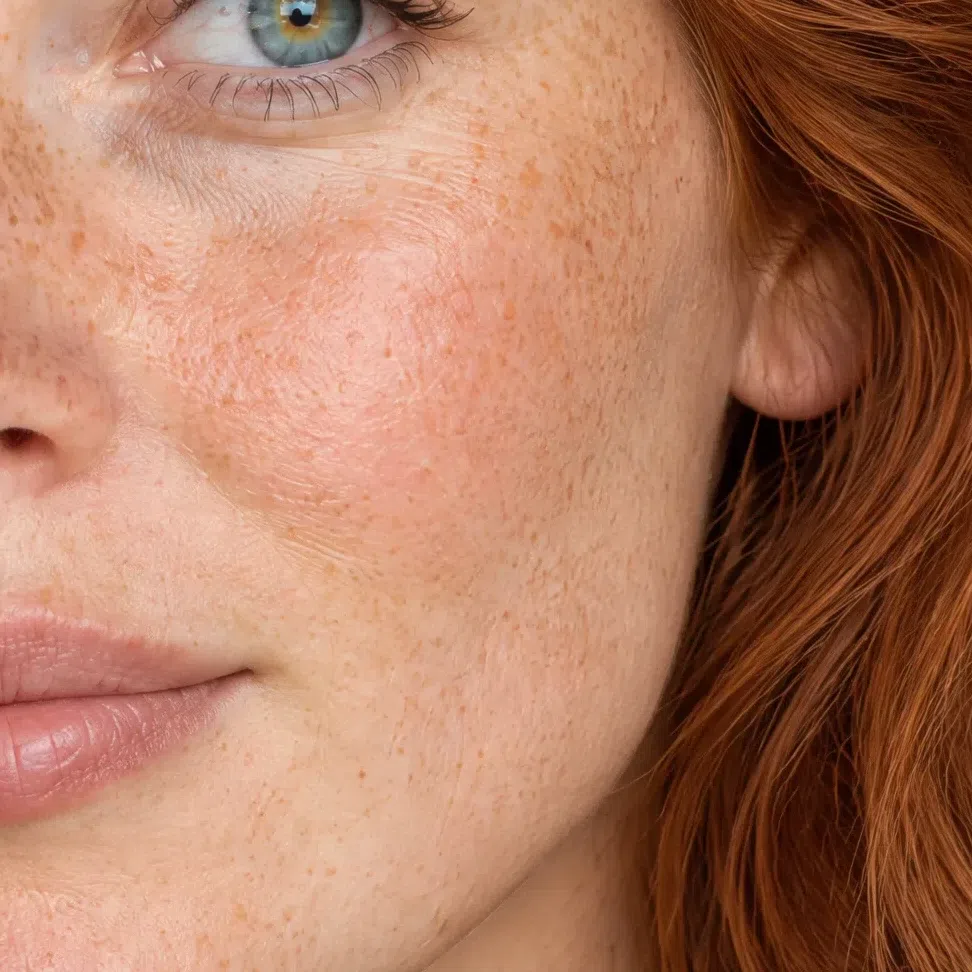
Golden or peach undertone at any depth; tans gold, never red or gray, and freckles come up ginger.
Eyes
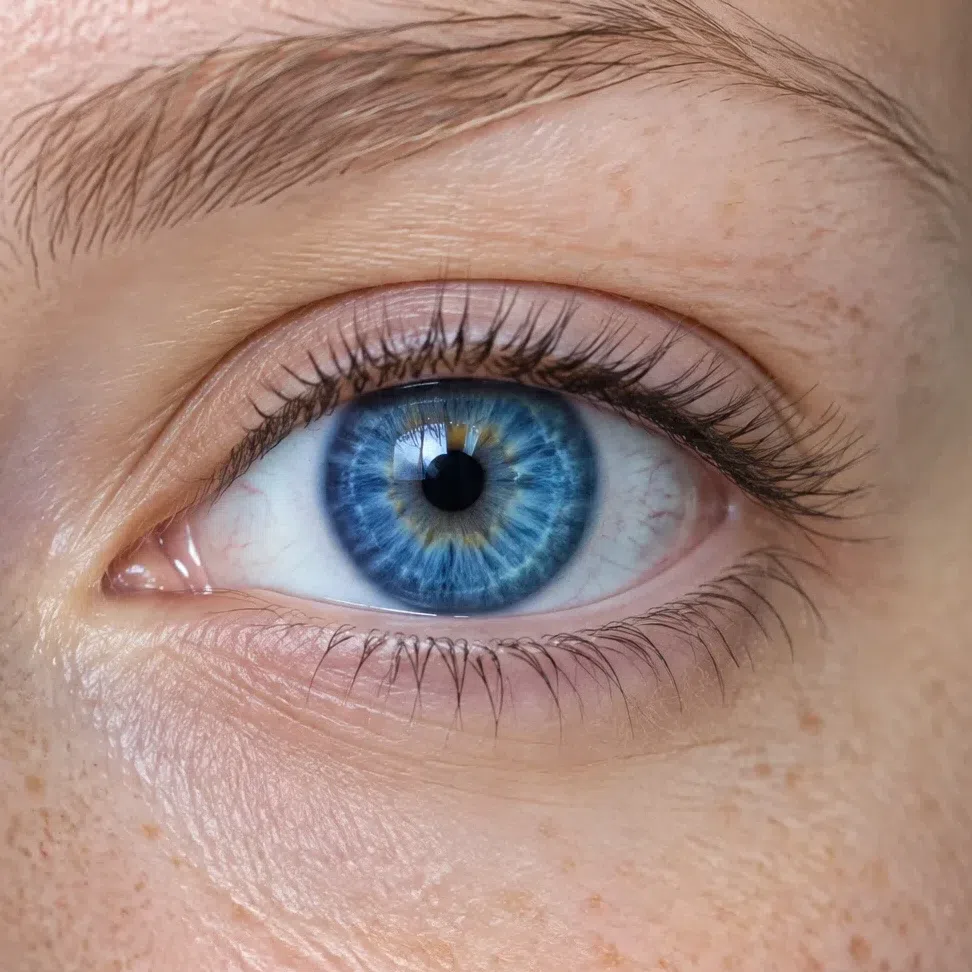
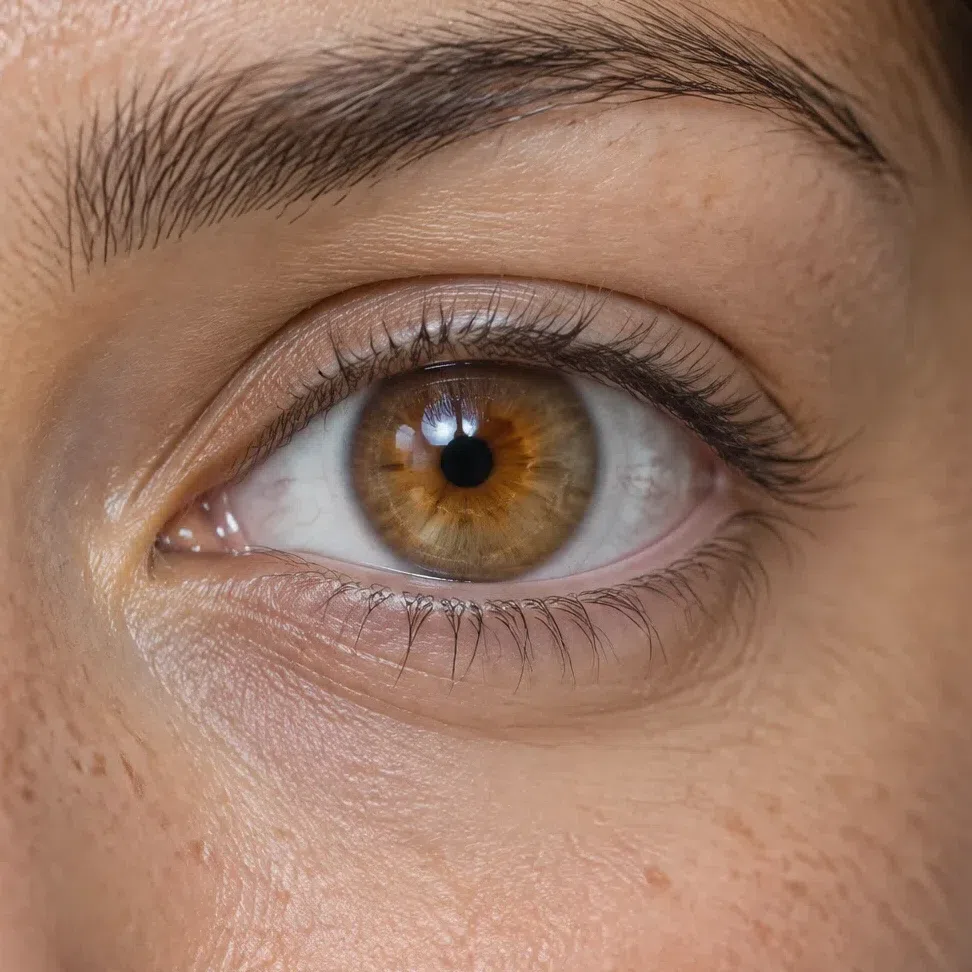
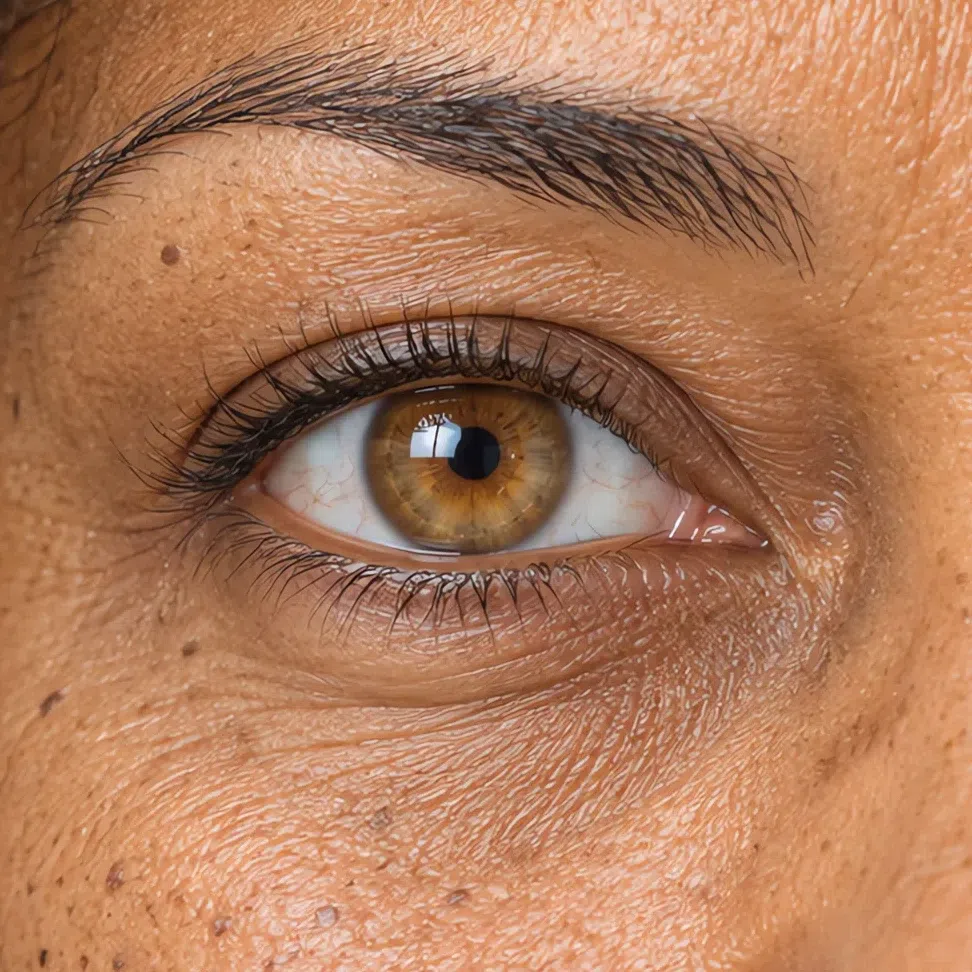
Clear with light in them - aqua, warm green, amber, honey brown - and a gold ring at the pupil.
Hair
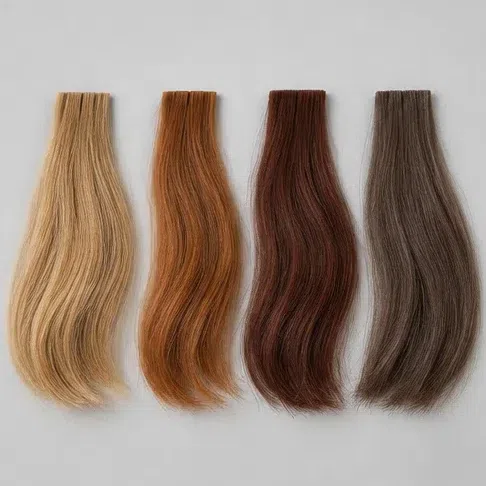
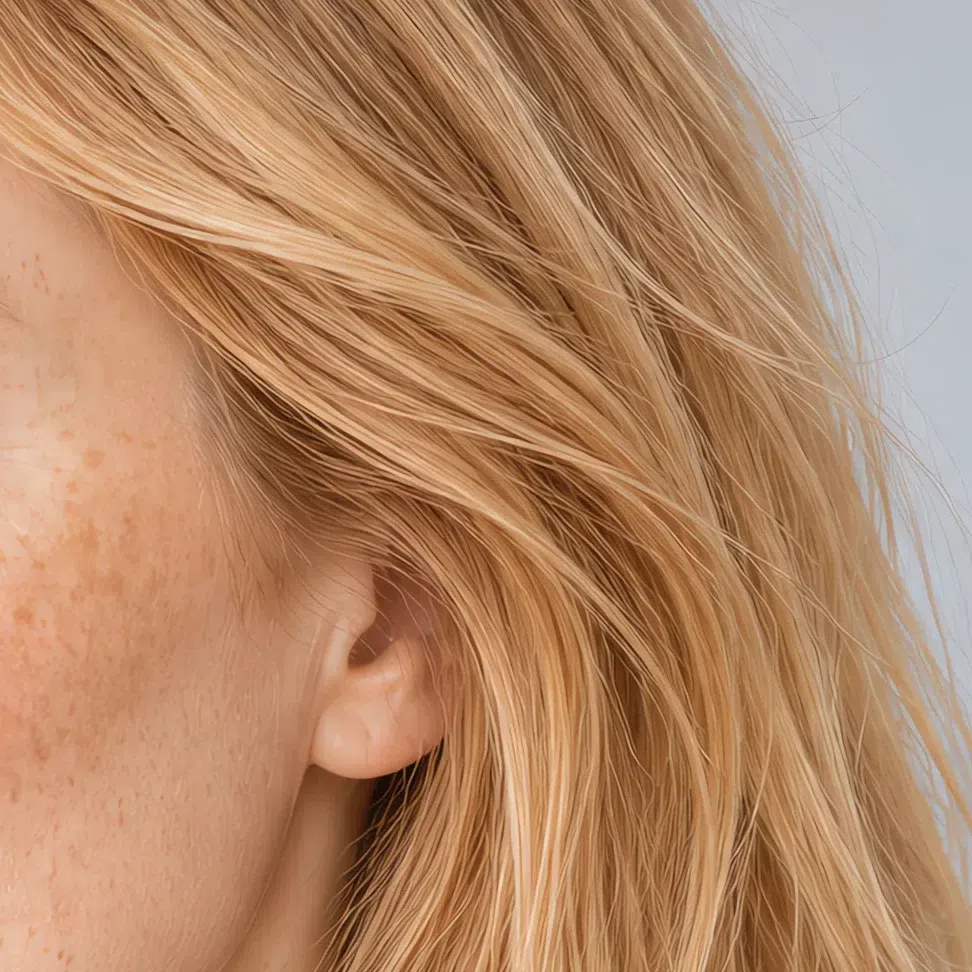
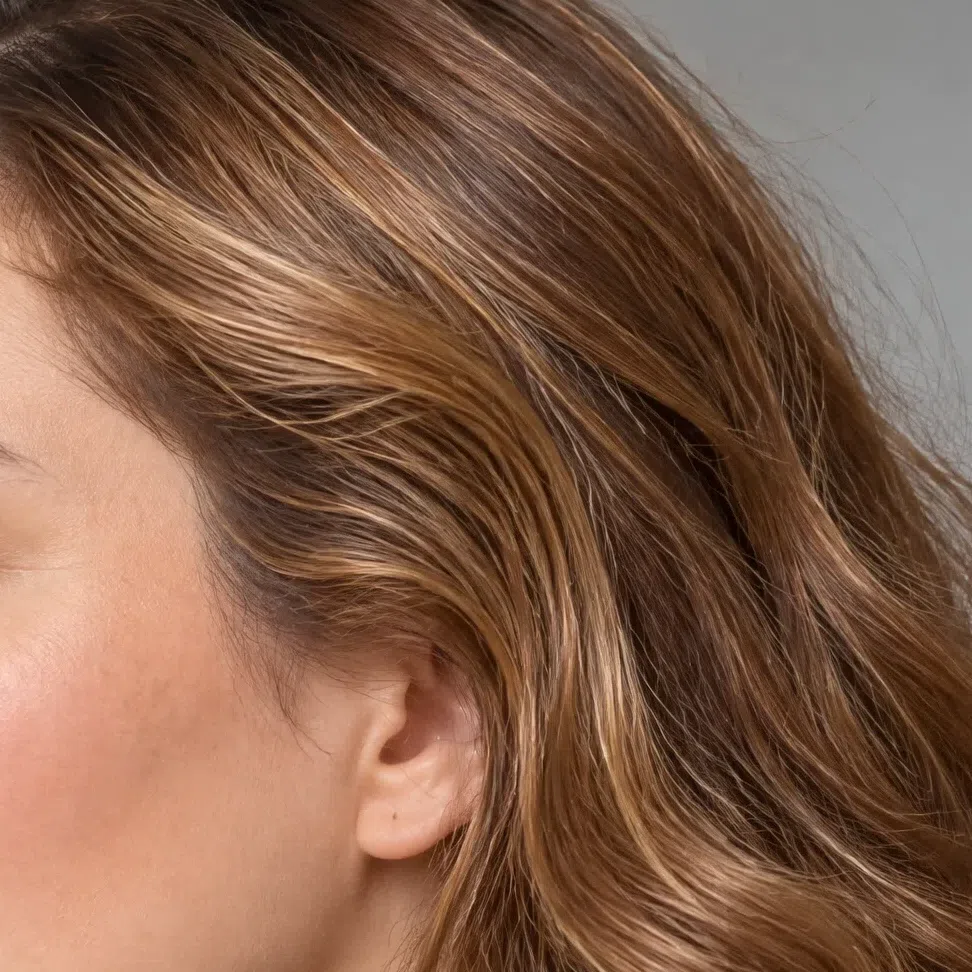
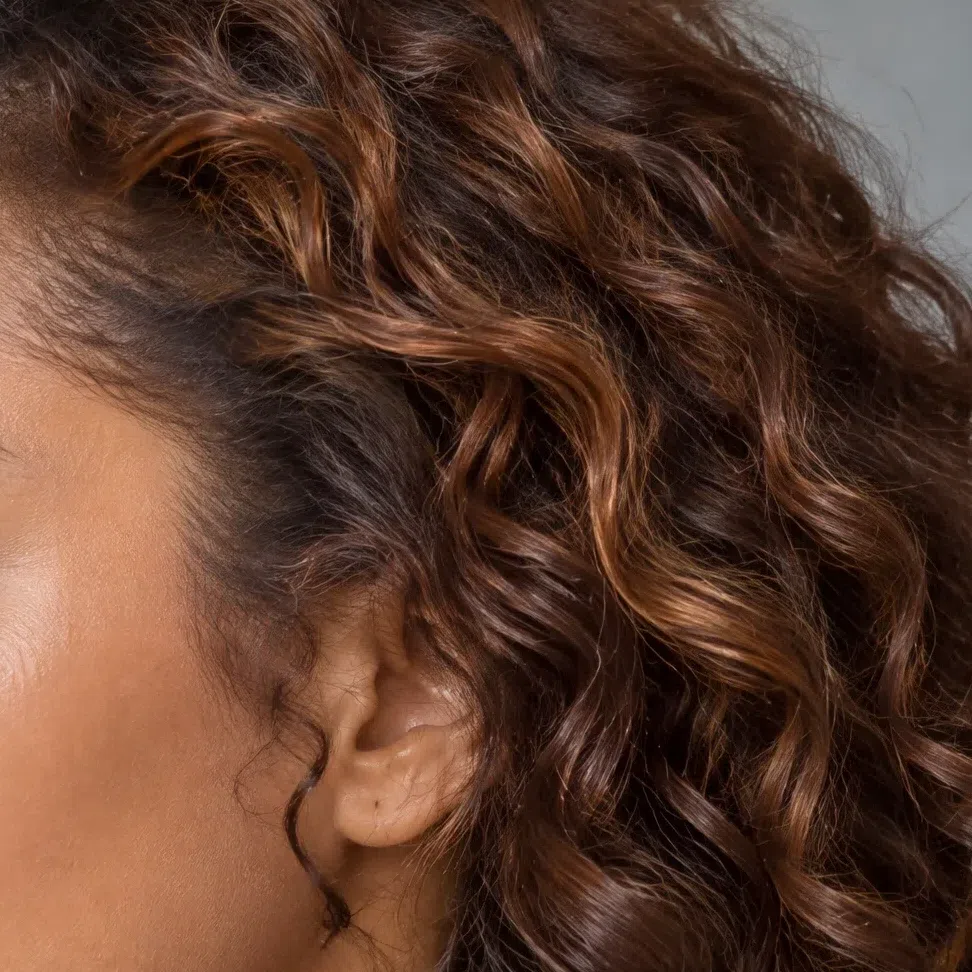
Gold, honey, copper or warm chestnut: a gold cast at every darkness, never ash.
Contrast
Low on a Light Spring, medium on a Warm, highest on a Bright - but never the cut of a Winter, so black beside the face looks borrowed.
Metal
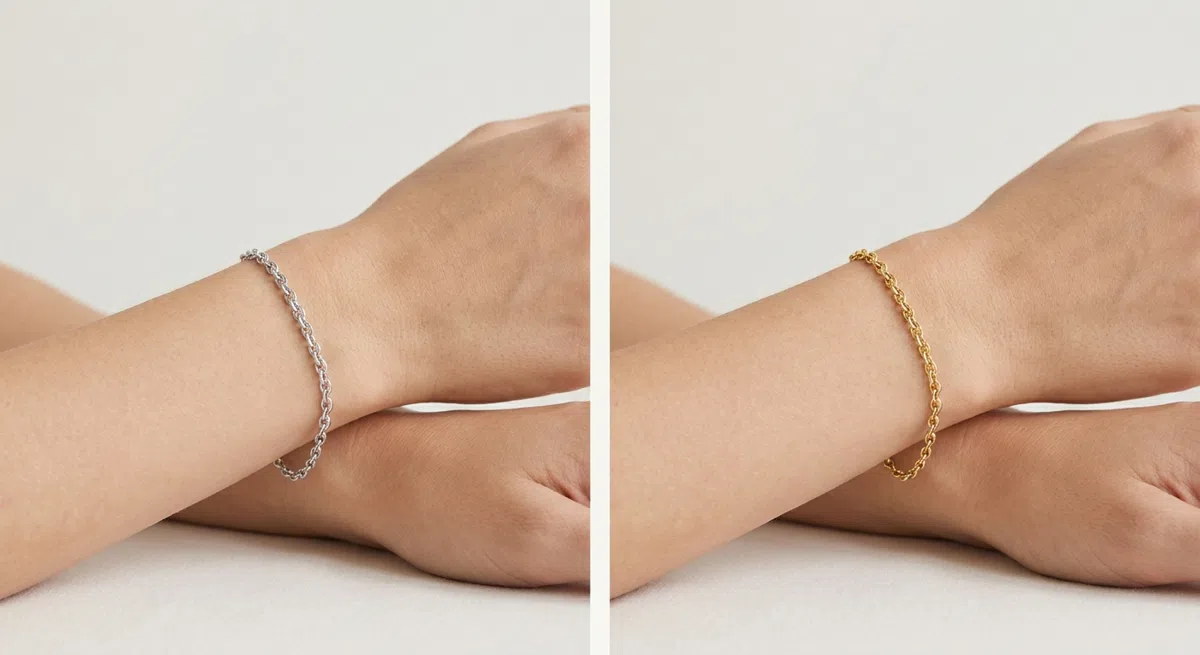
Yellow gold first, then copper and bronze; rose gold works, silver and platinum gray the skin.
Subtypes
Light Spring is led by lightness, Warm Spring by warmth, Bright Spring by saturation - one axis decides which.
Season core:
IvoryCamelTanPeach sorbetCoralTurquoise
Wear with care:
Jet blackBlue-grayDusty blueCold violet
If you take one thing: a Spring is put out by cold and gray, not by dark or bright, and that holds on the deepest complexion as much as the fairest. Which of the three you are is Which Spring? below; when the drapes disagree, a photo settles it.
Am I a Spring? Five ways to tell
Five checks, best done by daylight, in this order
Two things are fixed on every Spring and one is free. The fixed pair is temperature and clarity: the undertone is warm, and the coloring reads as if light had been mixed into it rather than gray or black. The free one is depth - a Spring can be porcelain-pale or deep golden brown, and the depth is what decides which of the three Springs you are, not whether you are one. Springs are rarely lost to a cool season; they are lost sideways into Autumn, which shares the warmth, or into Light Summer, which shares the lightness. The checks below are ordered so each one narrows the field before the next.
Undertone and clarity decide the season - skin depth does not. You will find Springs from porcelain to deep brown, and what they have in common is gold beneath the skin, a clear look to the coloring, and no hard contrast.
11. Skin: a golden undertone at any depth
Start under the surface, not on it. Every Spring carries gold, peach or apricot beneath the skin, whether the skin itself is ivory, olive, honey or deep brown.
The tell is a warmth that looks lit rather than painted on. Fair Spring skin is translucent with a peach flush; olive Spring skin has more gold in it than green; tan and deep Spring skin glow copper across the cheekbones and take the sun as gold, never as red or gray. A Spring never shows pink or blue under the surface, and never the heavier, flatter finish typical of Autumn skin.
Two details are enough to rule the season out: freckles that look gray rather than ginger, and a lilac-pink flush where a Spring flushes peach. A golden undertone produces neither. The three tests below check for that undertone; Spring on every complexion, further down, shows what it looks like at each depth.
Three checks for the undertone
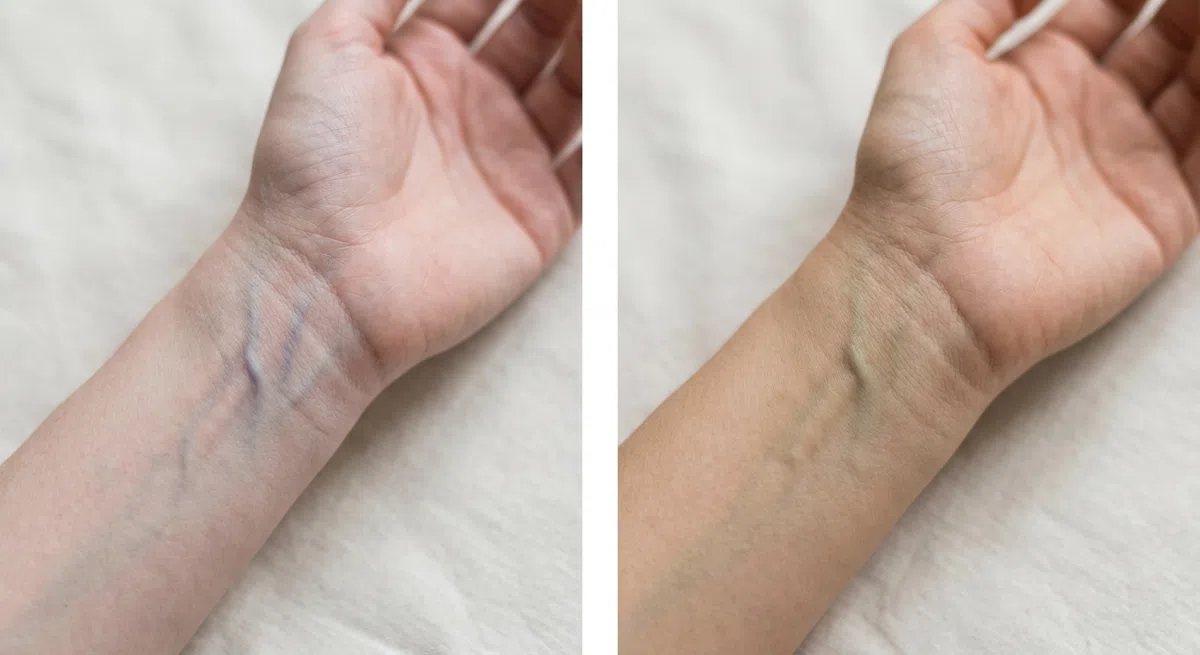
Test 1The veins at the inner wrist
Daylight only - a warm bulb throws yellow into this and a cold LED throws blue. Turn the wrist up and read the vessels as a group rather than picking out one.
Green or olive - warm, so Spring stays in play, and so does Autumn.
Blue or violet - cool, so not a Spring.
Hard to say - neutral, or the veins do not show. Move on to the next test.
Caveat: trust this one least. On deep skin the veins are often invisible, and on very pale, thin skin they can look bluer than the undertone really is. When they are hard to judge, go by the paper test.
Test 2White paper at the jaw
Bare skin, hair pulled back, natural light. Hold plain white copier paper against the jaw - it must be true white, because cream paper carries its own warmth and only tells you what you hoped. Look at the border between paper and skin, not the whole face.
The skin looks golden or peach beside it - warm, which fits Spring.
The skin looks rosy or blue-tinged - cool.
It goes flat and grayish - neutral, and often olive. Read the next test carefully.
Caveat: this is the most reliable of the three because it reads the same on every complexion. Skip it straight after exercise or a cold walk, when a temporary flush can pass for a pink undertone.
Test 3Yellow gold against silver
Two plain pieces, no stones, similar width. Hold each against the wrist in turn and read the skin next to the metal, not the metal.
Gold looks better - the skin warms and evens out. Every Spring passes this one.
Silver looks better - the skin looks brighter next to it, which points to cool.
No clear difference - neutral, so warmth or coolness is not what defines your coloring.
Caveat: on deep skin both metals can seem to work, because each stands out strongly. Judge the skin just beside the ring instead - next to gold a Spring looks warmer, next to silver slightly grayer.
If the paper and the gold both say warm, every cool season is off the table. What is left is Spring or Autumn, and the next four checks are there to split them.
Fair - ivory with a peach flushOlive - more gold in it than greenMedium - golden honeyDeep - brown with a copper glow
22. Eyes: clear, with light in them
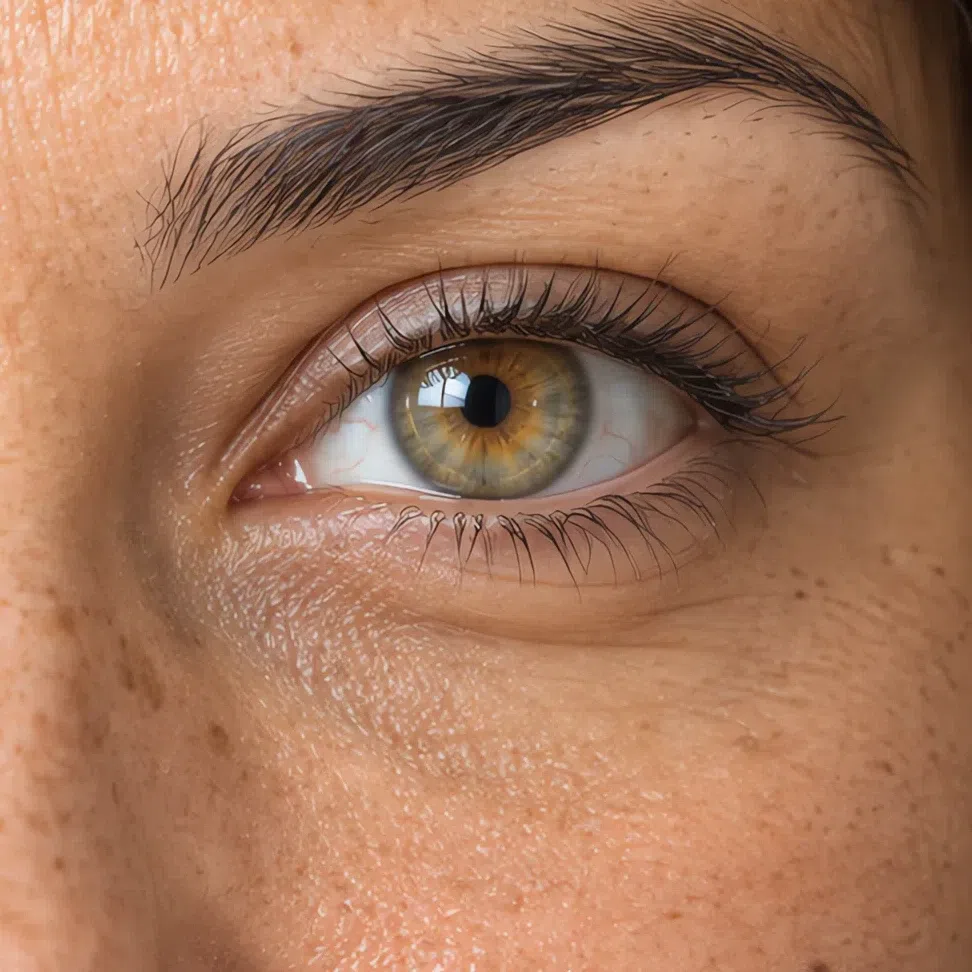
Spring eyes look lit from inside. The color is clean - aqua, clear blue, warm green, hazel, amber, honey brown - and there is almost always a gold or amber ring around the pupil.
The color itself is not the test; brown-eyed Springs exist at every depth, and blue-eyed ones do too. What the season shares is the quality of the color: it reads as one clear shade rather than a smoky mix, the whites are bright, and the iris shows warm rays or flecks close to the pupil when you look in daylight. A gray-blue eye with no warmth in it, or a soft, dusted green, belongs to Summer; a deep matte brown with no light in it leans Autumn or Winter.
Look at the pupil edge, not the iris color. A warm glint there puts a clear eye in Spring, whatever the main color is.
Light aqua-blueClear greenLight hazel with goldAmber
33. Hair: gold in it at every darkness
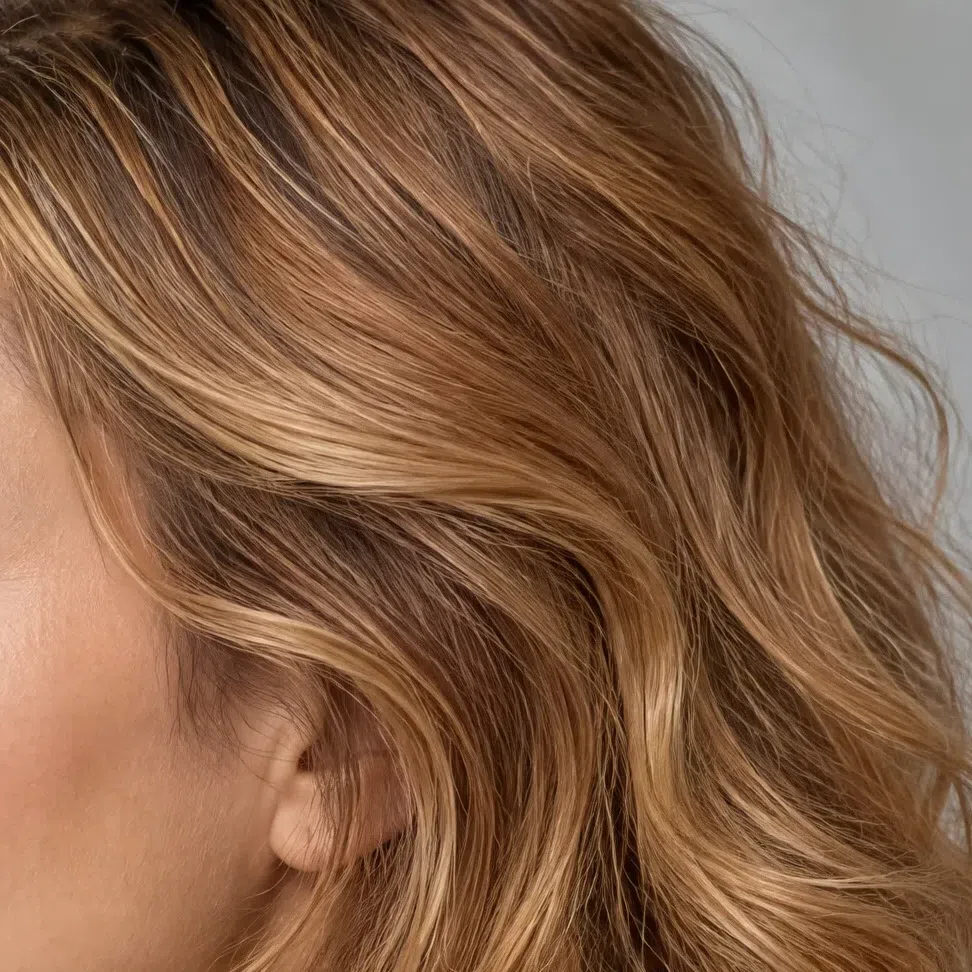
Spring hair carries a warm pigment - gold, honey, copper, ginger, warm chestnut - and it shows in sunlight at every level from pale blonde to dark brown.
The level is not the sign; the sheen is. A Light Spring may be flaxen, a Warm Spring honey or copper, a Bright Spring a warm chestnut that is noticeably darker than the skin - and all three glint gold when you hold a strand to a window. Ash, mouse and cool taupe never do, and a black that stays black in the sun is not a Spring either. On deep complexions the hair is often very dark; the check is the same, and the warm cast is usually plainest at the ends and the hairline.
Dyed hair tells you nothing. Judge your natural color, or the roots if you have to.
Hold a strand to a window: any darkness that shows gold qualifies, and no darkness with ash in it does.
Contrast is where the three Springs differ most, so the season-level rule is a ceiling rather than a number: hair, skin and eyes sit at readable but soft distances from one another, and nothing in the face lands near black against something near white.
A Light Spring has almost no contrast - everything sits in the pale register. A Warm Spring has a medium, readable step between hair and skin. A Bright Spring has the most, with dark hair and vivid eyes against the skin, and it is the only Spring that borders a Winter. What rules out the season is the Winter cut itself: near-black hair, brows and lashes against light skin, the difference surviving a black-and-white filter intact.
Height on the ramp is depth; the distance between hair and skin is contrast. A deep Spring sits low on the ramp with a short distance, and that is still a Spring.
Do it with your own photo
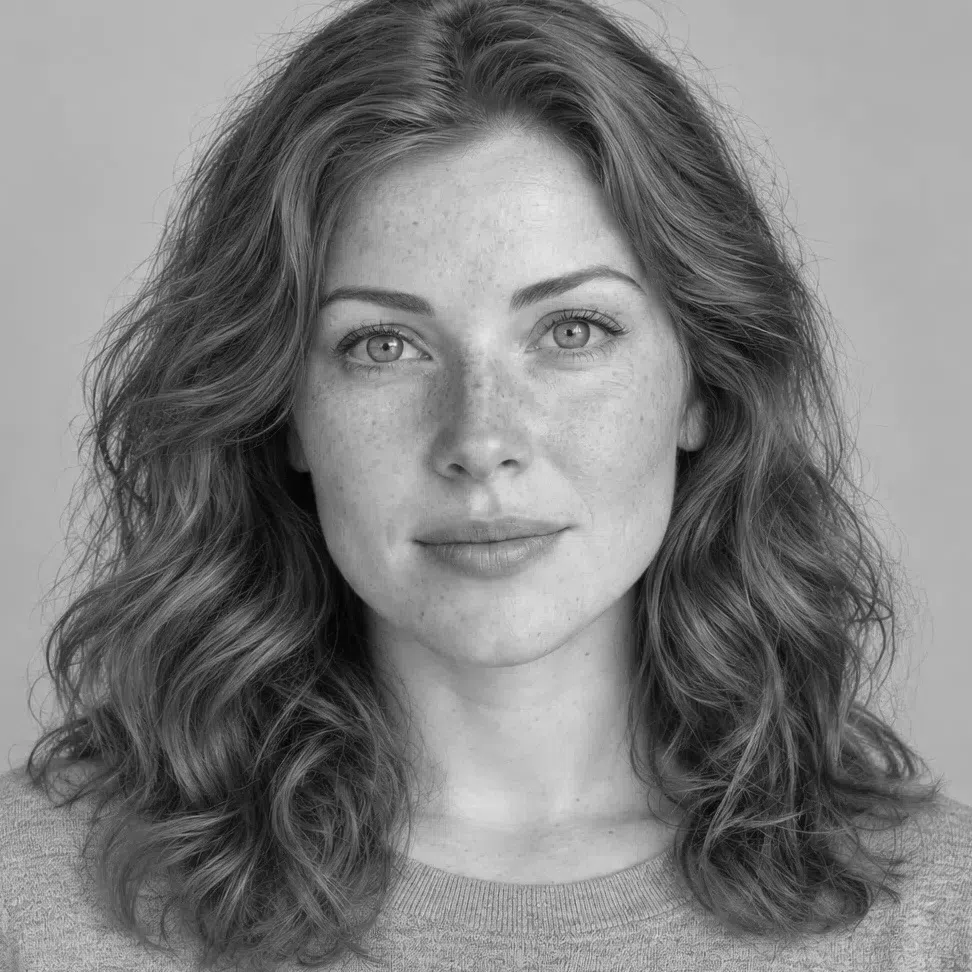
Take a bare-faced daylight selfie and apply a grayscale filter. On a Spring, hair and skin come out as different grays that still sit close together. If the hair or brows go almost black against the skin, look at Winter; if everything blurs into a single flat gray, look at Summer.
Low - a Light SpringMedium - a Warm SpringHigher - a Bright SpringDeep - low on the scale, short step
The black-and-white test, shown
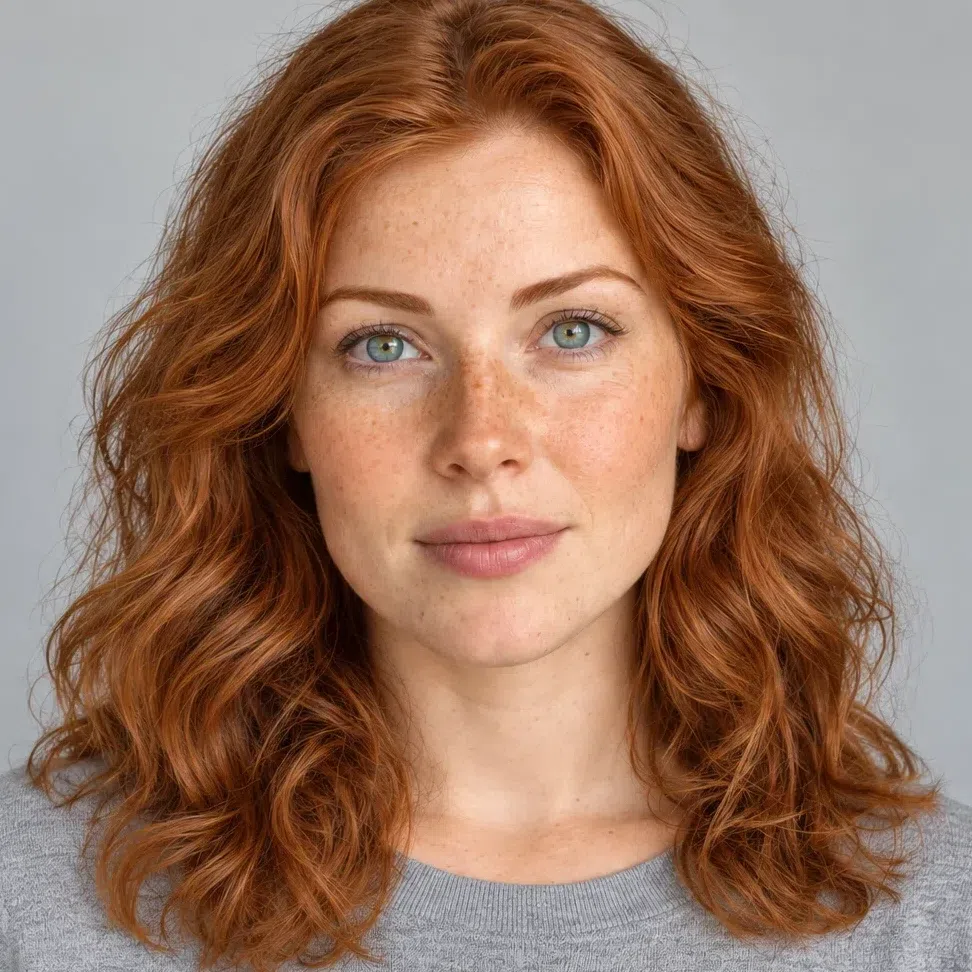
The left photo is in color; the right is the same shot with the color stripped out. Without hue, lightness is all that remains, and it shows her hair only a little darker than her skin.
In colorThe same frame, hue removed
Spring, fairCopper hair only slightly darker than her skinSpring, deepDarker overall, with the same small gapDeep WinterNear-black hair against light skin
HairSkinRamp runs black to white
Compare how far apart each pair of markers sits, and ignore where on the bar they fall. The deep Spring's hair is nearly as dark as the Winter's, yet her skin is dark too, so the gap stays small. The Winter keeps light skin under near-black hair, and that wide gap is something no Spring has.
55. Colors at the face: the fabric test
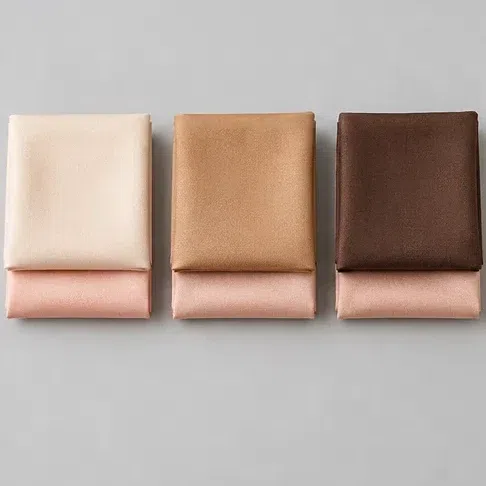
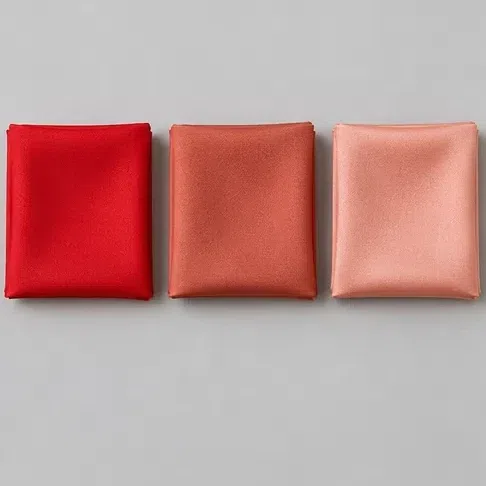
This is the check that separates Spring from Autumn most clearly. Stand by a window with no makeup, bring each fabric up to just below your chin, and keep your eyes on your skin, not the cloth.
A Spring shade evens the skin, lifts the shadows under the eyes and brings the eyes forward. The same face under an Autumn shade - terracotta, mustard, olive - looks heavier and slightly muddy; under a Summer shade it goes flat and gray. Black is hard to judge with a scrap of fabric, since up close it reads as a dark patch rather than a garment; try an actual black top in a mirror instead, and expect it to drain color from any Spring face.
Shades that switch the face on
If these even the skin and brighten the eyes, you are in the right season:
Peach sorbet
Coral
Butter
Spearmint
Turquoise
Dandelion
Ivory
Tan
Shades that drain it
If these gray the skin and settle shadow under the eyes, they are not yours:
Jet black
Blue-gray
Cold violet
Dusty blue
Optic white
Spring vs Summer vs Autumn vs Winter
The four seasons are set by two axes. Temperature separates Spring and Autumn (warm) from Summer and Winter (cool); clarity separates Spring and Winter (clear) from Summer and Autumn (soft). Read the two rows that name those axes first - the rest of the table follows from them.
If you fit two columns equally, go back to Temperature first and Clarity second. A Spring that passes both is warm and clear; an Autumn is warm and soft, a Summer cool and soft, a Winter cool and clear. Which of the three Springs you are is the next section.
Three Springs
Which Spring are you: Light, Warm or Bright
Same warmth, same clarity - three different leading axes
Spring is not one palette. It splits three ways, and the split is wide enough that a shade which makes one Spring glow will wash out the second and shout over the third. Every Spring is warm, and every Spring is clear; the split comes from which property leads. On a Light Spring it is lightness, on a Warm Spring it is warmth, on a Bright Spring it is saturation. Find your leading axis and the rest of the page reads as one column instead of three.
Still torn between two columns? Ignore the fine print and pick the one word a stranger would use first about your face: light, golden, or vivid. That word is your subtype.
The palest Spring, and the one that borders Light Summer. Lightness leads: pastels work, and a dense saturated color overloads the face - a navy sweater at the collar looks like someone else's, even when the shade is warm.
Skin very light and translucent, with a peach or golden flush
Eyes light and soft in outline - aqua, light blue, gray-green, light hazel
Hair pale golden blonde or light golden brown, bleaching to near-white in summer
IvoryPeach sorbetButterSpearmintCoralAzure
The one rule: Keep the whole outfit in the upper half of the lightness scale, and get impact from clarity of shade rather than depth.
The warmest Spring, and the one closest to Autumn. Lightness and saturation come second here; temperature decides. Gold reads in every feature, and any cool note - bluish, lilac, icy - sends the skin gray on contact.
Skin golden beige or peach at any depth, tans gold and rarely reddens
Eyes warm - amber, hazel, green with gold flecks, warm brown
Hair golden, honey, copper - the warmth is obvious with no test at all
EggshellNectarineOld goldGrapefruitCapriChestnut
The one rule: Check the temperature, not the strength: if gold is mixed into the shade it is yours, if blue is mixed in it is not.
The most saturated Spring, and the only one that borders Winter. Saturation leads: color has to arrive at full volume, so a pure coral works on this face and a dusty pastel switches it off and blurs the features.
Skin clear and bright, fair to golden beige, often with visible color in the cheeks
Eyes vivid and clean - turquoise, green, clear blue, topaz - with a sharply drawn iris rim
Hair golden blonde to warm chestnut, always with shine, darker than the skin
ApricotCaribbeanCoral flameTangerinePeacockMarine
The one rule: Saturation leads. A color has to be clean and noticeable - toning the palette down for subtlety here means losing the face.
Each question tests one axis. Answer in daylight, with no makeup, and treat the answer as a direction to look in - self-diagnosis is least reliable right at the borders between Springs.
Question 1 of 4
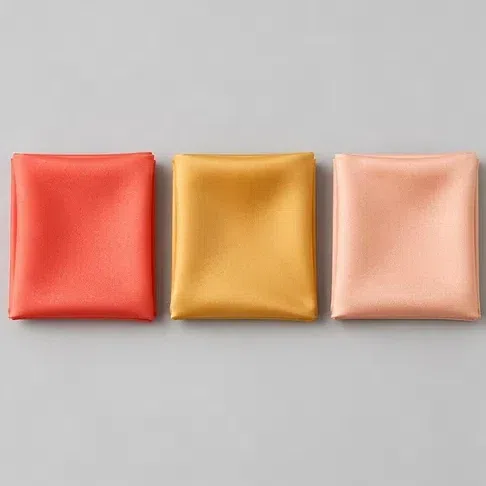
Hold three fabrics to your face - a clear coral, a warm gold, a soft peach. Which one works best?
Your hair color before any coloring:
How far apart are your hair, eyes and skin in lightness?
What does a pure, saturated color do to you - a tomato red, say?
Your likely subtype
Looks like Light Spring
Everything stays in the light register, and a dense saturated color near the face overloads it. Lightness leads, warmth follows.
Four questions narrow it down; they cannot measure your coloring. The photo analysis does, and it is where borderline cases get decided.
Other names for the Springs
Twelve-season systems and sixteen-season systems name the Springs differently, and several of the names people search for are not Springs at all in the twelve-season system this site uses. Here is where each one lands.
True SpringWarm Spring palette
The older name for Warm Spring - the Spring whose leading axis is temperature. Same coloring, same palette.
Warm Spring →
Clear SpringBright Spring palette
The older name for Bright Spring - saturation leads, contrast is the highest of the three. Same coloring, same palette.
Bright Spring →
Soft SpringLight Spring + Soft Autumn
A sixteen-season name for a warm, light coloring that is slightly muted. In a twelve-season system that is Light Spring when the muting is faint, and Soft Autumn when it is real - a Spring is clear by definition.
Light Spring →
Cool SpringLight Spring + Light Summer
A sixteen-season name for a light, clear coloring that leans neutral. There is no cool Spring in a twelve-season system: the nearest is Light Spring, and if the coolness is real, Light Summer.
Light Spring →
Deep SpringBright Spring + Warm Autumn
A sixteen-season name for a warm, clear coloring with dark hair or eyes. That is Bright Spring when the color stays clear, and Warm Autumn when the depth comes with richness rather than brightness.
Bright Spring →
Dark SpringSame as Deep Spring
The same coloring as Deep Spring under another name - warm, clear, with more depth than a typical Spring. Start with Bright Spring, and check Warm Autumn if your colors read rich rather than vivid.
Bright Spring →
This site uses three Springs because three is what the drapes actually separate: one leading axis each, and every warm, clear coloring lands in one of them.
Spring on every complexion
Fair, olive, medium and deep - one undertone at four depths
A season is not a skin shade, and Spring is the season people most often picture as a single face: pale, freckled, strawberry blonde. That face is a Spring, but so are the three below it. What the four share is the gold under the surface and the clear, lit quality of the coloring; what changes is how much depth sits on top. Each block shows one depth through a portrait, the skin, the eyes and the hair, taken from all three Springs so no depth is tied to a single subtype. The photographs are all of women. On a man the same reading happens at the brows, the beard line and the hairline, and the palette that follows is the same.
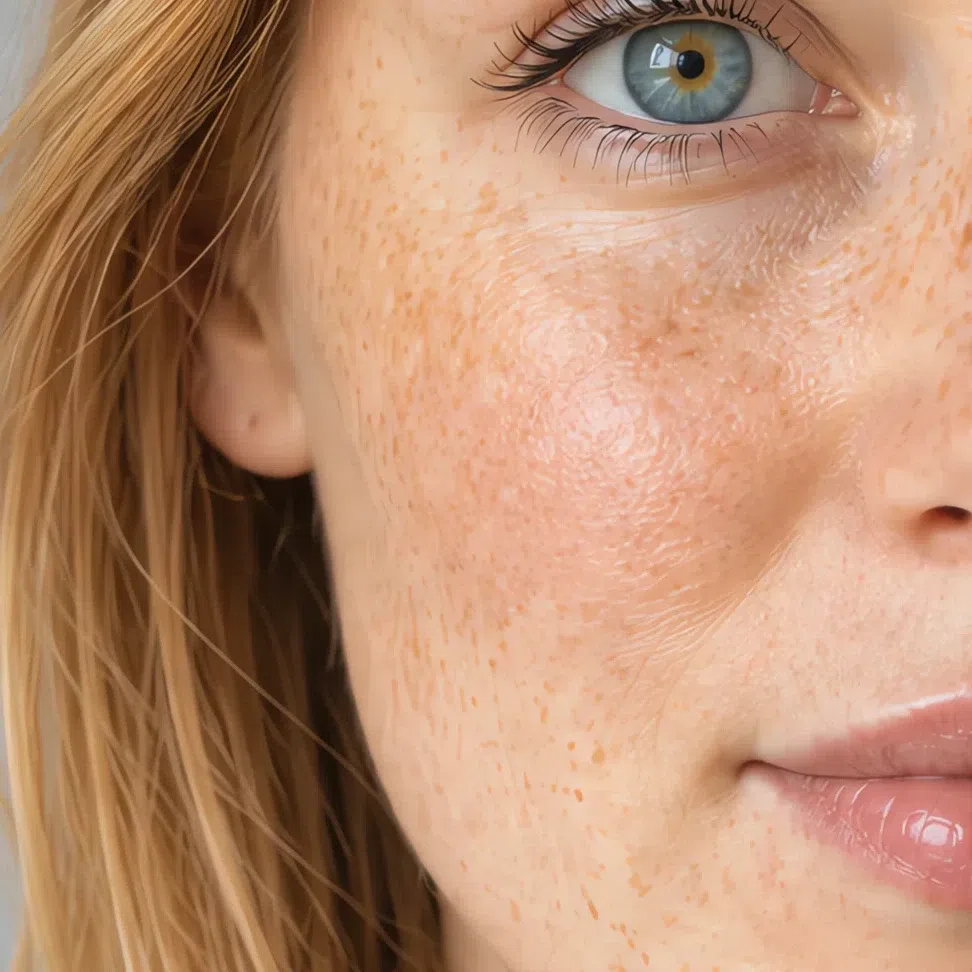
Fair: peach under porcelain
At the fair end the gold is at its most legible. The skin is thin enough to show a peach or apricot flush through it, and the warmth is something you can point at rather than infer.
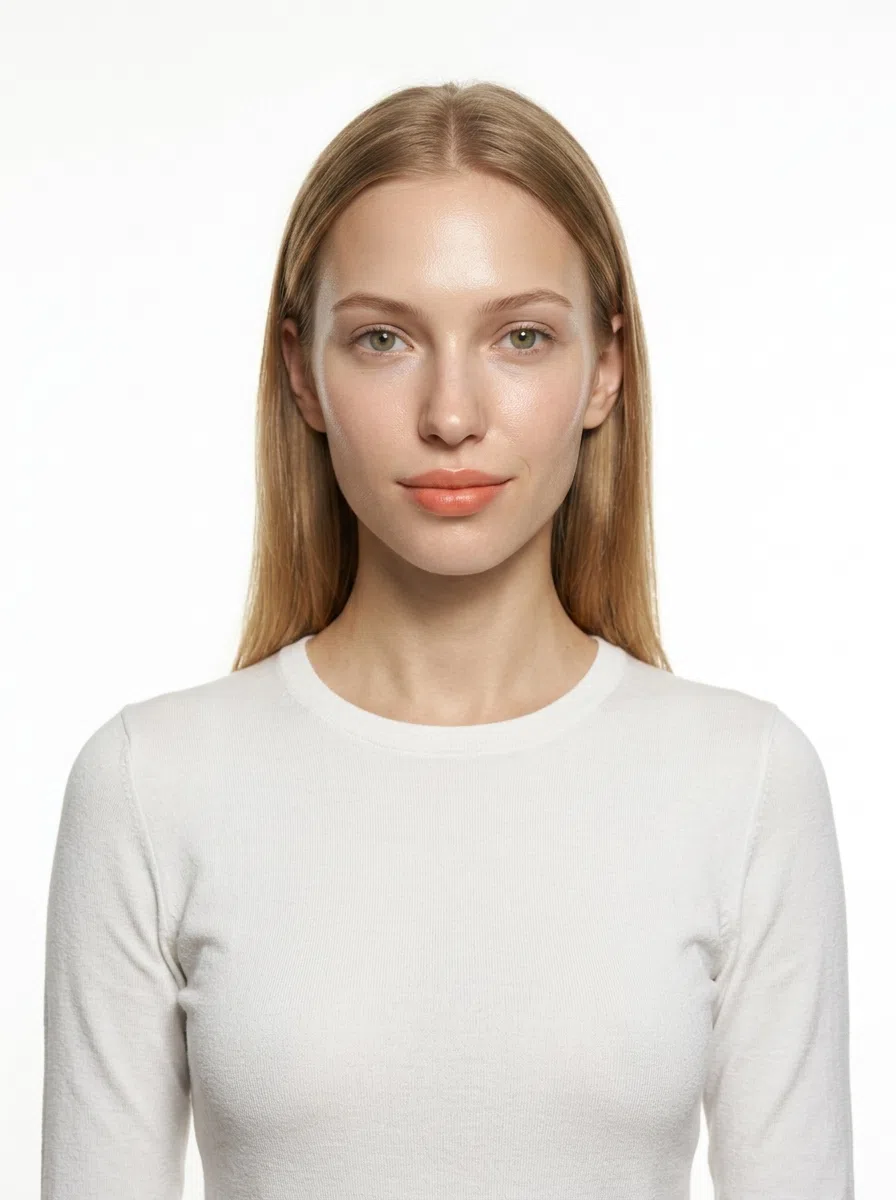
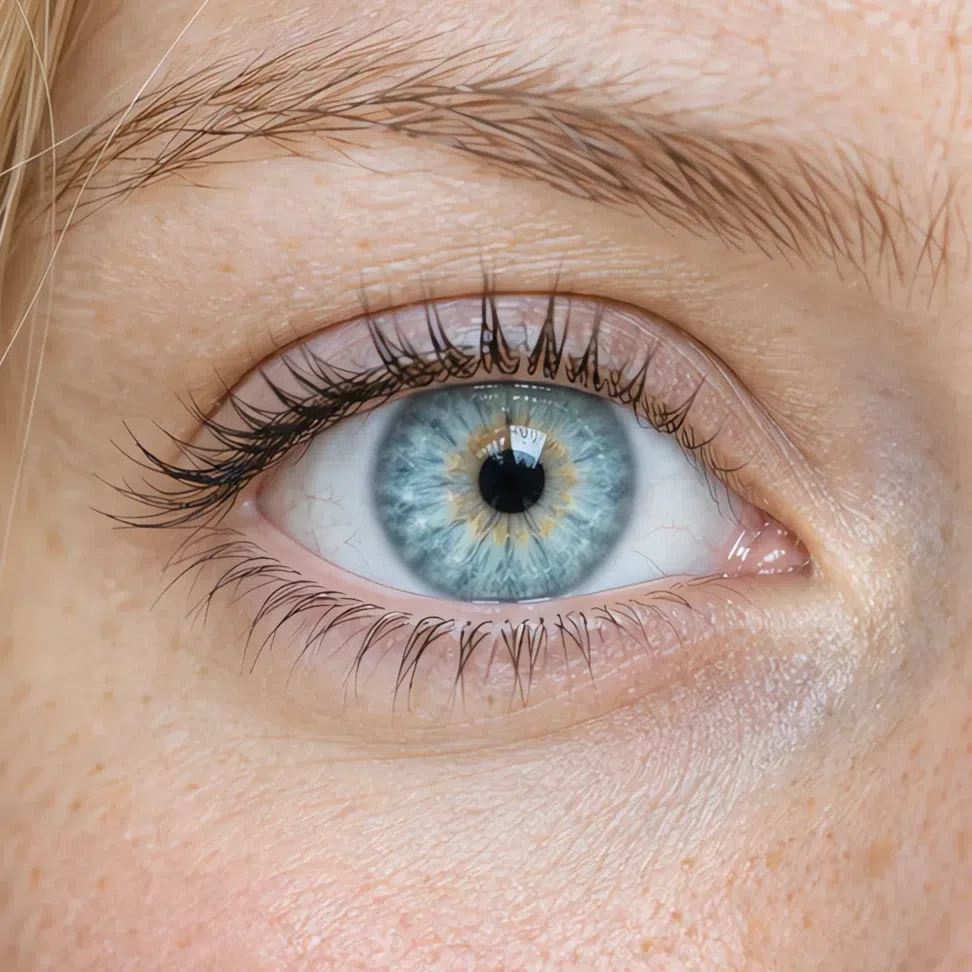
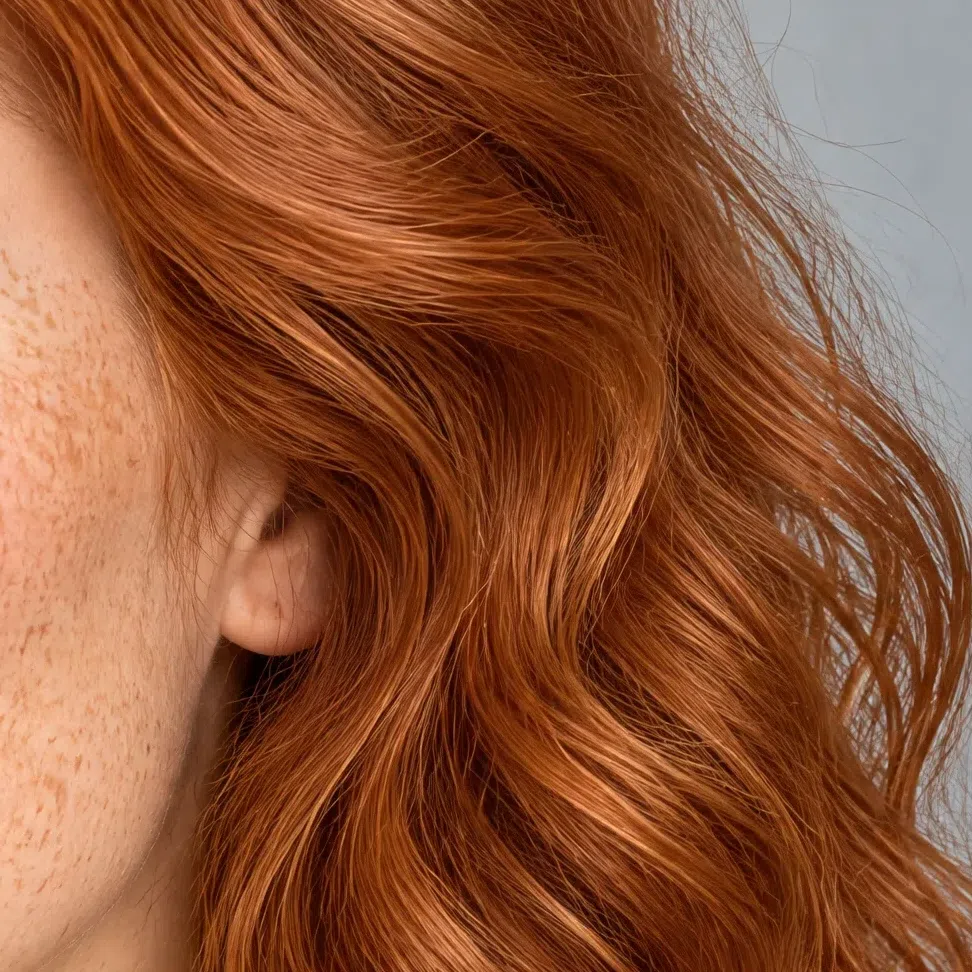
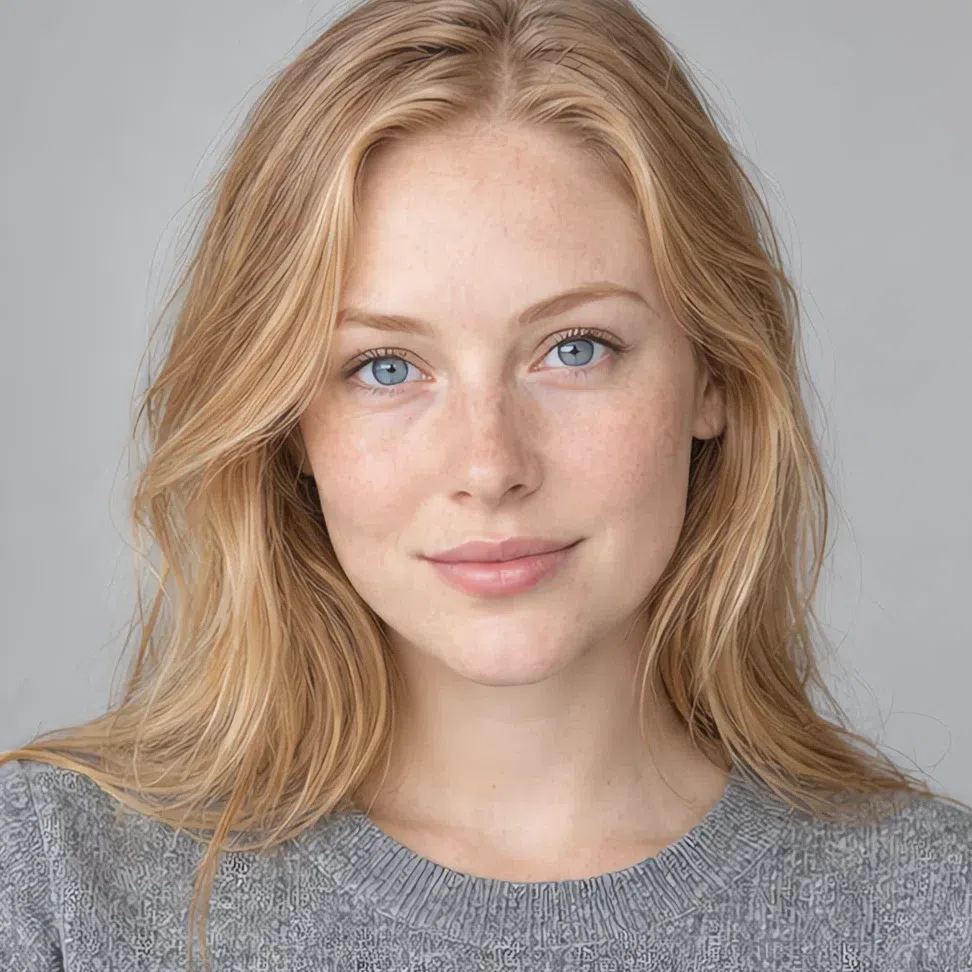
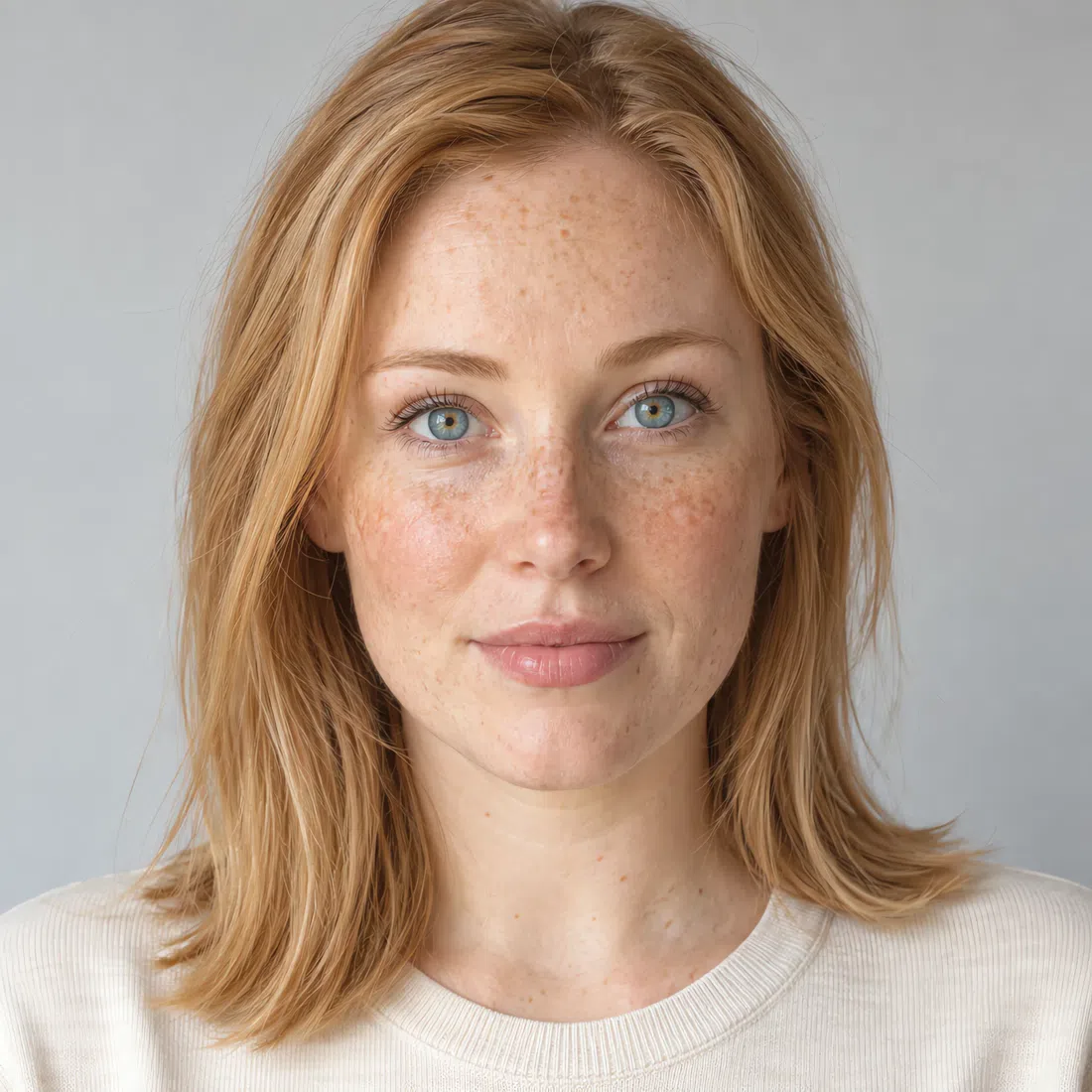
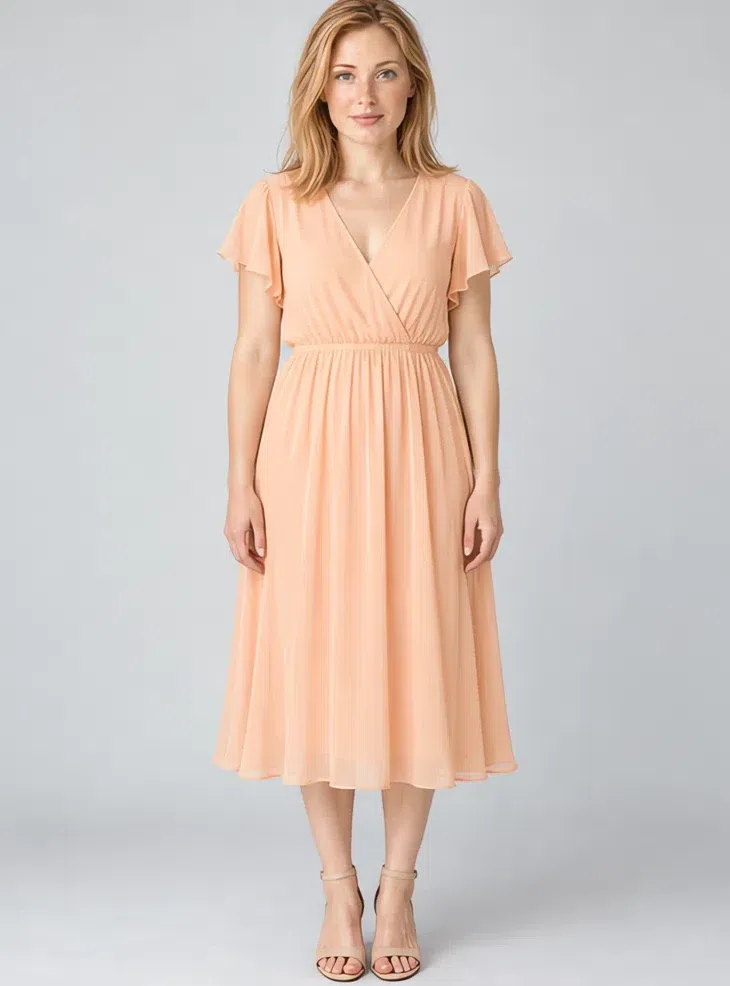
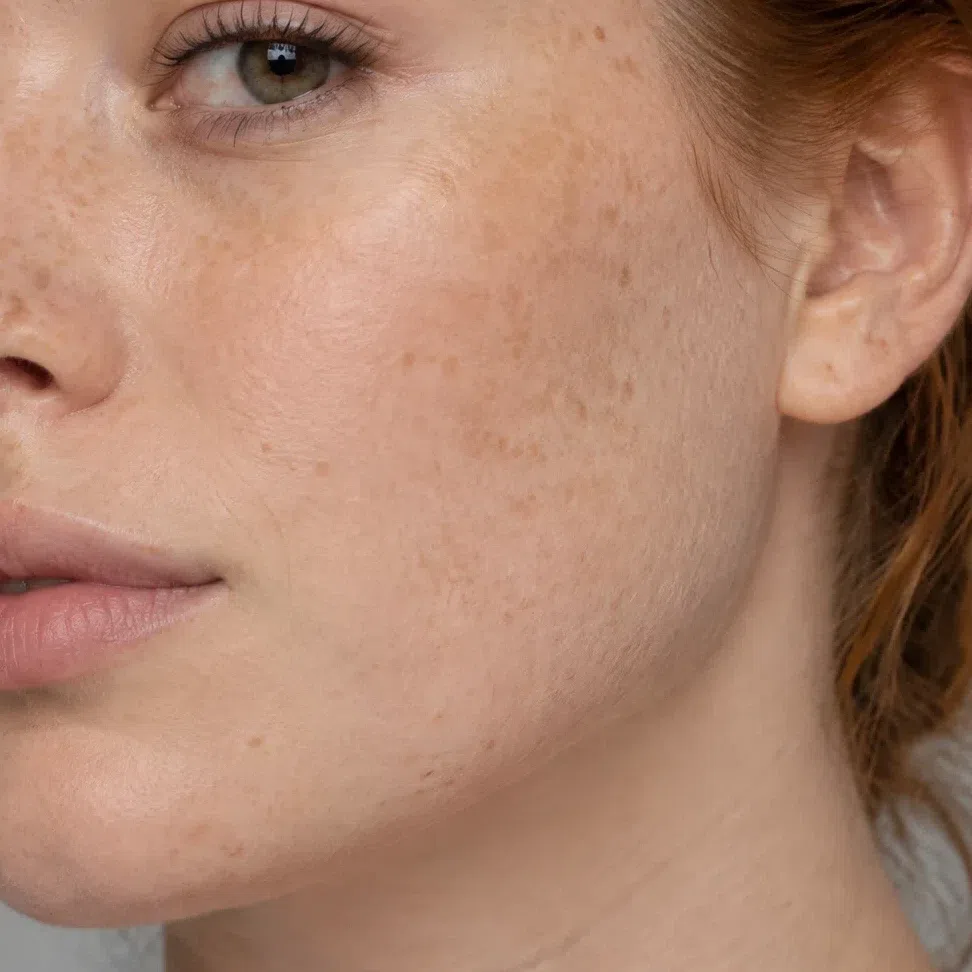
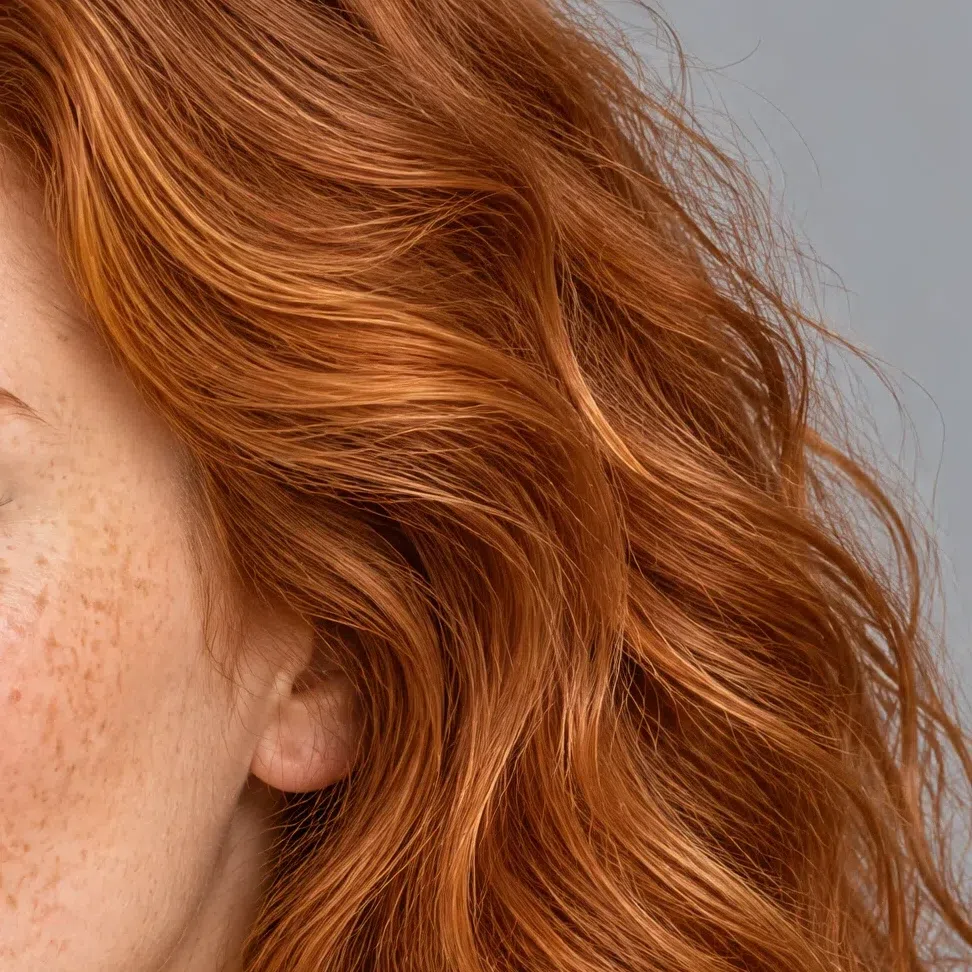
The portraitA Light Spring: ivory skin, golden freckles, strawberry blonde hair and aqua eyes ringed with gold. Ask someone to describe a Spring and this is usually who they describe.SkinA peach flush under the cheekbone and freckles that come up ginger. Fair Spring skin burns first and then tans a light gold rather than staying red.EyesClear, saturated blue with a clean white around it. On a fair Spring the eye is often the most colorful thing in the face.HairStrawberry blonde, golden wheat, pale copper - light hair with an obvious warm pigment in it, never platinum or ash.
Does very pale skin mean I am a Light Spring?
Not on its own. Pale skin tells you depth, and depth does not name the subtype. A fair Spring with light golden hair and soft contrast is usually a Light Spring. A fair Spring with vivid copper hair and medium contrast is a Warm Spring, and a fair Spring whose hair and eyes are strikingly darker than the skin is a Bright Spring. The three-way comparison settles it by leading axis.
Fair Springs land most often in Light Spring, because at this depth lightness is usually the first thing anyone notices about the face.
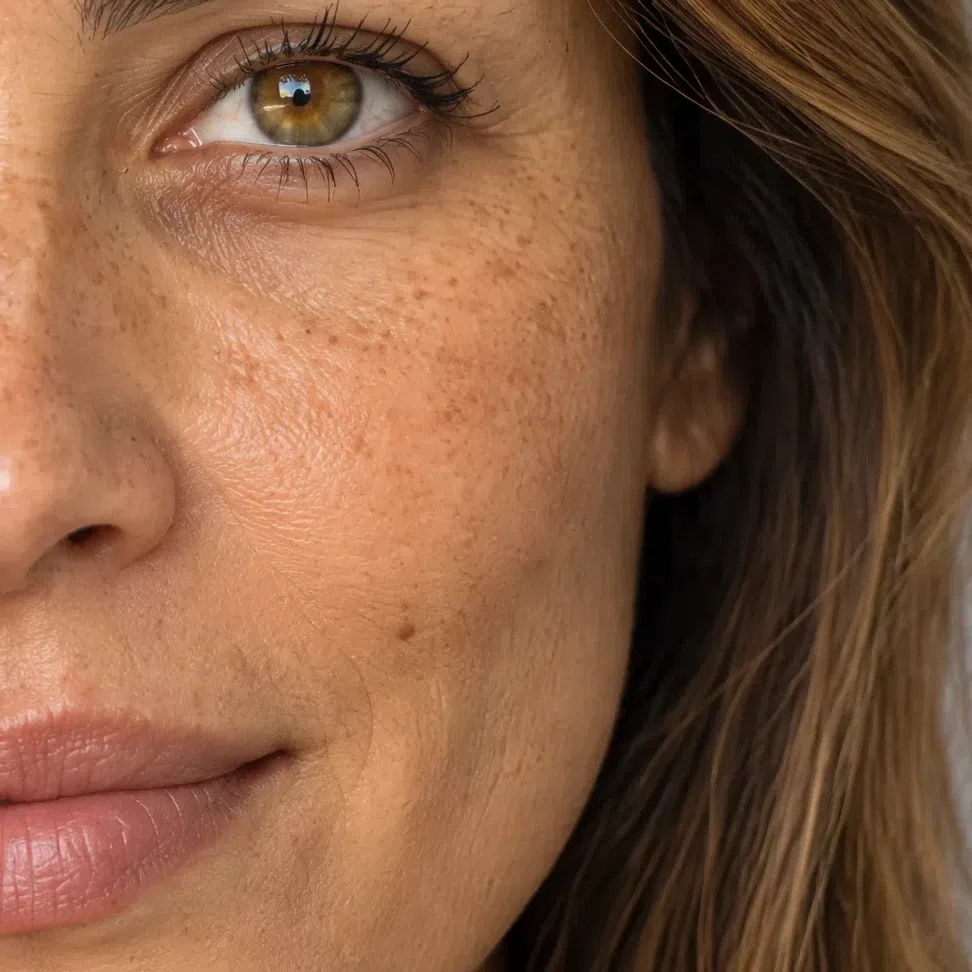
Olive: gold beneath the green
Olive is where Spring gets misread most. The green-gray cast on the surface makes people assume a cool or muted season, when the undertone underneath it is plainly golden.
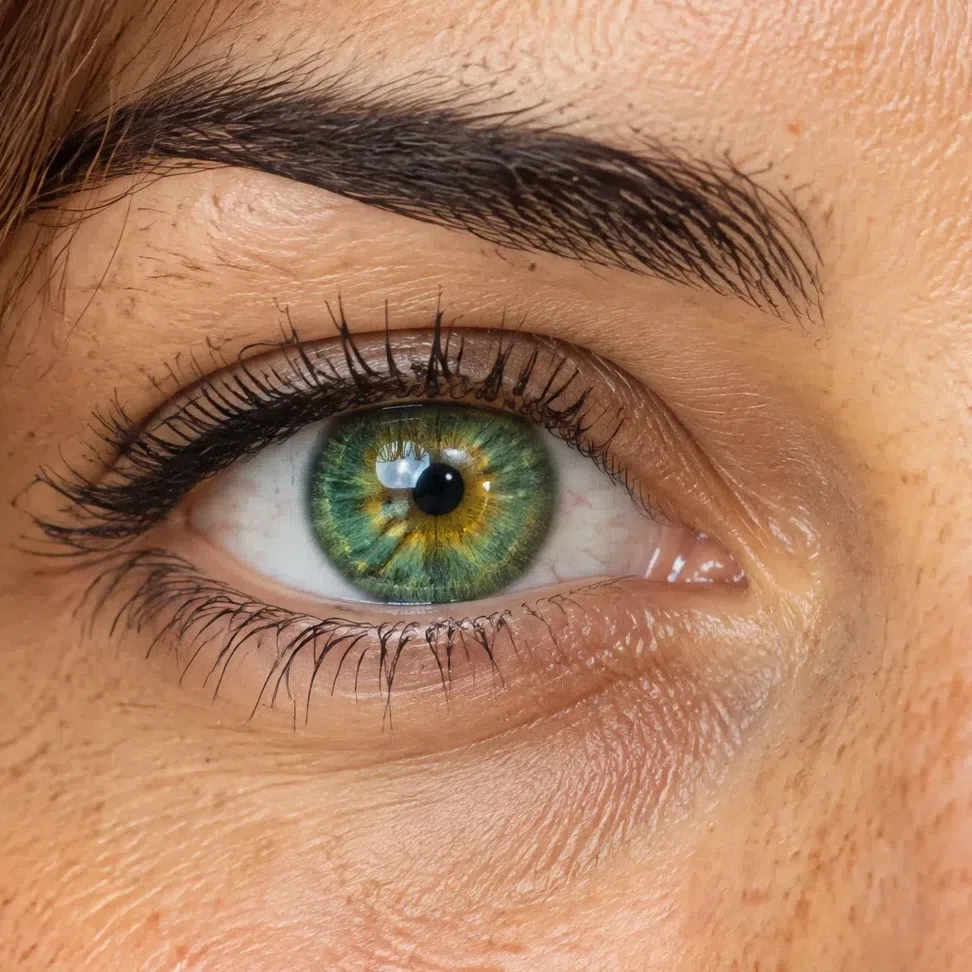
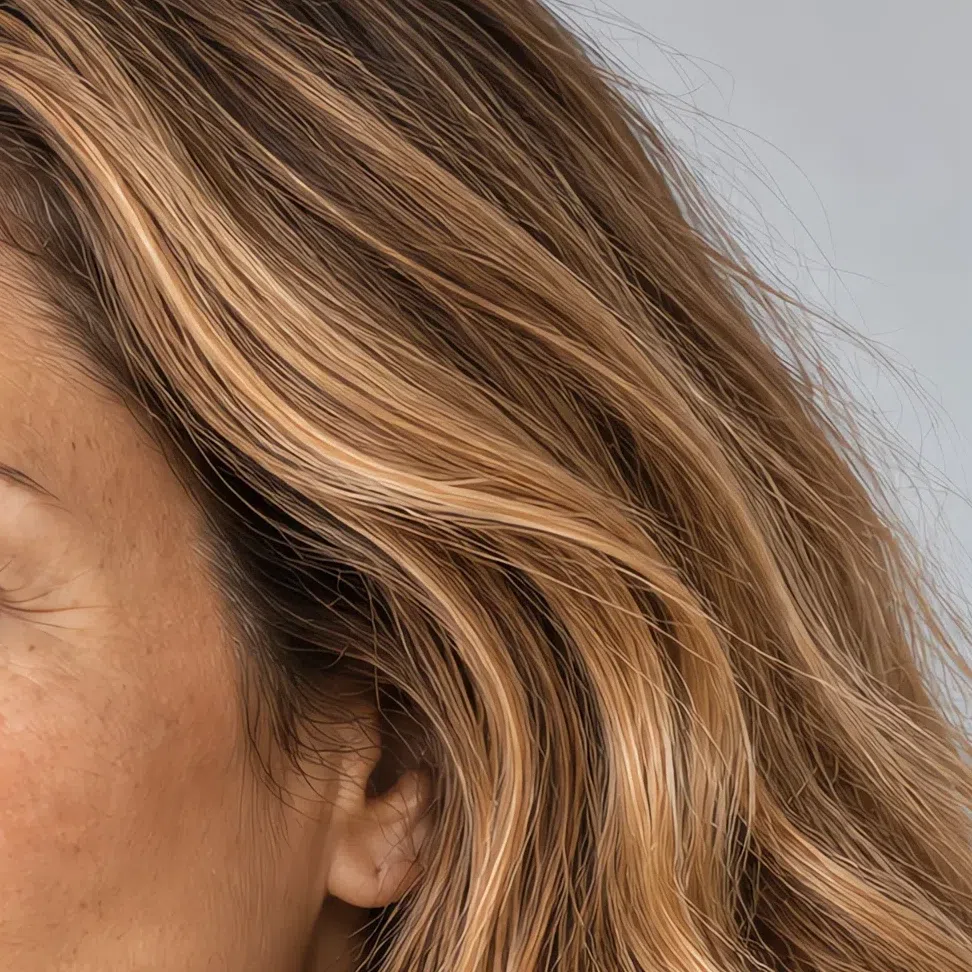
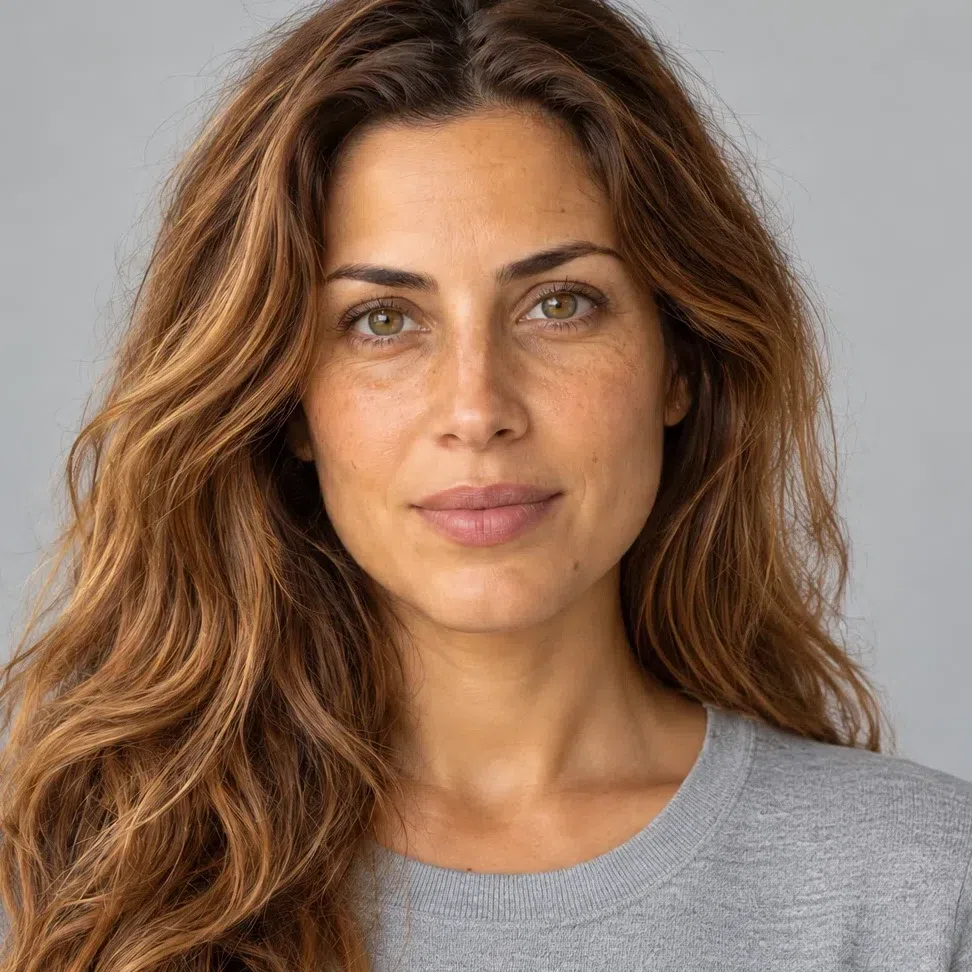
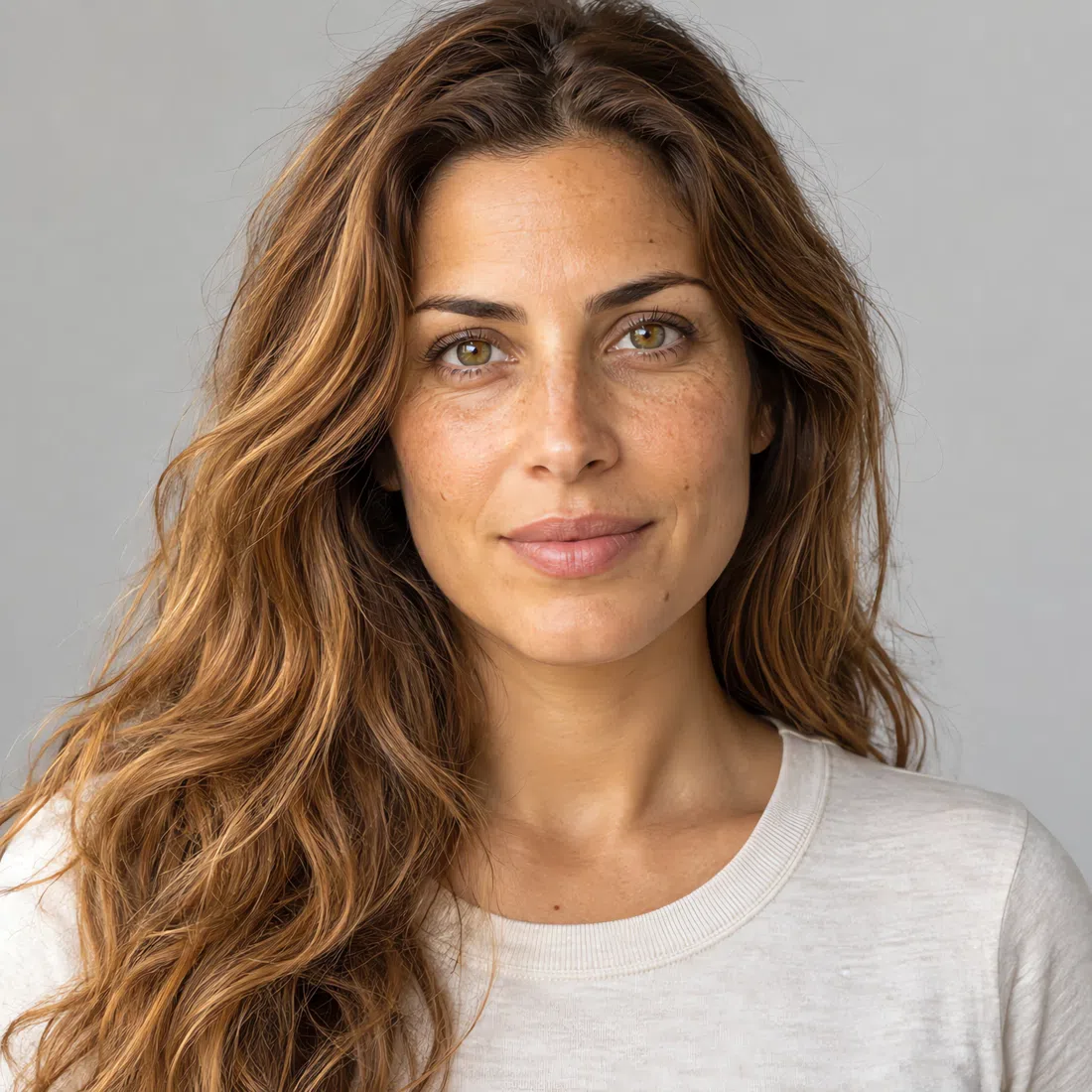
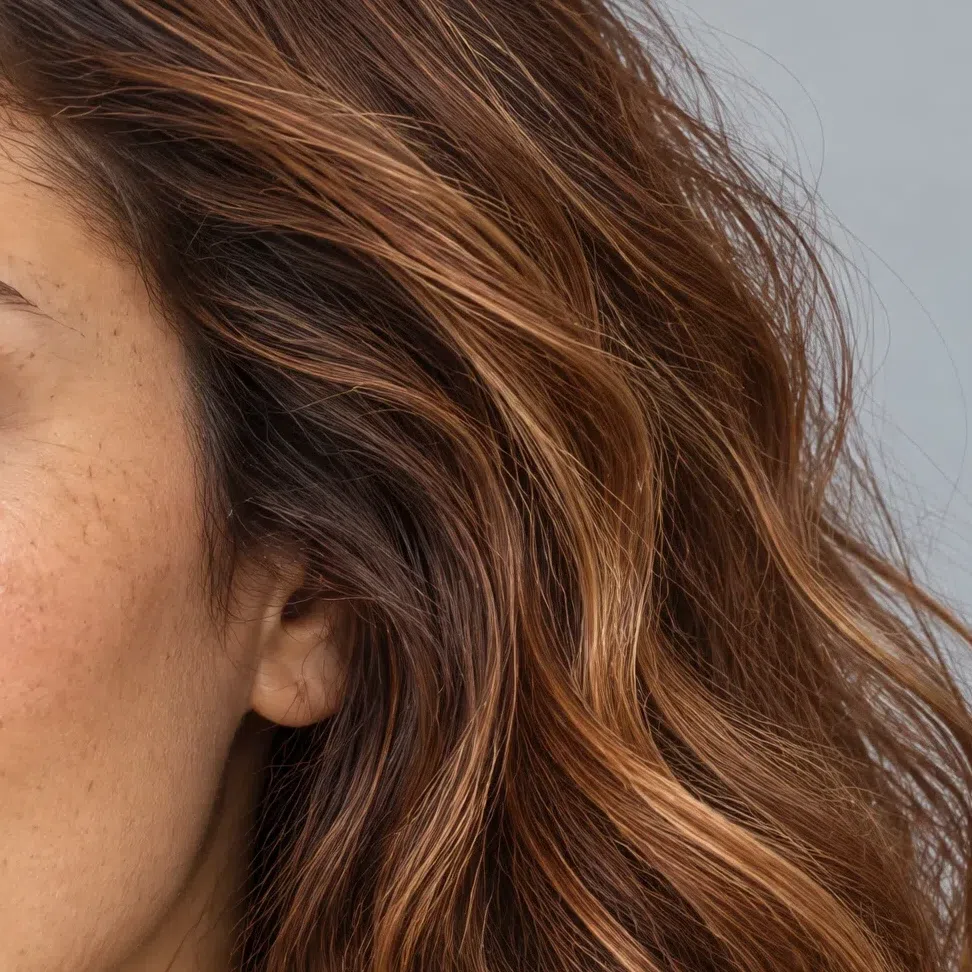
The portraitA Warm Spring with a light olive complexion, honey-streaked brown hair and warm green-hazel eyes. The olive is visible; so is the glow.SkinA light olive surface with a clear golden undertone showing through at the cheekbone. It warms under a coral drape instead of turning sallow.EyesA light leaf green with gold sparks at the pupil. Olive-skinned Springs often have green or hazel eyes that read clearer than the skin suggests.HairHoney and caramel through a light brown base. The gold is plainest where the sun has lifted it.
Can olive skin be warm?
Yes. Olive describes a green-gray cast on the surface, and it can sit on either undertone. On a Spring the gold comes through it: the skin brightens next to coral and gold and looks tired next to silver. If the same skin stays green-gray under coral and only looks right in muted shades, the season is more likely Soft Autumn or Soft Summer. The paper test is the one to trust at this depth.
Olive Springs land most often in Warm Spring, because once the gold is found it is the strongest thing in the coloring. With dark hair and vivid eyes the same skin can be a Bright Spring.
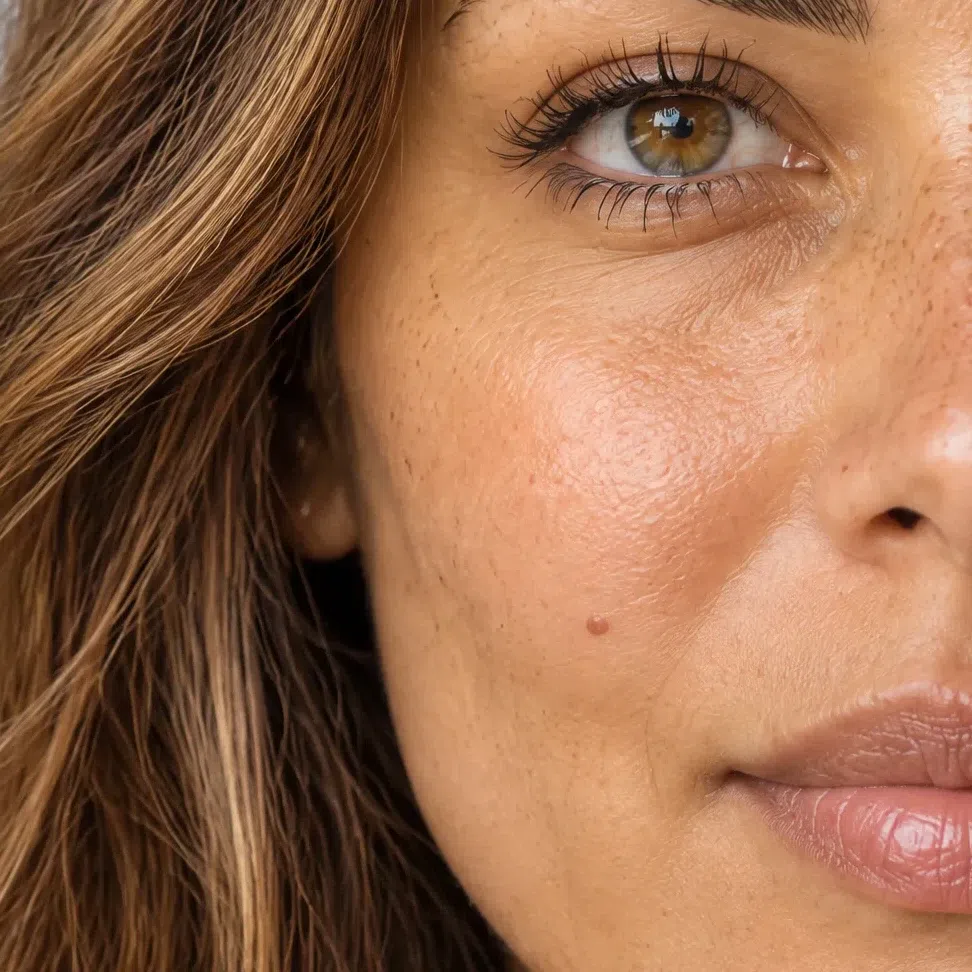
Medium: honey, beige and golden tan
At medium depth the skin carries enough color to look sunlit year-round. The Spring signal is that the color stays clear: honey and golden beige, never the brick or bronze of an Autumn.
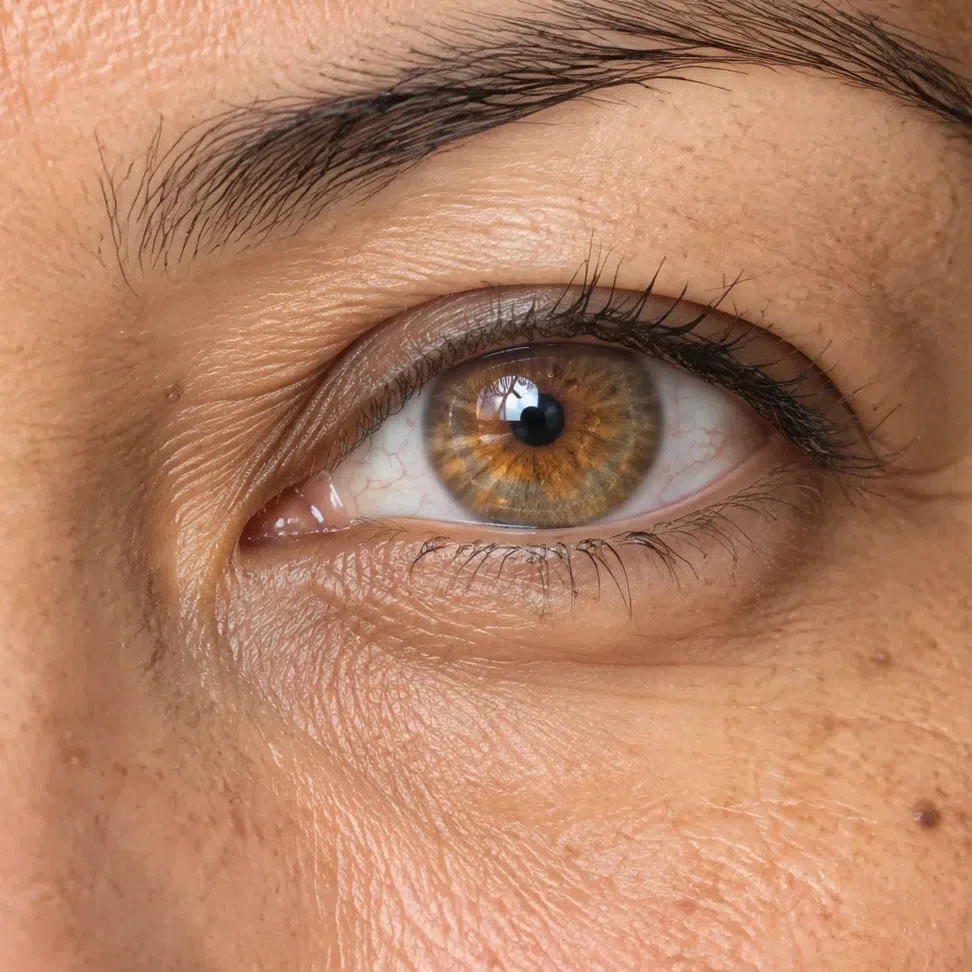
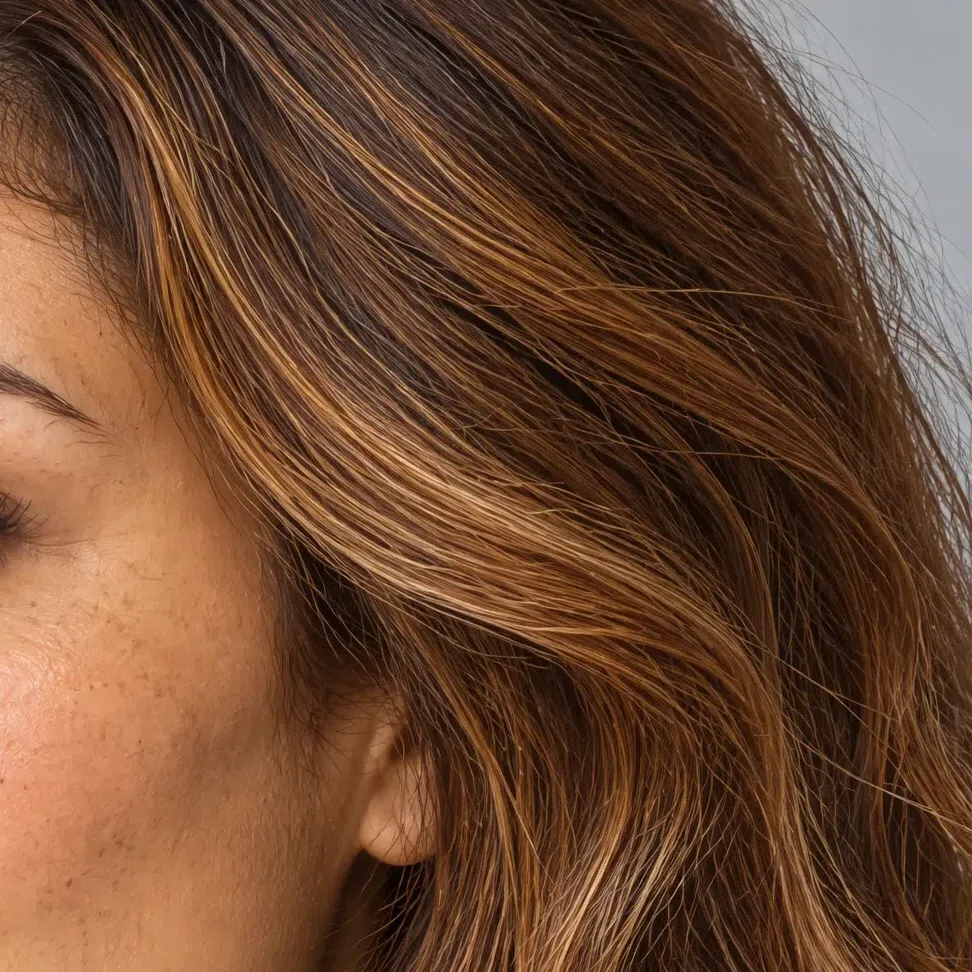
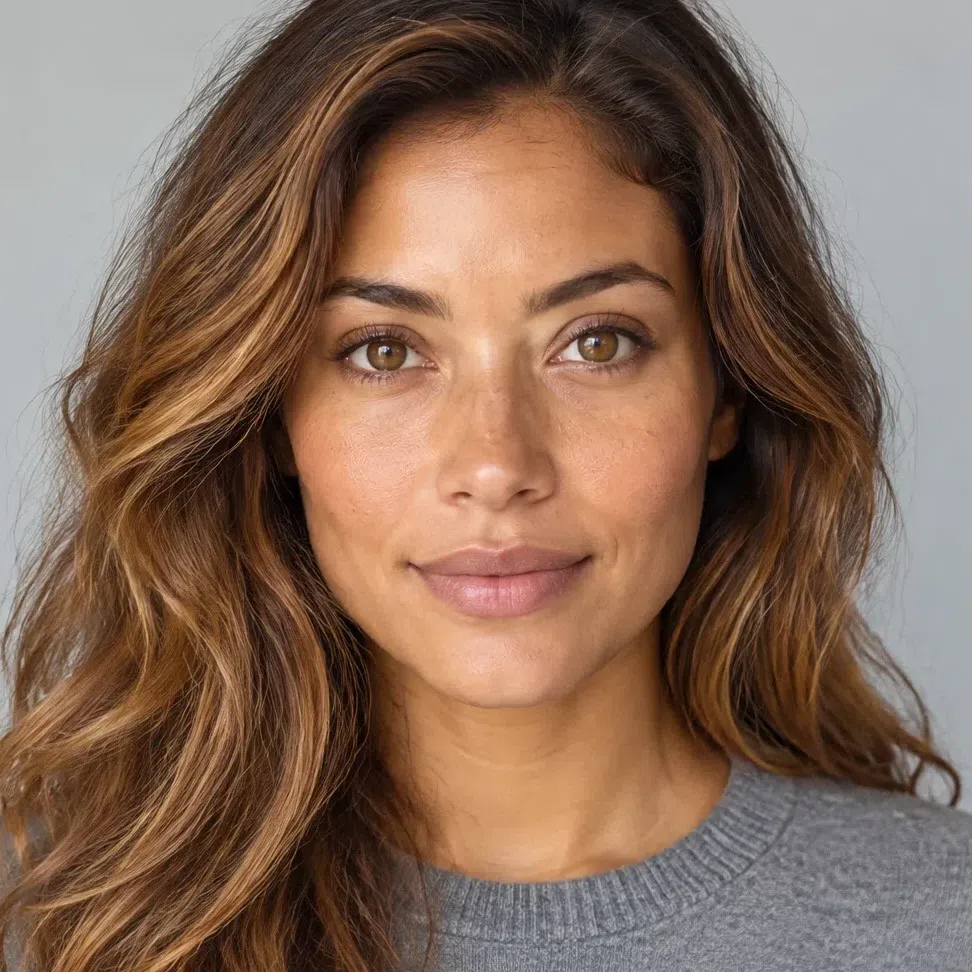
The portraitA Bright Spring with golden-beige skin, dark warm-brown hair lit with caramel and clear light-brown eyes. The step between hair and skin is visible but warm.SkinGolden-beige skin with a light honey tan across the cheek. It tans evenly and quickly and stops at honey rather than going on to deep bronze.EyesAmber with the light still in it - transparent golden brown rather than a dense, opaque brown.HairWarm light brown with a caramel undertone. Dark enough to frame the face, warm enough to glint in daylight.
Does a golden tan mean a warm undertone?
No. A tan adds depth for a season; the undertone is there in midwinter. Plenty of cool-undertone people tan golden-brown in July. Judge in your palest month, on skin that rarely sees the sun such as the inside of the upper arm, and ignore how the tan itself looks.
Medium Springs split between Warm Spring and Bright Spring. Soft, readable contrast points to Warm; deep hair and eyes that stand out sharply from the golden skin point to Bright.
Deep: copper light on brown
On a deep complexion the gold is not a tint any more but a light. It shows as a copper or amber glow across the forehead and cheekbones, and it is exactly as much a Spring signature as a peach flush on porcelain.
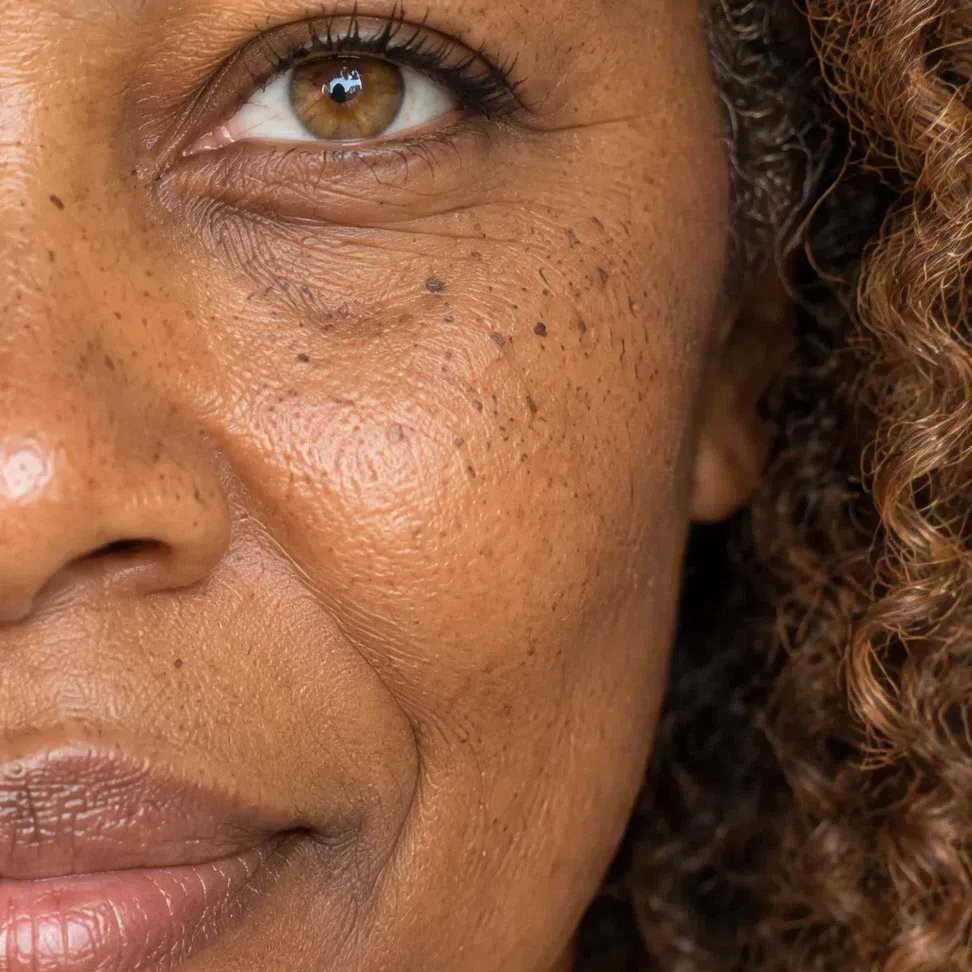
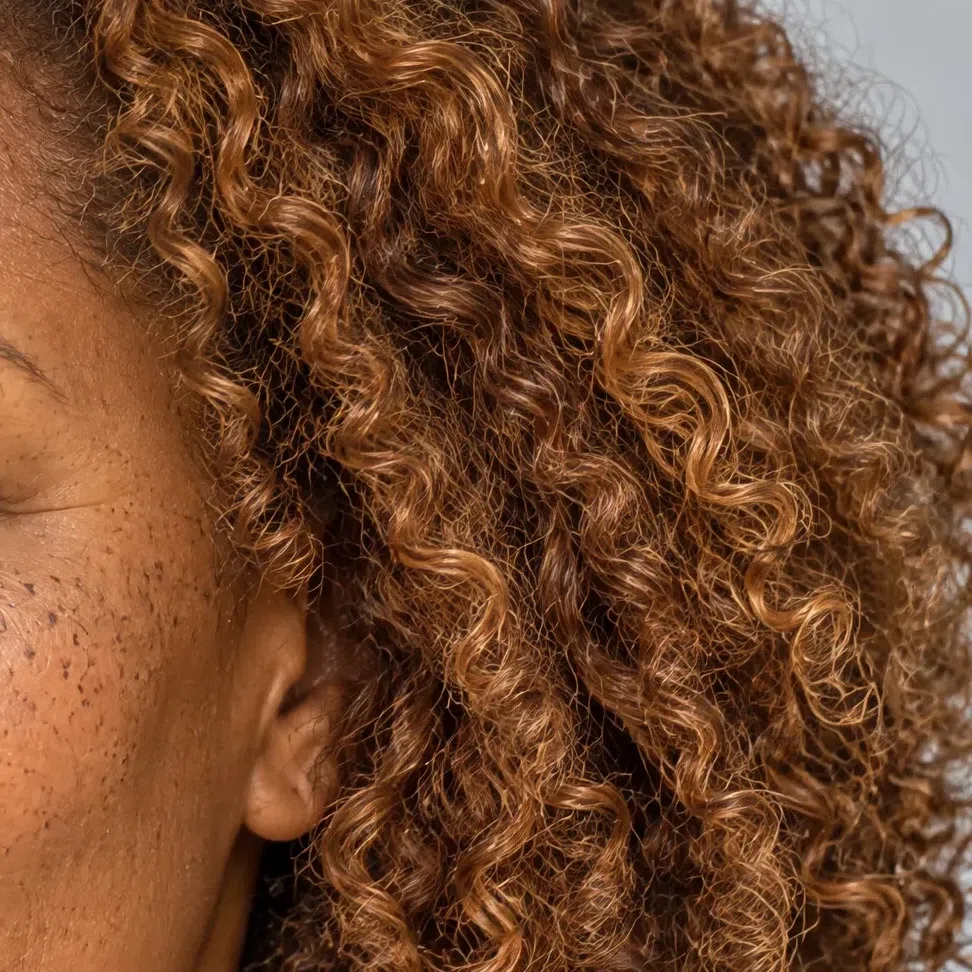
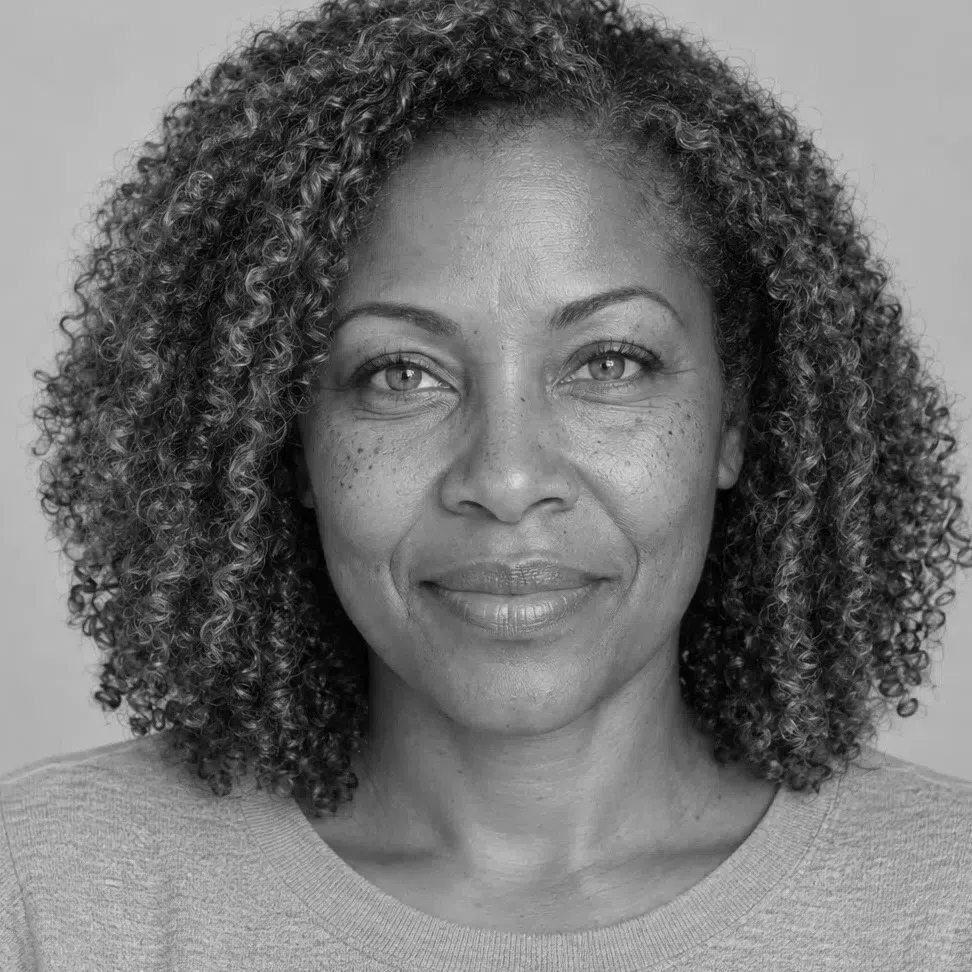
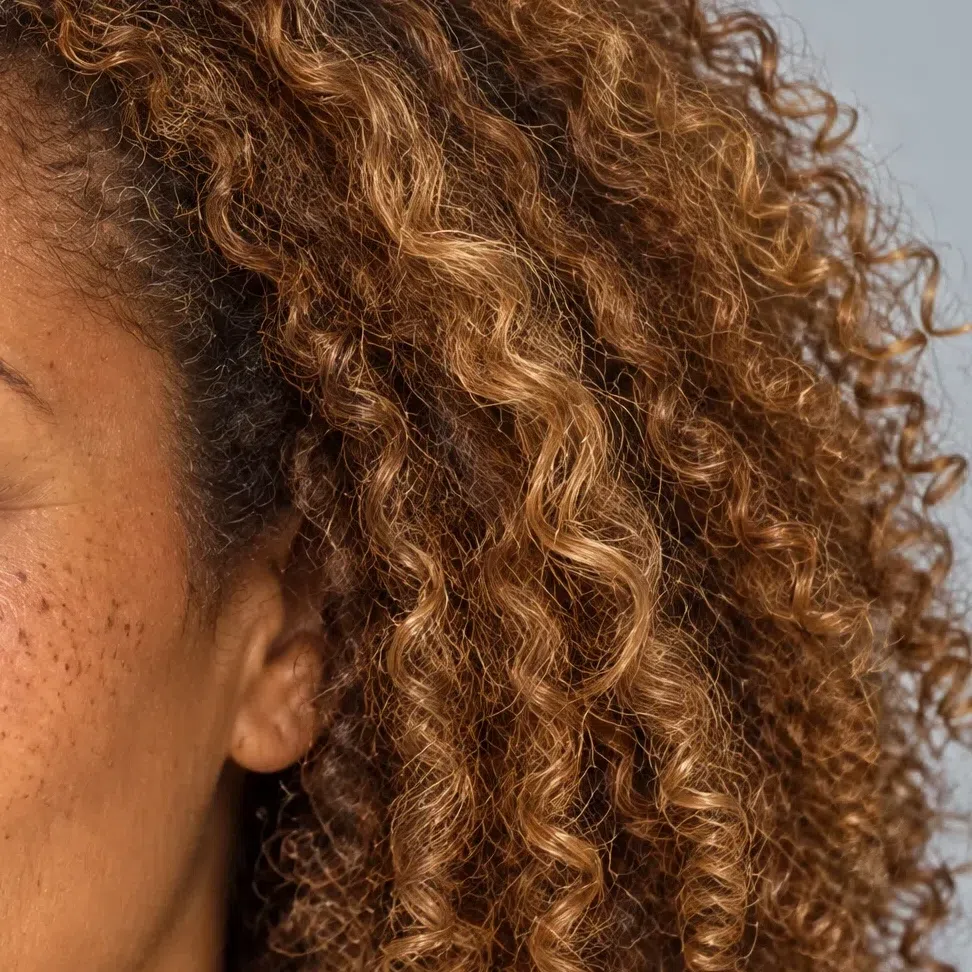
The portraitA Warm Spring with deep brown skin, golden-bronze curls and amber eyes. The warm glow sits across the whole face, and the contrast stays soft.SkinDeep brown skin that keeps its golden warmth in daylight and never turns ashy. Freckles and sun marks come up warm brown, not gray.EyesLight honey-amber, transparent against the skin. A clear, lit brown is the deep Spring eye; a flat, opaque one belongs to a darker season.HairDeep warm chestnut with honey and copper lights running through the curl. Very dark hair still qualifies when the warm cast shows at the ends.
Can you be a Spring with dark skin?
Yes. Undertone and clarity decide the season, and neither one depends on how dark the skin is. A deep complexion with a golden or copper undertone, lit eyes and warm-cast hair is a Spring, and the palette works on it the same way: coral, turquoise and warm gold brighten it, black and cold gray flatten it. The try-on at the top of this page is a Spring at this depth.
Deep Springs land most often in Bright Spring when the eyes are vivid and the hair is dark, and in Warm Spring when copper or golden hair keeps the contrast soft. A deep Light Spring exists but is the rarest of the three.
The Spring palette on a real face
21 keepers and 10 misses, each photographed on a person
Twenty-one shades that hold across all three Springs, in the order you would shop for them: six neutrals that carry the structure, six light shades for the neckline, and nine accents for the pieces meant to be noticed. After them come ten shades that work against the coloring, each matched with what to wear instead, and five outfits to copy.
If you keep only three, the top 3 Spring colors are Peach sorbet, Coral and Turquoise. Peach repeats the natural flush on every Spring, coral is the shade the season is known by, and turquoise is the one blue-green that leaves warm skin warm. All three work on Light, Warm and Bright Spring - at different strengths, which the strips below show.
This is the core the three subtypes share. Each carries more than this - paler on one, stronger on another - and each has its full palette on its own page: the Light, the Warm and the Bright Spring palette.
Every card is one photograph of the woman in the color widget above, with only her top recolored. Face, hair and skin are left alone, so a card is not showing you a shade - it is showing what that shade does to a deep golden complexion. A strip of three cards opens most groups: the same shade on a Light, a Warm and a Bright Spring, which is where the three start to part ways.
Base colors: what a Spring wardrobe stands on
Twelve shades do the daily work. The six neutrals are the long-lived pieces - coats, trousers, knitwear - and the six light shades are what goes near the neckline, where they meet the skin directly.
Neutrals: six to replace black and gray
None of the six is black, charcoal or a cool gray, and leaving those three out is the real line between a Spring closet and a Winter one. Can a Spring wear black? It can, provided the black stays well below the chin: black jeans, black boots and a black handbag all behave. Up at the neckline it draws the hardest edge in the closet against a coloring made of soft ones, and the face pays for it. Tan and Cognac give that depth without the drain.
Camel on the three Springs
Light SpringSlightly heavy for her register. A sand one step lighter sits closer.Warm SpringHer native neutral: it sits evenly and brings the gold in her skin forward.Bright SpringWorks as a base, but wants a clear accent beside it or the look goes flat.
Camel is safe for the whole season. Lighten it for a Light Spring; give a Bright Spring something vivid next to it.
Ivory
#F6EBD9The Spring white. Softer than optic white, so the skin next to it reads golden instead of sallow.
Wheat
#E4CFAEThe light base under everything, and the shade that takes over from pale gray in a Spring closet.
Camel
#C79E67The main neutral of the season: coats, trenches, knitwear. The one piece to buy first.
Fawn
#B9A48CThe gray for people who cannot give gray up - a gray with gold in it, and the only one this season gets.
Tan
#A67C52Takes black's job in shoes, belts, bags and outerwear, in a register the face agrees with.
Cognac
#96613AThe deepest neutral a Spring carries without losing the face. Leather, suede, a winter coat.
Six neutrals, four pairings
Instead of black and white. Ivory with Tan or Cognac keeps the crispness of that pairing and loses its severity.
Tonal dressing. Wheat, Camel and Cognac worn light to dark look deliberate, because every step sits at the same temperature.
One color on top. Any of these as the base, with one clear shade over it - Coral, Turquoise, Dandelion - is how this palette is meant to be used.
For gray days. Fawn with Ivory is the quiet pairing for anyone used to living in gray; it reads calm without pulling the color out of the skin.
Light shades for the collar
Spring's light shades are clean rather than powdery: they look lit, where a Summer's pale shades look dusted with gray, and the difference shows from across a room. The Spring pink is Apple blossom, a warm pink with no lilac in it, and the Spring green is Pistachio, a green with yellow underneath. Bluebell is the one light blue in the set; it is at its best near the face on the lighter Springs and works lower down on the rest.
Peach sorbet on the three Springs
Light SpringClose to ideal. It repeats her flush exactly and the whole face lifts.Warm SpringGood near the face; a step deeper toward apricot suits her even better.Bright SpringPleasant but quiet on her. Best as a base under a stronger accent.
Peach is the shade every Spring shares. The lighter the subtype, the closer it comes to perfect.
Peach sorbet
#FFCBA4The most Spring of the light shades. It echoes the natural flush and switches the face on.
Apple blossom
#F7BCB0A warm pink with no cool lilac in it. Next to it the skin looks rested.
Butter
#FBE3A0Soft gold for the collar, where a full yellow would be too loud.
Pistachio
#C3DB92A warm green with yellow in it - what a Spring wears instead of cold mint.
Spearmint
#A8E0CEBlue-green with warmth inside it: fresh, with none of the icy note.
Bluebell
#9DB4E8A light blue built on a warm base. Beside Dusty blue in the avoid block below the difference is plain - same lightness, different temperature.
Accent colors: color at full strength
Nine shades with real saturation, then the metals. A Spring can carry strong color; what it cannot carry is color that has been darkened or grayed down.
Nine accents, shown on a scarf
Here the color sits on the scarf and not on the top, on purpose: color running from neckline to hem stops accenting anything and simply becomes what you are wearing. The top underneath stays Ivory. Coral, Poppy and Chili are the reds, running from light to deep; Kiwi and Turquoise are the greens; Geranium is the full-strength pink.
Coral on the three Springs
Light SpringThe upper limit of saturation for her. In a scarf or a top, not a whole coat.Warm SpringStrong and easy; the gold in her skin answers it directly.Bright SpringHer base accent. At this strength it pulls the whole face together.
Accents are where the three Springs part most. The same coral is a daily shade on a Bright Spring and a ceiling on a Light Spring.
Coral
#FF7F50Spring's signature. A coral jacket or dress lifts the face more than blusher does.
Poppy
#E8674CDenser than coral and warmer than red. Good in outerwear.
Chili
#E63A21The red a Spring can wear: orange underneath, never blue.
Dandelion
#FFC93CPure gold as a fabric, and the color the cool seasons cannot wear at all.
Kiwi
#8DBF4AA lively yellow-green. Never swampy, never khaki.
Turquoise
#45C4B0Green-leaning turquoise, the version that holds the warmth of the skin.
Azure
#6FB3D9A clear blue on a warm base, for where an icy light blue would miss.
Geranium
#F76C7BWarm pink at full strength - the Spring answer to fuchsia.
Marine
#35507FA warm navy. The weight of a dark suit without the cold note of midnight blue.
Metals: gold, copper, bronze
Should Springs wear gold or silver? Gold. Yellow gold is the default for every Spring, with copper and bronze beside it and rose gold as a softer option. Silver, white gold and platinum lay a gray film over golden skin. Each disc is a gradient, since real metal runs from highlight to shadow as it moves.
Yellow goldThe metal to buy if you buy only one. It restates the gold already in the skin rather than adding a new one. Polished 14k or 18k.
CopperA warm copper in jewelry and hardware reads as an extension of the undertone. Especially good on olive and deep Springs.
BronzeQuieter than copper: buckles, clasps, and the hardware on handbags and shoes.
Putting the metals to work
Jewelry. Gold as the everyday metal, copper and bronze for variety, rose gold when you want it quieter. Silver belongs at the wrist if anywhere, not at the ears or the throat.
Stones. Amber, topaz and citrine - the warm transparent row. Coral and turquoise stones work too, for the same reason the fabrics do.
Bags and shoes. Tan and Cognac leather in place of black; Camel suede for spring and summer.
Glasses. Tortoiseshell, honey and gold frames. A black frame draws the same hard line at the face that a black collar does.
Spring colors to avoid
Ten shades in two groups, failing for two different reasons: the first five are too cold or too gray, the second five too stark or too heavy near the face. Each card names what to wear instead, always a shade from this page.
Cold and dusty
The larger problem, because these are the shades a basics aisle is full of and nothing about them looks wrong on the hanger.
Dusty blue on the three Springs
Light SpringThe gray under the blue dulls her; her own clean light blue does not.Warm SpringThe clearest miss of the three - her gold turns sallow against it.Bright SpringFlattens her contrast and blurs the eyes.
The most common Spring mistake is not too bright but too cold. The same gray-washed blue misses on all three; Bluebell, at the same lightness on a warm base, brings the face back.
Dusty blue
#B0C4DEThe failure is the gray under the blue, not the lightness - a clean warm light blue works. With the gray in it, the skin dulls and under-eye shadows deepen.Wear insteadBluebell#9DB4E8
Cold violet
#B19CD9Lilac with no warmth in it drags the face toward gray. A Spring needs the peach register at the collar instead.Wear insteadPeach sorbet#FFCBA4
Dusty pink
#C08081Gray-pink cancels the natural flush instead of repeating it.Wear insteadApple blossom#F7BCB0
Blue-gray
#7E8A93The most common safe choice, and the most damaging one for this coloring.Wear insteadFawn#B9A48C
Army green
#708238An earthy green with no yellow in it: an Autumn shade, and on a Spring it reads muddy.Wear insteadKiwi#8DBF4A
Why cold and dusty fails
They carry a gray or blue base. Put a cool, grayed shade under a golden undertone and the two cancel into the flat, washed-out look people describe as tired.
They take the clarity away. A Spring reads clear, as if lit. Every shade here has gray stirred into it, and grayness is the one thing a clear coloring cannot absorb.
They fail quietly. None of them looks loud or wrong in a shop, which is why they collect in a closet without anyone noticing what they do at the collar.
Too hard or too heavy at the face
Here temperature is secondary. Each shade opens a gap in lightness or weight between the garment and the face that nothing in a Spring's coloring can bridge.
Optic white
#FFFFFFToo sharp beside golden skin. It pulls redness forward and flattens the face; the difference from ivory is small on the hanger and obvious on a person.Wear insteadIvory#F6EBD9
Jet black
#000000Contrast a Spring does not have. Next to it the face looks pale and tired and shadows gather under the eyes. Fine below the waist; replace it at the collar.Wear insteadTan#A67C52
Midnight navy
#191970Cold and heavy at once, and the features get lost in it.Wear insteadMarine#35507F
Bordeaux
#5C1A33A red with blue beneath it, which puts out the warmth of the skin instead of feeding it.Wear insteadChili#E63A21
Deep magenta
#C71585A cold, heavy pink that argues with the undertone - and misses even on a Bright Spring, which carries almost any other saturation.Wear insteadGeranium#F76C7B
Why hard and heavy fails
Too much distance. Spring contrast is soft to medium. A garment near black or near pure white opens a gap the face cannot match, and the eye goes to the fabric.
Depth reads as fatigue. Weight added close to a light, clear coloring settles in the hollows - under the eyes, along the jaw - instead of reading as elegance.
A warm version fixes it. Each one has a Spring counterpart at a similar strength - Tan for black, Marine for navy, Chili for bordeaux - so the look survives and only the hardness goes.
Spring color combinations
Five outfits assembled from this page, with the chips in dressing order.
Five outfits
Nearly all of them share a pattern: one or two warm neutrals, then one clear color. Once the pattern is familiar, you stop needing the list.
Ivory
+
Camel
+
Peach sorbet
The everyday classic
Ivory and Camel as the frame, Peach sorbet in a blouse or a knit at the collar. Add turquoise earrings and it becomes a romantic look.
Coral
+
Dandelion
+
Yellow gold
Sunny weekend
A Coral dress or top with Dandelion in a bag or a scarf, finished in yellow gold. Bright, warm, and entirely in the season's register.
Peach sorbet
+
Turquoise
The office
Peach sorbet at the collar under a Turquoise jacket or cardigan. Polished and fresh without a single neutral doing the work.
Kiwi
+
Butter
Casual
Kiwi with Butter: a light, lively pairing for jeans, sneakers and weekends.
Chili
+
Wheat
Evening or a meeting
A Chili jacket over Wheat trousers. The one red a Spring owns, grounded by the light base.
What the five have in common: a Spring makes contrast out of color, not out of dark against light. Coral beside turquoise, at roughly equal lightness, does the work that black and white do for a Winter. A single cold piece undoes an outfit; a warm metal ties two bright shades together.
Wardrobe, makeup and hair color: the Spring rules
One rule each, and the point where the three Springs split
This page stays at the level of the season. Each Spring subtype has its own page with the detail: a full capsule wardrobe photographed at four complexions, makeup product by product, and dyed hair shades on real hair. Below is the one rule each of those rests on, with a link straight to the version for your subtype.
The wardrobe and hair rules apply to men exactly as written.
Wardrobe
The rule: Build on warm, light neutrals instead of black and gray, and bring clear color up to the face.
Camel, wheat, ivory and tan take over the jobs black and gray usually do, which means the base of the closet already agrees with a golden undertone before any color goes near it. Color then works best high on the body - a top, a blazer, a dress - where it can reflect onto the skin. The four outfits below are the same rule at four depths.
The three Springs use the rule differently. A Light Spring keeps the whole look pale and lets color arrive softly. A Warm Spring leans on camel and tan and adds golden, sunlit accents. A Bright Spring pairs the same neutrals with color at full strength and can take a warm navy where the other two cannot.
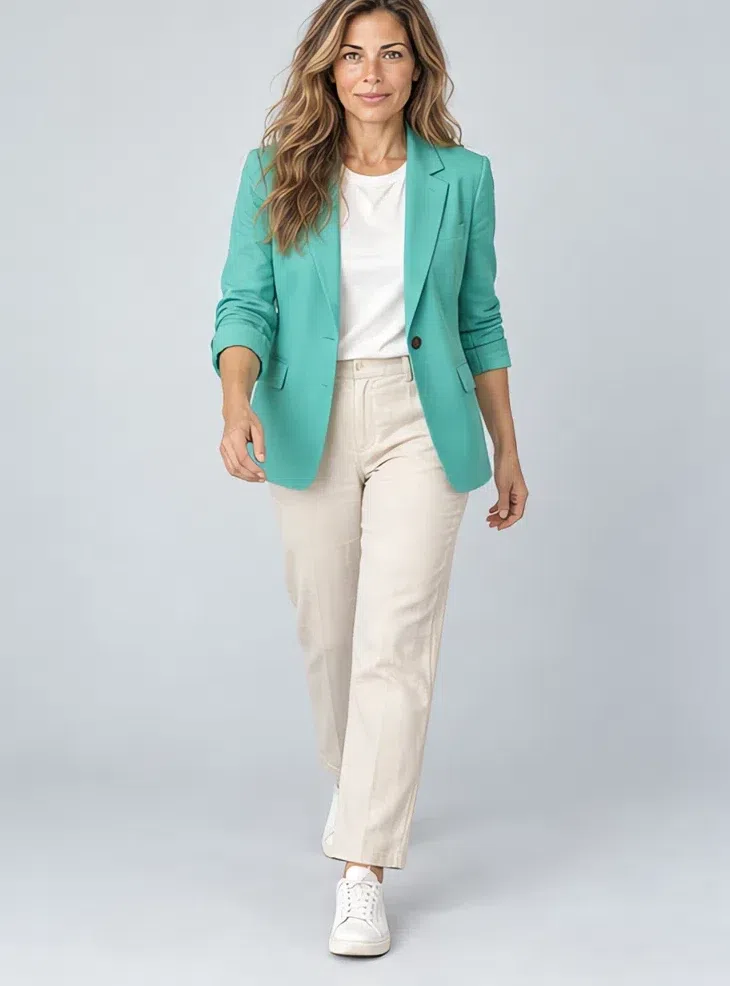
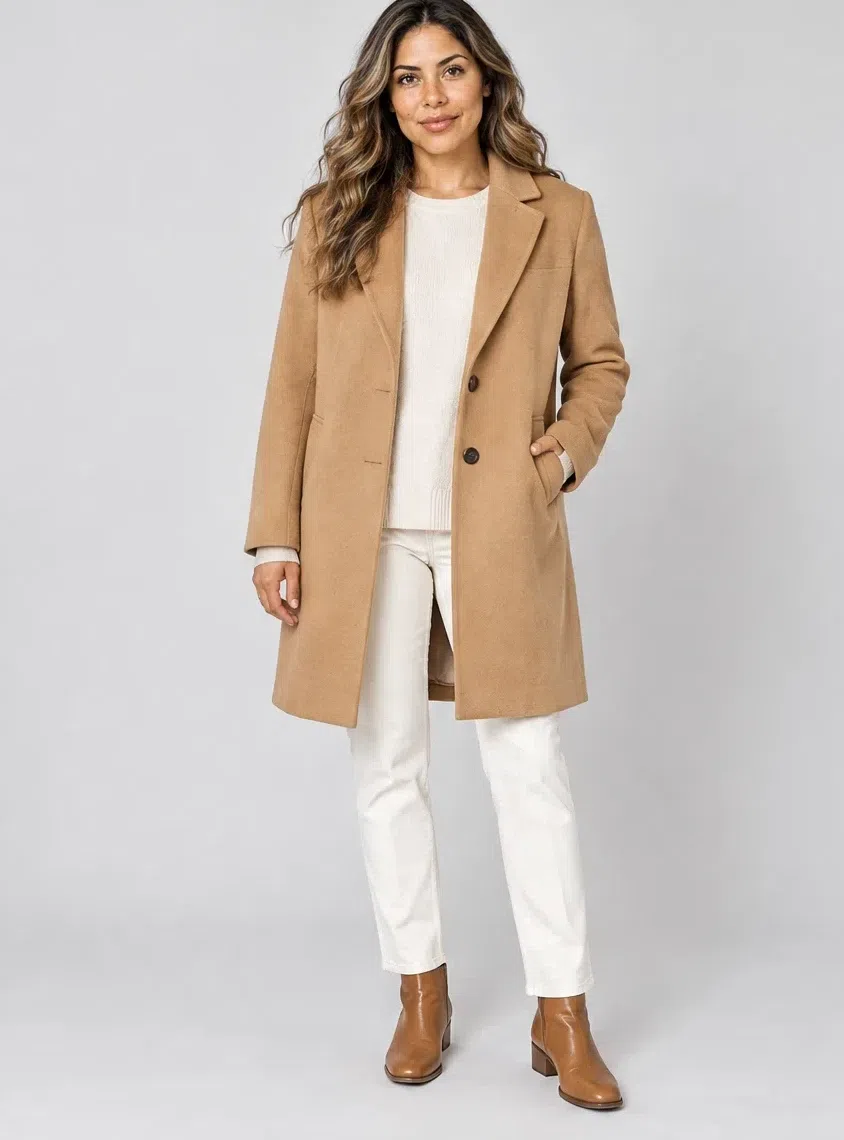
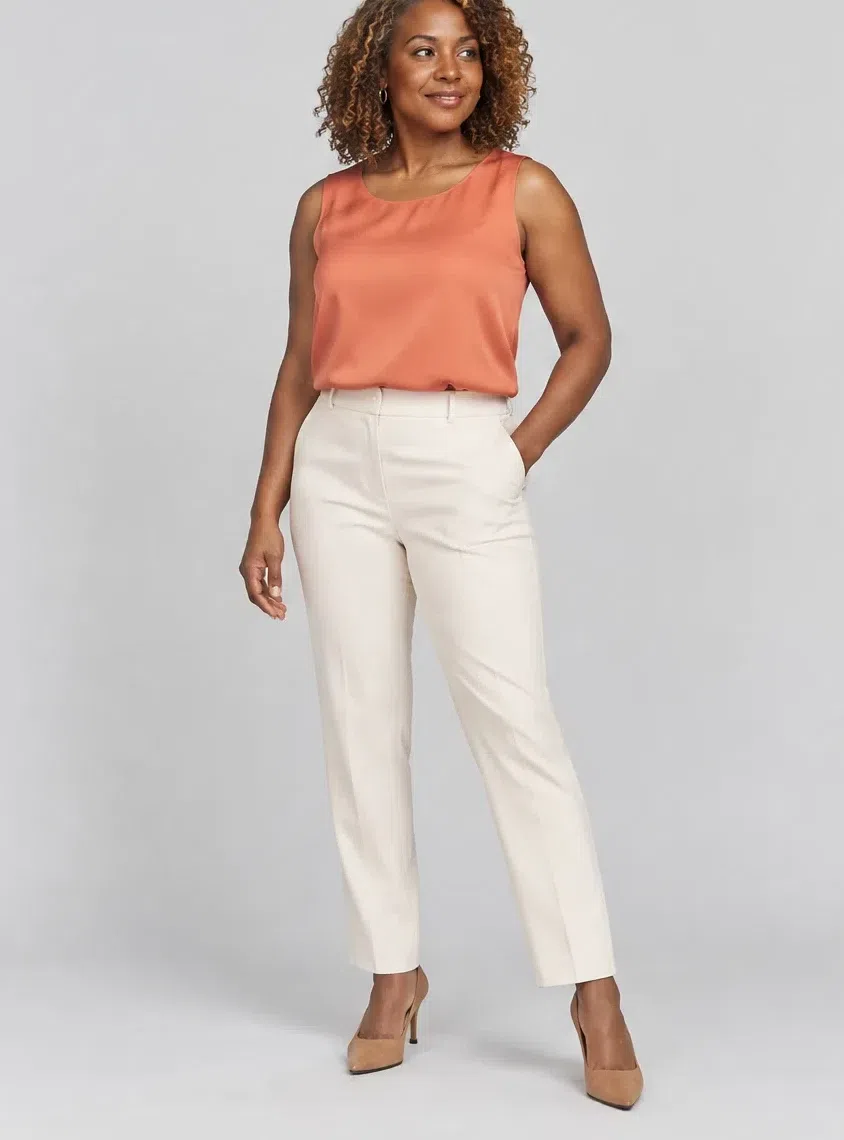
Light Spring, fair: a peach chiffon dressLight Spring, olive: a turquoise linen blazerBright Spring, medium: a camel wool coatWarm Spring, deep: a grapefruit silk top
The rule: A golden base, peach-to-coral color, warm glow - nothing pink-based, ashy or berry.
Foundation has to match the gold in the skin at every depth; choose a pink-toned one and the skin reads grayish under it, which is the most common reason a Spring face looks flat in photographs. Blush and lips live in peach, apricot and coral. Highlight and bronzer go golden or copper, never silver or cool taupe. Eyes take warm browns and bronze by day, and clear turquoise or green for evening.
Intensity is where the subtypes differ. A Light Spring wears the palette sheer - champagne glow, a peach lip. A Warm Spring pushes it golden, with copper on the lids and a warmer coral. A Bright Spring can wear a full coral or poppy lip that would overpower the other two.
Warm Spring, fair: warm ivory baseLight Spring, olive: golden tan bronzerBright Spring, medium: apricot gold glowBright Spring, deep: warm amber base
The rule: Keep the gold, or add it. Never go ash, platinum or blue-black.
Whatever the level, a Spring's hair color should show warmth in daylight: honey and golden blonde at the light end, copper and warm chestnut in the middle, caramel and copper lights through dark hair at the deep end. Ash tones and platinum take the gold out of the face along with the hair, and a flat blue-black adds a hard edge the coloring does not have.
Each subtype has its own range. A Light Spring stays between golden blonde and light golden brown, where strong copper would overwhelm her. A Warm Spring owns copper, honey and warm chestnut. A Bright Spring can hold a deeper golden chestnut or a bright copper, because her contrast is higher.
Light Spring: sunny golden blondeWarm Spring: copperBright Spring: golden chestnutWarm Spring: honey balayage on curls
One principle runs under all three: gold in, gray out - in the closet, on the face and in the hair. If you are not yet sure which Spring you are, the comparison and quiz above will point you there, and the photo analysis settles it.
Spring vs Summer, Autumn and Winter
What each neighbor shares with Spring, and the single axis that splits them
Each of the other three seasons shares exactly one of Spring's two fixed qualities, which is why each one can be mistaken for it. Summer shares the light, soft-contrast look but is cool. Autumn shares the warmth but is muted. Winter shares the clarity but is cool and cuts hard. So every comparison below turns on one axis, and each ends with a test built to isolate that axis and nothing else.
The test: peach against dusty rose Pick two fabrics at the same lightness - a light peach and a light dusty rose - so that lightness cannot sway the result. Try them one at a time just below the jaw, in daylight. On a Spring the peach warms the cheeks and clears the eyes, while the rose leaves the skin looking faintly gray and tired. A Summer gets the opposite result: the rose looks natural and the peach turns her slightly sallow. Because both are light, only temperature can be making the difference.
Warm and golden, with the warmth reading bright rather than rich.
Clarity
Clear. Nothing in the palette is dusted or earthy.
Colors
Coral, Dandelion, Kiwi, Turquoise - sunlit versions of warm.
Contrast
Soft to medium, light in overall register.
Overall impression
Spring daylight: fresh and clean.
Autumn
Temperature
Warm and golden-olive, with the warmth reading deep and rich.
Clarity
Muted. Earthy, spiced, softened shades.
Colors
Rust, mustard, olive, terracotta, forest green - earthy warm.
Contrast
Medium, deeper and heavier in overall register.
Overall impression
Harvest light: rich, earthy and grounded.
The test: bright yellow against mustard Temperature cannot separate these two, so this test takes it out: both fabrics are warm yellow, one clear and one muted. Hold a bright dandelion yellow under your chin, then a mustard. A Spring glows in the dandelion and looks sallow and older in the mustard. An Autumn looks rich and polished in the mustard, while the dandelion looks cheap and loud against her face. Only clarity changes between the two fabrics, so clarity is what you are reading.
Warm. Even the brightest Spring has gold under the skin.
Contrast
Soft to medium. Hair and skin sit at readable but gentle distances.
Colors
Coral, Geranium, Turquoise, Ivory - vivid and warm.
Neutrals
Ivory, camel, tan and a warm navy; black stays away from the face.
Overall impression
Bright and warm, never severe.
Winter
Temperature
Cool. Pink, blue or cool olive under the skin.
Contrast
High. Dark hair and brows against light skin, or vivid eyes against dark hair.
Colors
Fuchsia, royal blue, emerald, true red - vivid and cold.
Neutrals
Black, pure white, charcoal and navy all work at the face.
Overall impression
Crisp and dramatic, drawn in black and white.
The test: coral against fuchsia Both colors are saturated, so strength is equal and temperature is the only variable. Hold a clear coral under your chin, then a clear fuchsia. A Spring's skin stays warm and even in the coral, while the fuchsia turns it slightly yellow and puts shadow round the mouth. A Winter looks sharp and alive in the fuchsia, and the coral makes her look washed and slightly orange. This is the test that separates Bright Spring from Bright Winter, the closest pair across these two seasons.
Still unsure after the three tests? Note which pair gave you trouble, because it tells you which border you are sitting on - and each subtype page above settles its own border in detail. The photo analysis measures the same axes on your own face.
FAQ
Spring color season: questions people ask
Are springs warm or cool toned?
Springs are warm toned - every one of them. The undertone under the skin is golden, peach or apricot, whatever the skin depth on top, and the hair carries gold, honey or copper. What makes a Spring a Spring rather than an Autumn is that the warmth also reads clear and fresh instead of earthy. If your undertone comes out cool or clearly neutral, look at Summer or Winter instead. The five checks walk through it.
How do you tell which Spring color palette you are?
Find the quality that leads your coloring. There are three Spring palettes, each named for its leading axis: Light Spring when paleness is the first thing anyone notices, Warm Spring when it is the gold, Bright Spring when it is vivid eyes and noticeable contrast. Hold a soft peach, a warm gold and a clear coral to your face in daylight; the one that works best usually names your subtype. The comparison and four-question quiz narrow it further.
What are the top 3 Spring colors?
Peach, coral and turquoise. On this page they are Peach sorbet (#FFCBA4), Coral (#FF7F50) and Turquoise (#45C4B0). Peach repeats the natural flush and suits every Spring. Coral is the season's signature shade, strongest on a Bright Spring and softest on a Light one. Turquoise is the blue-green that keeps golden skin looking warm, where a cooler blue would gray it. The full palette shows each one on a face.
Should springs wear gold or silver?
Gold. Yellow gold is the Spring metal, with copper, bronze and rose gold alongside it. Silver, platinum and white gold lay a faint gray cast over golden skin, which is most visible at the ears and neck. The same logic runs through stones: amber, topaz and citrine sit well, icy clear stones less so. If you own silver pieces you love, a bracelet or a ring keeps them far enough from the face to do no harm.
Can a spring wear black?
Yes, below the waist; not at the face. Black on the lower half of an outfit, or in shoes and bags, causes no trouble. Near the neckline, black sets up far more contrast than a Spring's coloring has, and the face tends to look pale, tired and shadowed next to it. For the same depth in a top or a jacket, a Spring wears Cognac, Tan or a warm navy like Marine. The neutrals show all three on skin.
What are the three types of Spring in color analysis?
Light, Warm and Bright Spring. Light Spring is the palest and most delicate, and borders Light Summer. Warm Spring is the most golden and borders Warm Autumn; the older name for it is True Spring. Bright Spring is the most saturated and highest in contrast, borders Bright Winter, and is also called Clear Spring. All three share warmth and clarity. Which Spring? sets them side by side.
Is there a Soft Spring, Cool Spring or Deep Spring?
Only in sixteen-season systems. In a twelve-season system a Spring is warm and clear by definition, so there is no soft or cool one. Soft Spring usually corresponds to Light Spring, or to Soft Autumn if the muting is real. Cool Spring corresponds to Light Spring, or to Light Summer. Deep or Dark Spring corresponds to Bright Spring, or to Warm Autumn when the depth reads rich rather than vivid. The name map covers all six.
What is the difference between a Spring and a Summer color palette?
Temperature. Both palettes are light and gentle in contrast, which is why the two get confused, but Spring colors are warm and clear - peach, coral, butter yellow - while Summer colors are cool and softened - dusty rose, powder blue, lavender. A Spring glows in peach and looks gray in dusty rose; a Summer is the reverse. The comparison includes a test that isolates temperature.
Am I a Spring or an Autumn?
Look at clarity, because temperature will not help - both seasons are warm. A Spring's warmth looks bright and fresh, an Autumn's looks rich and earthy. Hold a bright yellow and a mustard to your face in daylight: a Spring lights up in the bright yellow and looks sallow in the mustard, an Autumn looks polished in the mustard and cheap in the bright one. Spring vs Autumn goes through the rest.
Can a Spring have deep or dark brown skin?
Yes, and often. Skin depth is a separate property from season. What makes a deep complexion a Spring is warmth that reads as light across the cheekbones, eyes that look clear rather than opaque, and dark hair that still shows warmth in the sun. Most deep Springs are Bright or Warm Springs. The woman in the color widget near the top is one, and Spring on every complexion shows the season at four depths.
Does seasonal color analysis work for men?
Yes, in exactly the same way. Undertone, clarity and contrast are properties of a face, not of a gender. On a man you read them in the skin, the eyebrows, facial hair and the hair on his head, and a Spring man gets the same palette: camel and tan instead of black and gray, clear warm colors near the face, gold-toned metals for a watch or cufflinks. The wardrobe and hair rules in the Spring rules apply unchanged.
What hair color suits a Spring, and can a Spring go dark?
Any hair color that keeps visible warmth. Golden and honey blondes, strawberry and copper, caramel and warm chestnut all suit the season. Going darker works when the shade stays warm and stops a level or two short of very dark; a flat, cool dark brown or blue-black takes the light out of the face. Ash blonde and platinum fail for the opposite reason. The right range differs by subtype - the hair color rule links to each.
What makeup suits a Spring?
A golden base and peach-to-coral color. Choose foundation with a yellow or peach undertone at your depth, blush in peach or apricot, lips from peach nude to clear coral, and bronze or warm brown on the eyes, with turquoise or green for evening. Avoid pink-based foundation, berry and mauve lips, and silver shimmer. Intensity is the subtype question: sheer on a Light Spring, full coral on a Bright one. The makeup rule links to each.
Can your color season change with age?
The season rarely changes; the look within it does. Undertone stays the same for life. What shifts is contrast and hair: hair lightens or grays, and the face can soften overall. Many Springs find the lighter, gentler end of the palette works better later on, and warm golden or creamy grays suit graying hair better than stark silver. If your old colors suddenly feel wrong, retest in daylight rather than assuming a new season.
Is the Spring color palette the same as the spring fashion colors for 2026?
No - they are unrelated. In color analysis, Spring is the name of a coloring type, not a time of year, and a Spring wears the same palette in January as in May. Runway and retail color forecasts for a spring season change every year and are made for everyone at once. When a trend color happens to be warm and clear, a Spring can buy it; when it is cool or dusty, it will not suit her however fashionable it is.
Which celebrities are Springs?
This page deliberately names nobody, and the lists that do name people are not much use. Seasons are judged on undyed hair and skin without makeup, under plain daylight. Nobody sees public figures that way: what reaches a magazine or a feed has been through a colorist, a makeup artist and an editor, so those lists judge the styling. The same person often appears under three different seasons on three sites. Your own face in daylight is better evidence; the five checks use it.
Sources
Most of this page is color judgment, and judgment has no citation. A handful of its claims are facts about light, skin and photographs, and those are sourced below. Each note says which statement on this page the source supports and where its support stops. Every source was opened and read while the page was written.
Supports the instruction, repeated through Am I a Spring? and Spring vs Summer, Autumn and Winter, to run every paper, metal and fabric test by a window. The article’s table of light sources lists a standard incandescent lamp at about 2,400 K and warm-white LED and compact fluorescent lamps at 2,700 to 3,000 K, far warmer than daylight, so indoor bulbs tint the skin before any test begins.
Supports the general point under Spring on every complexion that how dark skin is and what shows through it are different things. According to the article, melanin is what mostly sets the color of darker skin, while light skin takes its color largely from connective tissue and the hemoglobin circulating in the dermis. It says nothing about seasons; it only shows that skin color has more than one source.
Adds the measurement side of the same point. The abstract notes that instruments reading skin pigmentation rely on melanin absorbing light, and that hemoglobin in the dermal capillaries absorbs light too and has to be accounted for separately. That is the physical basis for reading depth and the warmth underneath it as two properties, not a finding about which colors suit anyone.
Supports two things: that contrast in a face is something you can measure from a photograph, which is what the black-and-white demonstration does, and the FAQ answer that faces soften in contrast as people get older. Its authors found contrast between facial features and skin dropping with age in adult women, and faces with lower contrast being rated as older. Its sample was Caucasian women, and it makes no claim about color seasons.
Supports the black-and-white photo test in the contrast check. The article describes a grayscale image as recording the intensity of light at each pixel through a weighted combination of wavelengths, so once hue is removed, lightness is the only thing left to compare between hair and skin.
Supports the history behind Other names for the Springs: seasonal analysis grew out of Johannes Itten’s teaching and Robert Dorr’s undertone work before Carole Jackson’s four seasons. It also notes that some people sit on the cusp of two seasons, and reports Jackson acknowledging that the season names are a convenient artifice. It does not cover the twelve- or sixteen-season systems; it supports only the point that the names are a convention.
None of these sources is evidence for which shades suit a Spring. The 21-shade palette, the three subtypes and where their borders sit, the name-map correspondences, the metal, makeup and hair rules, and the peach, yellow and coral tests are this site’s own judgments, based on testing fabrics against faces rather than on published research. Different color analysis schools draw these lines in different places, and there is no agreed standard between them.
What is color analysis, how do you find your season, and what are the 12 types?
The main guide covers all of it - the four axes your season is built from, all twelve subtypes side by side, and a free quiz that places you in about a minute.